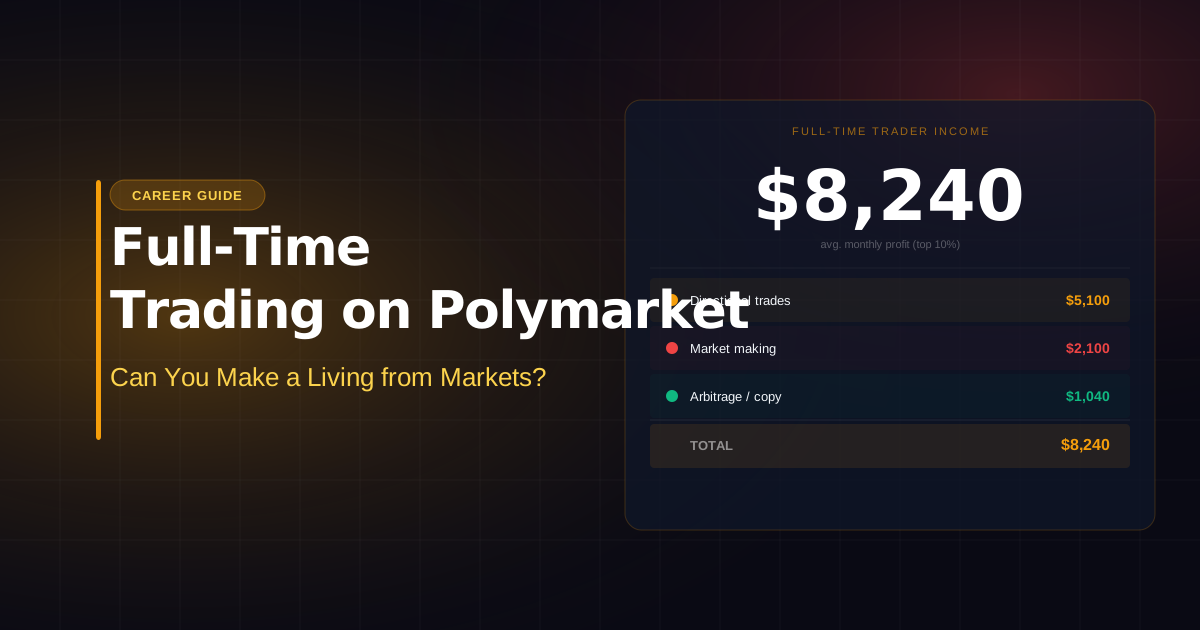
Polymarket is not a casino, a savings account, or a guaranteed income stream. It is a financial market — which means consistent profit is possible, but it requires edge. The traders who make money on Polymarket over the long run share a common set of characteristics: they understand probability, they have a defined information advantage in specific market categories, and they apply systematic risk management. This guide covers what realistic returns look like, the five strategies that produce consistent profit, and the fastest path to Polymarket income if you’re starting without an established edge.
Can You Really Make Money on Polymarket?
Yes — and the on-chain data proves it. Because all Polymarket transactions are permanently recorded on the Polygon blockchain, we can verify which wallets have made money over long timeframes. A meaningful minority of active Polymarket wallets show consistent positive ROI across hundreds of resolved trades — a statistical pattern that cannot be explained by luck alone.
The distribution of Polymarket returns, like most financial markets, is highly skewed: a small number of traders generate most of the profit, a large number of traders lose money, and a middle tier breaks roughly even. Understanding which group you are currently in, and what it takes to move to the profitable group, is the foundational question of Polymarket strategy.
What Are Realistic Return Expectations?
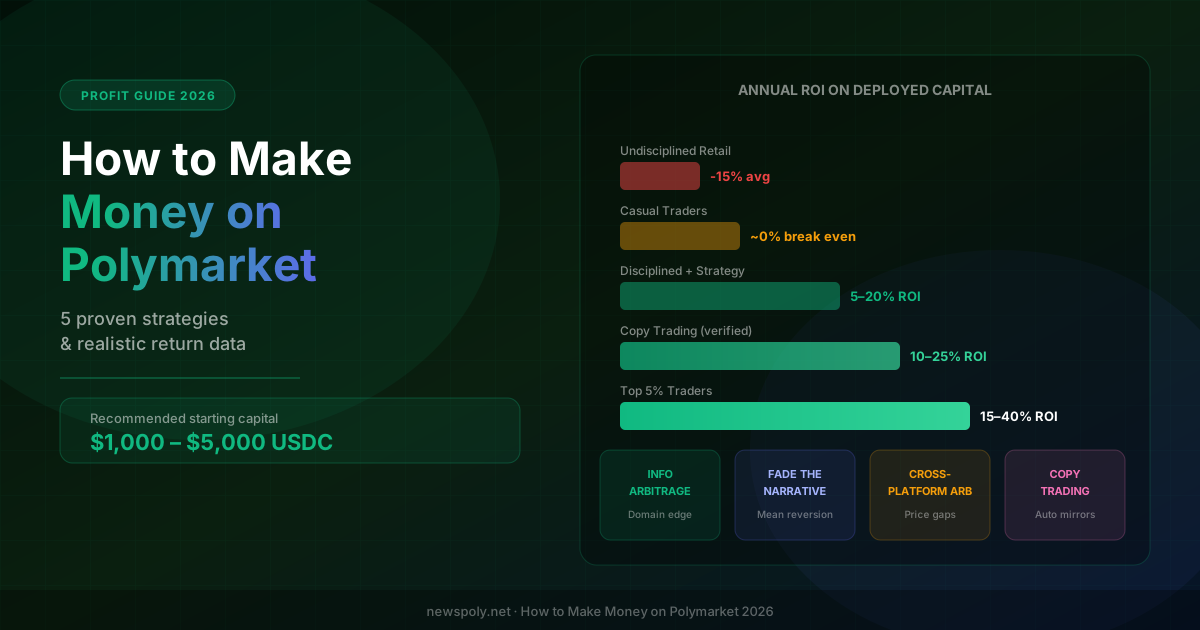
Return expectations depend heavily on strategy, capital deployment, and market selection. Some reference points from on-chain data:
- Top 5% of wallets — Consistent 15–40% annual ROI on deployed capital, across diverse market categories and 200+ trades. These are professional-grade forecasters with genuine information advantages
- Active retail traders with a defined strategy — 5–20% annual ROI on deployed capital is achievable for disciplined traders who focus on specific market categories where they have real knowledge
- Undisciplined retail traders — Negative expected value. Chasing news-cycle moves, overtrading, and poor risk management are the primary causes of retail losses on Polymarket
These figures apply to deployed capital, not total bankroll — a trader with $10,000 who keeps $7,000 in stablecoin reserves and deploys $3,000 in active positions has $10,000 of bankroll but $3,000 of deployed capital. Annual returns on deployed capital can look much higher than returns on total bankroll. Be precise about which number you are optimising.
Strategy 1: Information Arbitrage in Your Domain
The highest-ROI Polymarket strategy is having genuine information that the market has not yet priced correctly. Every professional category — law, medicine, policy, engineering, finance — creates Polymarket markets where domain expertise translates directly to edge. The formal framework for measuring that edge — calculating your expected value before entering a position — is covered in our Polymarket expected value guide.
Examples: A former policy analyst who reads legislative text has genuine edge in "will this bill pass?" markets. A software developer who monitors GitHub commit velocity has edge in protocol upgrade timing markets. An election law practitioner who understands state-level ballot processes has edge in primary and general election markets. See our guide to finding mispriced markets for the full research methodology.
Strategy 2: Cross-Platform Arbitrage
The same real-world event is often traded simultaneously on Polymarket, Kalshi, Betfair, and Metaculus. When prices diverge beyond the transaction cost threshold, a risk-free arbitrage profit exists. For example: if Polymarket shows 62% YES on a candidate winning a primary and Betfair shows 55% YES, the gap is worth investigating. If both markets resolve on identical criteria, one is mispriced — or both are.
True arbitrage requires fast execution across platforms and careful attention to resolution criteria differences. Using limit orders rather than market orders when entering arbitrage positions is essential — you need to enter at a specific price to lock in the spread, and a market order risks slippage that eliminates the profit. See our full trading strategies guide for the complete arbitrage workflow.
Strategy 3: Fading Narrative Overreaction
The most reliable short-term pattern on Polymarket is narrative overreaction: price moves triggered by news events that systematically overshoot the actual informational content of that news. Post-debate moves, endorsement reactions, breaking news spikes — these typically revert to prior levels within 24–72 hours as the market processes information more carefully.
The pattern is particularly strong in election markets, as covered in our election markets guide. The key skill is distinguishing genuine information events (actual vote counts, court rulings) from narrative events (media commentary, pundit consensus) — the former update true probabilities, the latter mostly create fading opportunities.
Strategy 4: Copy Trading
Copy trading is the fastest path to positive Polymarket returns for traders who don't yet have a developed information edge. Rather than developing your own strategy, you identify wallets with verified long-run positive ROI on the blockchain and mirror their positions systematically.
The on-chain transparency of Polymarket makes this uniquely viable: every position taken by every wallet is publicly visible and verifiable. The methodology for identifying and following smart-money wallets is covered in our whale tracking guide and copy trading guide.
Strategy 5: Near-Certainty Market Liquidity Provision
Markets that have moved to 90%+ on one outcome still pay out the implied 10% on the opposing position if that outcome resolves. In markets where the implied minority probability is genuinely lower than the price suggests — where the market is overconfident — there is consistent edge in taking the low-probability side with small position sizes.
This is not blind contrarianism. It requires identifying specific scenarios where market consensus has overcorrected: regulatory announcements that are less final than the market believes, election results that remain genuinely contested despite apparent consensus, or resolution criteria that are narrower than the market is pricing. Advanced traders can formalise this into market making — systematically providing liquidity at both ends of near-certain markets to earn the spread while remaining delta-neutral. The risk management implications of the directional version of this strategy are covered in our risk management guide.
How Much Money Do You Need to Start on Polymarket?
Polymarket has no minimum deposit requirement. Practically, positions below $50–$100 generate returns too small to be meaningful after transaction costs, and managing a Polymarket portfolio with less than $500 is operationally inefficient.
A working starting bankroll for serious trading is $1,000–$5,000. This allows meaningful position sizes (2–5% of bankroll per trade = $20–$250 per position), sufficient diversification across 5–10 active markets, and enough buffer to survive normal variance without ruin. Proper position sizing using the Kelly Criterion helps maximise long-run growth without over-exposing capital. Systematic portfolio management — tracking open positions, monitoring P&L by market category, and reviewing performance weekly — is what separates traders who improve over time from those who repeat the same mistakes. Traders just getting started should also review our 10 most common beginner mistakes before deploying real capital.
How to Invest in Polymarket: The Passive Approach
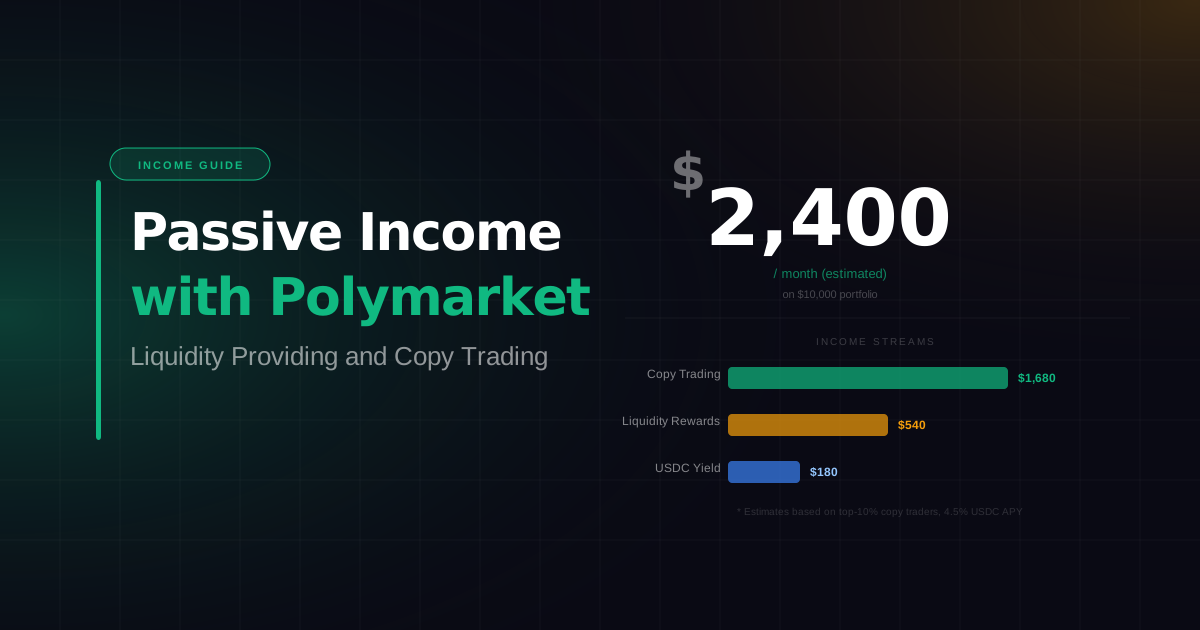
Not everyone wants to be an active trader. For those who want Polymarket exposure without the research time, copy trading is effectively a passive investment approach. You allocate capital to a copy trading system, configure risk limits, and let the automation handle execution.
PolyCopyTrade is built specifically for this use case: it continuously monitors and copies the positions of Polymarket’s top-performing wallets, with no manual intervention required after initial setup. Your funds stay in your own wallet (non-custodial), you set the position limits, and the bot executes every time a tracked trader opens a new position. There are no country restrictions — the service is available to traders globally.
Frequently Asked Questions
How much money can you make on Polymarket?
Realistic returns for disciplined active traders are 5–20% annually on deployed capital. Top performers achieve 15–40% on deployed capital across diverse market categories. Returns depend entirely on strategy quality and risk management. Copy trading systems that follow verified top performers can deliver comparable returns without requiring individual trading expertise.
Can you invest in Polymarket?
You cannot invest in Polymarket as a company (it is privately held — see our guide on whether Polymarket is publicly traded). You can invest capital in Polymarket markets as a trader, or deploy capital into a copy trading system like PolyCopyTrade for a more passive approach.
How do I withdraw money from Polymarket?
Polymarket positions are held as USDC on the Polygon blockchain. When a market resolves, winning positions automatically convert to USDC in your wallet. You can then bridge your USDC from Polygon to Ethereum mainnet and withdraw to a centralised exchange (Coinbase, Kraken, etc.) to convert to fiat. The process typically takes 15–30 minutes for the bridge and 1–3 business days for fiat withdrawal depending on your exchange. Note that all profits withdrawn are potentially taxable — our Polymarket tax guide covers exactly how on-chain trading profits are treated in the US and UK, and what records you need to keep.
How old do you have to be to use Polymarket?
Polymarket requires users to be 18 years or older. KYC verification is required for account creation, and the verification process confirms age eligibility. This applies to all users regardless of country.