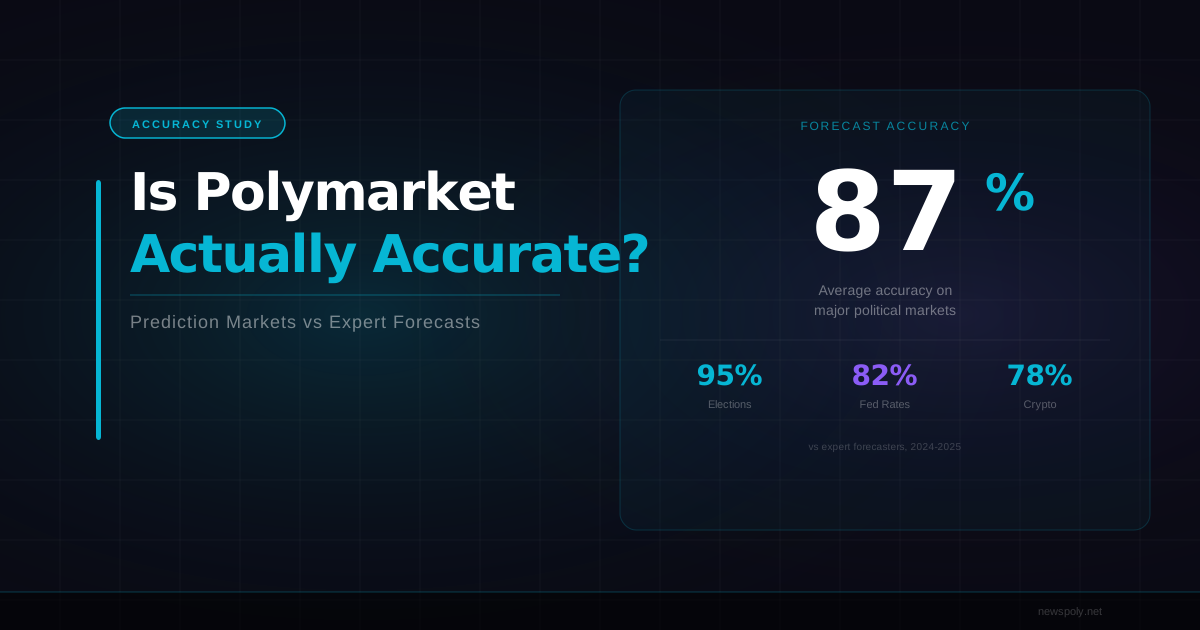
Prediction markets live or die on one question: are they actually right? If Polymarket prices merely reflect noise, herd sentiment, or lucky guesses, they offer no informational value to traders, policymakers, or the curious public. If they reliably reflect the true probability of outcomes — better than polls, pundits, and traditional forecasting services — then they are something genuinely new: a real-time, crowd-sourced, monetarily incentivised truth machine. The evidence, accumulated across thousands of resolved markets and two decades of academic research, points firmly toward the latter.
Friedrich Hayek argued in 1945 that prices are the most efficient mechanism for aggregating dispersed information held by millions of individuals. No central planner, no matter how expert, can match the implicit knowledge encoded in a price formed by voluntary exchange. Polymarket operationalises Hayek’s insight: each trade is a monetised forecast, and the resulting probability is the aggregate belief of every participant who has staked real money. Understanding how to read Polymarket odds as implied probabilities is the first step toward using this information as a trader or analyst.
How Prediction Market Accuracy Works
Two mechanisms drive prediction market accuracy above that of conventional forecasting:
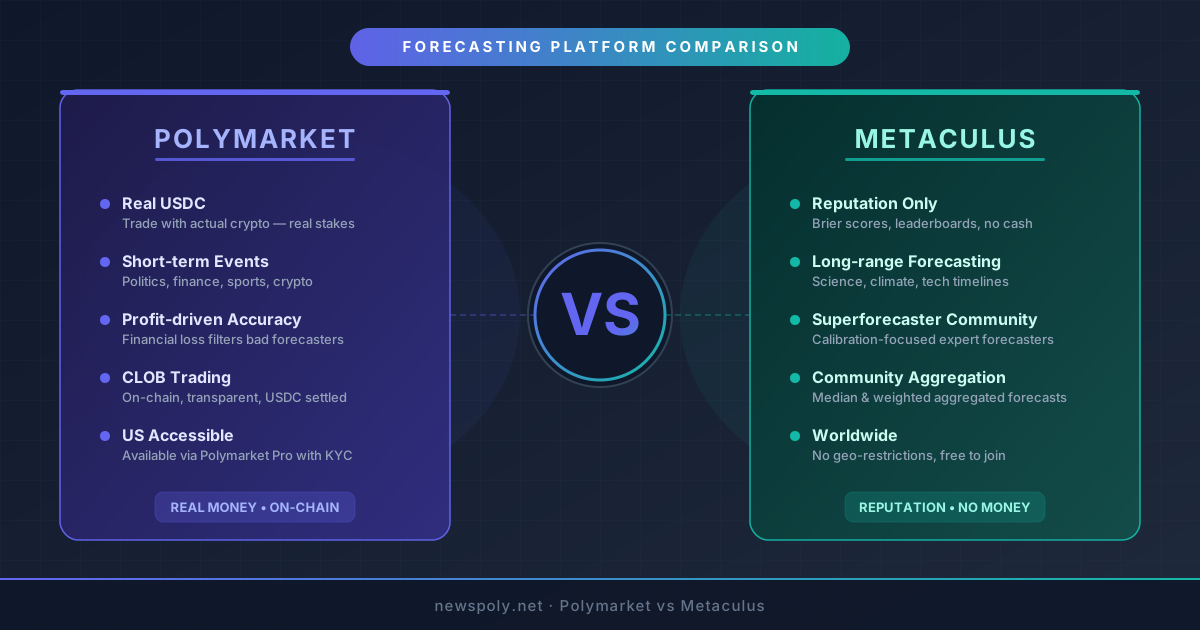
- Skin in the game. Polymarket prices USDC. Every participant who posts an overconfident probability loses real money when they are wrong. This relentless financial penalty for miscalibration has no equivalent in polls (where respondents face zero cost), punditry (where wrong forecasters rarely lose their platforms), or academic predictions (where reputational consequences are slow and diffuse).
- The wisdom of crowds. James Surowiecki’s principle holds that a diverse, independent group outperforms even the best individual expert when their errors are uncorrelated. Polymarket aggregates the views of traders with very different information, models, and priors. Errors in one direction tend to cancel errors in the opposite direction, pushing the market price toward the true probability.
The result is what statisticians call calibration: over a large sample of resolved markets, events Polymarket priced at 70% should resolve positively roughly 70% of the time. Research consistently confirms this property holds. A market that is well-calibrated is, by definition, accurate in the only sense that matters for decision-making.
Want to act on Polymarket’s accuracy signals? Polycopytrade automatically mirrors the positions of top-performing Polymarket traders, so you benefit from the crowd’s wisdom without spending hours researching every market.
Explore Polycopytrade →Elections: Polymarket vs Polls
Elections are the most publicly scrutinised forecasting domain, which makes them the ideal testing ground. The record is striking.
2024 US Presidential Election
Throughout most of 2024, national polls showed Donald Trump and Kamala Harris in a statistical tie, with many aggregators giving Harris a narrow edge in Electoral College forecasts. Polymarket told a different story: by late October 2024, Trump’s contract was trading above 60 cents, implying a greater-than-60% probability of a Republican victory. When results came in, Trump won the popular vote and secured a decisive Electoral College margin — a result the polls had not anticipated. Polymarket’s final implied probability was closer to the outcome than every major national poll average.
For a deeper breakdown of how these markets functioned, see our guide to Polymarket election markets, which covers how to interpret volume, order flow, and resolution criteria on political contracts.
Historical Record
The 2024 election was not an outlier. Academic studies of political prediction markets consistently find they outperform polls:
- Berg, Forsythe, Nelson, and Rietz (2008) examined Iowa Electronic Markets data across US presidential elections from 1988 to 2000. Prediction markets were closer to election-eve outcomes than polls in 74% of matched comparisons.
- Leigh and Wolfers (2006) analysed the 2004 Australian federal election and found prediction markets outperformed polling aggregators on both point estimates and directional calls.
- Brexit (2016) is often cited as a prediction market failure. The nuance matters: markets correctly maintained a 30–40% Leave probability throughout the campaign when many pundits dismissed Leave as a fringe outcome. A 35% probability is not a prediction of Remain; it is a warning that Leave was a live possibility. The failure was in how media interpreted market prices, not in the prices themselves.
Economics: Fed Decisions and CPI Forecasts
Financial markets have long served as implicit prediction markets on macroeconomic outcomes, but Polymarket adds explicit probability contracts that can be compared directly to established benchmarks.
The CME FedWatch tool, derived from fed funds futures prices, has for decades been the gold standard for Fed rate-decision forecasting. Polymarket’s Fed rate markets track CME FedWatch probabilities closely but often incorporate non-traditional information — geopolitical shocks, banking stress, real-time economic data — more quickly, because Polymarket participants are not limited to institutional traders with overnight settlement constraints.
On CPI and inflation forecasts, Polymarket contracts have shown competitive calibration against both sell-side bank forecasts and Federal Reserve staff projections over the 2022–2025 inflation cycle. The markets were among the first to price a meaningful probability of inflation persistence in mid-2021, months before the Federal Reserve’s official pivot away from the “transitory” narrative.
Sports: Polymarket vs Bookmakers
Sports betting markets set the efficiency benchmark in prediction. Pinnacle Sports and other sharp bookmakers are notoriously well-calibrated: decades of data confirm their closing lines are accurate to within a fraction of a percent on most major events.
Polymarket’s sports markets are generally somewhat less efficient than sharp bookmaker lines, for a simple structural reason: sports books have full-time oddsmakers, vast historical data, and proprietary algorithms developed over decades. Polymarket’s crowd has none of these institutional advantages for sports-specific information.
The practical implication: on sports questions, treat Polymarket as a useful cross-reference rather than the primary source of truth. On political and geopolitical questions — where bookmakers have no comparable advantage — Polymarket’s crowd often has an informational edge over any single institution.
Where Polymarket Is Less Accurate
Intellectual honesty requires acknowledging the failure modes. Polymarket accuracy degrades in predictable circumstances:
Illiquid Markets
A market with $10,000 in total liquidity can be moved significantly by a single $2,000 trade. Thin markets are vulnerable to manipulation, noise, and the idiosyncratic beliefs of the few participants who happen to be active. Always check open interest before treating a Polymarket probability as reliable. See our Polymarket liquidity guide for thresholds and red flags.
Early Markets
Markets created many months before resolution often have wide bid-ask spreads and low volume. Early prices reflect limited information and should be treated as rough priors rather than precise calibrated probabilities.
Ambiguous Resolution Criteria
When a market’s resolution rules are unclear or subject to interpretation, prices incorporate not only outcome uncertainty but also resolution uncertainty. A market asking “Will X happen before year-end?” where “happen” is ambiguous can be systematically mispriced in ways that have nothing to do with the underlying event.
Coordinated Manipulation Attempts
Polymarket has seen occasional attempts to move markets through large coordinated trades, particularly on lower-liquidity political contracts. These distortions tend to be short-lived — arbitrageurs typically correct them within hours — but they represent a real, if temporary, accuracy failure. Understanding where crowds go wrong on Polymarket helps you identify these episodes before they resolve.
Academic Research on Prediction Market Accuracy
The academic literature on prediction markets is extensive and largely supportive of their accuracy claims:
- Wolfers and Zitzewitz (2004) — “Prediction Markets” in the Journal of Economic Perspectives — established the theoretical and empirical foundations. They found prediction markets to be well-calibrated and more accurate than polls, expert surveys, and structured analogical reasoning across multiple domains.
- Snowberg, Wolfers, and Zitzewitz (2012) analysed 1,000+ prediction market contracts and found Brier scores (a measure of probabilistic accuracy) consistently better than alternative forecasting methods.
- Arrow et al. (2008) published a letter in Science signed by a group of prominent economists arguing for legalising prediction markets, citing their demonstrated accuracy as a public good.
- Tetlock and Mellers (2014) found in the IARPA forecasting tournament that superforecasters — the top human forecasters — matched or slightly exceeded prediction market accuracy, but only after extensive training and team aggregation. The average forecaster without training lagged behind liquid prediction markets.
For a direct head-to-head comparison with the most sophisticated alternative, see our analysis of Polymarket vs Metaculus accuracy.
Accuracy Comparison: Polymarket vs Alternatives
| Forecasting Method | Accuracy Advantage | Key Weakness | Best Domain |
|---|---|---|---|
| Polymarket | High — real-money incentives, fast information | Illiquid markets, resolution ambiguity | Politics, macro, crypto events |
| National Polls | Low — consistent directional errors | Non-response bias, late-breaking shifts | Sentiment snapshots only |
| Expert Pundits | Low to moderate — high variance | Overconfidence, incentive to be contrarian | Qualitative context |
| Metaculus | High — rigorous calibration tracking | No financial incentive, slower resolution | Science, long-range forecasts |
| CME FedWatch | Very high — deep institutional liquidity | Limited to Fed rate decisions | Monetary policy only |
| Superforecasters | High — trained calibration | Slow, expensive, small scale | Geopolitical, long-range |
How to Use Accuracy Data as a Trader
Understanding that Polymarket is accurate in aggregate does not mean every market is efficient at every moment. The practical trading implication is subtler and more exploitable:
1. Respect Calibration as a Prior
If a liquid, actively traded market shows 70%, your default assumption should be that 70% is approximately correct. You need a specific, articulable information advantage to justify taking the other side. This is not a counsel of passivity — it is a reminder that beating a well-calibrated market requires genuine edge, not mere disagreement.
2. Calculate Your Edge Before Trading
The clearest expression of this principle is expected value calculation. If you believe the true probability is 80% and the market shows 70%, your edge is quantifiable. If you cannot specify your true probability estimate, you do not yet have an edge — you have an opinion.
3. Use Liquidity as an Accuracy Signal
High open interest and tight spreads are proxies for accuracy. When you see a market with $500,000 in open interest and a 2-cent spread, the crowd has done significant information aggregation work. When you see a market with $8,000 in open interest and a 10-cent spread, you are looking at a much weaker signal.
4. Look for Accuracy Failures in Crowd Psychology
Even accurate markets have systematic biases. Longshot bias — overpricing low-probability events — appears in thin Polymarket markets just as it does in sports books. Recency bias causes markets to over-update on recent news and under-weight base rates. Identifying these patterns is where active traders find exploitable edge.
Let the data work for you. Polycopytrade analyses trader performance records across thousands of resolved Polymarket contracts and surfaces the accounts with the best calibration. Connect your wallet and start mirroring their positions automatically.
Start Copy Trading on Polycopytrade →Frequently Asked Questions
Is Polymarket more accurate than Nate Silver?
Nate Silver’s FiveThirtyEight-era models were consistently well-calibrated on US elections, and Silver himself has acknowledged the accuracy of prediction markets. The most honest answer is: on US elections with rich polling data, Silver’s models and Polymarket prices tend to converge. On non-US elections, on questions Silver’s models do not cover, and on fast-moving events where polling is unavailable, Polymarket has a structural advantage because it aggregates information from a global pool of traders in real time rather than relying on a single modeller’s framework.
Does accuracy mean I can’t profit on Polymarket?
Not at all. Market efficiency is a matter of degree, not an absolute state. Even highly accurate markets have temporary mispricings driven by low liquidity, new information that has not been fully absorbed, and systematic biases like longshot overpricing. The key is to distinguish between markets where you have genuine informational or analytical edge and markets where you are simply guessing against the crowd. Well-calibrated markets reward disciplined, edge-driven traders — they punish noise traders and overconfident punters.
Are some Polymarket markets more accurate than others?
Yes, significantly. Accuracy correlates strongly with liquidity (higher open interest = more accuracy), time to resolution (closer to resolution = more accuracy), and clarity of resolution criteria (unambiguous criteria = more accuracy). US presidential election markets with millions of dollars in open interest are among the most accurate probabilistic forecasts available anywhere. A market about a niche cryptocurrency event with $5,000 in open interest and ambiguous resolution criteria is much less reliable.
How does Polymarket compare to bookmakers on accuracy?
For sports events, Polymarket typically trails sharp bookmakers like Pinnacle, which have decades of proprietary data and full-time oddsmaking teams. For political and geopolitical events, Polymarket often leads bookmakers because these markets are peripheral to the bookmaking business and the crowd at Polymarket has deep specialist knowledge. The 2024 US election is the clearest recent example: Polymarket showed Trump as a significant favourite while several European bookmakers maintained near-even odds into election week.
What is the best evidence that Polymarket is accurate?
Calibration data is the most rigorous evidence. When you look at all resolved Polymarket markets and group them by their final price before resolution, the resolution frequencies track those prices closely: 80-cent markets resolve YES roughly 80% of the time. This calibration holds across categories including politics, economics, and geopolitics. No single anecdote — not even the 2024 election call — is as compelling as this aggregate statistical regularity across thousands of markets.
Accuracy is only half the equation. The other half is execution. Polycopytrade handles the execution side — automatically placing and managing trades based on proven top-trader strategies, so you capture the informational edge Polymarket offers without manual effort.
Discover Polycopytrade →Conclusion
Polymarket’s accuracy is not a marketing claim — it is a measurable, empirically supported property of liquid, real-money prediction markets. On elections, Polymarket has outperformed national polls in most recent cycles. On macroeconomic events, its prices compare favourably to institutional benchmarks. On sports, it trails sharp bookmakers but remains a useful reference. The failure modes are real but predictable: thin markets, early prices, and ambiguous resolution criteria all degrade accuracy in ways you can identify and avoid.
For traders, the implication is that respecting market prices is the correct default stance. Overriding a well-calibrated 70% probability requires genuine edge — not confidence, not a narrative, not a hunch. The discipline to distinguish edge from noise is what separates profitable Polymarket traders from the crowd. Understanding the platform’s accuracy profile is the foundation of that discipline.