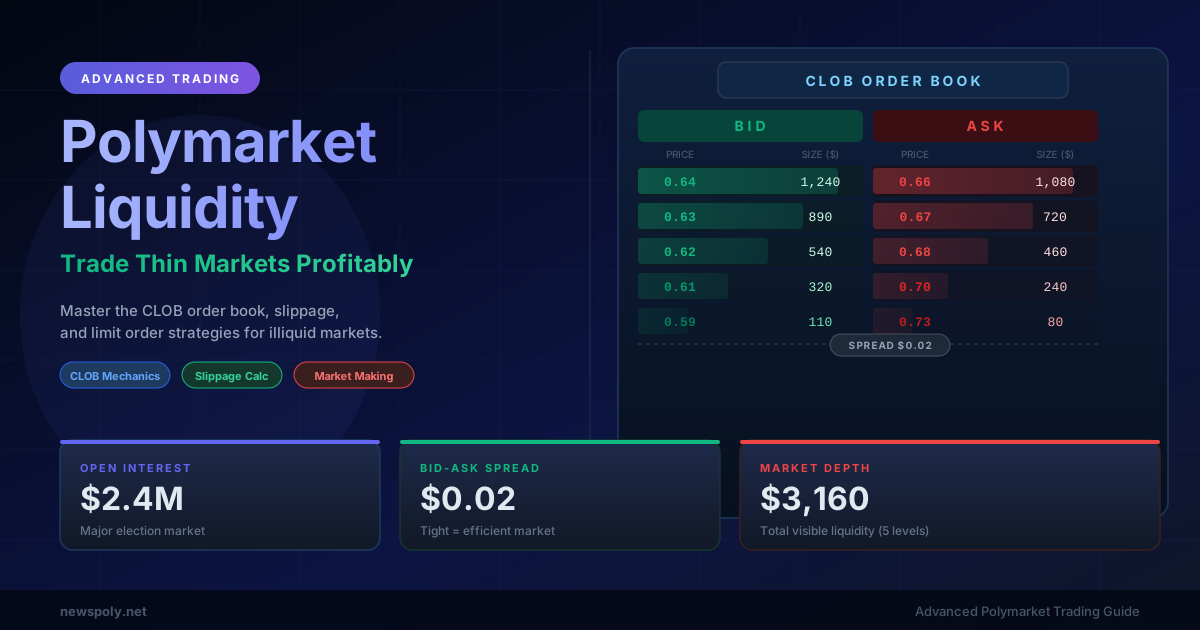
Every experienced Polymarket trader has made the same expensive mistake: they spotted a mispriced market, hit the buy button, and watched their entry price jump 4–6 cents higher than expected. That gap between where you thought you were trading and where you actually traded is slippage — and it is almost always a liquidity problem. Understanding how liquidity works on Polymarket is not optional. It is the difference between a strategy that looks profitable on paper and one that actually is.
What Is Liquidity in Prediction Markets?
In traditional finance, liquidity describes how easily an asset can be bought or sold without moving the price. In prediction markets the concept is identical, but the stakes are amplified because markets are binary and bounded between $0.00 and $1.00.
On Polymarket, liquidity has two components:
- Depth — How many dollars of open orders sit near the current price. Deep markets absorb large trades with minimal price impact. Shallow markets move violently on even small orders.
- Tightness — The width of the bid–ask spread. A spread of $0.01 on a $0.70 market is tight and efficient. A spread of $0.08 on the same market is wide and expensive to cross.
On a major election market — say, U.S. Presidential winner — you might see $2 million or more in open interest with spreads as tight as $0.01. On a niche sports prop asking whether a specific NBA player scores 30 points in Tuesday's game, total liquidity might be $400 with a spread of $0.12. Both are valid Polymarket markets. How you approach them must be completely different.
How Polymarket's CLOB Works
Polymarket operates a Central Limit Order Book (CLOB) — the same fundamental structure used by the NYSE or Nasdaq, adapted for on-chain prediction contracts.
Here is how it works in practice:
- Market participants post limit orders. A trader submitting a limit buy order at $0.62 is saying: "I am willing to buy YES shares at $0.62 or lower." That order sits in the book until someone fills it or the trader cancels it.
- The best available prices form the spread. The highest active bid and the lowest active ask define the current market. If the best bid is $0.62 and the best ask is $0.64, the spread is $0.02.
- Market orders sweep the book. When you hit "Buy" without specifying a price, your order becomes a market order. It executes against the cheapest available ask. If you need $500 worth and the best ask only has $100, your order climbs up the ask stack, filling progressively worse prices until it is complete.
- On-chain settlement. All orders are settled on-chain via Polygon. This means the CLOB is transparent — anyone can audit the order flow — but it also means thin books are publicly visible to every trader watching.
Limit Orders vs Market Orders
The distinction matters enormously on Polymarket. A limit order guarantees your price but not your fill. A market order guarantees your fill but not your price. In liquid markets the difference is trivial. In illiquid markets it is the difference between a fair entry and giving away 8–15 cents. Our dedicated guide to Polymarket limit orders covers order placement, slippage reduction, and good-till-cancel strategy in detail. For a deeper dive into the CLOB mechanics — bid walls, depth charts, and order book sentiment signals — see our companion Polymarket order book guide.
Skip the order book entirely. PolyCopyTrade automatically mirrors positions from Polymarket's highest-performing wallets — wallets that already trade with liquidity-aware sizing so you never accidentally sweep a thin book.
Reading the Polymarket Order Book
To view the order book on Polymarket, open any market and look for the "Order Book" tab in the trading panel. You will see two columns:
- Bids (green) — buy orders ranked from highest price at the top down to the lowest. Each row shows a price level and the total dollar volume available at that price.
- Asks (red) — sell orders ranked from lowest price at the top (closest to the spread) up to the highest.
The visual gap between the highest bid and lowest ask is the spread. A narrow gap means the market is efficiently priced. A wide gap means there is meaningful disagreement (or low participation) about where the market should trade.
Practical Example: Reading Depth
Suppose you are looking at a Fed rate cut market with this order book:
- Ask $0.68 — $320 available
- Ask $0.69 — $150 available
- Ask $0.71 — $80 available
- Ask $0.75 — $200 available
If you submit a market buy for $600, your average fill will be approximately: ($320 × $0.68) + ($150 × $0.69) + ($80 × $0.71) + ($50 × $0.75) / $600 = roughly $0.694. You intended to buy at $0.68 but your actual average price is $0.694 — a $0.014 slippage cost on a $600 position. That is $8.40 of immediate, silent loss before the market even moves.
What Is Slippage?
Slippage is the difference between the price you expected when you submitted your order and the average price at which it actually filled. It occurs whenever your order size exceeds the volume available at the best price.
On Polymarket, slippage compounds the already-binary risk of prediction markets. A market order for $1,000 in a market with only $400 of ask depth at the best level will sweep through multiple price tiers before completing, leaving you with a blended fill that could be 5–10 cents worse than the displayed price — on a contract that may only ever pay out $0.00 or $1.00.
Why Slippage Hurts More in Binary Markets
Consider a YES contract trading at $0.65. If you pay $0.72 due to slippage, you need the event to occur for a return of about 39% ($1.00 / $0.72 − 1). At the intended $0.65 entry, the return was 54%. Your edge has been cut by roughly 28% before anything happens in the real world. In a market where your true edge might only be 5–10%, slippage alone can turn a positive-EV trade into a negative one.
How to Calculate Your Slippage Before Trading
Before placing any significant order on Polymarket, run this quick mental calculation:
- Note the best ask price and total volume available at that level.
- Check the next 3–4 price levels above it and their available volumes.
- Total the cumulative volume until you reach your desired trade size.
- Calculate your weighted average fill price using each tier’s price and volume.
- Subtract the best ask from your weighted average. That is your expected slippage.
As a rule of thumb: if your estimated slippage exceeds 1.5% of the contract’s current price, you should either use a limit order, split your order, or reconsider the position size entirely.
Identifying Liquid vs Illiquid Markets on Polymarket
Three metrics tell you most of what you need to know:
1. Open Interest
Open interest (OI) is the total dollar value of outstanding shares across both YES and NO. Markets with OI above $500,000 are generally liquid. Markets below $10,000 are thin. Below $2,000, expect spreads of 10 cents or more and significant slippage on any order above $50.
2. 24-Hour Volume
Volume tells you how actively a market is being traded right now. High OI with low recent volume means the market has cooled off and liquidity providers may have pulled their orders. Always check volume, not just OI. Our Polymarket charts guide explains how to read the probability and volume charts on each market page to spot these signals at a glance.
3. Bid-Ask Spread Width
The spread is the fastest liquidity signal. Here is a rough guide for Polymarket:
- $0.01–$0.02 spread: Excellent liquidity. Trade freely with market orders if needed.
- $0.03–$0.05 spread: Acceptable. Prefer limit orders for larger sizes.
- $0.06–$0.10 spread: Thin market. Limit orders only. Consider splitting.
- $0.10+ spread: Very illiquid. Only trade with a clear edge that exceeds the spread cost.
Strategies for Trading Thin Markets Profitably
Thin markets are not off-limits — they are opportunities for traders who understand the mechanics. These four strategies are the foundation of a disciplined approach to low-liquidity Polymarket trading. For a broader view of what works across all market types, see our guide to top Polymarket trading strategies.
a) Use Limit Orders, Never Market Orders in Thin Markets
This rule is non-negotiable. In a market with $300 of ask depth at the best price, a $500 market buy will sweep the book and you will have no control over your final entry. Post a limit order at or slightly above the best ask and wait for a fill. You may not fill immediately, but you will fill at your price or better. The patience cost is almost always worth it.
b) Split Large Orders Into Smaller Pieces
If you want to buy $2,000 worth of a thin market, submitting a single order will move the price against you. Instead, split it into four $500 chunks submitted over 15–30 minute intervals. This approach does two things: it limits your immediate price impact, and it allows market makers to repost orders between your fills, giving you access to fresh liquidity at each tranche.
c) Look for Catalyst Events That Will Force Liquidity In
News events create liquidity. When a key data release, press conference, or breaking story is imminent, market participants flood thin books with orders to capitalize on the move. If you can identify a credible catalyst 30–60 minutes before it hits, entering in advance of the liquidity surge means you get filled at pre-catalyst spreads and exit into a deep, liquid market. This is one of the highest-edge plays on Polymarket for traders who follow news closely and know how to identify mispriced markets.
d) Target Markets with Scheduled Resolution (Known Catalysts Compress Spreads)
Markets that resolve on a known future date — Fed meeting outcomes, earnings beats, scheduled sports events — attract market makers who can hedge their exposure. As resolution approaches, these markets typically see tightening spreads and increasing depth because the time uncertainty collapses to a single known event. Entering these markets early (when they are still thin) and riding the liquidity improvement as resolution nears is a repeatable structural edge.
Want the edge without the research overhead? PolyCopyTrade identifies and copies Polymarket’s top-performing wallets in real time — giving you access to liquidity-aware, professionally sized positions without spending hours analyzing order books yourself.
Market Making on Polymarket — Providing Liquidity for Profit
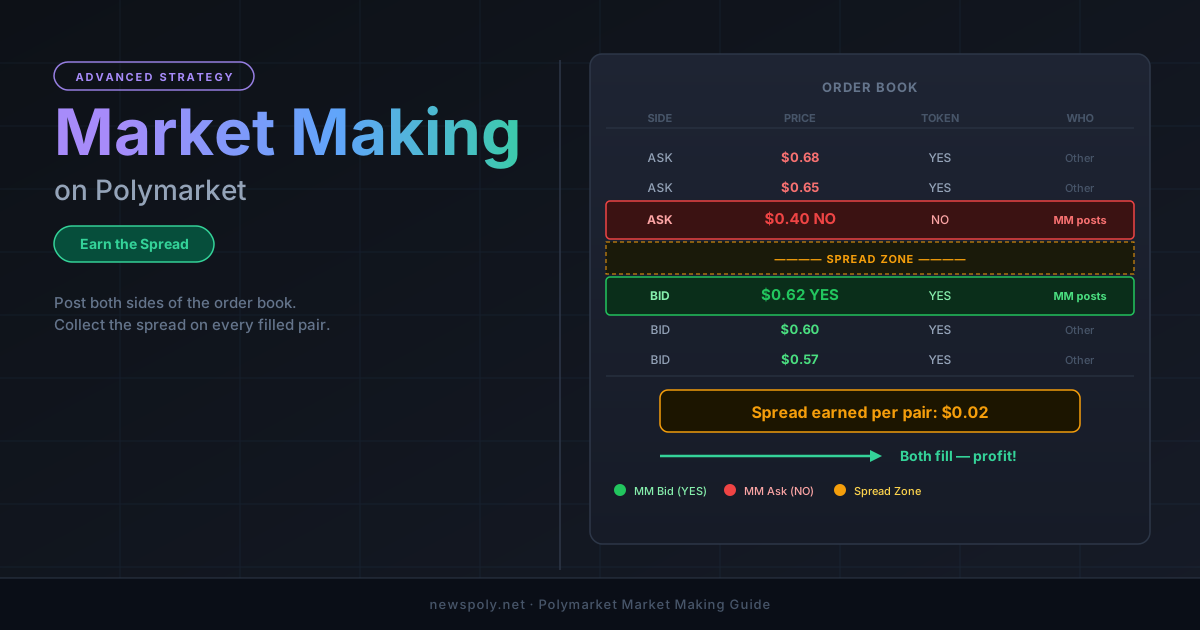
If trading against thin books is the problem, being the thin book is the solution. Market making on Polymarket means posting limit orders on both the bid and ask sides simultaneously, earning the spread as compensation for providing liquidity.
Here is a simplified example of how it works:
- You post a limit buy at $0.63 and a limit sell at $0.66 on a market currently trading $0.645.
- Over time, traders on both sides fill your orders. When both sides fill, you have earned $0.03 per share regardless of where the market ultimately resolves.
- Your risk is inventory risk: if you accumulate a large one-sided position (e.g., you get filled heavily on the buy side) before the other side fills, you are now exposed to directional movement.
Successful Polymarket market makers keep their positions balanced, adjust spreads based on new information, and focus on high-volume markets where fill frequency justifies the complexity. It requires active management but can generate consistent returns uncorrelated with whether any individual outcome occurs. For a comprehensive look at market making strategies on Polymarket, see our Polymarket market making guide.
The Most Liquid Markets on Polymarket
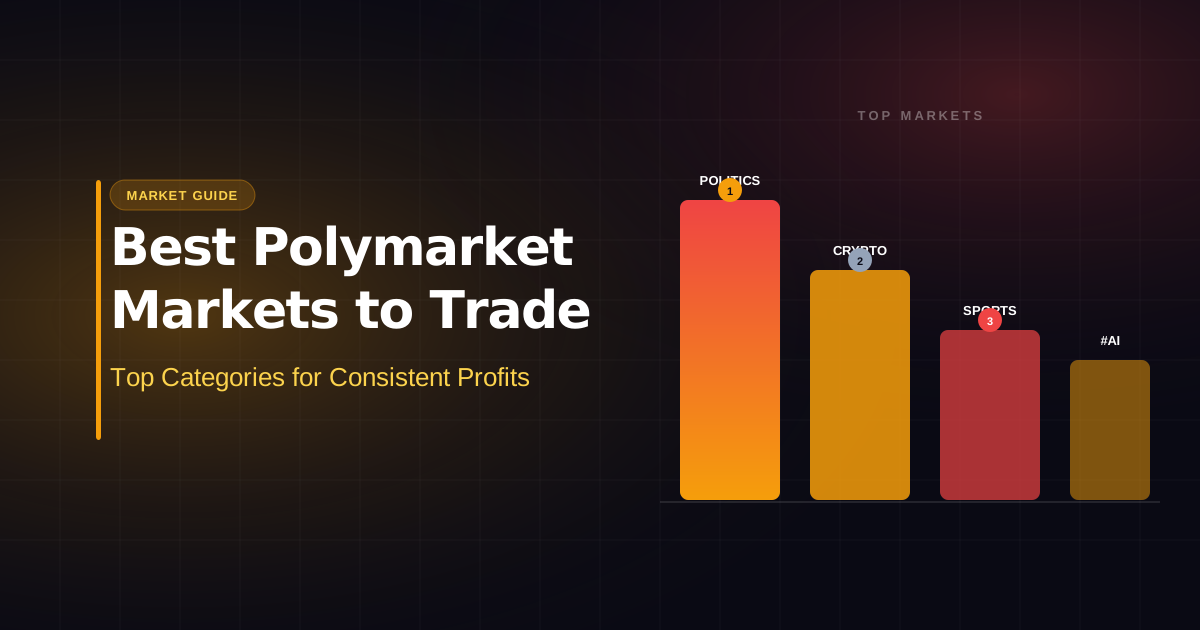
If you want to trade efficiently without fighting liquidity, these market categories consistently offer the deepest books on Polymarket:
- U.S. Presidential and Congressional Elections: During peak election season, these markets have tens of millions in OI with spreads as tight as $0.005. They are among the most liquid prediction markets in the world.
- Bitcoin and Ethereum Price Targets: Crypto-native markets attract large institutional and retail flows. “Will BTC close above $100K by end of month?” type markets routinely hit $1M+ in OI.
- Federal Reserve Rate Decisions: Fed markets spike in liquidity around FOMC meetings. The combination of institutional hedging demand and retail speculation creates very tight spreads in the week before each meeting.
- Major Sports Championships: NFL playoffs, NBA Finals, World Cup — these attract massive retail flow and typically offer $100K+ in OI with reasonable spreads.
- Macro Economic Data: CPI, unemployment rate, GDP growth — markets tied to scheduled government data releases are liquid in the 48–72 hours before release.
Avoiding Liquidity Traps
Some markets look liquid at first glance but are traps at size. Watch out for these patterns:
Stale Open Interest
A market might show $80,000 in open interest but have had zero trading volume in the past 48 hours. The OI was built weeks ago; current liquidity providers have moved on. The spread is wide, the book is thin, and you are trading against stale quotes. Always filter by recent volume.
Lumpy Order Books
Some market makers post one large order at the best price to attract the spread, but the next tier is 8 cents away. The market looks liquid for the first $200 but becomes illiquid immediately after. Always look at the full depth of the book before sizing your order, not just the best bid and ask.
Resolution-Date Liquidity Collapse
As a market approaches resolution, liquidity often collapses rather than improves (the opposite of scheduled-catalyst markets). When the outcome is nearly certain — say, a candidate has already won and the market is at $0.97 — market makers withdraw because the spread available no longer compensates for inventory risk. Trading at $0.97 to capture the last 3 cents is often a poor risk-reward because of wide spreads and minimal depth.
How Liquidity Correlates with Predictive Accuracy
One of the most well-documented findings in prediction market research is that more liquid markets produce more accurate prices. The intuition is straightforward: when a market is deep and tight, informed traders have a strong incentive to trade on their information because slippage costs are low. Their trading pushes prices toward true probability.
In thin markets, informed traders often sit on the sidelines because the cost of crossing a wide spread exceeds their perceived edge. The result is that thin market prices are noisier and more susceptible to manipulation by a single large order. Understanding expected value calculation is essential here: a trade is only worth taking if your EV edge exceeds the round-trip spread cost.
The practical implication for traders: treat thin market prices with more skepticism. A YES contract sitting at $0.35 in a market with $1,500 in OI and a $0.12 spread is not necessarily a better value than a $0.35 contract in a $5M OI market. It may simply be a price that no one has had the incentive to correct. Chasing apparent value in thin markets is one of the most costly beginner mistakes on the platform.
Trade like the top 1% without mastering every nuance. PolyCopyTrade copies the exact positions of Polymarket’s most profitable wallets — traders who have already done the liquidity analysis, sized their orders correctly, and built consistent track records you can verify on-chain.
Frequently Asked Questions
What is a good bid-ask spread on Polymarket?
For active trading, a spread of $0.01–$0.03 is excellent and comparable to liquid traditional financial markets. Spreads of $0.04–$0.06 are acceptable for smaller positions where you have a clear edge. Anything above $0.07 should be approached with caution — your edge must exceed the round-trip cost of crossing the spread twice (entry and exit), which becomes a significant hurdle on contracts priced near $0.50.
Can I make money as a market maker on Polymarket?
Yes, but it requires active management and a clear strategy for handling inventory risk. The most common approach is to market-make in categories you understand well, so you can quickly adjust your quotes when new information arrives. Running automated bots via the Polymarket API is also common for serious market makers; our API and on-chain data guide covers the technical setup in detail. Expect spreads to compress over time in popular markets as competition increases — early movers in newly created markets tend to capture the most spread income.
Why does my Polymarket order sometimes fill at a worse price than shown?
This happens when your order size exceeds the volume available at the displayed best price. The remainder of your order sweeps to the next price tier in the book. To avoid this, always check the full order book depth before submitting, use limit orders instead of market orders in thin markets, and consider splitting large orders into smaller tranches. Polymarket’s interface shows the best bid and ask prominently, but the full depth view is essential for any order above $100 in a less-liquid market.