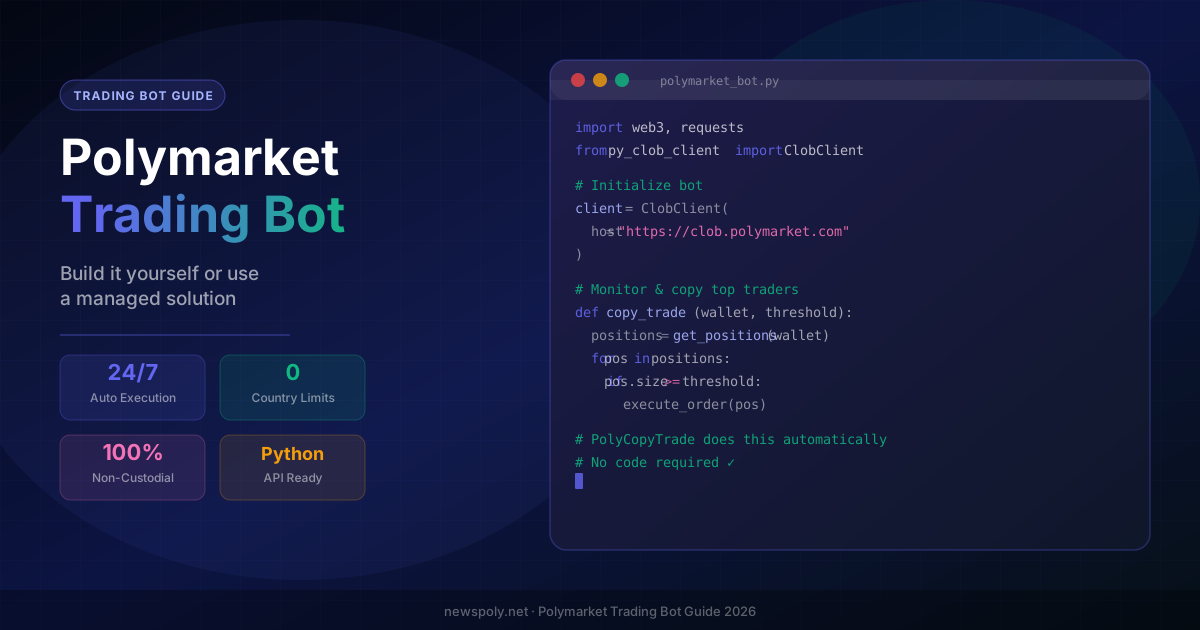
Polymarket's public blockchain infrastructure makes it uniquely suited to automation. Every market, every position, every price update is queryable via open APIs and readable directly from the Polygon blockchain. A trading bot can monitor hundreds of markets simultaneously, execute positions the moment entry conditions are met, and enforce risk rules with zero emotional override — things no manual trader can consistently do. This guide covers how Polymarket bots work, the technical stack required to build one, and why the majority of traders who want automation choose a managed solution instead.
How Does a Polymarket Trading Bot Work?
A Polymarket trading bot is a programme that interacts with Polymarket's smart contracts on the Polygon blockchain to place, manage, and close positions automatically. Unlike bots on centralised exchanges that use API keys to submit orders through a web server, Polymarket bots sign transactions directly with a private key and broadcast them to the blockchain.
The core loop of any Polymarket bot:
- Data collection — Poll the Polymarket REST API or listen to on-chain events for market prices, order book depth, and position data
- Signal generation — Apply a strategy (price threshold, whale wallet trigger, cross-platform arbitrage signal) to decide whether to act
- Execution — Sign and broadcast a transaction to the Polymarket conditional token contract via web3.py or ethers.js
- Position management — Monitor open positions, apply stop-loss logic, and close when target criteria are met
The on-chain nature of Polymarket means all execution is trustless and non-custodial — your funds never leave your wallet until a trade is executed. This is both a security advantage and a technical requirement: the bot needs direct access to a funded wallet's private key to function.
Technical Stack for Building a Polymarket Bot
Language and Libraries
Python is the most practical choice for most bot builders, with the following core dependencies:
- web3.py — Python library for interacting with Ethereum-compatible blockchains including Polygon
- requests / httpx — For polling the Polymarket REST API endpoints
- py-clob-client — Polymarket's official Python client for the CLOB (Central Limit Order Book) API, which handles order placement and market data
- APScheduler or asyncio — For scheduling polling loops and managing concurrent market monitoring
Key Polymarket API Endpoints
The full API documentation is covered in our Polymarket API and on-chain data guide. For bot builders, the most critical endpoints are:
GET /markets— Returns all active markets with current prices and resolution criteriaGET /book?token_id={id}— Returns the current order book for a specific outcome tokenPOST /order— Places a limit or market order (requires signed authentication)GET /positions?user={address}— Returns all open positions for a wallet
Wallet Setup and Authentication
Polymarket uses a proxy wallet system: you create a dedicated API key wallet that is authorised to trade on behalf of your main wallet. This avoids exposing your main private key in the bot's environment. The py-clob-client handles this authentication flow. Your USDC funds remain in your main wallet; the proxy key signs trade transactions that are then executed against your balance.
Building a Copy Trading Bot vs a Strategy Bot
There are two fundamentally different types of Polymarket bots:
Strategy Bots
A strategy bot generates its own trading signals from market data. Examples: an arbitrage bot that monitors price gaps between Polymarket and Kalshi, a mean-reversion bot that fades post-debate price spikes in election markets, or a whale-following bot that copies positions from a watchlist of high-performing wallets. Strategy bots require significant research, backtesting, and ongoing maintenance. The signal logic needs to be correct for the bot to be profitable — automation amplifies both good and bad strategy.
Copy Trading Bots
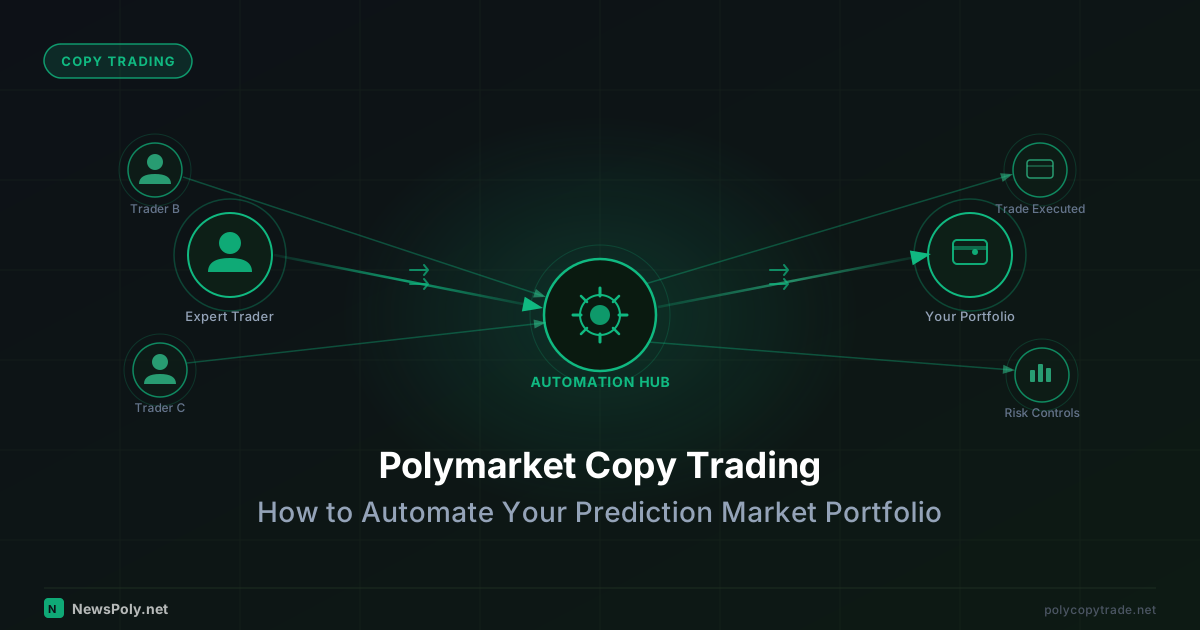
A copy trading bot monitors a set of target wallets and mirrors their trades to your wallet automatically. The signal source is another trader's on-chain behaviour rather than an algorithm you've written. Copy bots are simpler to build (the logic is: "if wallet X opens position Y, open the same position") but require robust wallet selection upfront. The approach is covered fully in our copy trading guide. Traders keeping wallets active through automation may also benefit from any future Polymarket airdrop, since consistent on-chain history is the primary factor retroactive distributions have rewarded. For traders who want to identify which wallets are worth following, our whale tracking guide covers the on-chain methodology for finding high-performing wallets. For a fully configured no-code automation setup, see the copy trading automation setup guide.
The Real Cost of Building Your Own Bot
The technical barrier to building a basic Polymarket bot is moderate — a developer with Python experience and some web3 familiarity can get a working prototype in a few days. The real costs are less obvious:
- Infrastructure — A bot needs to run 24/7 on a reliable server. AWS/GCP instances cost $20–$80/month depending on specification, and downtime during a fast-moving market can mean missed trades or unmanaged positions
- RPC reliability — Free Polygon RPC endpoints are rate-limited and unreliable under load. A paid Alchemy or Infura endpoint adds another $50–$200/month for serious usage
- API changes — Polymarket updates its API periodically. A breaking change can take your bot offline until you patch it
- Strategy development — A bot without a profitable strategy loses money efficiently. Most retail builders underestimate how hard it is to develop an edge that survives in live markets
- Security — A bot that holds or has access to a funded wallet private key is a high-value target. Operational security for live bots is a non-trivial problem
The total ongoing cost of a self-built bot — server, RPC, maintenance time — is typically $150–$400/month before accounting for your own development hours. For traders whose primary goal is Polymarket returns rather than building software, the build-vs-buy calculation rarely favours DIY. Regardless of which approach you choose, bot-generated profits are taxable income — see our Polymarket tax guide for how automated on-chain trading is treated by the IRS and HMRC, and why the on-chain record makes accurate reporting both straightforward and essential. A well-designed bot also feeds its trade history into a portfolio tracking system so you can verify whether the strategy is generating genuine edge or just lucky variance.
Does a Polymarket Trading Bot Work From Any Country?
This is one of the most common questions from traders outside the US, Canada, and Western Europe. The answer depends on which bot you're using.
A self-built bot interacts directly with Polymarket's smart contracts on the Polygon blockchain. Smart contracts have no concept of geography — any signed transaction from any wallet is valid, regardless of where it originates. A self-built bot works from any country.
PolyCopyTrade operates on the same principle: it interfaces with Polymarket's on-chain infrastructure non-custodially, with no centralised server that implements geo-blocking. There are no country restrictions on PolyCopyTrade — traders from the US, India, Turkey, Southeast Asia, South America, and anywhere else can use it without restriction. This is a structural advantage of on-chain automation that centralised platforms cannot replicate.
What Returns Can a Polymarket Bot Generate?
Bot returns depend entirely on strategy quality. There is no guaranteed return from automation — a bot with a losing strategy will lose faster than manual trading, not slower. That said, the edges that bots are well-suited to exploit are real:
- Arbitrage — Price gaps between Polymarket and Kalshi or Betfair can be closed algorithmically. True arbitrage is rare but occurs several times per week in active political markets
- Speed advantage in fast markets — Post-debate or breaking-news price moves happen in minutes. A bot monitoring prices continuously can enter fading positions faster than any manual trader. Bots can also implement limit order strategies that sit passively in the order book and fill when the price reaches a target — a form of automated liquidity provision
- Copy trading alpha — Following verified high-performing wallets automatically, at scale, across dozens of markets simultaneously — something impossible to do manually
- Market making — Sophisticated bots act as market makers, simultaneously posting bids and offers to earn the bid-ask spread. This is the strategy used by the most technically advanced participants on Polymarket
For a realistic picture of what Polymarket profits look like, see our guide to making money on Polymarket.
Frequently Asked Questions
How do I build a trading bot for Polymarket?
The minimum viable stack is Python + web3.py + py-clob-client + a funded Polygon wallet. You'll need a Polygon RPC endpoint (Alchemy or Infura recommended), a server for 24/7 uptime, and a strategy for when and what to trade. Polymarket's CLOB API handles order placement. The full API documentation and data guide is available at our Polymarket API guide.
Is building a Polymarket bot legal?
Yes. Polymarket's terms of service do not prohibit automated trading. The Polymarket API is public and designed to be used programmatically. Automated trading via the API is standard practice among sophisticated Polymarket participants. There are no legal restrictions on building or running a bot that trades on your own behalf using your own wallet.
What is the best Polymarket trading bot?
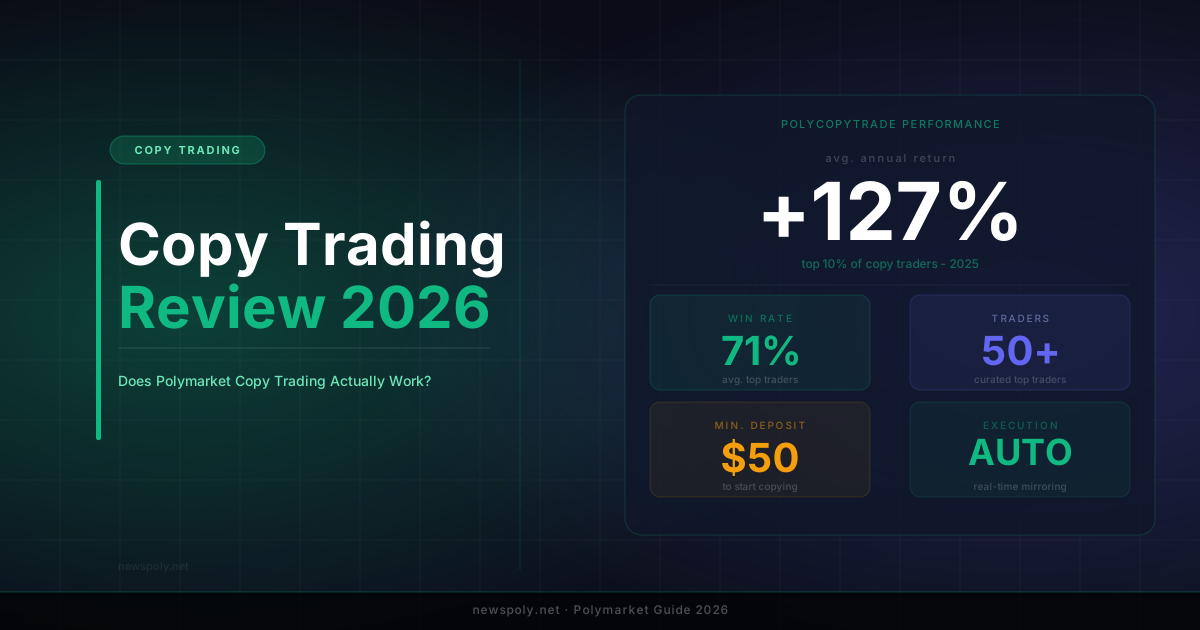
For traders who want copy trading automation without building their own system, PolyCopyTrade is the most complete managed solution currently available. It handles trader selection, position sizing, daily loss caps, and multi-trader portfolio diversification — all non-custodial, with no country restrictions, and without requiring any technical setup beyond connecting your wallet.
Can a Polymarket bot run from countries where Polymarket is geo-blocked?
A bot that interacts directly with Polymarket's smart contracts bypasses geo-blocking because it communicates with the blockchain rather than the Polymarket web interface. However, accessing geo-blocked web platforms via technical workarounds may violate their terms of service. PolyCopyTrade has no country restrictions and works globally without any workaround required.