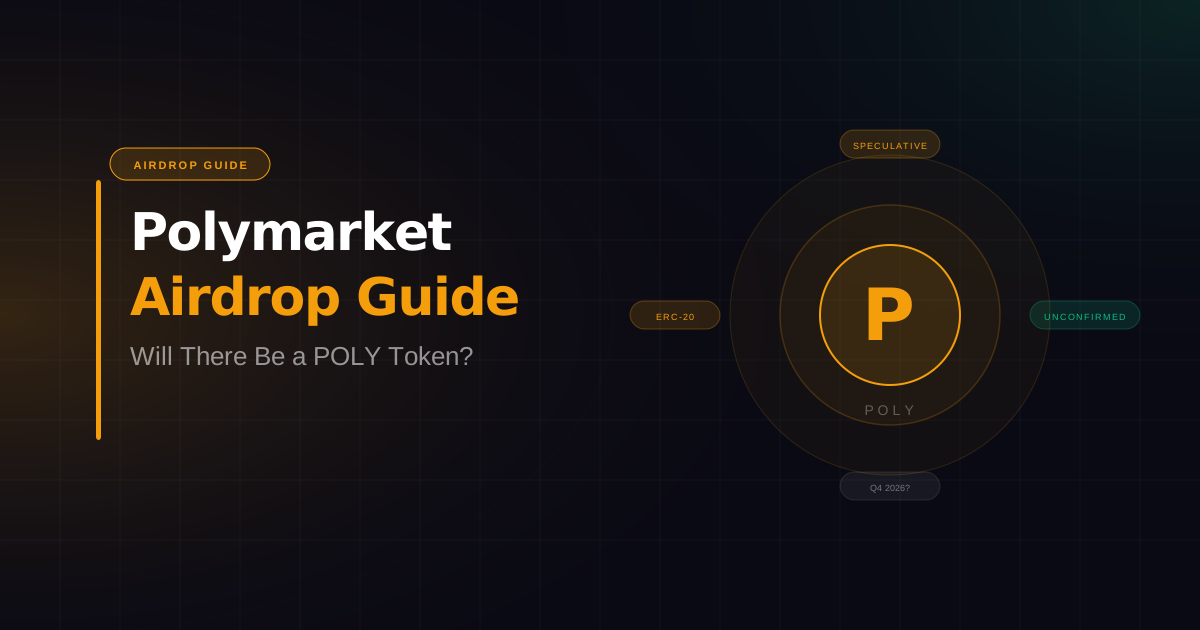
As of March 2026, Polymarket has not launched a native token and has not announced an airdrop. There is no official roadmap, no confirmed snapshot date, and no token contract address. Anyone claiming otherwise is either speculating or, more likely, attempting a scam. That said, the structural case for a future Polymarket token is real — and understanding the signals, the precedents, and the legitimate steps you can take now is worth every active trader’s attention.
Polymarket’s Funding Background: Why VCs Expect a Liquidity Event
Polymarket has raised at least $74 million in venture capital across multiple rounds. The most significant was a $45 million Series A in 2023 led by Founders Fund — Peter Thiel’s venture firm — with additional participation from Andreessen Horowitz-affiliated investors and Ethereum co-founder Vitalik Buterin as an individual angel. Earlier backing came from Polychain Capital and 1confirmation in a $4 million seed round in 2020, with further strategic capital raised in subsequent years. For a complete picture of Polymarket’s private company structure, see our guide to Polymarket’s legitimacy and backing.
Venture capital is not patient capital. Firms like Founders Fund invest on a 7-to-10-year fund cycle and need liquidity events — either an acquisition, an IPO, or a token launch — to return capital to their limited partners. Polymarket has grown dramatically since that Series A: the platform processed over $1 billion in a single month during the 2024 US presidential election cycle, and trading volume across political, sports, and crypto markets has remained elevated well into 2026. The business is large enough and the VC stakes material enough that a token launch remains one of the most plausible mechanisms for investors to crystallise returns without a traditional equity IPO, which remains complicated by Polymarket’s regulatory history with the CFTC.
Industry Precedents: Retroactive Airdrops to Early Users
The pattern of rewarding early platform users with a retroactive token airdrop is now well established across decentralised finance. Polymarket does not exist in isolation — it operates in an ecosystem where this model has been executed successfully multiple times:
- Uniswap (UNI, September 2020) — Every wallet that had ever interacted with the Uniswap protocol before the snapshot date received 400 UNI tokens. At the time of the airdrop this was worth roughly $1,200; at UNI’s peak in 2021 those tokens were worth over $16,000. Users who had traded once received the same allocation as regular traders.
- dYdX (DYDX, August 2021) — The perpetuals exchange distributed its governance token to past traders, with allocation tiered by historical trading volume. The most active traders received the largest allocations. This is the model most directly analogous to what a Polymarket airdrop might look like.
- Arbitrum (ARB, March 2023) — The Ethereum Layer 2 protocol airdropped governance tokens to wallets that had transacted on the network, with points-based criteria including transaction count, volume, and time span of activity.
- Optimism (OP, May 2022) — A phased airdrop rewarding active users of the Optimism L2, with criteria including number of transactions, bridge usage, and governance participation.
The common thread across all of these: early and consistent users were rewarded retroactively, often without any prior announcement. The absence of a Polymarket token today does not mean past activity will go unrecognised if a token is eventually launched. All trading on Polymarket is executed on-chain (via Polygon), creating a permanent, verifiable record of every wallet’s activity — exactly the kind of data a retroactive airdrop would draw on. For context on the on-chain infrastructure, see our Polymarket USDC and on-chain guide.
What Signals Suggest a Token Could Happen
Several structural factors make a Polymarket token plausible — none of them constitute confirmation, but they are worth understanding:
- Governance needs — Polymarket currently relies on a relatively centralised dispute resolution process via UMA’s optimistic oracle. A native governance token could decentralise market creation, outcome resolution, and protocol parameter changes — addressing ongoing criticism about centralisation risk.
- Liquidity incentives — The prediction market space is becoming more competitive. Kalshi has received CFTC approval for US users; Manifold, Metaculus, and new entrants compete for mindshare. A token-based liquidity mining programme would be a powerful tool to attract and retain market makers and active traders.
- VC exit mechanisms — As described above, the $74 million raised in venture capital creates structural pressure for a liquidity event. A token launch allows investor positions to be distributed and traded on secondary markets without requiring a traditional IPO or acquisition.
- On-chain precedent — Polymarket operates entirely on Polygon, making token distribution technically trivial. The entire trading history is already on-chain and addressable. Unlike many Web2 companies that would need to build blockchain infrastructure to run an airdrop, Polymarket already has it.
What a Polymarket Token Might Look Like
Speculating on token design is, by definition, speculative. But drawing on the dYdX, Uniswap, and Arbitrum models, a Polymarket token would likely incorporate some combination of the following:
- Governance — Token holders vote on market categories, resolution criteria standards, fee parameters, and protocol upgrades. This is the baseline function of most DeFi governance tokens.
- Fee sharing — A portion of the 2% settlement fee could be distributed to token stakers, creating a yield mechanism tied directly to platform trading volume.
- Staking — Tokens staked in a protocol contract could unlock reduced trading fees, priority market creation, or enhanced dispute rights.
- Liquidity mining — Market makers and liquidity providers in active markets could earn token emissions as an incentive to tighten spreads and improve market depth.
The most likely trigger for any token announcement would be a fresh funding round at a higher valuation, a competitive response to a well-capitalised rival, or a regulatory development that clarifies the legal status of prediction market tokens in key jurisdictions.
How to “Farm” a Potential Airdrop Legitimately
The honest approach here is straightforward: trade normally, trade regularly, and let your on-chain history accumulate. Airdrop farming has a bad reputation in some circles because it often involves artificial behaviour — creating dozens of wallets, pushing fake volume, or interacting with contracts solely for the purpose of meeting technical criteria. That approach is unlikely to work for Polymarket and carries real risks (see below).
The legitimate version of staying positioned for a potential Polymarket airdrop involves:
- Active and consistent trading — Trade regularly across multiple market categories. Volume and consistency over time is how dYdX tiered its allocations. Sporadic large trades are likely less valuable than regular activity across many markets.
- Market diversity — Engage with political, sports, crypto, and macro markets rather than concentrating exclusively on one category. This signals broader platform engagement.
- Long tenure — The earlier your wallet first interacted with Polymarket, the better. If your wallet has a long history, that is already an advantage. If you are new, the best time to start building that history is now.
- Wallet consistency — Using a single primary wallet consistently is better than scattering activity across many wallets. Retroactive airdrops have historically rewarded genuine users, not Sybil attackers.
- Market creation — If Polymarket’s tools permit, creating markets and providing liquidity may be weighted more heavily than passive trading in a future distribution.
For traders who want to maintain an active on-chain trading history without doing the daily research work, Polymarket copy trading is a practical solution. By automatically mirroring the positions of top-ranked traders, copy trading keeps your wallet active and accumulating volume across markets without requiring you to manually evaluate each position. Our Polymarket beginner’s guide covers how to get started if your account is new or inactive. Traders who want full automation can also review our Polymarket trading bot guide for options that keep wallets active without any manual input.
Risks of Airdrop Farming
Before optimising your activity around a hypothetical future token, the risks deserve honest consideration:
- No guarantee — The most important risk is that a Polymarket token may never happen. The VC pressure and structural logic are real, but plenty of well-funded crypto platforms have not issued tokens. Treating an unannounced airdrop as certain is a category error.
- Gas and transaction costs — Active trading on Polygon is cheap relative to Ethereum mainnet, but costs add up. Trading more than your natural risk tolerance dictates — purely to accumulate on-chain history — is a real cost with no guaranteed return.
- Regulatory uncertainty — Token distributions in the US remain legally complex following SEC enforcement actions against numerous DeFi projects. A Polymarket token, if it were to be distributed to US residents, would face significant legal structuring challenges. Any distribution might exclude certain jurisdictions, just as several past airdrops have done.
- Opportunity cost — Capital tied up in Polymarket markets in pursuit of an airdrop that may not come is capital not deployed in other opportunities. This is a standard portfolio consideration.
Scam Warning: Fake Airdrop Sites and Phishing
This section is not optional reading. Airdrop scams are one of the most common and damaging attack vectors in crypto, and Polymarket’s prominence makes it a frequent target. The pattern is almost always the same:
- A website with a URL resembling “polymarket-airdrop.io”, “polymarkettoken.net” or similar is launched, often with professional design copied from the real Polymarket site
- Social media posts — often from compromised accounts or paid promoters — spread the link with urgency framing: “claim before deadline”, “snapshot already taken”, “limited allocation”
- Users are prompted to “connect wallet to claim” — the wallet connection request contains a malicious transaction approval that drains all assets
The only legitimate source for any genuine Polymarket token or airdrop announcement will be Polymarket’s official domain (polymarket.com), their verified social media accounts, and their official blog. No third-party site can give you Polymarket tokens. No one needs you to “connect your wallet” to check eligibility — eligibility for retroactive airdrops is checked by the team against their own on-chain data, not by you initiating a connection. If you are unsure about the identity verification requirements on the platform, our Polymarket KYC verification guide explains what is required and what is not. For a full guide to staying safe on the platform, see our Polymarket security guide.
The rule is simple: if a site asks you to connect your wallet to claim a Polymarket token, it is a scam. Disconnect immediately and do not approve any transactions.
What to Do Right Now
Given everything above, the practical advice is deliberately undramatic: trade as you normally would on Polymarket, keep your wallet active, and do not change your behaviour in ways that cost you money chasing an uncertain outcome. Specifically:
- If you already trade regularly on Polymarket, you are already positioned. Continue.
- If your wallet has been inactive, reactivating it with genuine trading activity is worthwhile given the low downside. Traders who use Polymarket as a primary income source offer useful perspective on sustaining consistent activity — see our full-time Polymarket trading guide.
- Bookmark the official Polymarket blog and check it periodically — any genuine token announcement will appear there first.
- Ignore all third-party “airdrop checker” tools, Telegram groups, and Discord servers claiming insider knowledge of Polymarket’s token plans.
- Do not create multiple wallets to try to multiply a potential airdrop allocation — Sybil detection has become sophisticated and past airdrops have aggressively filtered it out.
Frequently Asked Questions
When will Polymarket launch a token?
There is no confirmed date. As of March 2026, Polymarket has not announced a token launch or airdrop. Any specific date circulating on social media or third-party sites is fabricated. The only legitimate announcement will come through official Polymarket channels.
How do I qualify for a potential Polymarket airdrop?
No official eligibility criteria exist because no airdrop has been announced. Based on precedents from dYdX, Uniswap, and Arbitrum, active trading history, trading volume, market diversity, and wallet longevity are the factors most likely to matter in a retroactive distribution. The practical answer is to trade genuinely and consistently on the platform.
Is there a snapshot date for the Polymarket airdrop?
No snapshot date has been announced. Many retroactive airdrops use a past date — sometimes months or years before the announcement — as their eligibility cutoff, meaning activity you have already done may already count. This is another reason not to modify your behaviour dramatically: the relevant history may already be in the past.
Are Polymarket airdrop websites legitimate?
No. Any website other than polymarket.com claiming to distribute Polymarket tokens or allow you to check airdrop eligibility by connecting your wallet is a scam. Polymarket has not authorised any third-party claim sites. Connecting your wallet to such sites risks losing all assets in that wallet.
Does Polymarket have a token right now?
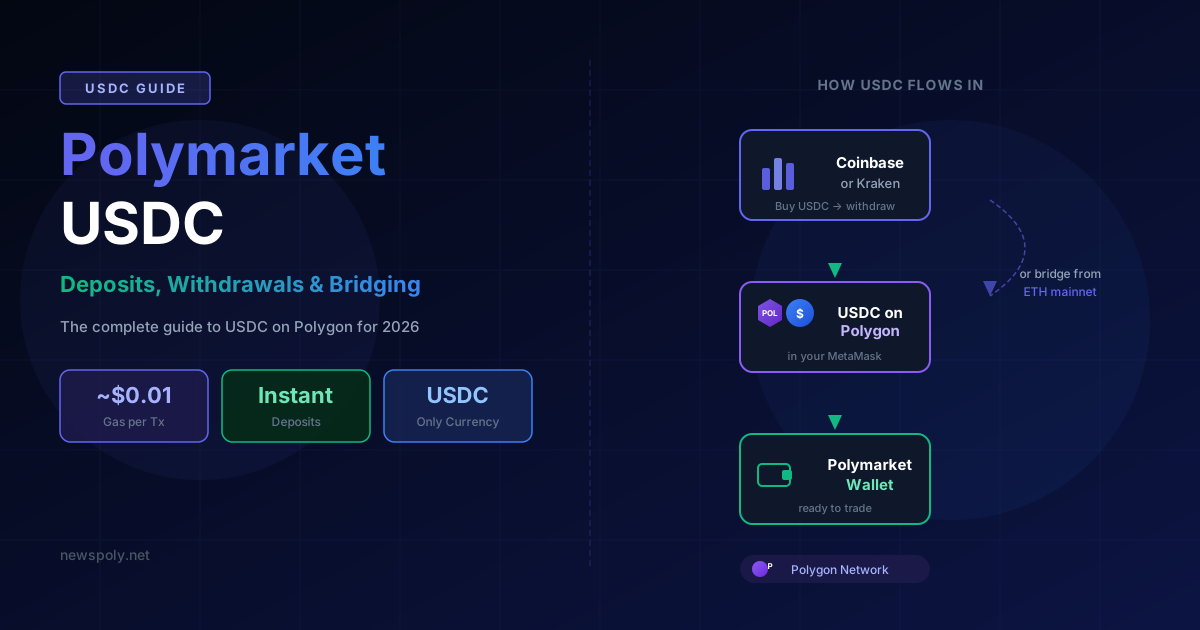
No. As of March 2026, all trading on Polymarket uses USDC. There is no native Polymarket token in circulation. Any token calling itself “POLY” or similar and claiming Polymarket affiliation is not an official Polymarket product.