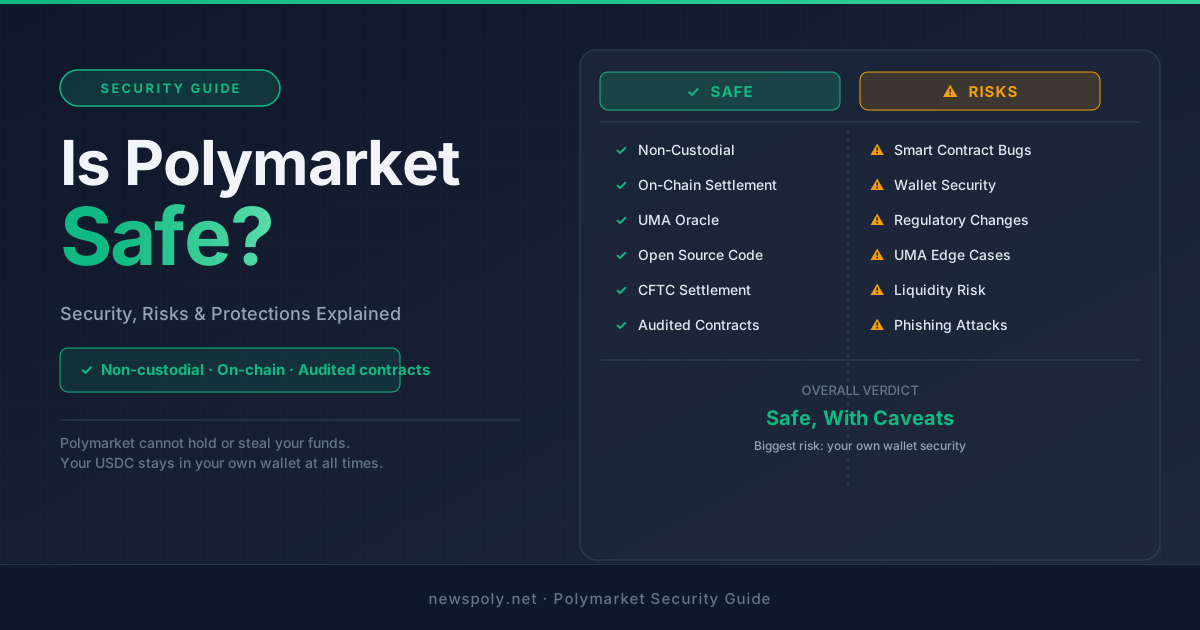
Polymarket is safe in the most important sense: the platform cannot steal your money, freeze your account or run off with your deposits. Its non-custodial, on-chain architecture means your funds never pass through a company bank account. That said, no trading platform carries zero risk, and Polymarket is no exception. This guide walks through exactly how it is built, what the genuine risks are, and how to protect yourself as a trader.
The Non-Custodial Model: Why Polymarket Cannot Hold Your Funds
Most traditional platforms — bookmakers, stock brokers, even some crypto exchanges — take custody of your money. You deposit, they hold it, and you trust them to pay out. If the company collapses or turns out to be fraudulent, your funds can disappear.
Polymarket works differently. You connect a self-custody wallet (such as MetaMask or a Polygon-compatible hardware wallet), trade using USDC on Polygon, and your assets remain in your own wallet throughout. If you are unfamiliar with the underlying mechanics, our complete explainer on how Polymarket works covers smart contracts, the CLOB order book, and resolution in full detail. The platform interacts with your funds only through audited smart contracts that execute automatically. Polymarket the company never holds a balance on your behalf. There is no withdrawal process that can be blocked, no account that can be frozen arbitrarily, and no central fund that can be misappropriated.
This is the single most important safety property of the platform, and it distinguishes Polymarket from almost every centralised competitor.
Non-custodial and secure by design. PolyCopyTrade works the same way — your funds stay in your own wallet while it automatically copies top Polymarket traders on your behalf.
Smart Contract Security
Every trade on Polymarket is executed by smart contracts deployed on the Polygon blockchain. These contracts are:
- Open source. The code is publicly visible on GitHub and on-chain, meaning anyone can read it. There are no hidden mechanisms.
- Audited. Polymarket's contracts have been reviewed by independent security firms. Audit reports are publicly available.
- Immutable once deployed. A deployed contract cannot be quietly updated to steal funds; any upgrade requires a transparent on-chain process.
When you buy shares in a market, the contract locks the USDC collateral and mints outcome tokens. When the market resolves, the contract automatically pays winners. No human intervention is required at settlement. This removes the single biggest vector of fraud in traditional platforms: the operator deciding not to pay.
The UMA Oracle: How Resolution Is Protected Against Manipulation
The most technically interesting safety layer on Polymarket is its resolution oracle, provided by UMA (Universal Market Access). Here is how it works in practice:
- When a market closes, an initial answer is proposed by a designated proposer.
- Any UMA token holder can dispute that answer during a challenge window by staking UMA tokens.
- If disputed, UMA token holders vote on the correct outcome through a decentralised governance process.
- The final on-chain vote result settles the market, and the smart contract pays accordingly.
This mechanism means no single party can manipulate a resolution. An incorrect or fraudulent answer can always be challenged, and the dispute process is transparent, decentralised, and economically incentivised (bad actors lose their staked tokens). In practice, the vast majority of markets resolve without dispute.
Polygon Blockchain: A Proven Network
Polymarket operates on Polygon (now branded as Polygon PoS), one of the most battle-tested Ethereum scaling networks in existence. Polygon has processed billions of transactions, holds significant total value locked, and has been operating reliably since 2020. The network itself is not an experimental or unproven chain. While no blockchain is technically infallible, Polygon's track record is strong. A catastrophic network failure that would affect Polymarket positions is a theoretical rather than realistic concern.
What Are the Real Risks?
Being honest about risks is more useful than false reassurance. Here is a candid breakdown:
1. Smart Contract Bugs
Even audited smart contracts can contain vulnerabilities. If a critical bug were discovered and exploited, funds locked in open positions could theoretically be at risk. This risk is low — audits and open-source review reduce it substantially — but it is not zero. It is the same risk that exists for any DeFi protocol.
2. UMA Oracle Edge Cases
In rare situations, disputed resolutions have resulted in outcomes that traders found surprising. The governance process is decentralised and not always perfectly predictable. This is a small but real risk for markets with genuinely ambiguous resolution criteria. Reading market rules carefully before trading reduces this risk.
3. Your Own Wallet Security
Because Polymarket is non-custodial, you are responsible for your own wallet. Phishing attacks, seed phrase exposure, malware on your device, or signing a malicious transaction are the most common ways traders actually lose funds. This is user-side risk, not platform risk — but it is the most common source of real losses in the DeFi space. See the safety tips section below.
4. Liquidity Risk
Polymarket uses an automated market maker model. In lower-volume markets, the spread between buy and sell prices can be wide, and exiting a position before resolution may result in losses even on a correct prediction. For high-profile markets this is rarely an issue, but for niche or long-dated markets it is worth checking the order book before entering a large position.
5. Regulatory Risk
Polymarket has already navigated significant regulatory scrutiny. In 2022 it settled with the CFTC and restructured to exclude US users. As of 2026, geo-blocking of US IP addresses is in place. There is no guarantee that regulatory situations will not change again in other jurisdictions. If you are concerned about legal status in your region, consult local legal advice before trading.
Non-custodial and secure by design. PolyCopyTrade works the same way — your funds stay in your own wallet while it automatically copies top Polymarket traders on your behalf.
Is Polymarket a Scam?
No. Polymarket is not a scam, and there is substantial public evidence to support this:
- CFTC settlement. In 2022, Polymarket reached a $1.4 million settlement with the US Commodity Futures Trading Commission. Scam operations do not settle with federal regulators — they disappear. The settlement demonstrated that Polymarket was willing to engage with regulatory authorities and restructure its business accordingly.
- Fully on-chain. Every trade, every position, every resolution is visible on the Polygon blockchain. There is no hidden ledger, no off-chain matching, and no opaque processes. You can verify your own positions independently of Polymarket's interface.
- Years of operation. Polymarket has operated continuously since 2020 and has processed hundreds of millions of dollars in trading volume. Longevity and on-chain transparency are strong indicators of legitimacy.
- Backed by credible investors. The platform has raised venture capital from well-known funds. Institutional backers conduct due diligence and would not support a fraud.
For a deeper look at the platform's history and track record, see our article on legitimacy.
How to Stay Safe on Polymarket
Given that wallet security is the primary real-world risk, here are the most important steps to protect yourself:
Use a Hardware Wallet
A hardware wallet (Ledger, Trezor) keeps your private key offline and requires physical confirmation for every transaction. Even if your computer is compromised, an attacker cannot drain your wallet without physical access to the device. For any significant trading balance, a hardware wallet is the single most effective protection available.
Protect Your Seed Phrase
Your seed phrase (12 or 24 words) is the master key to your wallet. Store it offline, written on paper or engraved on metal. Never type it into any website, app, or chat. Never photograph it. Never email it or store it in cloud services. No legitimate service will ever ask for it.
Verify URLs and Beware Phishing
Phishing sites that mimic Polymarket's interface are the most common attack vector. Always type the URL directly or use a verified bookmark. Check that you are on polymarket.com before connecting your wallet. Be suspicious of any link sent via social media, Discord, or email that claims to be from Polymarket. See our MetaMask setup guide for how to connect your wallet safely.
Review Transactions Before Signing
Never approve a transaction without reading what it does. Legitimate Polymarket interactions will ask you to approve USDC spending up to a defined amount, or to buy/sell specific outcome tokens. If a transaction asks for unlimited token approvals across your entire wallet, treat it as suspicious.
Use a Dedicated Trading Wallet
Consider keeping your Polymarket trading funds in a separate wallet from your main crypto holdings. This limits exposure: even in a worst case scenario, only the trading wallet is at risk. Our beginner's guide to Polymarket walks through setting up a dedicated trading wallet step by step.
Polymarket vs Centralised Platforms: Who Holds Your Money?
It is worth comparing the safety model directly with competitors:
| Platform | Custodial? | Your funds held by | Withdrawal blocking possible? |
|---|---|---|---|
| Polymarket | No | Your own wallet | No |
| Betfair | Yes | Betfair Ltd | Yes |
| Kalshi | Yes | Kalshi Inc | Yes |
| Traditional bookmakers | Yes | The bookmaker | Yes |
Centralised platforms like Betfair and Kalshi are regulated, which provides some legal recourse if something goes wrong, but your funds are still held by a third party. Polymarket eliminates that counterparty risk entirely. Read our full review for a complete comparison of how Polymarket stacks up against alternatives.
Non-custodial and secure by design. PolyCopyTrade works the same way — your funds stay in your own wallet while it automatically copies top Polymarket traders on your behalf.
Frequently Asked Questions
Can Polymarket steal my money?
No. Because Polymarket is non-custodial, the company never holds your funds. Your USDC sits in your own wallet and interacts with smart contracts only when you initiate a trade. There is no mechanism by which Polymarket could unilaterally transfer funds out of your wallet. This is fundamentally different from a bank or centralised exchange where you hold an IOU.
What happens to my funds if Polymarket shuts down?
Your funds remain in your wallet. Because positions are represented by on-chain tokens, they exist independently of Polymarket's website or servers. As long as the smart contracts remain deployed on Polygon (which they would, since blockchains are permanent), your positions remain valid. You would still be able to interact with the contracts directly through Polygon block explorers or other interfaces even if Polymarket's frontend went offline.
Has Polymarket ever been hacked?
As of 2026, there has been no reported smart contract exploit resulting in user fund losses on Polymarket. The platform has experienced the 2022 CFTC enforcement action, which was a regulatory matter unrelated to technical security, and resolved without user fund losses.
Is Polymarket safer than a crypto exchange?
In terms of counterparty risk, yes. Centralised crypto exchanges hold custody of your funds, creating the same risks as any financial institution (insolvency, fraud, hacks of the exchange's hot wallets). Polymarket eliminates this by keeping funds in your wallet. However, using Polymarket still involves DeFi-specific risks (smart contract bugs, wallet security) that a centralised exchange's user does not directly face in the same way.