Yes, you can create markets on Polymarket — but it is not as simple as typing a question and hitting publish. Market creation on Polymarket is a request-based process: you submit a proposal, the team reviews it against a strict set of criteria, and only proposals that pass get deployed on-chain. This guide walks through every step, from eligibility requirements to writing airtight resolution criteria, so your first market request has the best possible chance of going live.
Who Can Create Markets on Polymarket?
In principle, anyone with a Polymarket account can submit a market creation request. There is no special creator tier, no paid subscription, and no whitelist you need to join in advance. The submission form is open to all registered users regardless of trading history or account age. If you are still evaluating the platform, our Polymarket review covers the full feature set before you commit.
In practice, however, the approval rate for first-time submissions is far lower than veterans expect. Polymarket receives hundreds of requests each week, and the moderation team applies the same quality bar whether the proposal comes from a new user or a high-volume trader. Understanding what the team is looking for — and why — is what separates approved markets from rejected ones.
Eligibility Requirements for Market Creators
Before drafting your proposal, make sure your idea clears these baseline requirements:
- Binary or categorical outcome — Polymarket only supports YES/NO binary markets and multi-outcome categorical markets. Continuous-range questions (“What will the S&P 500 close at?”) are not supported.
- Verifiable resolution source — The outcome must be determinable from a specific, publicly accessible source. Vague appeals to “general consensus” or “widely reported news” are not sufficient.
- Future event with a defined end date — Markets must resolve at a clear point in time. Open-ended questions without a deadline are rejected automatically.
- Non-manipulable outcome — The event result must not be controllable by any single person, especially the market creator. Proposing a market on something you have direct influence over is a conflict of interest and grounds for rejection.
- Legal and policy compliance — Markets on illegal activity, personal privacy, or content violating Polymarket’s terms of service will not be approved.
The Market Creation Request Process
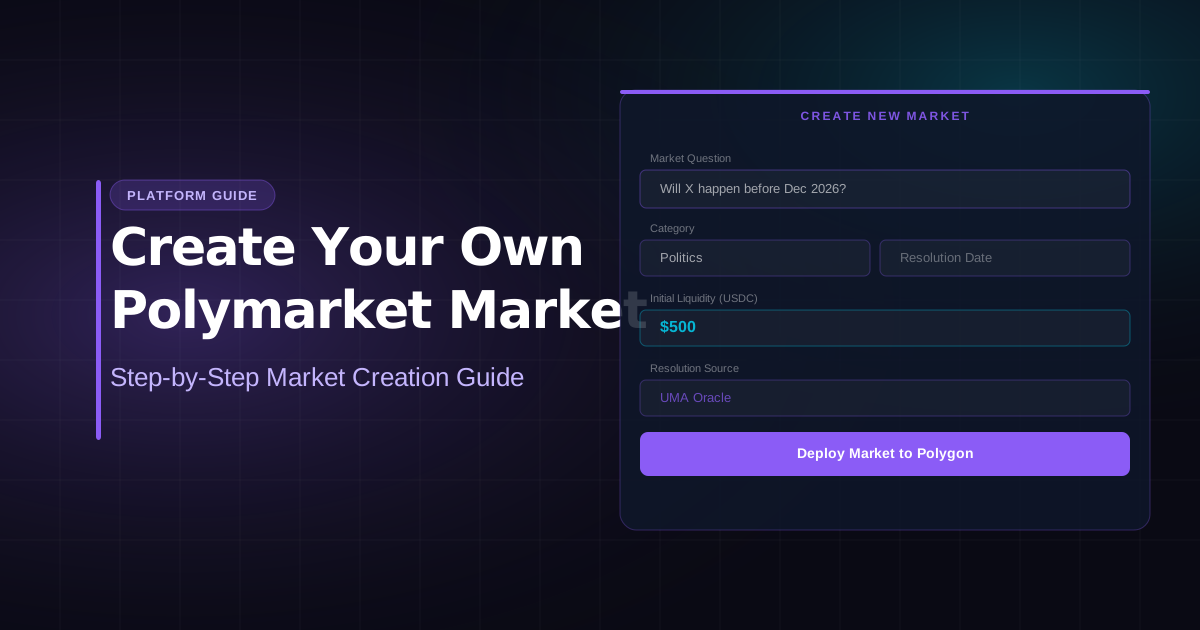
Polymarket does not offer a self-serve deployment tool. All new markets go through a proposal workflow:
- Submit the request form — Navigate to the market creation request page in your Polymarket account dashboard. Fill in the question text, proposed resolution criteria, resolution source URL, and desired end date.
- Internal review — The Polymarket operations team reviews the proposal against platform standards, checks for duplicate markets, and evaluates the resolution source.
- Feedback or approval — You may receive a request for clarification on the resolution criteria. If approved, the market is scheduled for deployment. If rejected, a brief reason is usually provided.
- On-chain deployment — Approved markets are deployed as smart contracts on Polygon. Once live, the market is publicly visible and tradeable.
- Initial liquidity seeding — Polymarket or a designated liquidity provider seeds the market with initial USDC so traders can enter positions immediately.
For context on how markets resolve once they are live, read our guide on Polymarket market resolution and the role of the UMA oracle system that powers the dispute process.
What Makes a Good Polymarket Market?
The three pillars of a strong market proposal are clarity, binary structure, and verifiability. Every decision the review team makes comes back to these three properties.
Clear Resolution Criteria
Resolution criteria are the exact conditions under which the market resolves YES or NO. Ambiguous criteria are the single most common reason proposals are rejected. Your criteria should leave no room for interpretation: specify the exact source, the exact threshold or event, and what happens in edge cases.
Weak: “Will the Fed raise rates in 2026?”
Strong: “Will the Federal Reserve increase the federal funds target rate at any FOMC meeting between January 1, 2026 and December 31, 2026, as announced in the official FOMC press release published at federalreserve.gov?”
Binary Outcome
Binary markets are the core product on Polymarket. YES and NO shares always sum to $1.00. Every event you propose needs to map cleanly onto a yes/no framework. If the natural framing of the event has more than two outcomes, consider whether a categorical multi-outcome market would work better — or whether you can restructure it as a binary threshold question.
Verifiable from a Specific Source
The resolution source must be a URL that can be checked at resolution time. Acceptable sources include official government websites, major newswire APIs, on-chain data from verified smart contracts, and official sports data feeds. Unacceptable sources include social media posts, anonymous blogs, or “any major news outlet.”
How Resolution Criteria Are Written
Well-written resolution criteria follow a consistent structure. Here is a template the Polymarket team uses internally for binary markets:
“This market resolves YES if [specific event] occurs [under specific conditions] as confirmed by [specific source URL] before [specific date and time in UTC]. This market resolves NO otherwise. In the event that [common edge case], this market resolves [YES/NO/N/A].”
Notice the explicit handling of edge cases. What if the source is unavailable at resolution time? What if the event is postponed? What if the result is contested? Anticipating these scenarios and writing explicit handling into the criteria dramatically increases approval odds and reduces the chance of a dispute at resolution.
For a deep dive into how disputes are adjudicated, read our explainer on the UMA oracle and the dispute process.
Approved vs. Rejected: A Comparison
| Proposal Type | Likely Outcome | Reason |
|---|---|---|
| “Will the ECB cut rates in Q2 2026?” with ECB press release as source | Approved | Binary, verifiable, dated, authoritative source |
| “Will Bitcoin hit $200K in 2026?” with CoinGecko price feed | Approved (likely) | Clear threshold, public on-chain price source, binary |
| “Will AI become sentient by 2026?” | Rejected | No verifiable resolution source; subjective outcome |
| “Will my favourite team win their next game?” | Rejected | Duplicate coverage (sports markets already exist); vague team reference |
| “Will [person] resign?” with no end date | Rejected | No defined resolution date; open-ended |
| “Will the S&P 500 close above 5,500 on June 30, 2026?” with Yahoo Finance data | Approved | Specific threshold, specific date, reliable price source |
| “Will there be a major earthquake in California in 2026?” | Rejected | “Major” is undefined; resolution source not specified |
| “Will [crypto project I created] reach $1?” | Rejected | Creator conflict of interest; manipulable outcome |
Liquidity Requirements and Initial Funding
One of the most misunderstood aspects of market creation is liquidity. When a new market launches, it needs enough initial liquidity so that traders can enter and exit positions without suffering extreme slippage. A market with only $50 in liquidity is essentially untradeable — the bid-ask spread will be so wide that no sophisticated trader will touch it.
Polymarket handles initial liquidity seeding internally for approved markets. You do not need to provide capital yourself as the proposer. However, markets that are expected to attract significant organic trading volume — think major elections, Fed decisions, or top-tier crypto price moves — are prioritized because the platform’s liquidity providers can deploy capital more efficiently.
If you want to understand how liquidity affects trade execution and why it matters for both creators and traders, our Polymarket liquidity guide covers the mechanics in detail. And if you are interested in becoming a liquidity provider yourself, read our guide on market making on Polymarket.
Practical implication for creators: the more naturally interesting your market is to a broad audience, the more likely it is to be approved and to receive adequate liquidity at launch. Niche markets that only you would want to trade are hard sells. For inspiration on the types of events that attract deep trading interest, browse our list of best Polymarket markets.
Approval Process and Timeline
After you submit a proposal, the typical review timeline is 2–5 business days, though this varies based on submission volume and the complexity of the proposal. High-activity periods (around elections, major central bank decisions, or large crypto events) tend to have slower review turnaround because submissions spike.
You will receive a notification through the platform when your market request is reviewed. If the team needs clarification — most commonly on resolution criteria or the resolution source — you will be asked to revise and resubmit. There is no penalty for a rejected submission; you can refine and resubmit immediately.
There is no public-facing approval queue or status tracker. If you have not heard back within seven business days, it is reasonable to follow up through Polymarket’s official Discord server in the market-requests channel.
Tips for Getting Markets Approved
Based on the patterns of successful and unsuccessful submissions, here are the most impactful things you can do to improve your approval odds:
- Search for duplicates first. If a market on the same event already exists, your proposal will be rejected immediately. Always search before you submit.
- Write the resolution criteria before you write the question. Start with how the market will resolve, then reverse-engineer the question wording from there. This prevents vagueness from creeping in.
- Name the exact URL. Do not write “as reported by Bloomberg.” Write the specific Bloomberg data endpoint or article template that will confirm the outcome.
- Include edge-case handling. Think of the three most likely ways this market could be ambiguous at resolution time, and write explicit rules for each scenario.
- Choose end dates conservatively. Markets with very long time horizons (more than 12 months) are less likely to attract liquidity and are harder to get approved. Keep markets tight.
- Avoid novelty for its own sake. Markets succeed when many different traders want to express opposing views. Hyper-niche questions fail because there is no natural counterparty.
- Reference existing similar markets. In the notes section of your submission, link to a comparable market that was previously approved on Polymarket. This shows the team you understand the platform’s standards.
Frequently Asked Questions
Can I create a market about myself?
No. Polymarket explicitly prohibits markets where the creator has a direct ability to influence the outcome. This includes markets about your own actions, your own company’s performance, or any project you control. Submitting such a proposal is grounds for account review.
Can I create markets anonymously?
Proposals are tied to your Polymarket account, but the identity of the market creator is not publicly displayed on the market page. Your wallet address is not exposed through the creation process.
What happens if a market I created resolves incorrectly?
You are not legally liable for a resolution outcome on Polymarket. Resolution is handled by the UMA oracle and, in the event of a dispute, by UMA token holders. However, if your resolution criteria were poorly written and contributed to an ambiguous resolution, it affects the quality of the market you proposed. For more on how this works, see our full breakdown of Polymarket market resolution.
Is there a fee for submitting market proposals?
No. Submitting a proposal is free. There is no cost to submit, revise, or resubmit a market proposal.
Can I create a market from a mobile device?
Yes, the submission form is accessible from the Polymarket mobile interface. For a full walkthrough of using Polymarket on mobile, see our beginner’s guide to Polymarket.
Market creation is one of the more advanced interactions available on Polymarket — and one of the most rewarding when done well. A well-designed market that attracts genuine two-sided trading becomes part of the information ecosystem that Polymarket is known for: a place where prices actually reflect collective knowledge about the future.