Every Polymarket trade you place ends the same way: a smart contract asks the UMA oracle whether the outcome was YES or NO, and that answer determines who gets paid. Most traders never think about this layer—until a resolution goes wrong. Understanding how the UMA oracle works, how disputes are raised, and where the process can break down is not just academic. It directly affects the risk profile of every position you hold.
What Is the UMA Protocol?
UMA (Universal Market Access) is a decentralized oracle and financial contracts protocol built on Ethereum, with Polymarket operating on its Polygon deployment. Founded in 2018 and launched in 2020, UMA’s core thesis is that most oracle requests are uncontested—so instead of requiring on-chain verification for every single data point (which is expensive), UMA uses an optimistic model: propose an answer, assume it is correct unless challenged, and only invoke full community arbitration when someone disputes it.
UMA powers the resolution layer for Polymarket’s conditional token markets. When a market on Polymarket expires, the outcome is not determined by Polymarket Inc. — it is determined by UMA’s oracle system, making it credibly neutral and resistant to platform-level manipulation. This is a foundational reason why Polymarket is considered a legitimate on-chain prediction market rather than a centralized betting book; for more background, see our Polymarket beginner guide.
How UMA Settles Polymarket Markets
Each Polymarket market is backed by a conditional token contract on Polygon. When a market is created, it specifies an ancillary data string—a plain-English description of the resolution criteria—and a UMA price identifier (typically YES_OR_NO_QUERY). At expiry, the following sequence begins:
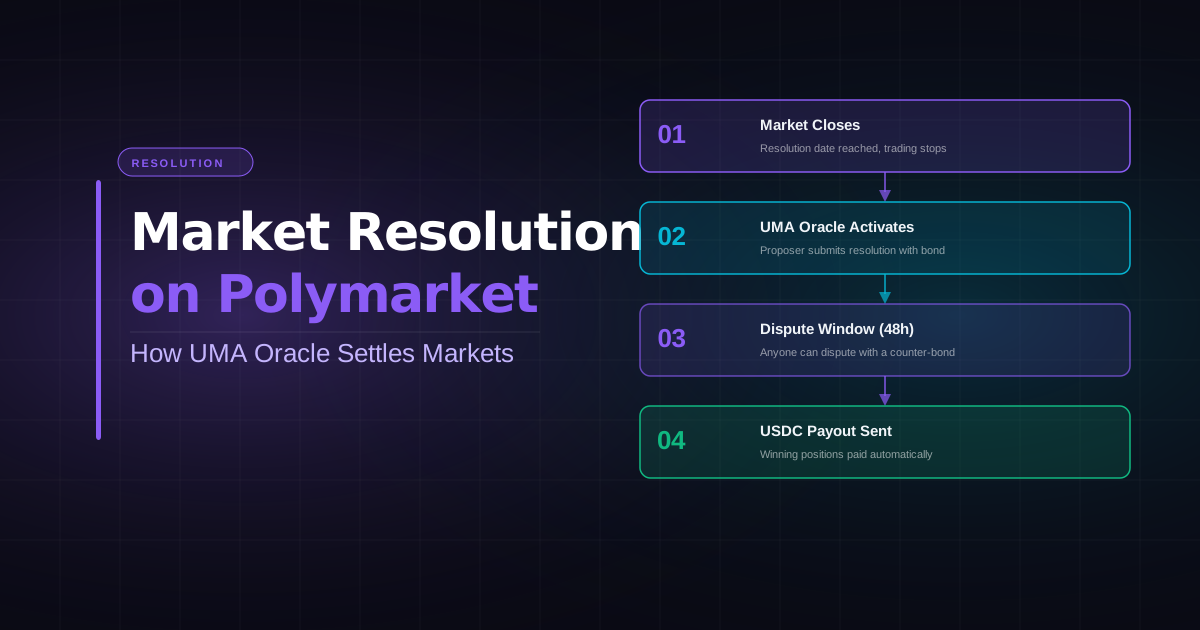
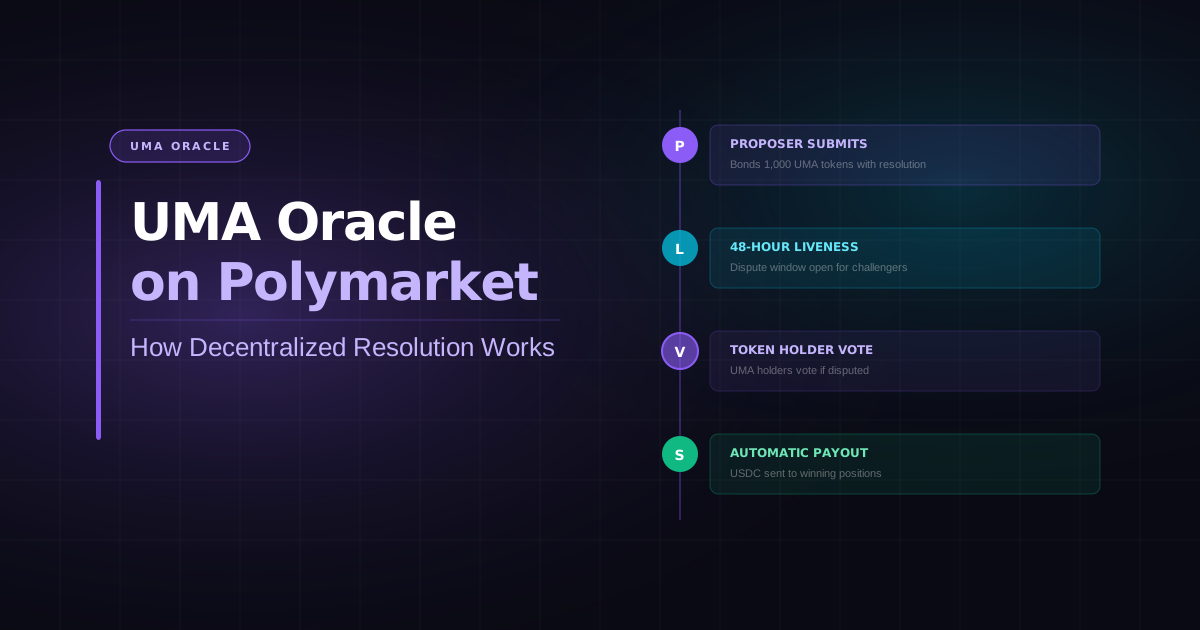
- The market contract requests a price from UMA’s Optimistic Oracle.
- A proposer (anyone who bonds UMA tokens) submits an answer: 1 (YES) or 0 (NO).
- A challenge window opens—typically two hours on Polymarket’s standard markets.
- If no one disputes, the proposed answer is accepted and payouts are released.
- If someone disputes, the question escalates to UMA’s Data Verification Mechanism (DVM) for a community vote.
For a deeper look at how this feeds into final payouts, see our article on Polymarket market resolution. The USDC mechanics of how winners receive funds are covered in our Polymarket USDC guide.
The Optimistic Oracle Mechanism
The term “optimistic” refers to the assumption of good faith. UMA’s Optimistic Oracle (OO) does not require expensive on-chain verification for every resolution request—it assumes the first proposer is correct and gives disputers a short window to object. This design has two major practical benefits:
- Speed: Most markets resolve within two to four hours of expiry, far faster than a full DAO vote.
- Cost efficiency: Gas costs for routine resolutions are minimal because no heavy computation occurs on-chain.
To propose an answer, a proposer must post a bond in UMA tokens (or USDC, depending on the contract configuration). If their answer is accepted unchallenged, they reclaim the bond plus a proposer reward. If they are found wrong after a dispute, they lose their bond to the disputer. This economic incentive structure keeps proposers honest.
The ancillary data string is critical here. It is the verbatim text that proposers and token holders use to evaluate the outcome. Ambiguous or poorly written resolution criteria are the single most common root cause of disputes and controversial outcomes on Polymarket. Always read the resolution criteria in full before entering a position—our guide on whether Polymarket is accurate covers how resolution quality affects market reliability.
The Dispute Process and the Data Verification Mechanism
When a disputer challenges a proposed answer, they must also post a bond equal to the proposer’s bond. The question then moves to UMA’s Data Verification Mechanism (DVM)—a decentralized governance vote conducted by UMA token holders.
The DVM process works as follows:
- Commit phase: UMA token holders submit encrypted votes on the correct outcome. This blind commitment prevents early votes from influencing later ones.
- Reveal phase: Voters reveal their votes. The majority answer wins.
- Resolution: The winning answer is sent back to the Optimistic Oracle and then to the market contract. The losing party’s bond is distributed to the winning party and to voters who voted with the majority.
The full DVM voting cycle typically takes two to seven days from the moment a dispute is raised. During this window, Polymarket markets show a “Disputed” or “Resolving” status and payouts are frozen. This delay is the primary operational risk of the oracle layer for active traders.
| Stage | Who Acts | Typical Duration | Bond Required |
|---|---|---|---|
| Market Expiry | Smart contract (automatic) | Instant | None |
| Price Proposal | Any proposer (bonded) | Minutes to hours | Yes (proposer) |
| Challenge Window | Any disputer (bonded) | ~2 hours | None unless disputed |
| DVM Commit Phase | UMA token holders | ~24–48 hours | Yes (disputer) |
| DVM Reveal Phase | UMA token holders | ~24–48 hours | — |
| Final Settlement | Smart contract (automatic) | Instant post-reveal | — |
UMA Token and Governance
The UMA token ($UMA) is the governance and security token of the entire system. Its two primary functions are:
- Voting rights: Token holders vote in DVM disputes. Voters who vote with the majority earn a share of the losing party’s bond plus inflationary token rewards. Voters who vote with the minority receive nothing, creating a Schelling point that incentivizes honest assessment rather than contrarian positions.
- Security collateral: The total market cap of UMA tokens must be greater than the total value of contracts it could be asked to resolve, in order to make it economically irrational to corrupt the oracle. This “cost of corruption” argument is central to UMA’s security model.
UMA governance also controls protocol parameters such as bond sizes, voting windows, and which price identifiers are approved. Changes go through a governance vote of token holders, giving $UMA holders real influence over the resolution rules that govern Polymarket outcomes. On-chain data about UMA governance activity is accessible via the Polygon explorer—our Polymarket on-chain data guide explains how to query it.
Past Resolution Controversies
The UMA oracle has performed reliably for the vast majority of the thousands of markets resolved on Polymarket, but several high-profile disputes illustrate where the system faces stress:
Ambiguous resolution criteria. The most frequent source of controversy is not bad actors but poorly written ancillary data. When market creators use phrases like “as reported by a major news outlet” without specifying which outlet or when, proposers and disputers can disagree in good faith. DVM voters must then interpret the intent rather than apply a clear rule—an inherently subjective exercise that occasionally produces outcomes traders find counterintuitive.
Data source disagreements. Some markets specify a single authoritative source (e.g., a government agency’s official release). If that source is delayed, revised, or ambiguous, the oracle faces a gap between what “actually happened” and what the resolution criteria technically specify. Traders who held what appeared to be a winning position have found themselves on the wrong side of a technically correct but economically surprising resolution.
Edge-case outcomes. Markets that expire on boundary conditions—exactly at a threshold, during a contested period, or when the underlying event is itself disputed—are disproportionately likely to generate DVM votes. The 2024 U.S. election cycle produced several such cases that required full DVM arbitration before payouts were released.
These controversies do not represent oracle failure in the sense of fraud or manipulation—they represent the inherent difficulty of encoding complex real-world outcomes into binary on-chain contracts. They are a reason to treat oracle risk as a genuine component of position risk, especially on markets with loosely defined criteria.
How to Challenge a Resolution
Any Ethereum/Polygon address can dispute a proposed resolution during the challenge window. The practical steps are:
- Monitor the UMA Optimistic Oracle UI at oracle.umaproject.org. Active proposals for Polymarket markets appear here with their proposed answers and challenge window countdowns.
- Assess the proposed answer against the market’s ancillary data string. Is the proposed answer clearly wrong, or is it defensible given the resolution criteria? Raising a frivolous dispute costs you your bond.
- Post the dispute bond. The required bond amount is shown in the Oracle UI. You will need UMA tokens (or the specified collateral currency) in your wallet plus MATIC for gas.
- Participate in the DVM vote. Once disputed, UMA token holders vote. If you hold $UMA, you can vote on the dispute yourself; if not, the outcome rests with other token holders.
- Await the result. If the DVM rules in your favor, you receive your bond back plus the proposer’s bond minus protocol fees. If the DVM rules against you, you lose your bond.
In practice, most individual Polymarket traders do not personally raise disputes—the bond requirement and DVM participation create meaningful barriers. Institutional participants, protocol contributors, and market creators are the most common disputers. However, knowing the mechanism exists is important: it means that even if Polymarket posts an answer you believe is wrong, there is a formal on-chain path to contest it, and the outcome is determined by a decentralized community rather than a single company.
What Traders Should Know About Oracle Risk
Oracle risk is distinct from the market risk of “will this event happen?” It is the risk that even if the underlying event resolves clearly in your favor, the oracle layer introduces delay, ambiguity, or a technically incorrect settlement. Experienced Polymarket traders manage oracle risk in several concrete ways:
Read the resolution criteria before every trade. The ancillary data string is visible on each market page. If it is vague, contains undefined terms, or relies on a single source that could be disputed, price in a margin for oracle risk. Our beginner guide covers where to find this information on the market page.
Avoid high-value positions on markets with novel or complex resolution criteria. Elections, regulatory decisions, and court rulings tend to have well-tested criteria developed over many iterations. Newer market categories—especially highly specific scientific or geopolitical questions—carry higher oracle risk because the resolution criteria have been stress-tested less.
Factor in settlement delay for near-expiry trades. If you are buying a market with hours to expiry at 95 cents on a position you believe is certain, the two-hour challenge window and possible DVM delay affect the real annualized cost of capital. A seven-day DVM delay on a “certain” 95-cent position is a meaningful drag on returns.
Track disputed markets. The UMA Oracle UI shows all active disputes. If a market you hold is in dispute, check the UMA governance forums and Discord for community sentiment. DVM votes on clear-cut questions tend to converge quickly; close calls take longer and are less predictable. Historical dispute patterns across thousands of resolved markets are queryable through the resources covered in our Polymarket historical data guide.
Diversify across markets and resolution dates. Concentrating your portfolio in markets that all expire around the same event (e.g., an election) means your oracle risk is correlated. If one controversial resolution triggers a DVM, related markets may also face disputes. Our Polymarket beginner guide and the broader discussion of how accurate Polymarket markets are both touch on the relationship between market design and outcome quality.
The UMA oracle is, on balance, a strong and credibly neutral infrastructure layer. But like any complex system, it has failure modes. The traders who understand those failure modes treat oracle risk as one more edge to manage—and they avoid the unpleasant surprise of winning the market but losing the settlement.