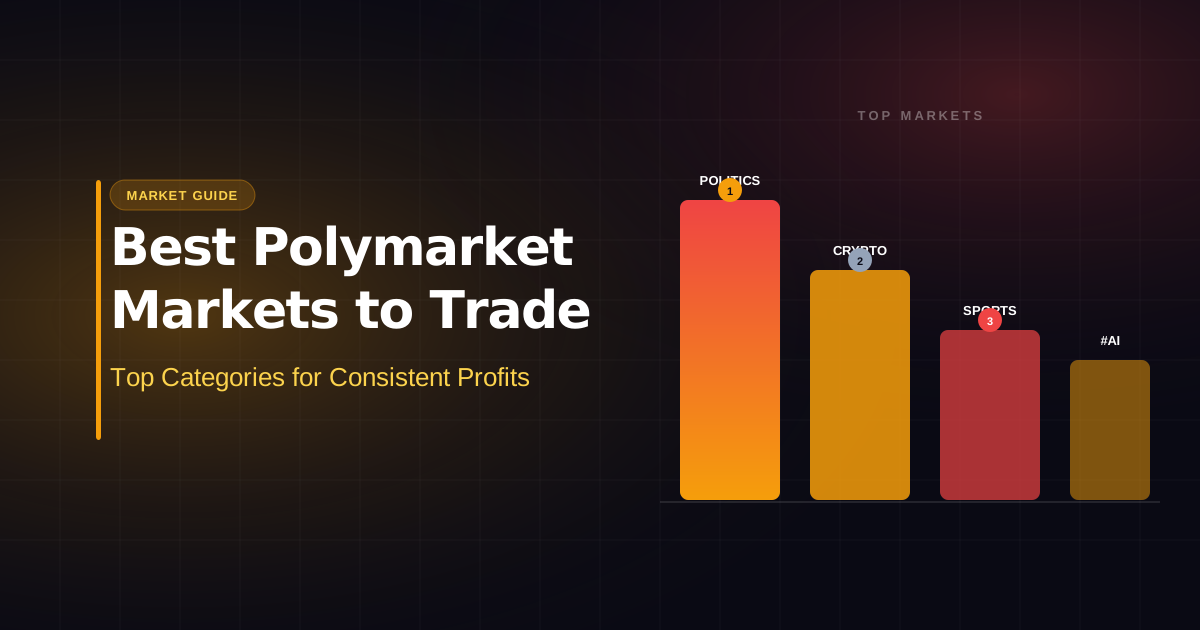
Most traders on Polymarket make the same mistake: they find a market that looks interesting, form a view, and place a trade. Market selection is an afterthought. That is backwards. The market you choose to trade in determines your ceiling more than almost any other decision. A sharp opinion in the wrong market earns nothing. A mediocre opinion in the right market — one with genuine uncertainty, loose pricing, and enough liquidity to get in and out — can be consistently profitable.
This guide ranks every major Polymarket category by four criteria: liquidity depth, pricing efficiency, resolution clarity, and how much information advantage is realistically achievable. If you want the quick version: US Politics and Fed/Macro markets reward research. AI/Tech markets reward patience. Crypto markets punish overconfidence. And certain market types should be avoided entirely regardless of how attractive the price looks.
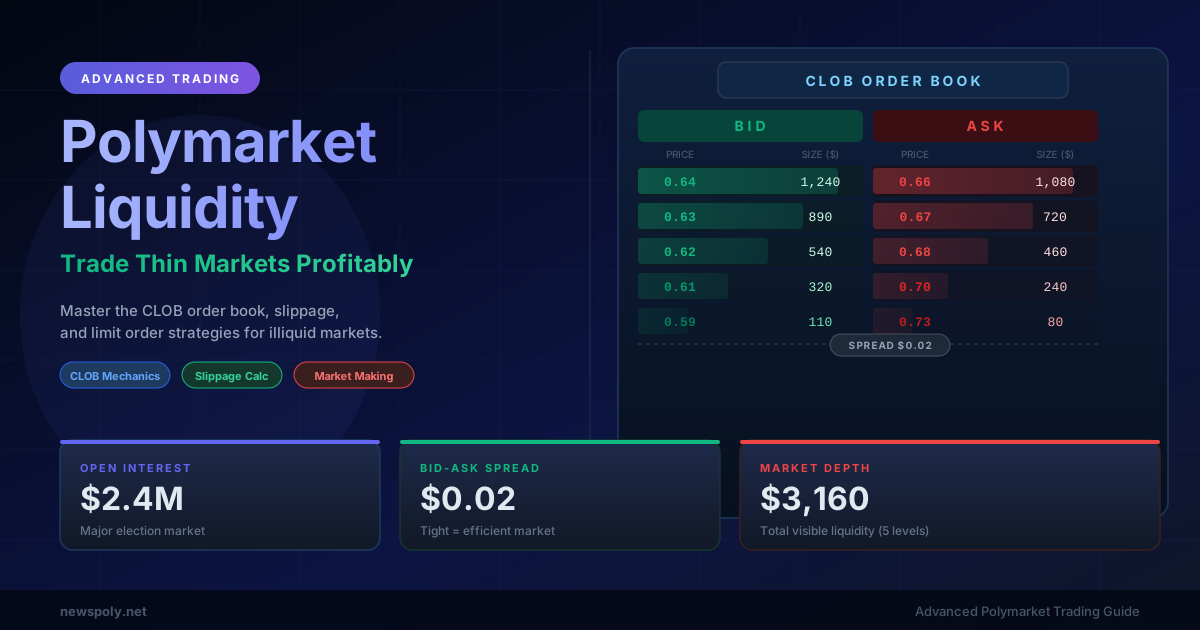
Understanding how liquidity actually works on Polymarket is the foundation for everything that follows. Without that context, the rankings below will not make complete sense.
Want an Edge Without the Research?
Copy the traders who already know which markets to pick
Polycopytrade mirrors the positions of Polymarket's top performers in real time — so you benefit from their market selection and their research.
Start Copy Trading Free →The Framework: Four Questions Every Market Must Answer
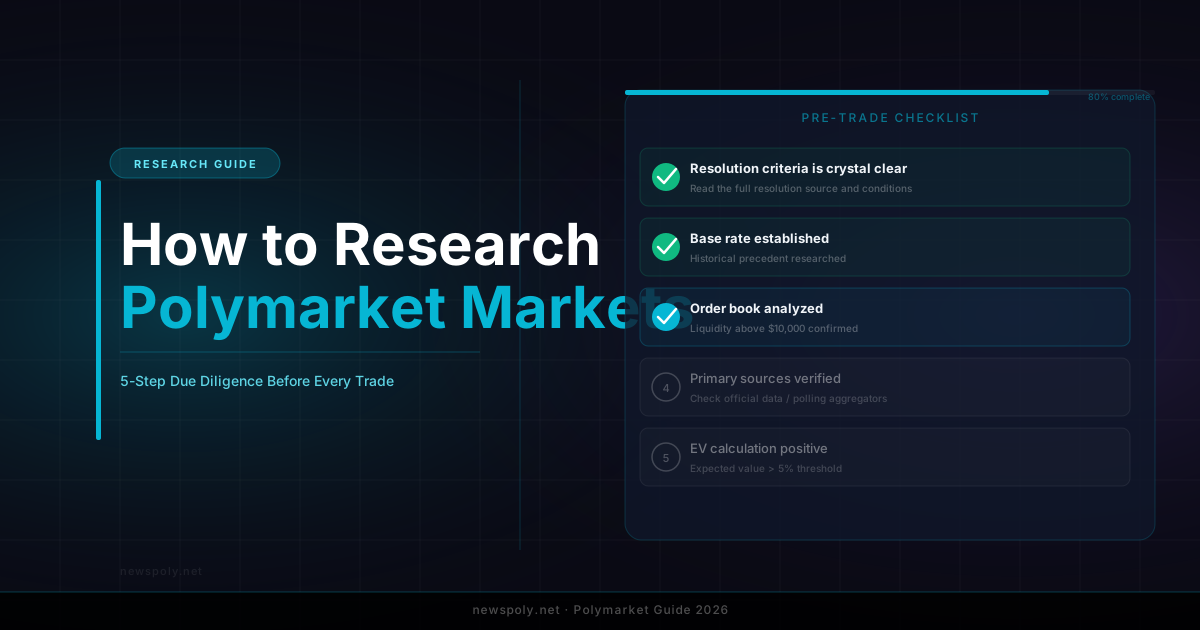
Before looking at specific categories, you need a repeatable framework for evaluating any individual market. These four questions cut through noise quickly:
1. Is there enough liquidity? A market with $10,000 in total volume is nearly unplayable for any meaningful position. You want markets where you can enter and exit $500–$5,000 without moving the price more than a few percentage points. Volume and open interest are your primary signals.
2. Is the current probability genuinely uncertain? A market sitting at 94% YES is almost certainly correctly priced. Markets between roughly 20% and 80% are where real uncertainty — and real pricing errors — live. Calculating expected value only matters when there is genuine probability mass on both sides.
3. Is the resolution criteria unambiguous? Vague resolution language ("Will X happen by year end?" without specifying what X means exactly) creates resolution disputes and sometimes perverse incentives. Markets with crystal-clear binary criteria are safer bets for your capital.
4. Do you have an information advantage? The crowd on Polymarket is not dumb. Professional traders, quants, and domain experts all participate. You need a reason to believe your probability estimate is more accurate than the consensus. That reason can be domain expertise, faster information access, or a better analytical model — but it must exist.
With that framework in hand, here is how each major category scores.
Category 1: US Politics and Elections
Liquidity: Very High | Edge Potential: Very High | Recommended for: Informed, news-fast traders
US political markets are Polymarket's most liquid category by a wide margin. Presidential election markets routinely exceed $500 million in total volume. Congressional races, gubernatorial elections, and Senate runoffs follow with tens of millions each. This depth means you can take meaningful positions and exit without slippage destroying your returns.
The inefficiency here is real and recurring. Political markets are populated by passionate participants who bet with their hearts rather than their probability models. During campaign season, markets consistently overprice whichever candidate is getting positive news coverage at any given moment. Polling aggregation, electoral history, and base-rate thinking are systematically underweighted by the crowd.
The best windows for edge in political markets: the 72 hours after an unexpected news event (the crowd overreacts), the week before a major debate (pricing gets emotional), and the final 48 hours before an election (late money often comes in mispriced). Read our full elections trading guide for specific entry patterns.
The risk: political markets are heavily scrutinized. Professional forecasters like those at prediction market research firms actively trade here. Your information advantage needs to be genuine, not just a feeling.
Category 2: Fed Rate and Macro Markets
Liquidity: Medium-High | Edge Potential: High | Recommended for: Traders with macro or finance background
Federal Reserve rate decision markets and broader macroeconomic markets — inflation prints, GDP figures, unemployment — represent one of the best risk-adjusted opportunities on the platform. The reason is structural: these markets have an external reference point in CME FedWatch, which aggregates institutional money and futures pricing into an implied probability for each Fed outcome.
When Polymarket pricing diverges from CME FedWatch by more than a few percentage points, that gap is almost always an opportunity. CME data reflects billions of dollars of institutional positioning. Polymarket reflects retail sentiment. When retail sentiment has shifted on a news story but futures markets have not moved, you have a directional signal worth acting on.
The limitations: macro markets require genuine understanding of monetary policy mechanics. Amateur participation is lower here than in political markets, which means the crowd is smarter on average. Our macro markets guide covers the specific edge-finding techniques in detail, including how to read Fed communications for probability signals the market has not yet priced.
Category 3: AI and Tech Milestones
Liquidity: Medium and Growing | Edge Potential: High | Recommended for: Technical insiders and patient traders
AI and technology milestone markets are the fastest-growing category on Polymarket and currently represent one of the better edge opportunities available. The participant pool is heavily skewed toward non-experts who are nonetheless extremely confident in their views. This creates systematic mispricings in both directions.
Common patterns: AI capability markets tend to overprice near-term breakthroughs (the crowd is influenced by hype cycles) and underprice longer-term ones (the crowd anchor-adjusts off recent disappointments). Product release markets for major tech companies often misprice because participants confuse internal roadmaps with public announcements.
If you have domain expertise in machine learning, semiconductor supply chains, or enterprise software, AI/Tech markets currently offer the widest gaps between your edge and the crowd's pricing. The markets are still immature enough that disciplined, research-backed participation compounds well over time. As the category matures and more professional traders enter, this edge will compress — which means now is the time to establish a track record here.
Category 4: Crypto Price Targets
Liquidity: Very High | Edge Potential: Low | Recommended for: Market makers, not directional traders
Crypto price target markets are the most liquid on the entire platform and also among the hardest to beat. The reason: crypto markets are covered around the clock by professional traders, quant funds, and derivatives desks. The implied probability in a Polymarket Bitcoin price target market is constantly being arbitraged against options pricing on major exchanges. By the time a retail trader forms a view, it is almost certainly already priced in.
This does not mean crypto markets are useless. If you are interested in market making — providing liquidity on both sides and earning the spread — crypto markets are ideal. Volume is high, markets are active around the clock, and the constant need for liquidity means the spread is occasionally wide enough to be attractive. But if you are trying to take directional positions based on your Bitcoin price views, you are competing against the most sophisticated participants on the platform.
The exception: during extreme volatility events (major hacks, regulatory announcements, exchange collapses), the crowd temporarily loses its anchor and mispricings emerge. These windows are short — often measured in minutes — but they exist.
Category 5: Sports Markets
Liquidity: Low-Medium | Edge Potential: Medium (situation-dependent) | Recommended for: Specialists with fast news access
Sports markets on Polymarket sit in an interesting middle ground. Liquidity is thinner than political or macro markets, and the participant base includes both sharp sports bettors who arbitrage against traditional sportsbooks and casual fans who bet emotionally. The net effect is a market that is reasonably efficient most of the time — and dramatically inefficient at specific moments.
The specific moments that matter: breaking injury news, coaching changes, and weather-related conditions in outdoor events. When a key player is ruled out 20 minutes before a game, the window between the announcement and the Polymarket price adjusting is often 5–15 minutes wide. During that window, you are trading against people who have not yet seen the news. That is a genuine, repeatable edge.
The challenge: capturing this edge requires near-real-time news monitoring, a pre-formed view on how the injury or change affects the probability, and the ability to execute quickly. It is a high-activity, low-margin strategy that rewards preparation over analysis.
Category 6: Geopolitics and International Markets
Liquidity: Low | Edge Potential: Very High (for specialists) | Recommended for: Domain experts only
Geopolitical markets — elections in foreign countries, international conflicts, diplomatic outcomes — are the most inefficiently priced category on Polymarket. The reason is simple: almost no one in the participant pool has a genuine information advantage about Peruvian congressional elections or Central Asian territorial disputes. The crowd is guessing, and guessing poorly.
For someone with genuine regional expertise or access to non-English language sources that the broader market ignores, geopolitical markets offer pricing errors that dwarf anything available in more popular categories. A market priced at 30% that should be 60% based on publicly available but under-read local reporting is not unusual.
The serious limitation is liquidity. Many geopolitical markets have total volume under $50,000. You cannot take a meaningful position without moving the price, and exit options are limited. These markets are best suited to specialists willing to take small, high-conviction positions and hold them to resolution.
No Domain Expertise? No Problem.
Let proven Polymarket traders do the market selection for you
Polycopytrade lets you automatically mirror the portfolio of traders who have demonstrated consistent edge across multiple market categories over time.
Explore Top Traders →Markets to Avoid
Knowing what not to trade is as important as knowing where to focus. Three categories of markets should be on your permanent avoid list:
Markets closing within 24 hours with extreme pricing. A market at 96% YES with one day to resolution has almost no value left to capture. The expected profit on a $1,000 position is tiny, but the downside if an unexpected event occurs is large. The risk/reward is structurally broken.
Markets at 95%+ or 5% and below. Regardless of time to expiry, markets this far from 50% are almost always correctly priced. The crowd consensus at these extremes tends to be accurate because outlier outcomes are easy to identify and dismiss. The apparent "upside" in betting against 96% is almost never real.
Markets with vague or disputed resolution criteria. Before entering any market, read the resolution criteria in full. If it contains phrases like "at the discretion of," "in the judgment of," or lacks a specific measurement source, the resolution risk is unquantifiable. Markets have been resolved in surprising ways based on technicalities in the criteria language. This risk cannot be modeled or priced — avoid it entirely.
How to Find the Best Markets Efficiently
Manually scanning hundreds of markets is not practical. Using Polymarket's filtering tools effectively is the difference between systematic edge-finding and random browsing. The three most useful filters:
Volume filter: Sort all active markets by 24-hour or 7-day volume. This immediately surfaces the markets where capital is flowing. High volume signals professional participation and genuine uncertainty — both of which you want.
Expiry window filter: Markets approaching expiry in 7–30 days are often mispriced because the crowd's attention is elsewhere. Early-stage markets get the initial pricing burst; late-stage markets get the resolution attention. The middle window is frequently underserved.
Recent large trade filter: When a single large trade (visible in the market order book) moves the price significantly, the market is telling you that someone with conviction just acted. That price movement is itself information. Understanding whether the large trader is sharp or emotional is the key interpretive question.
Category Comparison Table
| Category | Liquidity | Edge Potential | Best Strategy |
|---|---|---|---|
| US Politics / Elections | ★★★★★ | ★★★★★ | React to news overreactions; pre-event pricing |
| Fed Rate / Macro | ★★★★ | ★★★★ | Arbitrage vs. CME FedWatch divergences |
| AI / Tech Milestones | ★★★ | ★★★★ | Fade hype cycles; exploit amateur crowd bias |
| Crypto Price Targets | ★★★★★ | ★★ | Market making only; avoid directional bets |
| Sports | ★★★ | ★★★ | Injury/news windows only; requires speed |
| Geopolitics / International | ★★ | ★★★★★ | Small, high-conviction positions for specialists |
Building a Market Selection Routine
The traders who consistently outperform on Polymarket do not approach market selection randomly. They have a routine. A practical version: spend 15 minutes each morning scanning the top-volume markets in your target categories, note which markets have moved more than 10 percentage points in the past 24 hours (these are the active mispricings), and identify your highest-conviction opportunity for the day.
This discipline compounds. Over weeks, you develop a feel for which market types tend to recover from overreactions quickly and which ones stay mispriced for days. That pattern recognition is itself an edge — and it only develops through systematic engagement, not random browsing. For a broader view of approaches, our top Polymarket trading strategies guide covers how market selection fits into a complete trading framework.
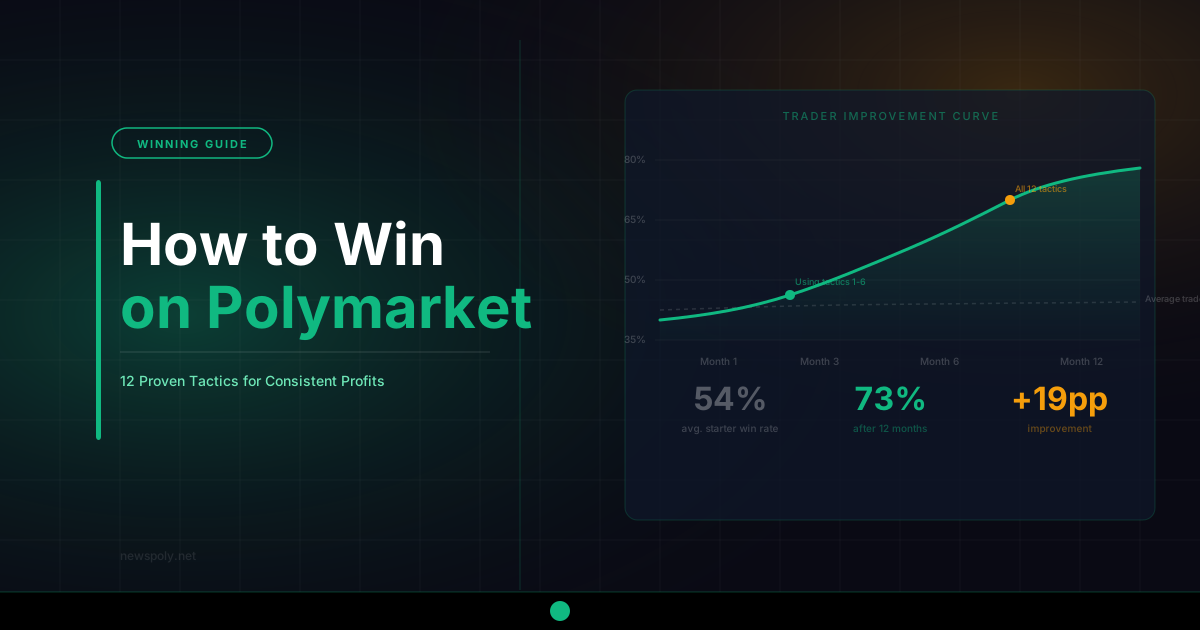
One final point worth emphasizing: your edge calculation is only valid if it is honest. The question to ask before every trade is not "do I think this will happen?" but "why is my probability estimate better than the market's?" If you cannot answer that question clearly, the market is almost certainly right and you are wrong. That discipline — applied consistently across all six categories — is what separates profitable participation from expensive guessing. For the mechanics of that calculation, the expected value framework is the place to start.
Frequently Asked Questions
Are new Polymarket markets better to trade than established ones?
New markets often have wider initial mispricings because the crowd has not yet aggregated all available information. In the first 24–72 hours of a new market's life, pricing can be particularly loose. However, new markets also carry higher resolution risk if the criteria are untested. The best window is often 48–96 hours after launch, once initial pricing chaos has settled but before the market becomes efficient.
How do I filter Polymarket markets by volume?
On Polymarket's main interface, use the sort and filter options to rank markets by 24-hour volume or total volume. Third-party tools like Polymarket Whales and various market analytics dashboards also provide filtered views with additional data layers including order book depth and recent large trades. Developing a workflow with these tools is one of the fastest ways to improve your market selection process.
Which Polymarket category has the highest ROI potential?
Based on consistent patterns, geopolitical markets offer the highest theoretical ROI per trade for domain specialists — but the thin liquidity caps absolute returns. For most traders, US Politics and Fed/Macro markets offer the best combination of accessible edge and sufficient liquidity to make meaningful returns. AI/Tech markets are emerging as a strong alternative for traders with relevant technical backgrounds. The "highest ROI category" for any individual trader is whichever category they genuinely know better than the crowd.
Skip the Learning Curve
Copy traders who have already mastered market selection
Polycopytrade automatically mirrors the full portfolios of Polymarket's top performers across all categories — politics, macro, AI, and more. One setup, continuous execution.
Get Started at Polycopytrade.net →