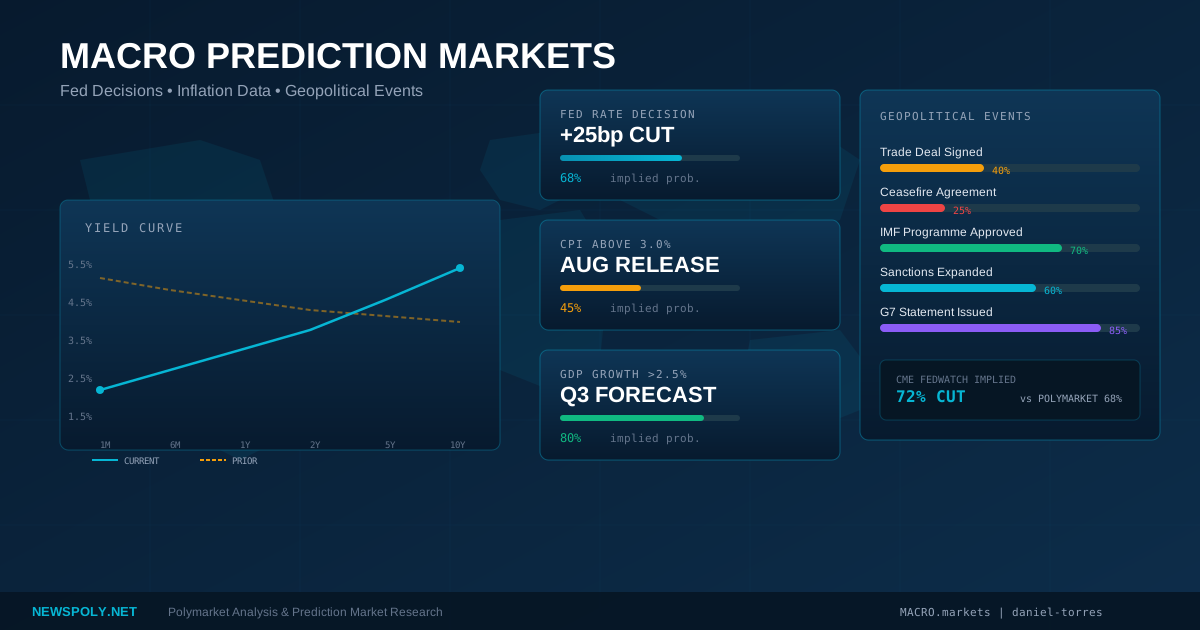
Macro prediction markets are where economics training pays its clearest dividend on Polymarket. A question like “Will the Fed cut rates by 25 basis points in September?” or “Will US CPI exceed 3.5% for the year?” isn’t a pure guessing game — it has a structured answer that emerges from analysing the same data the Fed itself uses. The market price reflects the crowd’s average view. If your analysis is better than average, the gap between your probability and the market price is your edge.
This guide covers how to identify, analyse, and trade macro prediction markets on Polymarket: what categories exist, which data sources matter, how to time entries around economic calendars, and the specific errors that cost traders money when they bring macro intuition to a prediction market structure. For the mechanics of how Polymarket prices work before diving into strategy, see our guide to reading Polymarket odds.
What Macro Markets Are Available on Polymarket?
Macro prediction markets on Polymarket cluster into four broad categories:
- Central bank decisions — Fed funds rate changes at FOMC meetings, ECB deposit rate decisions, Bank of England base rate votes. These are the most liquid and actively traded macro markets
- Economic data releases — Will US CPI exceed a specific level? Will GDP growth come in above or below a threshold? Will unemployment reach a specific rate by year-end?
- Geopolitical events — Will a specific country reach a ceasefire by a date? Will a trade deal be signed? Will a particular sanction regime be expanded or lifted?
- Sovereign and institutional decisions — Central bank balance sheet changes, IMF programme approvals, G7/G20 statement outcomes
Of these, central bank rate markets consistently offer the best combination of liquidity, clear resolution criteria, and publicly available data. Geopolitical markets are often more mispriced but carry higher resolution uncertainty — outcome definitions sometimes become contested in ways that monetary policy markets almost never do.
The Central Bank Decision Framework
Fed rate markets are among the most informationally rich prediction markets on Polymarket because the Fed itself telegraphs its intentions through multiple official channels. The primary data inputs for any Fed rate market:
Federal Funds Futures and OIS Markets
Before forming a view on a Fed rate Polymarket, check the CME FedWatch tool. This derives implied probabilities from federal funds futures contracts — traded by sophisticated institutional participants — and shows the market-implied probability of each rate outcome at each upcoming FOMC meeting. These probabilities are significantly more accurate than Polymarket prices in the weeks before a meeting, because the futures market has vastly more liquidity and more professional participants. If FedWatch shows 78% probability of a 25bp cut and Polymarket shows 65%, that 13-point gap is worth investigating seriously.
Fed Communication Hierarchy
Not all Fed statements carry equal weight. The hierarchy for updating your rate probability:
- FOMC statement and press conference — Highest weight; changes the baseline probability significantly
- Fed Chair speeches at major venues (Jackson Hole, Brookings, Senate testimony) — Very high weight
- Fed Governor speeches and interviews — Medium weight; signals internal consensus
- Regional Fed President commentary — Low-to-medium weight; often reflects non-consensus views
- Media reporting on Fed deliberations — Lowest weight unless citing specific officials on record
Most retail Polymarket traders invert this hierarchy — over-reacting to regional Fed president commentary while under-weighting the systematic signal in the dot plot and meeting minutes. That inversion creates the pricing errors that macro-focused traders can exploit.
The Dot Plot as a Probability Anchor
The FOMC’s Summary of Economic Projections, released quarterly, includes each member’s median rate expectation for the next three years — the “dot plot.” When the dot plot shifts, it is the clearest possible signal of where the committee is moving. Markets that haven’t fully reflected a dot plot shift within 48 hours of publication are reliably mispriced. Reading the probability chart for rate markets over the weeks surrounding a dot plot release makes the lag between the dot plot signal and market price adjustment visually clear — and helps confirm that the mispricing is genuine rather than already corrected. For the broader context of finding these mispricings, our guide to identifying mispriced Polymarket markets provides the systematic framework.
Inflation and Economic Data Markets
Economic data markets require a different analytical approach from rate markets. Here, the relevant question is not “what will policymakers decide?” but “what will the data show?” The tools:
Consensus Forecasts and Prediction Intervals
Bloomberg consensus forecasts and the Cleveland Fed’s CPI nowcast publish point estimates and confidence intervals for upcoming inflation releases. When a Polymarket “Will CPI exceed X?” market is priced at 40% and the consensus confidence interval implies 55% probability of exceeding X, that 15-point gap is a potential long position. The key caveat: consensus forecasts are also fallible. The value of this approach is using calibrated models with explicit uncertainty bounds, not just the point estimate.
Nowcast Models
The Atlanta Fed GDPNow model updates in real time as new data releases arrive and provides a continuously revised GDP growth estimate. For “Will Q3 GDP growth exceed Y%?” markets, GDPNow is significantly more informative than any single analyst forecast. Traders who monitor GDPNow updates and compare them to static Polymarket prices consistently find ahead-of-consensus opportunities in the days before GDP releases.
Component-Level Analysis
CPI is an aggregate of many sub-components — shelter, energy, food, core services. When energy prices have moved sharply but Polymarket’s headline CPI market hasn’t adjusted, that component-level analysis provides actionable signal. The same logic applies to GDP: if real consumer spending data is already available and the GDP market hasn’t incorporated it, that’s a pricing gap.
Geopolitical Event Markets
Geopolitical markets are the most information-intensive category on Polymarket and the most prone to both mispricing and resolution dispute. Before entering any geopolitical market, verify two things:
- Resolution criteria clarity — Exactly what conditions trigger YES resolution? Geopolitical questions like “Will [Country A] and [Country B] reach a ceasefire?” can be ambiguous. Does a temporary halt count? A formal UN-brokered agreement only? Check the resolution source and criteria before sizing any position
- Information advantage plausibility — Do you actually have a genuine informational edge in this market, or are you trading on narrative? Geopolitical markets attract heavy retail participation from people with strong opinions but no analytical advantage. A compelling narrative about why a conflict will resolve is not an edge
The most reliable geopolitical market edges come from:
- Historical base rates — How often do conflicts at a given stage resolve within 90 days? How often do trade negotiations that reach a specific phase result in a signed deal?
- Institutional process knowledge — Understanding the procedural steps required for a specific outcome (treaty ratification timelines, legislative calendars, institutional approval sequences) gives an edge over traders reasoning purely from news
- Cross-platform comparison — Betfair and Kalshi often price geopolitical events differently from Polymarket; persistent gaps are worth investigating. The same approach applies to political prediction markets, where institutional process knowledge similarly outperforms narrative-driven trading
Timing Macro Entries: The Economic Calendar
Macro prediction markets have a structure that is fundamentally different from political or sports markets: the key data releases that move them are scheduled in advance. The US economic calendar publishes exact dates and times for every major release — CPI, PPI, PCE, NFP, GDP — weeks in advance. This creates a trading rhythm:
- Pre-release positioning — Enter before major data releases when consensus forecasts diverge from market prices. This requires completing your analysis before the data arrives
- Post-release adjustment — When data surprises in one direction but Polymarket prices haven’t fully adjusted within the first hour, there is often a short-lived opportunity to trade the convergence. Using limit orders in these post-release windows avoids paying the elevated spreads that appear when the order book thins out immediately after a data print
- Inter-meeting drift — Between FOMC meetings, as new data accumulates, Polymarket rate markets often lag the FedWatch implied probability by 5–10 points for days at a time
The standard risk management framework applies here, with a specific macro adjustment: economic data releases create binary risk in the position immediately before the data prints. Apply the cluster-exposure rules from our Polymarket risk management guide — do not hold correlated macro positions simultaneously sized for maximum exposure. Traders who want macro market exposure without managing the economic calendar themselves can use PolyCopyTrade to automatically mirror traders who are already doing this monitoring full-time.
Common Mistakes in Macro Prediction Markets
Anchoring on Old Regime Expectations
Monetary policy regimes change. Traders who formed their intuitions during a decade of zero interest rates systematically mispriced the 2022–2023 hiking cycle because they anchored on prior regime behaviour. When the rate environment changes structurally, update your base rate entirely — historical averages from the wrong regime are worse than no base rate at all.
Over-Reacting to Preliminary Data
First-release economic data is frequently revised. Initial GDP estimates are revised an average of 0.5 percentage points in subsequent revisions. Polymarket macro markets typically resolve on initial release data, not revisions — which means the “right” number for resolution purposes is the first print, not the true underlying economic reality. Always check which data vintage the resolution criteria reference.
Ignoring the Resolution Source
A Polymarket market asking whether US CPI will exceed 3% may specify different resolution sources — seasonally adjusted versus non-seasonally adjusted, core versus headline, Bureau of Labor Statistics initial release versus later revision. Small differences in resolution source specification can move the probability by several percentage points. Read the resolution criteria, not just the headline question.
Frequently Asked Questions
How do Fed rate markets on Polymarket compare to CME FedWatch in accuracy?
FedWatch is consistently more accurate because it aggregates a much larger, more professional market. However, Polymarket macro markets often lag FedWatch by hours or days when new information arrives — particularly outside US trading hours. Traders who monitor FedWatch in real time and compare it to Polymarket prices systematically find the gaps. The approach is less about “being smarter than FedWatch” and more about “identifying where Polymarket hasn’t yet caught up to FedWatch.” When you identify such a gap, always verify the expected value of the trade — the gap must exceed your expected transaction costs and execution risk to be worth acting on.
Which macro markets have the most liquidity on Polymarket?
Federal Reserve rate decision markets are typically the most liquid macro markets, often reaching hundreds of thousands to low millions in open interest during active FOMC cycles. US CPI and GDP markets are next. Geopolitical markets vary enormously — high-profile conflicts and trade disputes attract significant liquidity; obscure bilateral agreements may have very thin markets where execution costs are high. Always check available liquidity before sizing a position in any macro market.
Are Polymarket macro markets correlated with political markets?
Yes, significantly. Fed rate decisions are influenced by political appointments (Fed Chair and Board Governor nominations), fiscal policy choices, and election outcomes. A presidential election result that implies a specific fiscal policy path will directly affect rate market probabilities. When holding both political and macro positions that point in the same direction (e.g., long a candidate who favours loose fiscal policy AND long a rate cut market), treat these as correlated positions and apply the cluster exposure limits from our top trading strategies guide. Election outcomes are among the most powerful macro catalysts — our election markets guide covers how political and monetary policy markets interact during major electoral cycles.