
The Best Polymarket Trading Strategies in 2025
Successful prediction market trading requires more than intuition. The traders who consistently profit on Polymarket use systematic, data-backed strategies with disciplined risk management. Here are the five most effective approaches.
1. Probability Mispricing Strategy
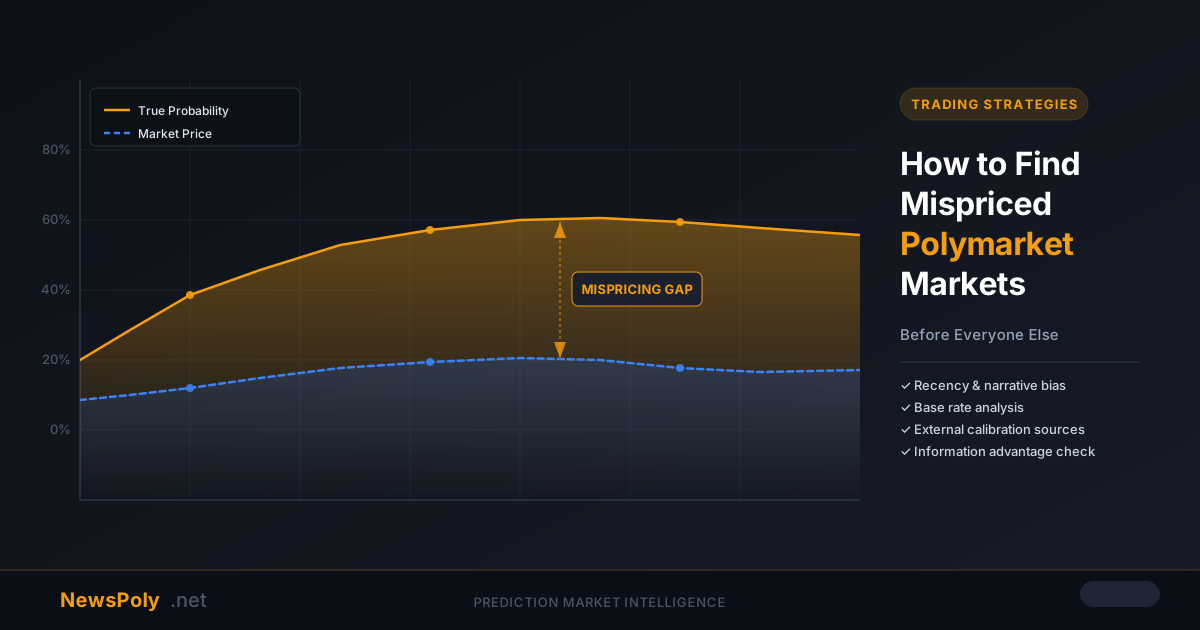
The most reliable edge on Polymarket comes from identifying events where the market's implied probability differs significantly from true odds. When the market prices "Will the Fed cut rates in December?" at 45% but your research (Fed communications, economic data, historical patterns) suggests 70%, that gap represents a high expected-value trade. For the EV formula and a practical framework for calculating your edge, see our Polymarket expected value guide.
How to find mispriced markets (see our guide on finding mispriced Polymarket markets):
- Compare Polymarket prices to forecasting aggregators (Metaculus, Manifold)
- Track expert consensus from specialized domains (FiveThirtyEight for elections, etc.)
- Look for markets with low liquidity — they're more likely to be mispriced
2. Late Liquidity Entry
Many prediction markets are thinly traded shortly after creation when uncertainty is highest. Waiting for more information to reduce uncertainty — then entering positions as prices stabilize — reduces risk while maintaining strong expected value. This is especially effective for markets with clear resolution criteria and approaching deadlines. Using limit orders rather than market orders when entering these positions helps you avoid slippage in thin markets.
3. Copy Top Traders (Automated)
The fastest way to profit on Polymarket is to leverage the expertise of traders who are already winning. Read our copy trading guide for a full overview, or jump straight in with a bot like PolyCopyTrade to automatically mirror the positions of top-performing traders without needing to do your own research.
This strategy works because:
- Top traders' on-chain history is fully transparent and verifiable
- You can diversify by copying multiple traders simultaneously
- Automation eliminates emotional decision-making and missed trades
4. Diversified Market Portfolio
Spreading positions across uncorrelated markets — politics, crypto, sports, and finance — reduces volatility and smooths out returns over time. A single-market trader is exposed to domain-specific shocks (election surprises, crypto crashes). A diversified trader captures opportunities across multiple categories while reducing drawdown risk. Pair this with solid Polymarket risk management to protect your bankroll through drawdown periods, and use our Polymarket portfolio management guide to track your positions and P&L across multiple markets.
Ideal portfolio breakdown:
- 30–40% Politics & Geopolitics
- 20–30% Finance & Economics
- 20% Crypto
- 10–20% Sports & Entertainment
5. Near-Resolution Arbitrage
As events approach resolution, market prices converge toward 0 or 100. Identifying markets where outcomes are near-certain but prices haven't fully converged is a low-risk, consistent strategy. For example, if a market asks "Will Candidate X win the election?" and vote counts already confirm a landslide, but the market still prices "Yes" at 85 instead of 99 — that's a near-riskless profit opportunity.
Combining Strategies
The best Polymarket traders don't rely on a single approach. They use automated copy trading as their baseline, supplement with probability mispricing in their areas of expertise, and take near-resolution arbitrage opportunities as they appear. This multi-layered approach maximizes consistency while capturing high-value opportunities.
Frequently Asked Questions
Which Polymarket strategy is best for beginners?
Copy trading is the best starting point for beginners — it requires no deep market knowledge and allows you to learn from top traders while generating returns. As you gain experience, add probability mispricing in areas where you have genuine expertise.
How much capital do I need to trade Polymarket?
You can start with as little as $50 in USDC. However, $500–$1,000 gives you better position sizing flexibility and allows meaningful diversification across multiple markets. Applying the Kelly Criterion can help you size positions optimally as your bankroll grows.