Position sizing is the most underappreciated variable in prediction market performance. Two traders with identical market selection ability can produce dramatically different returns purely based on how much of their bankroll they allocate to each trade. The Kelly Criterion is the mathematical answer to this question — not a guideline or a rule of thumb, but a provably optimal formula given accurate edge estimates.
This guide covers the complete Kelly framework for Polymarket: the formula, the assumptions it makes, why fractional Kelly is almost always the right choice in practice, and how to build the edge estimation process that makes Kelly useful rather than dangerous. For the broader risk management framework that Kelly fits within, see our Polymarket risk management guide. For the companion practical guide covering all four sizing methods — flat betting, percentage, full Kelly, and fractional Kelly — with worked examples across different price levels, see the Polymarket position sizing guide.
The Kelly Formula: What It Actually Says
The Kelly Criterion was developed by John L. Kelly Jr. at Bell Labs in 1956. The core formula for a binary outcome market is:
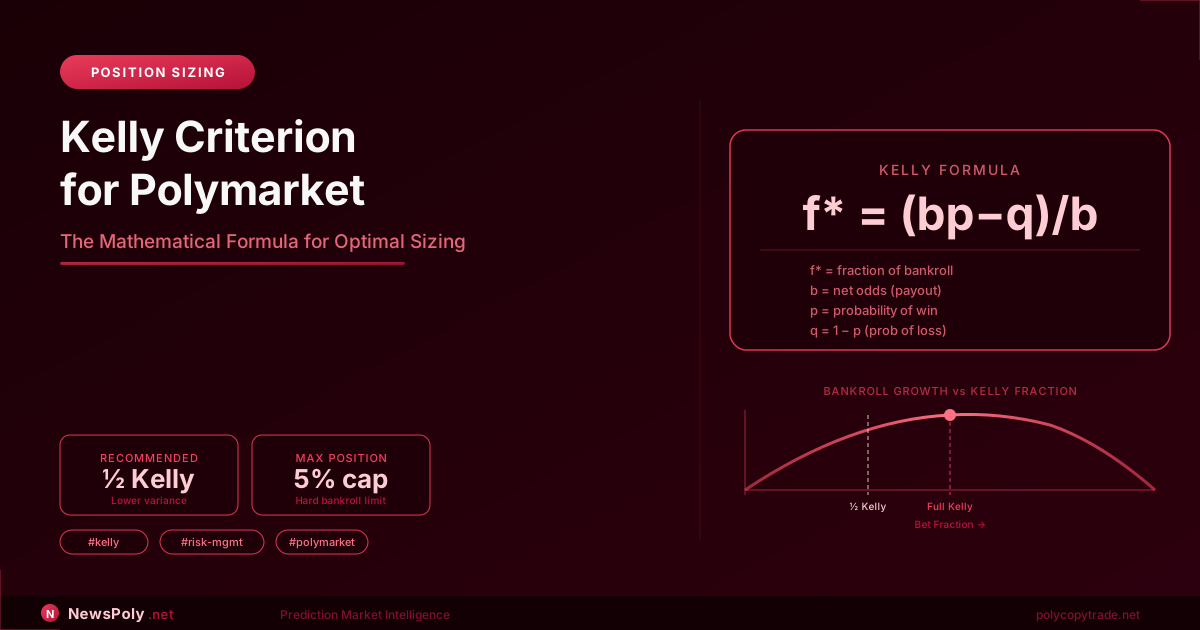
f* = (bp − q) / b
Where:
- f* = the fraction of bankroll to bet
- b = the net odds received (how much you win per unit risked)
- p = your estimated probability that the bet wins
- q = 1 − p (the probability the bet loses)
On Polymarket, converting this to practical terms is straightforward. If a YES token is trading at 40 cents ($0.40):
- If YES resolves, you receive $1.00 per token — net gain of $0.60 on $0.40 risked, so b = 0.60/0.40 = 1.5
- If NO resolves, you lose your $0.40 — so your risk is exactly your position cost
If you estimate the true probability of YES at 55% (p = 0.55, q = 0.45):
f* = (1.5 × 0.55 − 0.45) / 1.5 = (0.825 − 0.45) / 1.5 = 0.375 / 1.5 = 0.25
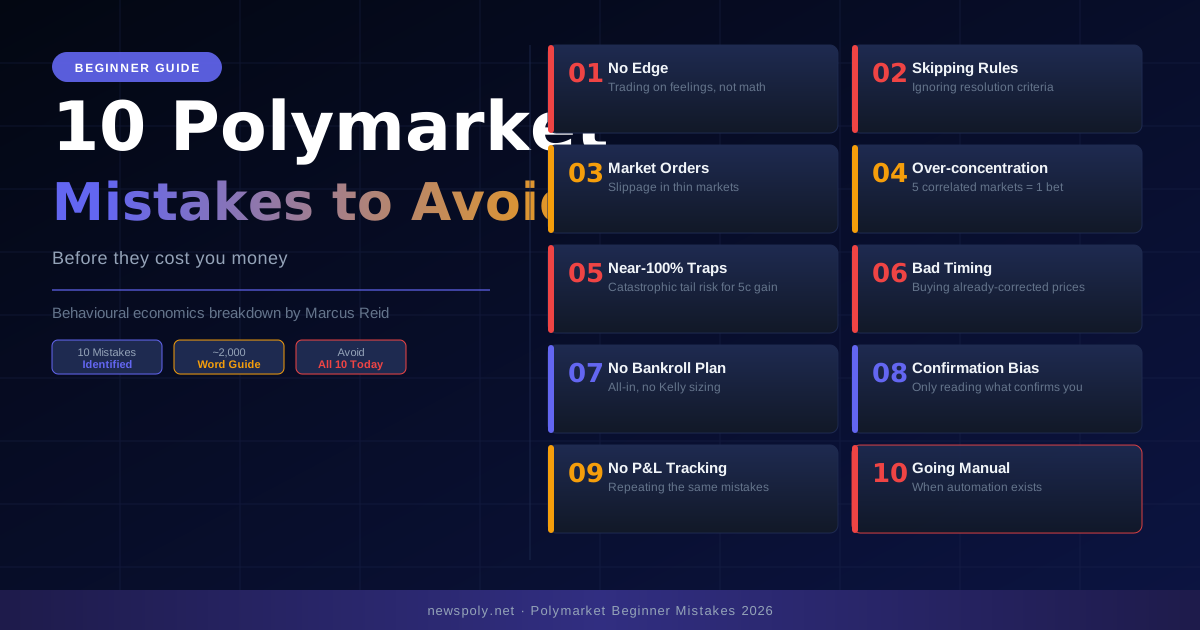
Kelly says: bet 25% of your bankroll. That number should feel uncomfortably large — and it should. We'll come back to this. Over-sizing positions is one of the most destructive beginner mistakes on Polymarket, and the Kelly formula helps explain exactly why.
Why Full Kelly Is Too Aggressive for Polymarket
The Kelly formula produces the mathematically optimal fraction for maximising the long-run geometric growth rate of your bankroll, given accurate inputs. The problem is the phrase "given accurate inputs."
In practice, your probability estimate (p) is never perfectly accurate. Every probability estimate carries uncertainty — your "55%" might really be anywhere from 48% to 62%. This uncertainty, known as estimation error, interacts catastrophically with full Kelly sizing:
- If your edge estimate is modestly wrong, Kelly over-bets significantly
- Over-betting with Kelly produces larger drawdowns and longer recovery times than under-betting
- The Kelly curve is asymmetric: overbetting above the optimal fraction hurts you far more than underbetting below it
This is the core argument for fractional Kelly. Half-Kelly (f* × 0.5) eliminates approximately 75% of the risk from estimation error while preserving approximately 75% of the long-run growth rate. Quarter-Kelly (f* × 0.25) is appropriate for traders who are less certain of their calibration or who operate in noisier, less liquid markets.
In the example above: full Kelly says 25%, half-Kelly says 12.5%, quarter-Kelly says 6.25%. In practice, the 5% per-trade hard cap we recommend in our risk management guide often supersedes Kelly regardless — if Kelly says 6% and your hard cap is 5%, the cap applies.
The Most Important Input: Estimating Your Edge Accurately
Kelly is only as good as the edge estimate you feed it. A 55% probability estimate that's actually 48% doesn't just reduce your edge — it produces a negative-Kelly situation where you're betting on a losing proposition while thinking you have edge. The formula will tell you to bet, and you'll lose money systematically. The structured approach to calculating and verifying your edge before applying Kelly is covered in detail in the Polymarket expected value guide.
This is why calibration — the practice of verifying that your stated probabilities match your actual accuracy — is the prerequisite for using Kelly. Before trusting any Kelly calculation, you need to know whether your probability estimates are reliable.
The Calibration Process
- For every trade, record your entry probability estimate (what you believe the true probability is)
- After the trade resolves, record the outcome
- After 50+ trades, calculate: of all the trades you estimated at "60% probability," what percentage actually resolved in your favour?
- Repeat for each probability bucket (50–55%, 55–65%, 65–75%, 75%+)
If your 60% estimates resolve correctly 60% of the time, you're well-calibrated. If they resolve correctly only 52% of the time, you're systematically overconfident and your Kelly inputs are inflating your apparent edge. Reduce your stated probabilities by a discount factor until your calibration improves.
The cognitive bias of overconfidence specifically distorts this input. Our guide to cognitive biases in prediction market trading covers this in detail and provides tools for systematic debiasing.
Kelly in Practice: Working Examples
Example 1: Political Market
A candidate in a parliamentary by-election is trading at 35% on Polymarket. Based on your analysis of the local polling, candidate quality, and historical base rates for this constituency type, you estimate the true probability at 48%.
- Token price: $0.35 | Net odds b = (1−0.35)/0.35 = 1.857
- Your p = 0.48, q = 0.52
- Full Kelly: f* = (1.857×0.48 − 0.52)/1.857 = (0.891−0.52)/1.857 = 0.371/1.857 ≈ 0.20 (20%)
- Half Kelly: 10% | Quarter Kelly: 5%
- Recommended position: 5% (applying hard cap) — aligns with the upper end of standard sizing
Example 2: Small Edge Near Market Price
A crypto price target market is at 52% YES. You estimate the true probability at 58% — a 6-point edge.
- Token price: $0.52 | Net odds b = 0.48/0.52 = 0.923
- Your p = 0.58, q = 0.42
- Full Kelly: f* = (0.923×0.58 − 0.42)/0.923 = (0.535−0.42)/0.923 = 0.115/0.923 ≈ 0.125 (12.5%)
- Half Kelly: 6.25% | Quarter Kelly: 3.1%
- Recommended position: 3% — appropriate for a modest edge in a liquid market
When Kelly Tells You Not to Bet
Kelly produces a negative or zero fraction when your edge is zero or negative. This is the formula's most useful feature: it provides a clear signal to stand aside.
f* ≤ 0 when: bp − q ≤ 0, i.e., when p ≤ q/(b+1) = 1/(b+1)
For a market at 60% (b = 0.667), you need p > 60% to have positive Kelly — meaning you need a probability estimate higher than the market price just to have a positive expected value position. This seems obvious, but the formula makes it explicit and prevents the very common mistake of betting on a market where you privately agree with the market price.
Many Polymarket trades are motivated by conviction rather than edge. "I'm pretty sure this will resolve Yes" is not a sufficient basis for a position — you need to be more confident than the market price already implies. Kelly quantifies exactly how much more confident you need to be before a position is mathematically justified. For frameworks on finding those situations, see our guide on finding mispriced markets.
Kelly vs. Fixed-Fraction Sizing
The main alternative to Kelly is fixed-fraction sizing: always betting a fixed percentage (say 2%) regardless of edge size. Fixed-fraction is simpler and eliminates the estimation error problem entirely. The trade-off:
- Fixed fraction — Under-bets high-edge situations, over-bets low-edge situations; consistent, predictable drawdown characteristics; easier to implement
- Kelly — Optimal when edge estimates are accurate; over-bets when estimates are inflated; produces higher theoretical returns but higher variance
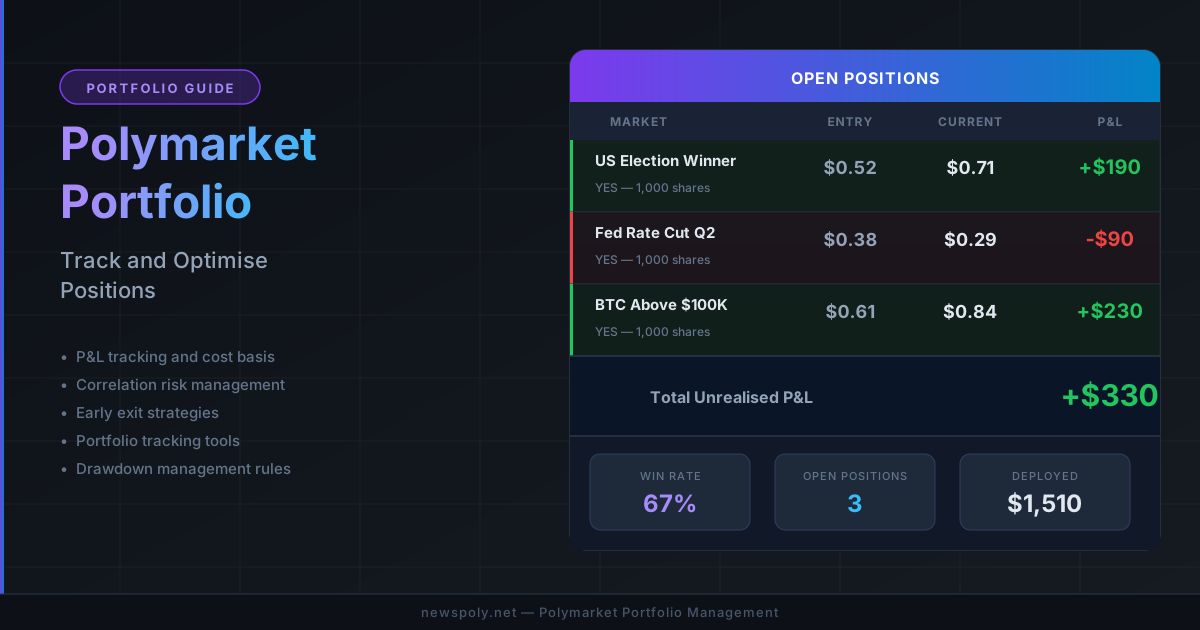
For most Polymarket traders who are still building their calibration history, a modified approach works well: use fixed-fraction sizing (1–3%) as the default, then apply Kelly as a ceiling check — if Kelly says less than your default fraction, reduce to Kelly's recommendation. This gives you the downside protection of Kelly's "don't over-bet" signal while keeping execution simple. Tracking your Kelly-sized positions and their outcomes over time is also a core part of portfolio management — your calibration history only improves if you record every position's intended edge and compare it to the actual result. For a broader look at how position sizing fits into a complete profitable strategy, see our guide on how to make money on Polymarket.
Traders who want position sizing enforced automatically — without running Kelly calculations on every trade — can use PolyCopyTrade to copy top-performing Polymarket traders with pre-configured position limits applied at the system level. The sizing discipline is built in, removing the calculation requirement entirely.
Frequently Asked Questions
Should I use Kelly Criterion for every trade on Polymarket?
Use it as a ceiling check on every trade, not as a precise sizing instruction. Before entering any position, calculate Kelly and half-Kelly. If your intended position size is larger than half-Kelly, scale back. If it's smaller, that's fine — underbetting is far less dangerous than overbetting. Over time, as your calibration history builds, you can lean more heavily on Kelly sizing for markets where your track record demonstrates accurate probability estimation.
How does Kelly change for markets priced above 50%?
The formula works identically — you're just buying more expensive tokens with lower net odds. A market at 75% YES has b = 0.25/0.75 = 0.333. For Kelly to recommend any positive position, you need to estimate the true probability above 75%. At these high prices, the risk-reward ratio is unfavourable unless your edge is substantial and very well-supported by evidence. The near-certainty trap — buying high-confidence markets at 85–95% — produces particularly bad Kelly outcomes because the net odds are extremely low.
What's the minimum bankroll to meaningfully apply Kelly on Polymarket?
Kelly works at any bankroll size, but it requires that your minimum position size covers the Kelly-recommended fraction. With a $500 bankroll, a 2% Kelly position is $10 — which is below Polymarket's minimum trade size for most markets. A bankroll of $1,000–$2,000 makes the math workable for most market types. Below $500, fixed-fraction sizing at the maximum practical position size is more realistic than attempting precise Kelly implementation. Remember that all profits from Polymarket trading are potentially taxable — our Polymarket tax guide covers how on-chain trading income is treated in the US and UK, and why keeping records of each position is important for accurate reporting.