Ask most Polymarket traders what separates winners from losers and they’ll point to market selection — finding mispriced probabilities, doing better research, or trading faster than the crowd. They’re not wrong. But there’s a second variable that quietly determines whether a skilled trader actually grows their bankroll or eventually blows it up: position sizing. Bet too little and your edge never compounds into real returns. Bet too much and a single bad run wipes out months of disciplined work. This guide walks through the frameworks serious Polymarket traders use to size every position — from flat betting basics all the way to correlation-adjusted allocation across a full portfolio.
Why Position Sizing Matters More Than Market Selection
It sounds counterintuitive, but mathematical simulations prove it consistently: a trader with a modest edge and excellent position sizing will outperform a trader with a large edge and poor position sizing over any long enough sample. The reason is the asymmetry of gains and losses. A 50% drawdown requires a 100% gain just to get back to even. Reckless sizing creates drawdowns that no level of skill can fully repair.
On Polymarket specifically, several features make position sizing especially consequential:
- Binary payoffs. Every market resolves to $1 or $0. There’s no partial win. One oversize position on a market that resolves against you can set back your entire account.
- Liquidity constraints. Large positions in thin markets move the price against you at entry and exit. Sizing must account for slippage as well as probability.
- Correlated events. Election markets, economic data releases, and geopolitical events often move together. Treating each market as independent when they’re not leads to hidden concentration risk.
- Long time horizons. Some Polymarket positions take weeks or months to resolve. Capital tied up in an oversize position has opportunity cost against new markets that open.
Good position sizing isn’t about being timid. It’s about staying in the game long enough for your edge to express itself across hundreds of markets rather than gambling it all on a handful of big bets. This principle underlies everything in our Polymarket risk management guide, and it starts with choosing the right sizing model.
Flat Betting vs. Proportional Sizing
The two simplest approaches sit at opposite ends of a spectrum. Understanding both gives you a foundation before moving to more sophisticated frameworks.
Flat betting means wagering the same dollar amount on every market regardless of your confidence level or the odds on offer. If you decide each bet is $50, then a market you think is 90% likely to resolve YES gets the same $50 as a market you think is 55% likely. Flat betting is easy to execute and easy to track, and it prevents you from over-committing on any single market. The downside is obvious: it leaves edge on the table. You’re putting the same capital behind a near-certain bet as behind a speculative one.
Proportional sizing scales your stake to your edge or conviction. Higher edge → larger bet. This is logically appealing but introduces a new problem: how do you define “edge” precisely enough to size off it? Without a rigorous framework, proportional sizing becomes a license for overconfidence. Traders convince themselves their conviction is high on every trade, and stakes creep upward across the board.
The resolution to this tension is a principled mathematical framework. The most important one in professional gambling and trading is the Kelly Criterion.
Kelly Criterion for Polymarket Position Sizing
The Kelly Criterion is a formula that calculates the theoretically optimal fraction of your bankroll to stake on any bet with a positive expected value. Developed by John Kelly at Bell Labs in 1956, it has since become the foundation of bankroll management in poker, sports betting, and quantitative trading.
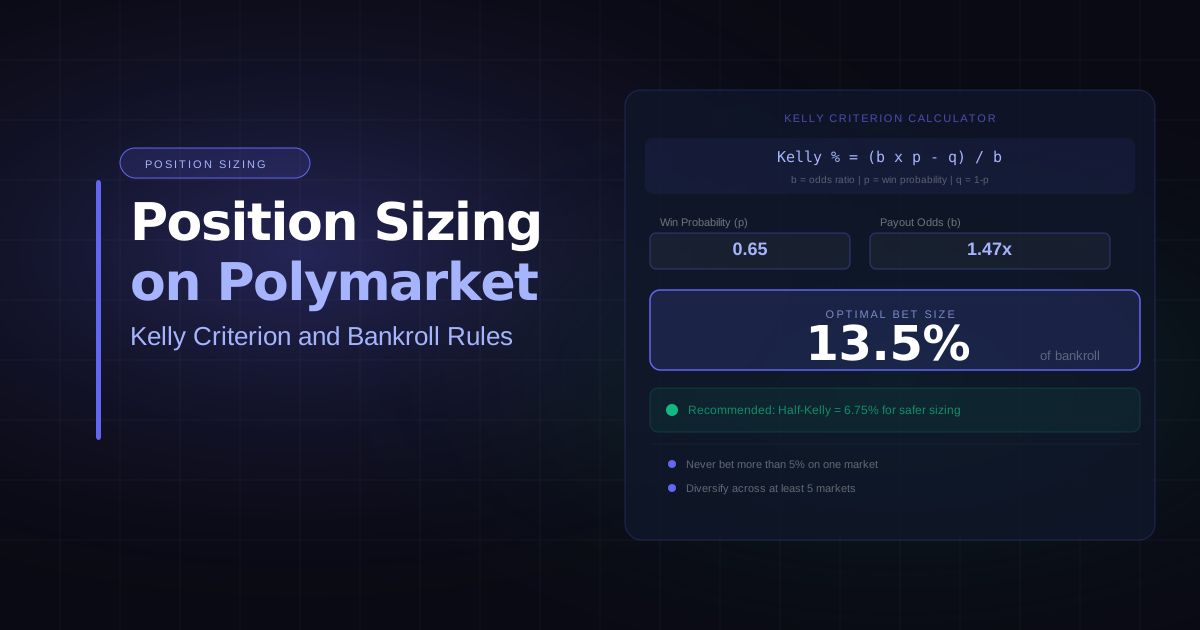
For a binary market — which is what every Polymarket contract is — the Kelly formula simplifies to:
f* = (p × b − q) / b
Where:
- f* = fraction of bankroll to wager
- p = your estimated probability that the outcome occurs
- q = 1 − p (probability it does not occur)
- b = net odds received (profit per $1 wagered if correct)
On Polymarket, if a contract is trading at 40 cents and you believe the true probability is 55%, then:
- p = 0.55, q = 0.45
- b = (1 − 0.40) / 0.40 = 1.5 (you profit $1.50 for every $1 at risk if correct, net of your $1 stake returning)
- f* = (0.55 × 1.5 − 0.45) / 1.5 = (0.825 − 0.45) / 1.5 = 0.375 / 1.5 = 25%
Full Kelly says bet 25% of your bankroll on this single market. That’s almost certainly too much for any real trading situation — and this is exactly why practitioners rarely use full Kelly in practice. Understanding how expected value works is a prerequisite to applying Kelly meaningfully, since the formula is only as good as the probability estimates you feed it.
Fractional Kelly: Quarter-Kelly and Half-Kelly in Practice
The Kelly Criterion maximizes the long-run geometric growth rate of your bankroll. But it has a serious flaw for real-world use: it assumes your probability estimates are perfectly accurate. In practice, they never are. Even a small overestimation of your edge causes Kelly to recommend stakes that are dangerously large.
The solution almost every serious trader adopts is fractional Kelly — deliberately betting a fixed fraction of the full Kelly stake. The two most common variants are:
Half-Kelly (0.5f*): Bet half the full Kelly amount on every position. Half-Kelly reduces the variance of your bankroll growth dramatically — roughly by 75% compared to full Kelly — while sacrificing only about 25% of the expected growth rate. For most active Polymarket traders managing a portfolio of positions simultaneously, half-Kelly hits the right balance between aggression and durability.
Quarter-Kelly (0.25f*): Even more conservative. Quarter-Kelly is appropriate when you’re new to a market type, when your historical calibration data is thin, or when you’re operating in a high-uncertainty environment where model error is likely to be larger than usual. Political black swans and breaking-news markets are good candidates for quarter-Kelly.
Applying fractional Kelly to the earlier example (full Kelly = 25% of bankroll):
| Sizing Method | Fraction of Bankroll | Stake on $1,000 Bankroll | Best Used When |
|---|---|---|---|
| Full Kelly | 25% | $250 | Perfect probability estimates (theoretical only) |
| Half-Kelly | 12.5% | $125 | Established edge in familiar market category |
| Quarter-Kelly | 6.25% | $62.50 | New market type, limited calibration data |
| Flat bet (baseline) | 2–5% | $20–$50 | No edge estimate, or maximum conservatism |
The key insight is that the cost of using fractional Kelly is small in terms of expected growth, but the protection against estimation error is enormous. A trader who thinks their edge is 15% when it’s actually only 5% will be severely punished by full Kelly and only mildly impacted by quarter-Kelly. Understanding your own expected value calculation accuracy is prerequisite to choosing where on this spectrum to operate.
Setting Maximum Position Caps
Even with a disciplined Kelly-based framework, there are situations where the formula produces a number that is simply too large to act on prudently. Strong mispricing on a highly liquid market might technically justify a 20% or 30% stake. But concentrating that much of your bankroll on any single binary event — no matter how confident you are — creates unacceptable tail risk.
Most serious Polymarket traders implement hard maximum caps as a second layer of protection on top of their Kelly calculation. Common approaches:
- Single-market cap of 5–10%: No individual position ever exceeds this percentage of current bankroll, regardless of what Kelly recommends. Five percent means you can lose twenty markets in a row and still have meaningful capital remaining.
- Category cap of 20–30%: Total exposure to any single category (e.g., US elections, crypto prices, economic indicators) is capped. This prevents thematic over-concentration.
- Liquidity-adjusted cap: Your position size should not exceed a certain fraction of the market’s available liquidity. Entering a position that you couldn’t exit without moving the market significantly is a risk that Kelly doesn’t account for.
The discipline to follow these caps even when a market looks obviously mispriced is what separates professionals from recreational bettors. Everyone has a story about the one obvious trade they sized up massively — and how it went wrong. Caps exist precisely for those moments when conviction clouds judgment.
Pairing caps with sound bankroll building practices creates a compounding engine that survives the inevitable losing streaks every active trader faces.
Correlation-Adjusted Sizing Across Multiple Markets
The frameworks above treat each market as if it exists in isolation. In reality, your Polymarket portfolio is a collection of positions that may be highly correlated with one another. Holding separate positions on “Democrat wins Senate” and “Democrat wins Presidency” is not twice the alpha — it’s concentrated exposure to a single underlying variable: political outcomes.
When positions are correlated, you need to adjust sizing downward on each individual position to maintain the same total risk level you’d have if they were independent. The practical heuristic most traders use:
- Identify correlation clusters. Group your open positions by the underlying driver: a specific election cycle, a macroeconomic data series, a single company’s performance, a geopolitical event. Each cluster should be thought of as a single “bet” from a risk perspective.
- Apply the cluster cap first. Decide the maximum total exposure to each cluster (e.g., 15% of bankroll per cluster). Then distribute that allocation across the individual markets within it.
- Scale individual positions accordingly. If you have three correlated markets in a cluster with a 15% total cap, each individual position should be sized to roughly 5–7%, not the 10% you might allocate to a fully independent market.
This approach connects directly to portfolio-level thinking. The goal isn’t to maximize the edge on each individual market — it’s to maximize risk-adjusted returns across the full book. Our Polymarket portfolio management guide covers this in more detail, including how to use correlation matrices to quantify relationships between open positions.
A Practical Position Sizing Framework
Synthesizing everything above into a decision process you can actually use before placing a trade:
Step 1: Estimate your edge. Calculate your probability estimate for the market outcome. Compare it to the market-implied probability (the current price). If your estimate is higher than the market price for a YES contract, you have a positive edge on the YES side. Quantify it explicitly before proceeding. If you can’t articulate your edge clearly, that’s a signal to pass or size minimally.
Step 2: Calculate full Kelly. Plug your estimates into the Kelly formula: f* = (p × b − q) / b. Treat this as an upper bound, not a target.
Step 3: Apply your fractional Kelly multiplier. Multiply full Kelly by your chosen fraction. Use half-Kelly as a default; move to quarter-Kelly for markets outside your primary expertise or during high-uncertainty periods.
Step 4: Apply hard caps. Check the result against your single-market cap (e.g., 5–10% of bankroll). Take whichever is smaller: your fractional Kelly result or your hard cap.
Step 5: Check correlation. Review your existing open positions. Is this new market correlated with anything you already hold? If yes, reduce the stake proportionally to maintain your cluster cap. This step is most important during active news cycles when many markets move together.
Step 6: Check liquidity. Confirm you can enter (and exit) your intended position without material slippage. If the market is thin, reduce size until slippage-adjusted returns remain positive.
Going through these six steps sounds slow, but with practice it becomes a quick mental checklist. The first few times you do it, you’ll likely find it changes your intended stake on at least half your trades — usually downward. That’s the point. Discipline at the sizing stage is what separates profitable traders from those who burn through bankrolls despite having genuine analytical skill.
Common Position Sizing Mistakes to Avoid
Even traders who understand these frameworks make predictable errors in practice. The most damaging:
Sizing up after a winning streak. A run of wins makes your bankroll larger and your confidence higher simultaneously — a dangerous combination. Kelly automatically adjusts stake sizes as your bankroll grows, which is appropriate. But increasing your fractional Kelly multiplier because you’re “running hot” is not. Your edge in any given market is unrelated to your recent results.
Chasing losses with larger bets. The mirror image of the above. After a drawdown, the temptation is to bet bigger to recover faster. Kelly-based sizing actually calls for smaller absolute bets when your bankroll shrinks. Doubling down after losses is the fastest route to ruin.
Ignoring transaction costs. Polymarket charges fees on trades. A small edge that looks positive before fees may be negative or break-even after them. Always calculate your net-of-fees expected value before applying your sizing formula. Markets with thin edges might not be worth trading at any stake size.
Treating all confidence as equal. “I feel strongly about this” is not a sizing input. The Kelly formula requires a specific probability estimate with enough historical calibration to be meaningful. Vague conviction is not a substitute for a quantified edge, and sizing as if it is will lead to systematic over-betting.
The right relationship to position sizing is one of ongoing calibration. Track your predictions, measure how well your probability estimates correspond to actual outcomes, and let that data drive which fractional Kelly multiplier you apply to different market categories. Over time, this feedback loop is what turns a decent Polymarket trader into a genuinely profitable one. Pair it with the principles in our risk management guide and you have a complete framework for long-term account growth.