Most people who lose money on Polymarket don't lose because they pick bad outcomes. They lose because they have no system. They oversize positions when they feel confident, chase losses after a bad day, and pile into correlated markets without realizing their entire bankroll is riding on one macro theme. The result is a drawdown they never recover from.
This guide covers the exact risk management framework that separates profitable prediction market traders from the majority who blow up their accounts. These aren't abstract concepts — they're concrete rules you can implement today.
Why Most Polymarket Traders Lose Money
The failure mode is almost always the same: overexposure with no system. A trader sees a Polymarket market at 85% "Yes" and thinks, "this is basically free money," so they put in 30% of their bankroll. The market resolves against them — unexpected events happen far more often than 15% implies in practice — and they've just taken a crippling hit.
The second failure mode is emotional escalation. After a loss, traders increase position size to "make it back." This is revenge trading, and it's the fastest way to go from a manageable drawdown to a wipeout. Markets don't care about your feelings or your running P&L.
The third failure mode is correlation blindness. A trader might think they have 10 separate positions, but if five of them are political markets that all move together, they're essentially running a highly concentrated bet.
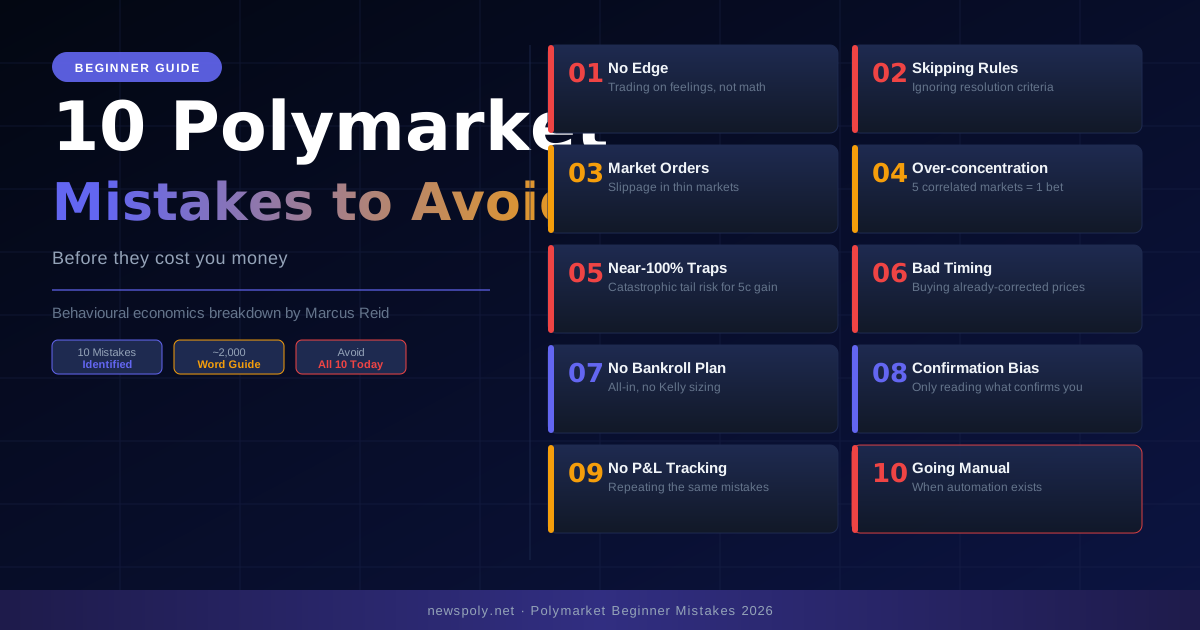
All of these problems have the same solution: rules you set before you enter any trade. For an expanded look at these and other common pitfalls, see our guide on Polymarket beginner mistakes.
The 1–5% Rule: Your Foundation for Position Sizing
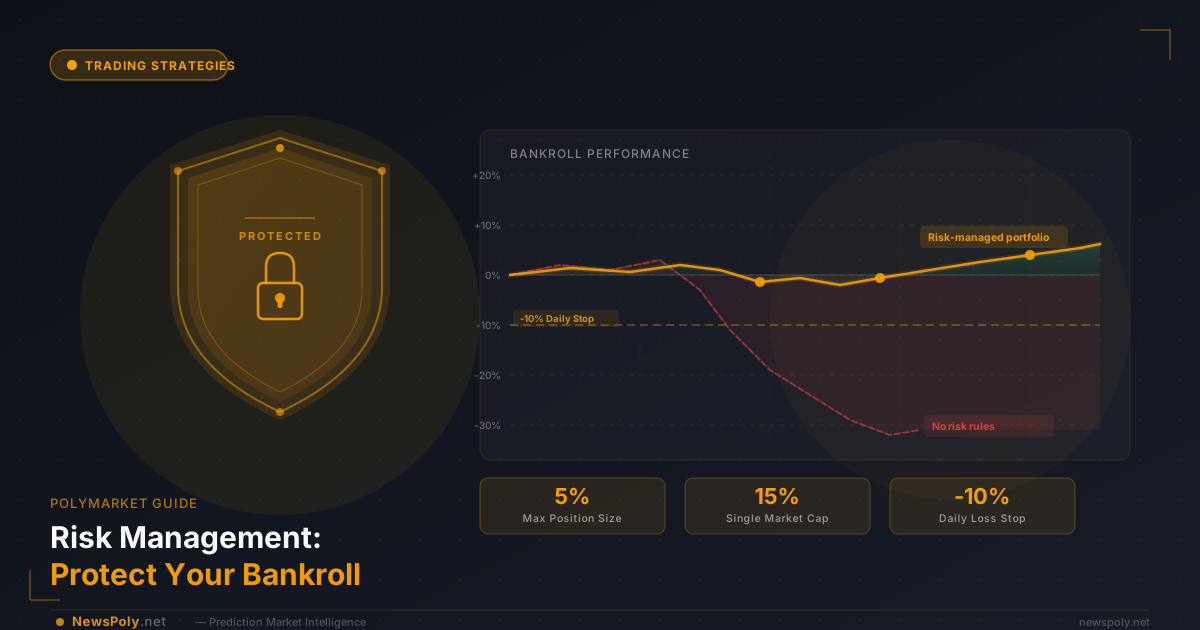
The core of any bankroll protection system is a strict limit on how much of your capital goes into any single market — a concept known as position sizing. The standard framework is simple:
- High-conviction, low-liquidity markets: 1–2% of bankroll
- Standard markets with good liquidity: 2–3% of bankroll
- Highest-conviction plays with clear edge: up to 5% of bankroll
Why so conservative? Because even a 90% probability market will resolve against you roughly 1 in 10 times. If you're sizing at 5% maximum and take 10 losses in a row — statistically unlikely but possible — you've lost 40% of your bankroll compounded. That's survivable. If you size at 20% per trade, a single bad week can be terminal. The binary structure of prediction markets also creates implicit leverage at low price points, which makes conservative sizing even more important — our Polymarket leverage guide explains exactly how this works and why it affects your position sizing decisions.
The discipline is in never exceeding these limits regardless of how confident you feel. Confidence is the enemy of risk management. The more certain you feel about a trade, the more alert you should be to the possibility that you're falling into a cognitive trap.
Maximum Single-Market Exposure: The 15% Hard Cap
Beyond per-trade sizing, you need a hard ceiling on total exposure to any single market or market cluster. Never let a single event account for more than 15% of your total bankroll — across all your positions in that event.
This matters because Polymarket often has multiple related markets for the same underlying event. An election might have markets for the winner, the margin, specific state outcomes, and third-party vote share. If you're in all of them, you need to treat your aggregate exposure as one position, not four.
Setting a 15% ceiling means no single surprise can take more than 15 cents from every dollar you have deployed. You can take that hit and come back. A 40% or 50% loss on a single event is psychologically devastating and mathematically very difficult to recover from.
Daily Loss Cap: Walk Away at -10%
One of the most effective rules any trader can implement is a daily loss cap. The rule is simple: if your portfolio is down 10% from your starting balance for the day, you stop trading. Full stop. No more positions until the next session.
Why 10%? Because most traders who are down 10% in a single day are either in a bad market environment, or they're already showing signs of emotional deterioration in their decision-making. Adding more positions in that state compounds the problem. The cap forces you to step away before small losses become catastrophic ones.
This rule feels unnecessary on days when you're confident you can recover. That feeling is exactly why the rule exists. The cap must be non-negotiable — decide on it in advance and treat it as a hard constraint, not a suggestion.
Portfolio Correlation Risk
Diversification only protects you if your positions are actually independent. This is a common mistake on Polymarket: traders spread capital across ten markets but all ten markets move in the same direction when something unexpected happens.
Correlated risk examples to watch for:
- Multiple political markets in the same country or election cycle
- Several economic indicator markets that all depend on Fed policy
- Multiple Polymarket crypto markets during periods of high macro sensitivity
- Geopolitical markets that all hinge on the same conflict or negotiation
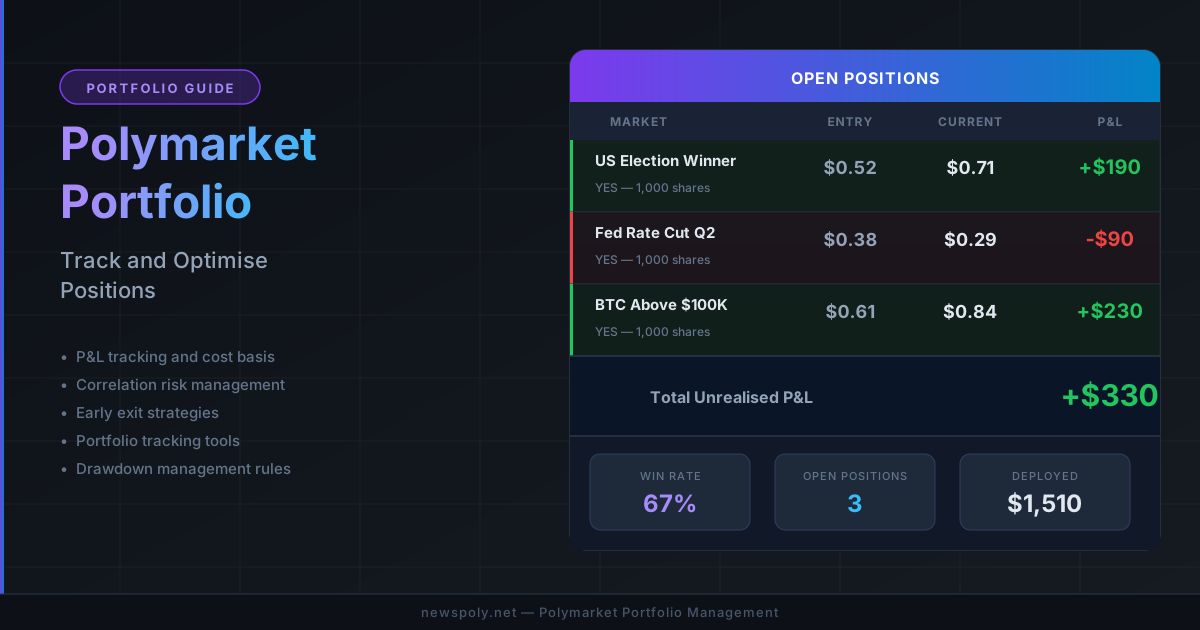
Before adding a new position, ask yourself: if event X happens and moves this market against me, which of my other positions would also get hurt? If the answer is "several of them," you're carrying more correlated risk than your position count suggests. Mentally group correlated positions together and apply the 15% cap to the cluster, not to each individual market. Our Polymarket portfolio management guide covers practical methods for tracking your positions and P&L across market categories. For a deeper look at how spreads and liquidity affect your entry price, see our guide on understanding Polymarket odds and spreads. Using limit orders rather than market orders is one of the most effective ways to reduce slippage when entering correlated or thin markets.
Kelly Criterion Simplified for Prediction Markets
The Kelly Criterion is a mathematical formula for optimal bet sizing. The full version can get complex, but a simplified version for prediction markets gives you a useful starting point.
The basic formula: Kelly % = Edge / Odds
Where your edge is the difference between your estimated probability and the market price, and odds is the potential payout. For example, if a market is at 60% "Yes" but you estimate the true probability at 70%, your edge is 10 percentage points. Kelly suggests: 10% / (1/0.60) ≈ 6% of bankroll. For a full walkthrough of the EV formula and calibration methodology, see our Polymarket expected value guide.
In practice, most experienced traders use half-Kelly or quarter-Kelly to account for the fact that your probability estimates are never perfect. Half-Kelly dramatically reduces variance while preserving most of the expected growth. If the formula suggests 6%, put in 3%.
Kelly is useful as a ceiling check: if the formula says 2% and you're considering 10%, you're overexposed. Use it as a sanity check, not a precise instruction.
The Near-Certain Market Trap
Markets priced at 90%+ present a specific danger that new traders chronically underestimate. The math looks appealing: buy "Yes" at 92 cents, collect 8 cents on resolution. But consider the risk-reward: you're risking 92 cents to make 8 cents. That's an 11.5:1 ratio of risk to reward.
A single unexpected resolution wipes out 11 winning trades. And unexpected resolutions happen. Regulatory rulings get reversed. Events get postponed. Definitions in market resolution criteria get interpreted differently than traders expected.
If you do trade near-certain markets, size them at 1% or less. The math simply doesn't support large positions at those odds, no matter how obvious the outcome seems.
Keeping a Trading Log
Bankroll tracking requires a trading log. At minimum, record for each position: the market, your entry price, your estimated probability at entry, your position size, the date, and the outcome. A complete trading log also simplifies Polymarket tax reporting, since on-chain transactions are taxable events that require accurate record-keeping. Over time, this data tells you something invaluable — whether you're actually calibrated.
If you mark a market as "70% likely" and that market resolves "Yes" roughly 70% of the time across your history, you're well-calibrated. If your 70% picks only win 50% of the time, you have a systematic overconfidence problem and need to revisit how you form estimates.
Most traders never do this analysis. It takes 15 minutes to set up a spreadsheet and two minutes per trade to maintain. The edge it gives you over the field is significant.
Emotional Discipline: Why Revenge Trading Destroys Accounts
No section on risk management is complete without addressing the psychological dimension. Revenge trading — increasing position sizes after losses to recover quickly — is responsible for more blown accounts than any single market mistake.
The pattern is predictable: a loss triggers frustration, frustration triggers the urge to act decisively, acting decisively feels like regaining control, and larger positions feel decisive. But the market has no memory of your loss. You're simply taking on more risk at a moment when your judgment is most impaired.
The rules above — position caps, daily loss limits, portfolio correlation checks — exist precisely to interrupt this pattern mechanically. When the rules are pre-committed, there's no decision to make in the heat of the moment. The cap has already been set. You follow it. For traders who want these guardrails enforced automatically, the PolyCopyTrade platform builds position limits and loss caps into every copied trade at the system level — removing the willpower requirement entirely. You can learn how to configure these controls in our guide to automated copy trading setup. These principles also apply across a range of top Polymarket trading strategies.
Frequently Asked Questions
What is a good starting bankroll for Polymarket?
There's no minimum requirement, but risk management rules work better with at least $500–$1,000. Below that, the 1–5% position sizing rule produces very small absolute positions, which can make it harder to build meaningful returns. More importantly, start with an amount you can afford to lose entirely while you're learning — treat the first few months as tuition, not investment. For a step-by-step framework on growing a small account through distinct stages, see the Polymarket bankroll building guide. For a broader look at profitability, see our guide on how to make money on Polymarket.
Should I use Kelly Criterion for every trade on Polymarket?
Kelly is best used as a ceiling check rather than a precise sizing tool. Use it to confirm you're not dramatically overexposed, but don't rely on it for exact position sizes. Your probability estimates are never as accurate as the formula assumes. Running half-Kelly or quarter-Kelly adds an important margin of safety, and combining it with the 1–5% rule ensures you're protected even when your edge estimates are off.
How do I recover from a large drawdown on Polymarket?
Slowly and deliberately. After a significant drawdown, the instinct is to trade aggressively to recover quickly — resist this. Reduce your position sizes to the lower end of the 1–2% range until you rebuild confidence and your trading log shows you're making good decisions again. Focus on high-quality, well-researched plays rather than volume. Recovery takes time, and trying to shortcut it almost always deepens the hole.