Walk into a traditional sportsbook and you'll see odds like +150 or -200. Walk into Polymarket and you'll see something completely different: a price between 0 and 1, displayed as cents. That number isn't arbitrary — it is the probability. Once you understand that, everything else clicks into place. If you're new to the platform entirely, start with our Polymarket beginner guide first.
Polymarket Prices Are Probabilities, Not Traditional Odds
This is the single most important concept for new users. On Polymarket, every market has two sides: YES shares and NO shares. The price of a YES share represents the market's collective estimate of the probability that the event will happen. For the full picture of how the CLOB, USDC collateral, and UMA oracle fit together, see our guide on how Polymarket works. For quick definitions of terms like "open interest," "resolution criteria," or "CLOB," the Polymarket glossary is a useful reference.
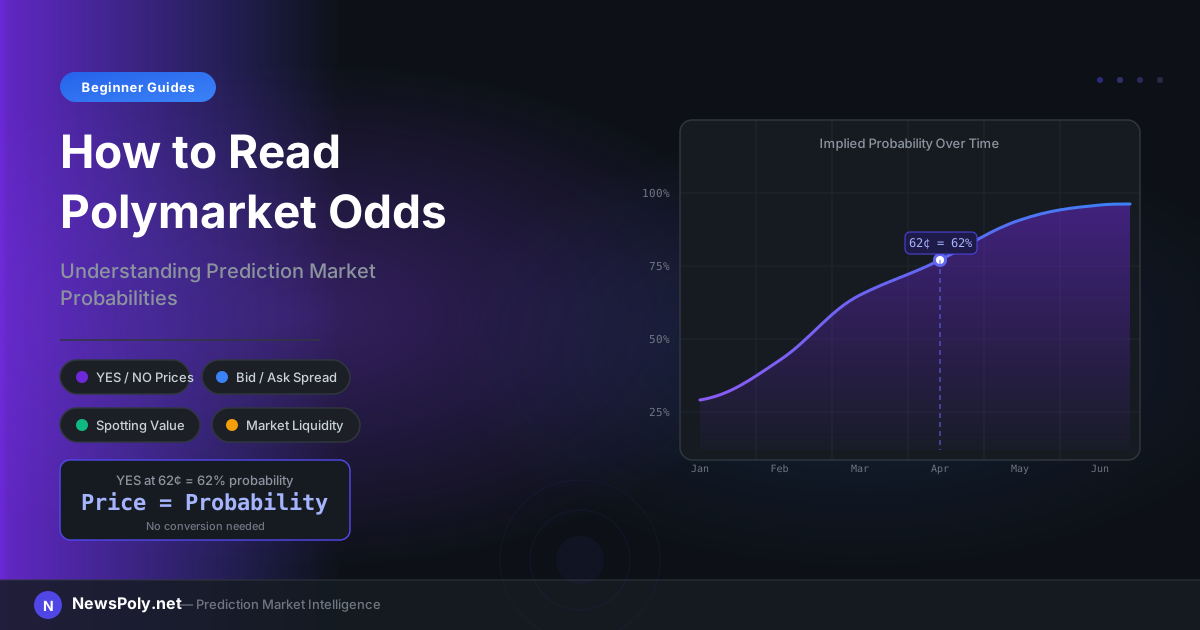
If YES is trading at 62¢, that means the market believes there is a 62% chance the event resolves YES. Conversely, NO shares will be trading at approximately 38¢ — because the two sides must sum to $1 (100%). When the market resolves, winning shares pay out exactly $1 each and losing shares pay out $0.
Compare this to traditional sports betting odds:
- American odds: -150 means you must bet $150 to win $100. To convert: implied probability = 150 / (150 + 100) = 60%.
- Decimal odds: 1.67 means you get $1.67 back per $1 wagered. Implied probability = 1 / 1.67 = 60%.
- Polymarket: 0.60 (60¢) simply means 60%. No conversion needed.
Polymarket's format eliminates mental gymnastics. The price is already the probability.
Converting Prices to Implied Probability
The math is about as simple as it gets (for a deeper look at how implied probability works across different odds formats, see Wikipedia):
Implied Probability = Price × 100
A YES price of 0.74 → 74% implied probability
A YES price of 0.08 → 8% implied probability
Going the other direction is equally simple. If you believe an event has a 55% chance of happening, you'd expect fair value for YES shares to be around 55¢. If the market is pricing them at 48¢, you might see that as a buying opportunity — the market is underpricing the event relative to your estimate. This is the foundation of finding mispriced markets and is one of the most reliable edges available on the platform.
One nuance: markets don't always sum to exactly $1.00. There's typically a small spread between the YES and NO prices, and during low-liquidity periods the gap can widen. Always check both sides before assuming the market price equals clean probability math.
How to Spot Value: When Your Estimate Differs from the Market
Value trading on Polymarket works on the same principle as any form of speculation: you're looking for cases where your estimate of an event's probability differs meaningfully from the market consensus. The formal framework for quantifying this is expected value (EV) calculation — a method that helps you determine whether a trade is worth taking based on the size of your edge.
Suppose a market asks: "Will Candidate X win the mayoral election?" The market is pricing YES at 35¢. You've done local research, read recent polling, and believe the true probability is closer to 50%. That 15-cent gap represents potential value.
The key discipline is calibration — how accurate are your probability estimates in general? Traders who win consistently on Polymarket tend to:
- Have a specific informational or analytical edge in the topic area
- Track their historical accuracy to understand where they're well-calibrated vs. overconfident
- Avoid markets where they have no real information advantage
- Size positions proportionally to the strength of their edge (Kelly Criterion is popular — see our Polymarket Kelly Criterion guide for the full methodology, and our risk management guide for practical sizing rules)
The market price isn't always right, but it aggregates the information of many participants. Beating it consistently requires genuine insight, not just gut feel.
The Bid/Ask Spread and What It Means for Profitability
Like any financial market, Polymarket has a bid/ask spread: the highest price a buyer is willing to pay (bid) and the lowest price a seller will accept (ask). If the YES bid is 61¢ and the YES ask is 63¢, the midpoint is 62¢ — but you'll pay 63¢ to buy immediately and receive only 61¢ to sell immediately.
For short-term traders, this spread directly eats into profitability. If you buy YES at 63¢ and the market only moves to 65¢, you've made just 2¢ per share — but paid 2¢ of spread to enter. Breakeven becomes harder on small moves.
Practical implications:
- Use limit orders when you're not in a hurry. Place your order at the midpoint or better and wait for the market to come to you.
- Wider spreads signal lower liquidity. Thin markets are harder to enter and exit cleanly.
- High-volume markets (major elections, Fed decisions) typically have tighter spreads — better for traders who need to move in and out quickly.
Reading Volume and Liquidity Indicators
Every Polymarket market page shows trading volume and open interest. These numbers matter:
- Volume tells you how many dollars have changed hands. High volume generally means more efficient pricing — it's harder to find obvious mispricings.
- Open interest tells you how many shares are currently outstanding. High open interest relative to volume can indicate traders are holding positions rather than actively trading.
- Liquidity depth (visible in the order book) shows you how much you can buy or sell before moving the price. If there's only $500 of liquidity in a market, a $2,000 trade will push prices significantly.
For beginners, sticking to high-liquidity markets is wise. The top 10–20 markets by volume on Polymarket typically account for the majority of all trading activity on the platform.
How Resolution Criteria Affect Odds Interpretation
A market at 82¢ looks simple — until you read the resolution criteria and realize the outcome depends on an obscure data source you weren't aware of. Resolution criteria are the fine print that determines what counts as a YES outcome.
Always read the full resolution rules before trading. Watch for:
- Ambiguous language: "Will X happen by December 31st?" — which timezone? End of day or midnight?
- Data source dependencies: Some markets resolve based on a specific third-party source. If that source is delayed or changes methodology, resolution can be disputed.
- Edge cases: Markets involving elections often have explicit rules about recounts, legal challenges, and certification timelines.
When resolution criteria are unclear, the market price should reflect that uncertainty — which means you may be pricing in ambiguity risk, not just event probability.
Comparing to Other Forecasting Sources
Polymarket doesn't exist in isolation. Smart traders cross-reference it with other forecasting platforms and data sources:
- Metaculus: Community-based forecasting platform with detailed reasoning on each question. Often covers longer-horizon questions not available on Polymarket.
- Manifold Markets: Play-money prediction market, but valuable for tracking community sentiment on questions too niche for Polymarket.
- FiveThirtyEight / Nate Silver: Statistical modeling for elections and sports. Useful to compare model-based probabilities with market-based prices.
- Kalshi: CFTC-regulated prediction market. Direct competitor to Polymarket — comparing prices between the two can surface arbitrage-like opportunities.
When Polymarket diverges significantly from other forecasters, it's worth investigating why. Sometimes the market is incorporating new information; sometimes it's temporarily mispriced. If you'd rather skip the cross-referencing entirely, a Polymarket copy trading bot like PolyCopyTrade handles the odds-reading and market selection on your behalf, mirroring traders who already have this analytical edge.
A Worked Example: A Political Market
Let's walk through a real-world style example using a political market — for a broader overview of how these work, see our Polymarket politics markets guide. Imagine a market: "Will Senator Y win re-election in November?"
- Current YES price: 58¢ (58% implied probability)
- Current NO price: 44¢ (44% implied probability)
- Notice the prices sum to $1.02 — there's a 2¢ spread in the market
- 24-hour volume: $45,000 — a reasonably liquid market
You look up three recent polls. Two show the senator at 52%, one shows 49%. A major forecaster gives a 61% win probability. You conclude the market's 58% estimate is roughly fair, with slight downside from the polls — you decide to pass.
Two weeks later, a scandal breaks. YES drops to 41¢. You reassess: the scandal is relatively minor, you estimate true probability is 52%. The gap between 41¢ and your 52% estimate looks like value. You buy YES at 42¢ using a limit order.
The market gradually recovers to 53¢ over the following week as the news cycle moves on. You exit, capturing roughly 11¢ per share in profit.
This is the core loop of Polymarket trading: identify a mispricing, understand why it exists, take a position, and exit when fair value is restored. For a broader view of how to build on this foundation, see the top Polymarket trading strategies used by experienced traders.
Frequently Asked Questions
What does a Polymarket price of 0.05 mean?
A price of 0.05 (5¢) means the market assigns roughly a 5% probability to that outcome. If you buy YES shares at 5¢ and the event resolves YES, each share pays out $1 — a 20x return. However, a 5% market also means the market believes there's a 95% chance you lose your entire stake. Low-priced markets can look appealing due to their payout potential, but the base rates exist for a reason.
Can I make money on Polymarket without picking winners?
Yes, through a strategy called market making. Market makers post both buy and sell orders, collecting the spread between them. If the bid is 60¢ and the ask is 62¢, a market maker who fills both sides earns 2¢ per round trip. It requires capital, careful risk management, and sophisticated tooling — but it's a legitimate way to profit without having a directional view on outcomes.
How does Polymarket compare to traditional sports betting for finding value?
Polymarket covers a much wider range of events — politics, economics, science, crypto, world events — while sportsbooks focus on sports. The key difference is that on Polymarket, you're trading against other market participants, not against a bookmaker with a built-in margin. This means prices can be more efficient (and harder to beat) on major markets, but genuine mispricings are more common on niche or low-liquidity markets where fewer sharp traders are paying attention.