Polymarket has its own vocabulary. Whether you’re reading a market description, sizing a position, or watching a dispute work through the oracle, you will encounter terms that mean something precise and important. This glossary organises every key term by theme — so you can understand not just what a word means, but how it connects to the mechanics around it. If you are completely new, start with the Polymarket beginner guide first, then return here as a reference.
Platform & Market Terms
These terms describe the infrastructure that underlies every trade on Polymarket.
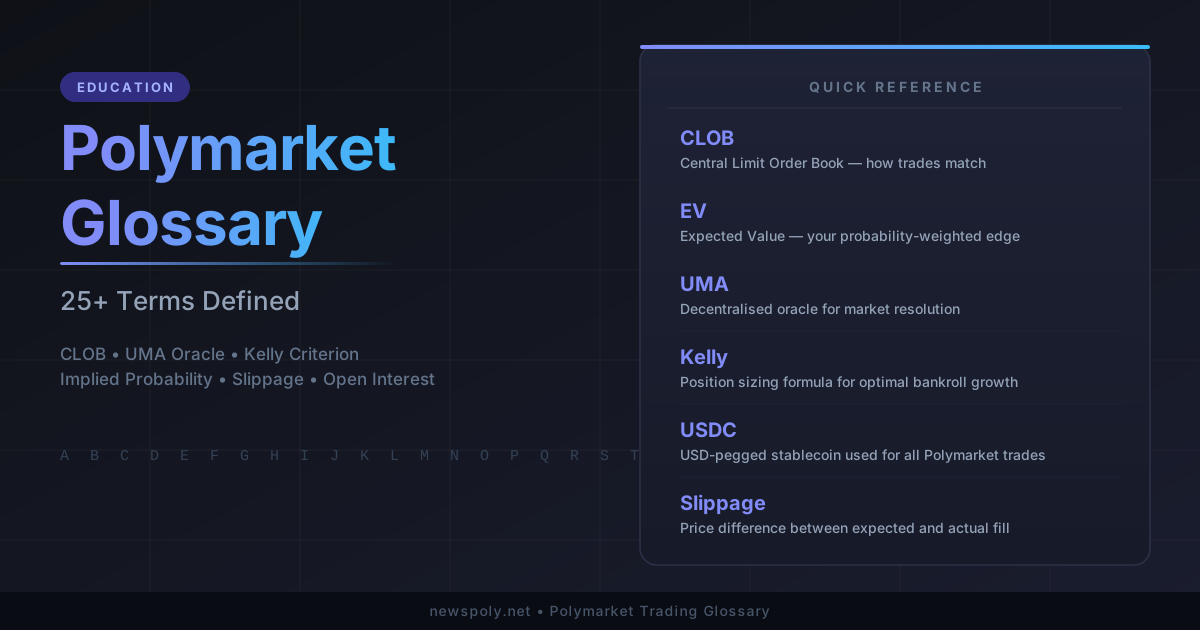
CLOB (Central Limit Order Book) — The matching engine that powers Polymarket’s markets. A CLOB collects all open buy and sell orders, ranked by price, and automatically executes trades when a buyer and seller agree. This is the same structure used by stock exchanges. Understanding the Polymarket order book helps you use limit orders effectively instead of paying the spread on every entry.
Order Book — The live, ranked list of all pending buy (bid) and sell (ask) orders in a market. The top of the book shows the best available prices on each side. Depth in the order book indicates how much volume can be absorbed without moving the price significantly.
Bid — The highest price a buyer is currently willing to pay for a share. If the best bid on YES is $0.61, someone will buy YES shares from you at 61 cents right now. The bid represents immediate demand.
Ask — The lowest price a seller is currently willing to accept. If the best ask on YES is $0.63, you can buy YES shares immediately at 63 cents. Together, the bid and ask define the tradeable range.
Bid-Ask Spread — The gap between the best ask and the best bid. A spread of $0.02 on a liquid market is cheap to cross; a spread of $0.10 is expensive. Every market order you place costs you at least half the spread, so narrower spreads reduce transaction costs on every trade.
Market Maker — A participant who continuously posts both bid and ask orders, earning the spread in exchange for providing liquidity. Market makers take on inventory risk — they may end up holding shares that move against them — but their presence keeps spreads tight and markets tradeable.
Liquidity — How easily you can enter or exit a position without significantly moving the price. High-liquidity markets have deep order books, tight spreads, and many active participants. Low-liquidity markets may trap you in a position or force you to accept a worse price on exit.
Open Interest — The total value of all outstanding shares that have not yet been settled. High open interest signals strong trader participation, which typically correlates with tighter spreads and more reliable pricing.
Probability & Pricing Terms
Polymarket prices are probabilities. These terms explain exactly how to read them.
Implied Probability — The probability the market is assigning to an outcome, read directly from the share price. A YES price of $0.68 means the market collectively estimates a 68% chance the event resolves YES. Comparing the implied probability to your own estimate is how you identify whether a trade has positive expected value.
Price (Cents Notation) — Polymarket shares are priced in cents between 0 and 100, representing 0% to 100% probability. A share at 45¢ implies a 45% chance; a share at 82¢ implies an 82% chance. At resolution, winning shares pay out $1.00 (100¢) each.
YES Share — A token that pays $1.00 if the market resolves YES. If you buy YES at $0.55 and the event occurs, your profit is $0.45 per share. YES and NO share prices always sum to $1.00 (before spread).
NO Share — A token that pays $1.00 if the market resolves NO. Buying NO is equivalent to betting the event will not happen. If NO is priced at $0.38, the market implies only a 38% chance of a NO resolution.
Calibration — A measure of how accurately your stated probabilities match actual outcomes. A perfectly calibrated forecaster whose “70% calls” resolve in their favour 70% of the time is well calibrated. Tracking calibration across dozens of trades is the most objective way to improve your edge estimates over time.
| YES Price | Implied Probability (YES) | NO Price | Implied Probability (NO) |
|---|---|---|---|
| $0.10 (10¢) | 10% | $0.90 (90¢) | 90% |
| $0.25 (25¢) | 25% | $0.75 (75¢) | 75% |
| $0.50 (50¢) | 50% | $0.50 (50¢) | 50% |
| $0.70 (70¢) | 70% | $0.30 (30¢) | 30% |
| $0.90 (90¢) | 90% | $0.10 (10¢) | 10% |
Trading Terms
These terms describe the mechanics of placing and managing trades.
Limit Order — An instruction to buy or sell shares only at a specific price or better. A limit buy at $0.60 will sit in the order book until a seller accepts that price. Limit orders let you avoid paying the spread and control your entry and exit prices precisely. See the full walkthrough in the order book guide and our dedicated Polymarket limit orders guide.
Market Order — An instruction to trade immediately at the best available price, regardless of what that price is. Market orders guarantee execution but not price — in a thin market you may receive a significantly worse fill than expected. Use them sparingly on Polymarket.
GTC (Good Till Cancelled) — An order type that remains active in the order book until you manually cancel it or it fills. GTC is the default for most limit orders on Polymarket, meaning your bid or offer persists across trading sessions until matched.
IOC (Immediate Or Cancel) — An order that must be filled immediately, in full or in part, and any unfilled remainder is cancelled instantly. IOC orders are useful when you need to execute quickly but do not want a resting order in the book.
Position — The shares you currently hold in a market. A long position in YES means you own YES shares and profit if the event resolves YES. Your position size is measured in shares or in the dollar value of those shares at the current price.
Entry / Exit — Entry is the price at which you opened your position; exit is the price at which you closed it. Your profit or loss on a trade is determined by the difference between your entry and exit prices, multiplied by your share count.
Slippage — The difference between the price you expected and the price at which your order actually filled. Slippage occurs when your order is large enough to consume multiple price levels in the order book, or when prices move between order submission and execution.
Settlement & Resolution Terms
Every Polymarket market eventually resolves. Understanding this process protects you from surprises.
Resolution — The process by which a market is settled and traders are paid out. After a market’s closing date, the verified real-world outcome is reported, winning shares are redeemed at $1.00, and losing shares expire at $0.00. The full mechanics are explained in our market resolution guide.
Oracle — A trusted external data source that brings verified real-world information onto the blockchain so smart contracts can settle correctly. Polymarket uses the UMA Protocol as its oracle. Without an oracle, a smart contract has no way to know what happened in the real world.
UMA (Universal Market Access) — The decentralised oracle protocol Polymarket relies on for resolution. UMA’s optimistic oracle assumes a proposed answer is correct unless challenged within a dispute window, making it efficient for the majority of uncontested resolutions.
DVM (Data Verification Mechanism) — UMA’s dispute resolution layer, activated when a proposed resolution is challenged. UMA token holders vote on the correct outcome, and the result is binding. The DVM makes resolution tamper-resistant — no single party can unilaterally determine the outcome of a disputed market.
Payout — The dollar amount you receive when your shares are redeemed at resolution. If you hold 500 YES shares and YES resolves, your payout is $500. If you hold 500 NO shares and NO resolves, your payout is also $500. Losing shares pay nothing.
Early Resolution — When a market closes and resolves before its stated end date because the outcome has become unambiguously clear. For example, a market asking “Will X win the election?” may resolve early once results are certified. Early resolution rules are specified in each market’s description.
Resolution Source — The authoritative reference used to determine a market’s outcome, specified in the market description. Reading the resolution source before trading is essential: if the source is ambiguous or hard to verify, that uncertainty should factor into your probability estimate.
Risk & Strategy Terms
These terms define the framework that separates disciplined traders from gamblers.
Expected Value (EV) — The probability-weighted average return of a trade. If you estimate 70% probability for YES and buy at $0.55, your EV per share is (0.70 × $1.00) + (0.30 × $0.00) − $0.55 = +$0.15. Positive-EV trades are the foundation of long-run profitability. The full framework is in the expected value guide.
Edge — Your informational or analytical advantage over the current market price. If you believe an event has a 75% probability while the market prices it at 62%, your edge is approximately 13 percentage points. Without genuine edge, transaction costs will erode your bankroll over time.
Kelly Criterion — A mathematical formula for the optimal fraction of your bankroll to stake: f* = (bp − q) / b. It maximises long-run bankroll growth given accurate probability estimates. Most traders use fractional Kelly (half or quarter) to guard against over-sizing when their edge estimate is uncertain. Full breakdown in the Kelly Criterion guide.
Bankroll — The total capital you have allocated to Polymarket trading. Treating your bankroll as a defined, ring-fenced amount — separate from living expenses — is the first principle of risk management. Your bankroll determines the absolute dollar size of every Kelly-sized position.
Position Sizing — Deciding how much of your bankroll to commit to a single trade. Too large and a single wrong prediction causes serious damage; too small and profitable trades barely move the needle. Kelly provides the mathematical upper bound; most traders apply a hard cap of 2–5% of bankroll per position as an additional safeguard.
Variance — The natural short-run fluctuation in results that occurs even when you are making correct probability estimates. A trader with genuine edge will still experience losing streaks due to variance. Understanding variance prevents you from abandoning a sound strategy after a normal downswing.
Blockchain Terms
Polymarket runs on-chain. These terms explain the infrastructure beneath every trade.
Polygon — The Ethereum layer-2 network on which Polymarket operates. Polygon processes transactions faster and at a fraction of the cost of Ethereum mainnet, making it practical to trade small positions without gas fees consuming your returns. All Polymarket trades settle on Polygon.
USDC (USD Coin) — A stablecoin issued by Circle, pegged 1:1 to the US dollar. All Polymarket trading is denominated in USDC, meaning your profits and losses are measured in dollars rather than volatile cryptocurrency. USDC on Polygon can be bridged from Ethereum or acquired via fiat on-ramps. For a full walkthrough of depositing, withdrawing, and managing USDC on Polymarket, see our Polymarket USDC guide.
MATIC — The native token of the Polygon network, used to pay gas fees for on-chain transactions. You need a small amount of MATIC in your wallet to execute trades on Polymarket, even though your trading capital is held in USDC. Most users acquire MATIC through exchanges or on-ramp providers.
Gas Fee — The small transaction fee paid in MATIC to validators who process and confirm your transaction on the Polygon blockchain. Gas fees on Polygon are typically fractions of a cent, far cheaper than Ethereum mainnet. High network congestion can temporarily increase gas costs.
Wallet — A software application that stores your private keys and lets you sign blockchain transactions. Popular options for Polymarket include MetaMask (browser extension) and Coinbase Wallet (mobile). Your wallet — not any exchange — controls your funds directly.
On-Chain — Describes data or transactions recorded directly on the blockchain, visible to anyone and immutable once confirmed. All Polymarket trades are on-chain, meaning the order history, positions, and payouts are publicly verifiable without relying on a centralised server.
Smart Contract — Self-executing code deployed on a blockchain that automatically enforces the rules of an agreement. Polymarket’s entire infrastructure — accepting deposits, issuing shares, distributing payouts — runs on smart contracts on Polygon. Because the code is public, anyone can audit that the rules cannot be changed after a market opens.
Using This Glossary
These terms do not exist in isolation — they form an interconnected system. Your limit orders interact with the CLOB; the implied probability you read off the price feeds into your EV calculation; your Kelly sizing pulls from your bankroll; and when a market closes, the UMA oracle triggers the smart contract that delivers your payout in USDC on Polygon.
The traders who consistently outperform on Polymarket use these concepts deliberately on every single trade — not occasionally. If any section raised further questions, dive into the dedicated guides: getting started, expected value, Kelly Criterion, the order book, and market resolution.