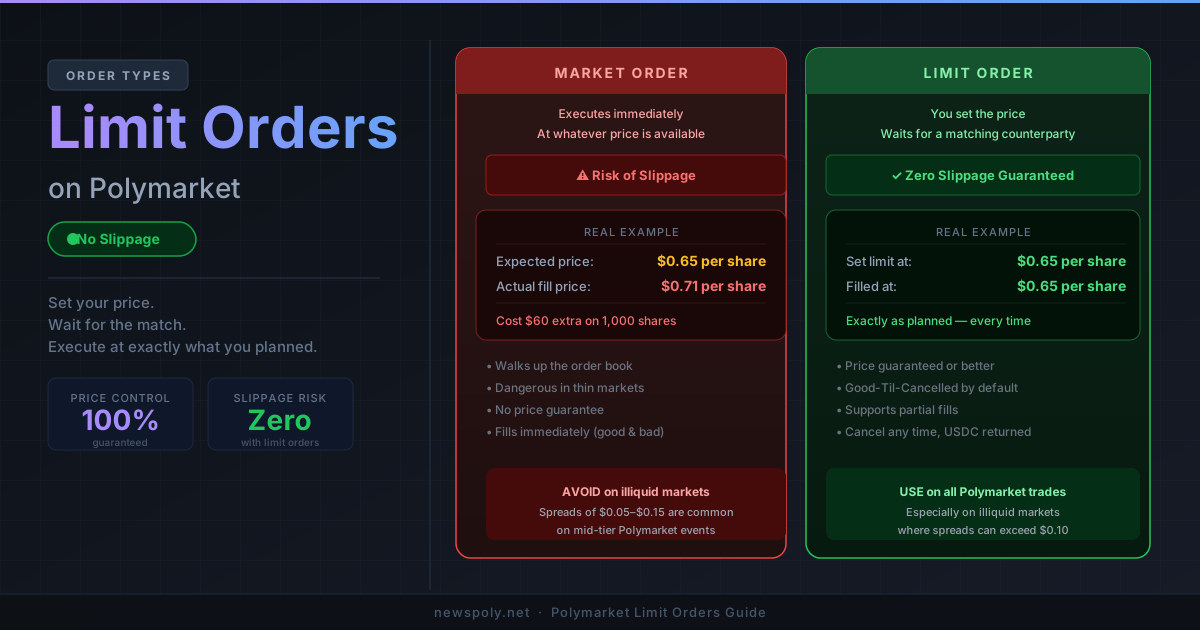
Most Polymarket traders click “Buy” and let the platform execute at whatever price is available — paying the spread, absorbing slippage, and never knowing exactly what they paid. Limit orders fix all of that. By specifying the maximum price you will accept before your order touches the order book, you stay in control of every entry, reduce friction costs, and — with a little patience — consistently build positions at prices that market-order traders never see.
Market Orders vs Limit Orders on Polymarket
The distinction is simple but the consequences are significant. A market order instructs Polymarket to fill your trade immediately at the best available price. Execution is certain; price is not. A limit order instructs the platform to fill your trade only at your specified price or better. Price is guaranteed; execution depends on a matching counterparty appearing.
On liquid equity markets the difference is often a fraction of a cent. On Polymarket’s prediction markets — where a mid-tier political event might have only a few thousand dollars of depth on each side — the difference can be several cents per share. On a 500-share position that is real money left on the table or, if you use limit orders, kept in your pocket.
| Feature | Market Order | Limit Order |
|---|---|---|
| Execution speed | Immediate | When price is matched |
| Price guarantee | None — fills at ask/bid | Your price or better |
| Slippage risk | High on thin books | Zero |
| Spread cost | You pay the full spread | You can earn the spread |
| Best for | Ultra-liquid markets only | All Polymarket conditions |
| CLOB role | Taker (removes liquidity) | Maker (adds liquidity) |
How the CLOB Works on Polymarket
Polymarket operates a Central Limit Order Book (CLOB) — the same matching engine used by professional stock and futures exchanges. Every resting limit order in the book is visible to all participants. When a new order arrives, the exchange engine attempts to match it against opposing orders at compatible prices. If no match exists, the order rests in the book until a counterparty arrives or the order is cancelled.
The CLOB has two sides for each outcome:
- Bid side: all open buy limit orders, ranked from highest price (best bid) to lowest.
- Ask side: all open sell limit orders, ranked from lowest price (best ask) to highest.
The gap between the best bid and the best ask is the spread. A market order to buy crosses the spread instantly and fills against the best ask. A buy limit order placed below the best ask rests on the bid side and waits. For a deeper look at how order flow and matching work in practice, see our guide to the Polymarket order book.
Understanding this structure explains why market orders create slippage: if the best ask only has 200 shares and you want 500, your order eats through multiple price levels — each one more expensive than the last. A limit order set at the best ask captures those 200 shares and stops there, leaving the rest to fill later if sellers come to you.
Placing a Limit Order: Step by Step
The Polymarket interface makes limit orders straightforward once you know where to look. For context on the broader platform before diving into order mechanics, our beginner’s guide to Polymarket covers the full account setup and deposit process.
- Open the market page for the event you want to trade.
- Select your outcome — click “Buy YES” or “Buy NO” to open the order panel.
- Switch order type. The panel defaults to “Market.” Click the toggle and select “Limit.”
- Enter your limit price. For a buy order this is the maximum price per share you will pay. For a sell order it is the minimum you will accept.
- Enter your size in shares or USDC. The interface calculates the other field automatically.
- Review the summary: total USDC committed, estimated fill price, and order expiry type.
- Click “Place Order” and confirm the on-chain transaction in your wallet. Your order is now live in the CLOB.
Your USDC is held in escrow from the moment you place the order. It cannot be used for other trades until the order fills, partially fills, or is cancelled. Plan your capital accordingly if you intend to run multiple open orders simultaneously.
Choosing the Right Limit Price
Where you set your limit price is the most consequential decision in limit order trading. It determines both your execution probability and your price improvement relative to a market order.
At the best ask (buy orders) or best bid (sell orders): Your order will usually fill immediately against existing resting orders. You get the price control of a limit order with near-instant execution — the best of both worlds on reasonably liquid markets.
One to three ticks inside the spread: You rest passively in the book and wait for a seller (or buyer) to come to your price. On binary markets where shares are priced between $0.01 and $0.99, one tick is typically $0.01. Setting your buy limit at $0.58 when the best ask is $0.60 means you save $0.02 per share if a seller accepts your bid — on 500 shares that is $10 saved before any resolution payout is considered.
Far from market (aggressive limits): Unlikely to fill in normal conditions but can capture exceptional value during news shocks or liquidity crunches. These GTC orders are “set and monitor” plays rather than active trades. Reading the price chart before setting an aggressive limit helps you identify meaningful support levels — our Polymarket charts guide explains how to interpret the probability charts on each market page. Check the Polymarket fees guide to ensure your spread savings still net positive after the 2% resolution fee on winning positions.
A practical rule: on markets with spreads wider than $0.04, always try to post inside the spread rather than crossing it. On tight-spread markets ($0.01–$0.02), the incremental saving from a passive limit rarely justifies the execution uncertainty — just match the best ask.
When to Use Limit Orders vs Market Orders
There are genuinely situations where a market order is the right call, and others where a limit order is non-negotiable. Knowing the difference saves both money and time. Our risk management guide covers position sizing and execution discipline as part of a complete trading framework.
Use a market order when:
- The market is in Polymarket’s top tier by volume and the spread is $0.01 or less.
- You need to exit a position before imminent resolution and every second counts.
- The size you are trading is small enough that walking the book is impossible (under $50 on most markets).
Always use a limit order when:
- The bid-ask spread is $0.03 or wider — anything else is giving money away.
- You are entering a niche or mid-tier market where total book depth is under $5,000.
- You are building a large position and a single market order would move the price against you.
- You want to ladder entries at different price points and let the market come to you.
GTC vs IOC Orders
Polymarket supports two time-in-force settings for limit orders:
Good-Til-Cancelled (GTC) is the default. Your order remains live in the order book indefinitely — until it fills completely, you cancel it, or the market resolves. GTC is the right choice for patient entries, spread-making strategies, and any situation where you are comfortable waiting for your price. The risk is forgetting about stale orders: a GTC limit set on old information can fill at an inopportune moment if the market moves to your price for the wrong reasons.
Immediate-Or-Cancel (IOC) attempts to fill your order at your limit price the moment it hits the book. Any portion that cannot fill immediately at that price is cancelled — no resting order is left behind. IOC is useful when you want price protection but do not want capital tied up in a resting order. If only 200 of your requested 500 shares are available at your limit, you get 200 shares and the rest is cancelled, returning your USDC immediately.
For most retail traders on Polymarket, GTC is the default. Use IOC when you want to execute a defined quantity at a price cap without leaving open capital commitments.
Limit Orders for Market Making
Every bid-ask spread on Polymarket represents an opportunity for passive income. A market maker posts a buy limit order below the current mid-price and a sell limit order above it simultaneously. If both sides fill against different counterparties, the maker captures the spread as pure profit with no directional exposure.
For example: YES shares have a best bid of $0.58 and a best ask of $0.63. You post a buy limit at $0.59 and a sell limit at $0.62. If the buy fills first against a panicking seller and the sell fills later against an eager buyer, you pocket $0.03 per share — on 500 shares that is $15 with zero view on the outcome.
The risks are real: if only one side fills and the market moves against you, you are left holding an unhedged position. Inventory management — knowing when to lean your quotes or pull them entirely — is what separates profitable market makers from accidental directional traders. The Polymarket market making guide covers bid-ask mechanics, inventory risk, and which market categories offer the best spread opportunities for smaller accounts.
The Polymarket CLOB rewards patient limit order users with better average prices than takers. Consistently posting inside the spread rather than crossing it is, over hundreds of trades, one of the most reliable ways to improve overall P&L without needing to improve your fundamental forecasting. For the complete picture on how your costs compound across trades, the fees guide breaks down the 2% resolution fee in the context of spread savings.
Common Limit Order Mistakes
Limit orders are powerful but they come with their own failure modes. Avoid these patterns to get the most out of the CLOB:
- Setting aggressive limits and forgetting about them. GTC orders can sit for weeks or months. A limit you placed based on old news can fill at the worst possible moment. Review your open orders at least weekly, especially ahead of major resolution events.
- Overcommitting USDC to resting orders. Every open limit locks up capital in escrow. Spreading yourself thin across too many open orders means you cannot react to new high-conviction opportunities. Keep at least 20–30% of your balance free and liquid. Our Polymarket position sizing guide has a framework for allocating capital across open orders without over-extending.
- Treating partial fills as full positions. A 250-share fill on a 500-share order is not a complete position — you still have 250 shares worth of open order tying up capital. Monitor the “Open Orders” tab actively.
- Using round-number price levels. Everyone else’s limit orders cluster at $0.50, $0.60, $0.70. Posting at $0.51 or $0.62 steps in front of that queue and improves your fill priority without materially changing your economics.
- Ignoring cancellation gas costs. On Polygon, cancellations cost fractions of a cent — but if you place dozens of micro-orders and cancel them all, the gas adds up. Size your orders sensibly from the start to avoid unnecessary cleanup costs. The fees guide has a full breakdown of all transaction costs on Polymarket.
- Not adjusting limits after news breaks. If major news drops that changes the true probability of an outcome, your resting limit may suddenly be significantly mispriced. Either cancel immediately or update your price to reflect the new information. Stale limits are an easy source of adverse selection.