Polymarket charts are not price charts. They are probability charts—and that distinction changes everything about how you should read them. The Y-axis does not represent dollars. It represents the market’s collective belief, expressed as a percentage, that a specific outcome will occur. Once you internalize that framing, patterns that looked random suddenly carry information. Sharp moves mean new information entered the market. Slow drifts mean sentiment is shifting. Compression toward 95% means the crowd thinks the outcome is nearly decided. This guide walks through every layer of Polymarket chart data—from the basics of the probability axis to advanced techniques like overlaying news timelines and pulling raw data from the API.
What the Y-Axis Actually Represents
On a traditional equity chart, the Y-axis shows a share price in dollars. On Polymarket, the Y-axis shows an implied probability expressed as a value between 0 and 1 (displayed as 0–100 cents, or equivalently 0–100%). A price of 0.72 on a YES share means the market currently assigns a 72% probability to that outcome resolving YES.
This matters because price and probability are not the same thing psychologically. A stock dropping from $72 to $68 is a routine fluctuation. A market dropping from 72% to 68% means the crowd has materially revised its view of how likely an event is to happen. Every move on a Polymarket chart is an information event—someone (or many people) revised their estimate and the market price moved to reflect it.
For context on what these numbers mean in plain terms, see our guide on reading odds on Polymarket, which covers the relationship between implied probability and expected value in more depth.
Reading the Probability Curve
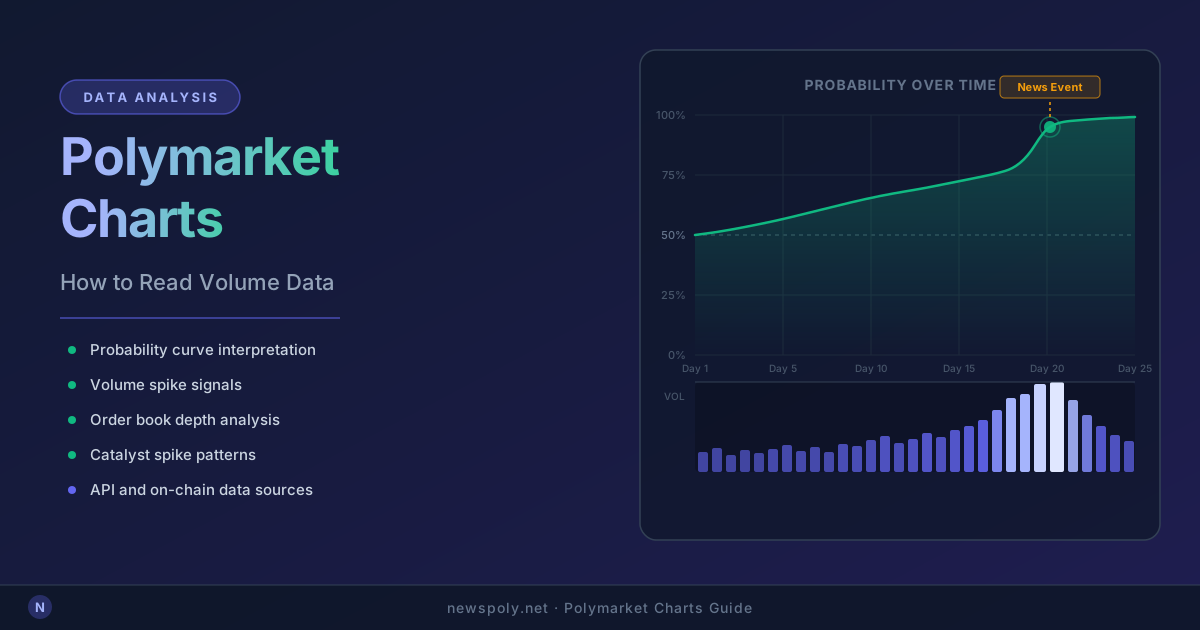
The main line on a Polymarket chart traces the last-traded price of YES shares over time. Here is how to interpret different shapes:
- Flat periods: No new information. The market has reached a temporary consensus and trading is thin. These are often the lowest-liquidity windows of the day.
- Slow drift: Incremental sentiment change. Could be a gradual news story developing, or large traders accumulating a position without triggering a sharp move. Watch volume alongside the price to distinguish the two.
- Sharp vertical move: New information arrived. A breaking news headline, a tweet from a key figure, a poll release, or an economic data print hit the market and traders repriced instantly. The bigger and faster the move, the more significant the catalyst.
- V-shaped reversal: A move was either a false signal (thin-market manipulation) or the catalyst turned out to be misread. Genuine reversals often come with a second volume spike as the initial direction unwinds.
The key habit to develop is never looking at the price line in isolation. Every shape on the chart is more meaningful when paired with the volume bars beneath it.
Volume Spikes: What High Volume Signals
Volume on Polymarket represents the dollar value of contracts traded in a given time window. Volume spikes are among the most actionable signals on the entire chart for several reasons:
Smart money entering: Sophisticated traders who have done deep research often move in size. When a quiet market suddenly sees a large volume candle before any obvious public news, someone with an informational edge is positioning. This is sometimes called a “silent spike”—price barely moves, but enormous volume transacts because the order book has enough depth to absorb the trade. These can be early warnings of coming news.
News-driven volume: When a major headline hits, volume and price move together. This is the most common type of spike and is often fade-able once the initial reaction exhausts itself, especially if the probability has already moved to an extreme (above 90% or below 10%).
Thin-market manipulation: In low-liquidity markets, a small volume spike can move the price dramatically. If you see a sharp price move with very low volume, treat it with skepticism. More on this in the section on manipulation below.
Comparing volume across different time windows also reveals whether a move is institutional or retail. Large single-candle spikes tend to be algorithm-driven or whale-driven. Sustained elevated volume over several hours suggests broader market participation and a more durable repricing.
Skip the chart reading entirely. PolyCopyTrade automatically mirrors traders who already know how to read the data — their analysis, your results.
Time of Day Patterns
Polymarket operates 24/7, but trader activity is far from uniform across the clock. Understanding when the market is most efficient helps you avoid getting caught on the wrong side of illiquid moves.
- US morning (9 AM–12 PM Eastern): Highest liquidity window for US-centric markets (politics, economics, sports). Professional and semi-professional traders are most active. Spreads are tightest, making this the best window for entering and exiting positions with minimal slippage.
- European overlap (3 AM–9 AM Eastern): Good liquidity for geopolitical and European markets. Also the window when many algorithmic market makers are active, so prices tend to be more efficiently set.
- Overnight US (11 PM–3 AM Eastern): Lowest liquidity. Spreads widen. A single moderately sized trade can move the price significantly. This is the window where “painted chart” moves are most common (see the manipulation section).
- Around scheduled events: Volume spikes predictably before and after known catalysts—Fed announcements, election result windows, major sports events. The pre-event window often shows a compression pattern as the market prices in certainty.
Overlaying a simple clock onto your chart analysis—noting what time a move occurred—gives immediate context for whether to trust a price level or treat it as a thin-market artifact.
Using the Order Book Alongside the Chart
The price chart tells you where the market has been. The order book tells you where liquidity is sitting right now—and these two sources of information often tell different stories.
A market sitting at 65% on the chart may look stable, but if the order book shows 80% of the depth stacked on the NO side below 60%, there is significant sell pressure waiting just below the current price. Conversely, if YES bids are deep and well-stacked above 60%, the floor beneath current prices is solid.
Key things to look for in the order book:
- Bid-ask spread: Wide spreads signal illiquidity. Narrow spreads signal market maker competition and a healthier market.
- Walls: Large resting orders at specific levels. These can act as support and resistance, similar to limit orders on equity markets. They can also be spoofed (placed and cancelled), so watch for whether they actually absorb volume or disappear when price approaches.
- Asymmetric depth: If the book is heavily skewed to one side, it often reflects a consensus that is leaning strongly in one direction. Trading against overwhelming order book asymmetry requires a strong fundamental thesis.
The most powerful combination is a chart showing a recent sharp move upward paired with an order book that has refilled with new buy depth—this suggests the move is being validated and backed by new capital, not just a thin-market print.
Identifying Manipulation vs. Genuine Moves
Prediction markets, especially thin ones, can be “painted.” This means a trader moves the price intentionally—not to establish a genuine position but to create the appearance of momentum, trigger stop-like behavior from other traders, or influence perception of the outcome probability.
Signs that a move may be manipulation rather than genuine information:
- Large price move with very low volume
- Move occurs during off-peak hours (overnight US)
- Price immediately reverts within one or two candles
- No corresponding news event or external catalyst
- The market has less than $50,000 in total open interest
Genuine information-driven moves tend to be sticky. The new price level holds because traders with an informational edge are willing to defend their position. Painted moves tend to be short-lived because the manipulator cannot sustain them indefinitely without taking on real financial exposure.
For markets where manipulation risk is higher, always cross-reference with external data sources before acting on a chart move alone.
Chart Patterns That Matter in Prediction Markets
Prediction markets have their own set of recurring chart patterns that carry distinct informational content. These differ from traditional technical analysis patterns because each one has a logical probabilistic explanation.
Slow Drift from 50% Followed by Sharp Reversal
A market that drifts slowly from 50% to 65–70% over days, then snaps back sharply, often reflects a narrative that built gradually and then was punctured by contradictory evidence. The drift phase can be a good entry in the direction of drift if supported by volume. The reversal is often violent because accumulated long positions unwind simultaneously.
Late-Market Compression Toward Certainty
As a resolution event approaches, markets with a strong leading outcome tend to compress toward 95% or higher. This reflects rational probability mechanics—once an outcome is nearly certain, the final uncertainty is priced down to almost zero. Trading near 95%+ offers very asymmetric risk: small gain if you are right, large loss if a surprise occurs. The chart will often show very low volatility in this zone, punctuated by occasional sharp dips when any uncertainty re-emerges.
Catalyst Spikes
The most reliable pattern. A known catalyst (a vote, an announcement, a data release) hits the market and price gaps sharply in one direction on high volume. The key question is whether the spike represents the full repricing or just the first wave. If the catalyst is genuinely decisive, price continues trending in the spike direction. If the market overreacted, the spike fades. Post-spike volume decay is the best indicator: if volume drops sharply after the spike and price holds, the move is real.
Skip the chart reading entirely. PolyCopyTrade automatically mirrors traders who already know how to read the data — their analysis, your results.
External Data to Overlay on Your Charts
Polymarket charts become far more interpretable when you annotate them with external event timelines. The most useful overlays are:
- News timelines: Mark when major stories broke relative to price moves. Tools like Google News search by date, or news aggregators with timestamp precision, let you reconstruct the information timeline behind any chart move.
- Poll releases: For political markets, major poll releases from organizations like RealClearPolitics, 538, or The Economist move prediction market prices visibly. Annotating these release dates on your chart reveals how much weight the market gives to different polling organizations.
- Economic calendars: For economic outcome markets (CPI, Fed rate decisions, GDP), the economic calendar from sources like ForexFactory or Investing.com gives you the exact timestamps of data releases. These are some of the most predictable volume spike windows on Polymarket.
- Social media spikes: Large viral moments—a candidate gaffe, a viral tweet, a trending news story—can sometimes be correlated with chart moves by using Google Trends data to estimate when public attention peaked.
Building a habit of annotating your charts before trading a market gives you a much cleaner read of what the current price reflects versus what future catalysts might move it.
Where to Get Polymarket Data Beyond the Main UI
The Polymarket interface provides a basic price chart and order book, but serious analysis often requires more granular data. The primary alternatives are:
The Polymarket API: Polymarket exposes a REST API that provides real-time and historical market data including prices, volume, and order book depth at the tick level. Our guide on API data covers how to access and query this data, including rate limits and authentication requirements. The API is the cleanest source for building custom charts or backtesting strategies.
Dune Analytics: Because Polymarket settles on-chain (Polygon), every trade is recorded on a public blockchain. Dune Analytics hosts dozens of community-built dashboards that visualize this data—including whale wallet activity, market-level volume breakdowns, and historical resolution data. Searching Dune for “Polymarket” surfaces dozens of useful dashboards covering everything from top traders by PnL to market-by-market volume rankings.
Polymarket Explorer tools: Third-party tools like Polymarket Whales and similar trackers surface large trades and wallet-level activity. Combined with the price chart, these reveal when significant capital is moving and in which direction. For a full breakdown of how to track large traders, see our guide on whale tracking.
For finding markets where the chart price diverges from your own probability estimate—which is the foundation of profitable trading—the analysis frameworks in our guide to finding mispricings are essential reading alongside this one.
Using Charts to Time Entries and Exits
Having a view on the correct probability for an outcome is only half the job. The other half is choosing when to enter and exit relative to current chart conditions.
Entry timing: The best entries are often after a sharp move has happened and a new level has been established with supporting volume—not during the move itself. Chasing a catalyst spike is one of the most common ways to overpay. Waiting for a retest of the post-spike level (if price pulls back slightly and holds) provides a cleaner entry with better risk definition.
Exit timing: For YES positions that have moved into high-probability territory (above 85%), the risk-reward of holding shifts. Use the compression pattern as a guide—if the chart is already pricing near-certainty, most of the expected value has been captured and the residual tail risk (surprise reversal) becomes the dominant consideration.
Avoid overnight entries: Given the thin-market dynamics outside peak hours, executing large entries or exits during off-peak windows carries meaningful slippage risk. The chart price you see at 2 AM may be significantly less representative of true market value than the same price seen at 10 AM during active trading. When you are ready to act on what the chart shows, using limit orders rather than market orders is the most effective way to control exactly what price you pay regardless of the liquidity environment.
Chart reading is a skill that compounds over time. The more markets you annotate and analyze retrospectively, the faster you will start recognizing patterns in real time. Combining chart literacy with the broader trading strategies used by experienced Polymarket participants gives you both the analytical toolkit and the strategic framework to act on what the charts are telling you.
Frequently Asked Questions
Can I use technical analysis indicators like RSI or MACD on Polymarket charts?
You can apply them, but they carry less predictive weight than in equity markets. Polymarket charts have hard boundaries at 0 and 100%, which distorts oscillators as markets approach resolution. The more useful indicators are volume-based ones (volume-weighted price, volume divergence) rather than momentum oscillators designed for unbounded price series. Treat technical indicators as context, not signals.
Why does the Polymarket chart sometimes show a price different from what I can actually trade?
The chart typically displays the last-traded price, which can lag the current order book during low-volume periods. The actual tradeable price is determined by the best available offer in the book. During thin-market windows, there can be a meaningful gap between the “chart price” and the real execution price. Always check the order book before entering a trade rather than relying solely on the chart display.
How far back does Polymarket price history go?
The main Polymarket UI typically shows 30 to 90 days of price history for active markets. For older or resolved markets, historical data is available through the API or through on-chain data tools like Dune Analytics. Some Dune dashboards archive complete tick-by-tick history for all resolved Polymarket markets going back to 2020, which is a valuable resource for backtesting pattern recognition across hundreds of resolved events.
Skip the chart reading entirely. PolyCopyTrade automatically mirrors traders who already know how to read the data — their analysis, your results.