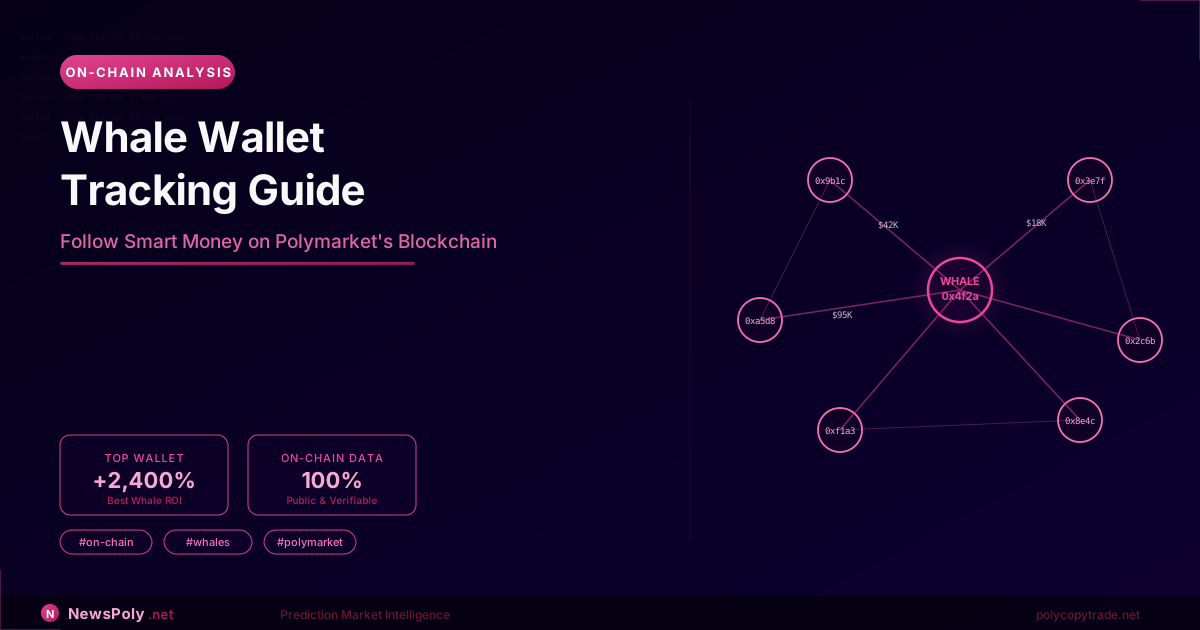
Traditional financial markets keep institutional order flow largely hidden. Polymarket is different in a fundamental way: every single trade, every wallet position, every USDC flow is permanently recorded on the Polygon blockchain and queryable by anyone. This isn't just a transparency feature — it's an information advantage waiting to be exploited.
When a wallet that has generated 400% returns over 200 trades takes a large new position, that is signal. When three high-performing wallets independently enter the same market within a 24-hour window, that is a very loud signal. This guide covers the complete methodology for identifying these wallets, reading their behaviour, and extracting actionable intelligence from Polymarket's on-chain data. For the foundational API and data tools, see our Polymarket API and on-chain data guide first.
Why On-Chain Transparency Creates Alpha
In traditional finance, information about what sophisticated traders are doing is protected, delayed, or fragmentary. Hedge funds file 13F disclosures quarterly, revealing positions months after they were established. Dark pools hide institutional order flow entirely. Retail traders work with a fundamental information disadvantage.
Polymarket has no dark pools. No delayed disclosure. No information asymmetry — only skill asymmetry. Every position taken by a Polymarket whale is as visible to you as it is to any other trader on the platform, the moment it happens. The edge lies not in having access to the data, but in systematically analysing it — which most retail traders don't do.
Understanding why Polymarket's on-chain structure enables this is also part of what makes the platform trustworthy. Our article on whether Polymarket is legitimate covers the blockchain transparency in depth.
Defining a Whale on Polymarket
Not every large-volume wallet is worth tracking. The wallets with genuine signal are those that combine high volume with high accuracy. The criteria to screen for:
- Minimum 100 resolved trades — enough history to distinguish skill from luck
- Positive ROI over the full history — not just recent performance
- Consistent market diversity — wallets that trade across categories (politics, crypto, sports, macro) show broader analytical skill than single-category specialists
- Position sizing consistency — erratic position sizes suggest luck runs or emotional trading; consistent sizing suggests a systematic approach. Some of the highest-performing wallets are also active market makers who earn the bid-ask spread in addition to directional positions; their activity patterns look different from pure directional traders
- Active across multiple market types — single-event specialists can have stellar records from one large correct call that doesn't reflect general ability
A wallet with 300 trades at 18% ROI across diverse categories is significantly more valuable to track than a wallet with 20 trades at 80% ROI — the latter is almost certainly lucky.
Using PolygonScan for Wallet Analysis
PolygonScan is the primary block explorer for the Polygon network. It lets you view the complete transaction history for any wallet address — every trade, every USDC transfer, every contract interaction.
For Polymarket analysis, the most useful PolygonScan workflow:
- Enter a wallet address in the search bar
- Filter transactions by the Polymarket conditional token contract address
- Review the token transfer history to identify which outcome tokens were bought, at what quantities, and at what timestamps
- Cross-reference the transaction timestamps with price history on the corresponding market to determine entry prices
This is manual but powerful for deep-diving a specific wallet's history. For systematic screening across many wallets, the Polymarket API is more efficient.
Using the Polymarket API for Systematic Whale Screening
Polymarket's REST API allows you to query position data by wallet address, which is the foundation of any scalable whale tracking system. The key endpoints for whale analysis:
/positions?user=0x...— Returns all current open positions for a wallet, including market ID, outcome token, and quantity/trades?user=0x...&limit=100— Returns the 100 most recent trades for a wallet/profile?user=0x...— Returns aggregated statistics: total volume, P&L, win rate
A basic Python script that periodically queries these endpoints for a watchlist of 20–30 high-performing wallets, then alerts when any of them opens a new position above a threshold size (e.g., $5,000 USDC), gives you a real-time smart-money feed. The full API documentation and setup process is covered in our Polymarket API guide.
What Whale Behaviour Actually Signals
Raw position data requires interpretation. A whale entering a market can mean many different things depending on context. Whale signals are most actionable when they confirm an independent mispricing you've already identified — see our guide on how to find mispriced Polymarket markets for the analytical framework to pair with on-chain signals.
Strong Signals
- Large limit buy at current market price — Paying market spread to enter quickly signals conviction and time-sensitivity; the trader believes the market will move against them if they wait. You can corroborate this by reviewing the probability chart to see whether the price has been trending consistently or if the whale is entering against the prevailing direction
- Multiple whale wallets entering independently within 24 hours — The most reliable signal; unlikely to be coincidence
- Large position in a low-liquidity market — The whale accepted worse execution to build exposure; this suggests very high conviction
- Accumulation via multiple smaller trades over 48 hours — Systematic position building; the trader is trying to minimise price impact
Weaker Signals to Approach with Caution
- Single large trade in a high-liquidity market — Could be noise, a hedge, or a single large retail player; insufficient on its own
- Recent-whale entry only — A wallet with a strong recent record but limited total history could be in a lucky run; check total trade count before weighting the signal heavily
- Position in a market near resolution — Near-resolution positions often reflect arbitrage or final-day pricing rather than original directional conviction
Building a Simple Whale Alert System
The most practical implementation for most traders is a lightweight monitoring script that checks a curated watchlist of wallet addresses every 15–30 minutes and alerts when specific conditions are met. A basic alert criteria framework:
- New position opened by a wallet with 100+ resolved trades and positive overall ROI
- Position size above $3,000 USDC
- Market is at least 14 days from resolution (avoid near-resolution arbitrage noise)
- No existing position by this wallet in this market (new entry, not position management)
Alerts meeting all four criteria warrant immediate investigation. You don't automatically copy the position — you investigate the market yourself and decide whether the whale's signal is actionable given your own analysis. This research-informed copy approach is fundamentally different from blind automation, and is the version that produces consistent alpha over time.
For traders who want the automation layer handled at the platform level rather than building it themselves, PolyCopyTrade provides a managed copy trading system with wallet selection built on exactly this kind of performance-based criteria. The underlying logic is covered in our copy trading guide, and the full technical setup process is in our copy trading automation setup guide.
Limitations and Risk Factors
Whale tracking is powerful but not infallible. Key limitations to keep in mind:
- Wallets can hedge — A large "No" position from a whale might be a hedge against an existing "Yes" position in a related market you can't see
- Historical performance decays — A whale with excellent 2023 performance may have lost their edge or changed their strategy
- Market impact — If you're tracking the same wallets as hundreds of other traders, you may be buying into already-moved prices
- Sybil risk — A single trader can operate multiple wallet addresses; correlated wallet movement is not always the independent signal it appears to be
Apply standard position sizing and risk management rules to every whale-signal trade, regardless of how strong the signal appears. Tracking whale-signal trades within your broader portfolio management process — recording which signals fired, which you acted on, and how they resolved — is the only way to validate whether your watchlist is generating genuine alpha over time. The strength of the signal affects your position size within your normal range — it doesn't justify abandoning the range entirely.
Frequently Asked Questions
How do I find high-performing whale wallets to track in the first place?
The Polymarket leaderboard (accessible via the main interface) shows top traders by volume and P&L. Start there, then use the API to verify that top leaderboard wallets have strong performance across diverse market types rather than a single large lucky trade. Prediction market community resources — Twitter/X accounts focused on Polymarket, the official Discord — also regularly surface notable wallets.
Is it legal to track and copy other traders' on-chain activity?
Yes. All Polymarket transaction data is public by design. There is no private information being accessed — you are simply reading the same public blockchain data that anyone can view. This is equivalent to observing public market order flow, which has been standard practice in traditional financial markets for decades. The on-chain structure of Polymarket makes this more accessible than in traditional finance, but the principle is the same.
How many wallets should I track at once?
Quality over quantity. A curated list of 15–25 rigorously vetted wallets will produce better signals than monitoring 200 wallets indiscriminately. The signal-to-noise ratio degrades as you add lower-quality wallets to your watchlist, and alert fatigue leads to missed genuine signals. Start with 10 thoroughly researched wallets and expand slowly as you validate the quality of each signal over time.