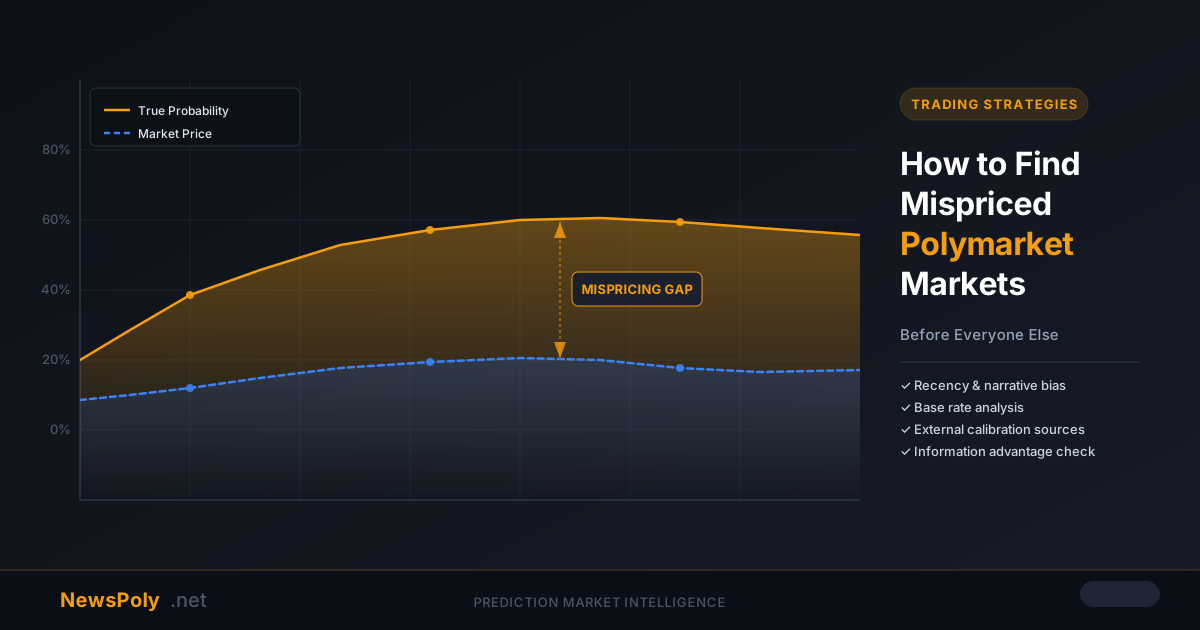
The gap between what a market says will happen and what actually will happen is where prediction market profits live. On Polymarket, that gap is called a mispricing — and finding them systematically is the difference between gambling and trading with an edge.
The efficient market hypothesis argues that prices instantly reflect all available information. In liquid stock markets with thousands of professional participants, that's approximately true. Polymarket is not that. It is a relatively young, retail-heavy, attention-driven venue where mispricings are common, often persistent, and entirely exploitable — if you know where to look.
What "Mispricing" Actually Means in Prediction Markets
A market is mispriced when the current contract price — interpreted as an implied probability (for a primer on reading Polymarket odds, see our dedicated guide) — diverges meaningfully from the true probability of the outcome. If a "Yes" contract trades at 30 cents ($0.30) but the event has a genuine 55% chance of occurring, that 25-percentage-point gap represents pure expected value waiting to be captured.
The catch: you can only profit from a mispricing if you can correctly identify that the true probability is different from the market price. That requires information, a framework, or domain expertise that the market currently lacks or is ignoring. Simply having a different opinion isn't enough. You need a grounded reason to believe the crowd is wrong.
The Five Categories of Market Inefficiency on Polymarket
Not all mispricings look the same. Experienced traders learn to recognize the structural patterns that cause markets to misprice repeatedly.
1. Recency Bias
Markets overweight recent events. If a candidate just had a strong debate performance, the market will often overshoot their probability for days. Conversely, a single bad poll can push prices below where base rates justify. The fix: anchor on longer-term historical distributions, not the last 48 hours of news.
2. Narrative Bias
Polymarket participants are often active crypto and finance Twitter users. When a compelling narrative takes hold — "the Fed will definitely pause," "this war ends by summer" — prices can drift toward the narrative rather than the evidence. Narrative-driven markets are often the most mispriced because they attract high volume with low analytical rigor.
3. Thin Liquidity
Markets with low total liquidity (under $50,000 in open interest) are frequently mispriced simply because no professional has bothered to correct them. These small markets can sit at 15 cents for events that deserve 60 cents, purely because there isn't enough money flowing to force efficiency. Small-cap prediction markets are the equivalent of small-cap stocks: more volatile, less efficient, higher potential reward.
4. Early-Market Pricing
When a market first opens on a long-horizon event — an election 18 months away, a geopolitical resolution years out — the initial price is often arbitrary. The first few liquidity providers are guessing. These early prices can persist for weeks before anyone seriously revisits them, creating a window where an informed trader can take large, uncrowded positions.
5. Attention Gaps
Polymarket users concentrate their attention on a small number of high-profile markets. Hundreds of markets — covering obscure regulatory decisions, regional elections, scientific outcomes, or sports futures — receive almost no analytical attention. These neglected corners of the platform are consistently fertile ground for mispricing.
Using External Forecasting Sources for Calibration
The fastest way to identify a Polymarket mispricing is to compare its price to what well-calibrated forecasting platforms say. Two are essential:
Metaculus is a track-record-verified forecasting platform with thousands of questions and a community of skilled superforecasters. Its aggregate predictions have been shown to be well-calibrated over time — meaning a 70% Metaculus prediction resolves YES roughly 70% of the time. When a Polymarket contract trades at 40 cents but Metaculus shows community consensus at 65%, that's a signal worth investigating.
Manifold Markets is a play-money prediction market with high engagement, particularly on political and tech questions. While play-money markets don't carry the same weight as real-money venues, Manifold often prices in information faster than Polymarket on niche topics because its community is more intellectually curious and less financially driven.
Neither source should be followed blindly. But a persistent divergence between Polymarket and both Metaculus and Manifold is a strong signal that one of three things is true: Polymarket is mispriced, the other platforms are wrong, or there is information asymmetry you need to resolve.
Domain Expertise as a Durable Edge
The most reliable mispricing edge isn't a tool — it's knowledge. A political scientist who studies electoral systems will consistently outperform on election markets. A physician will identify biotech trial mispricings that a generalist trader misses. A retired foreign service officer will price geopolitical resolutions more accurately than someone reading the same headlines as everyone else.
The question to ask yourself is: what do I know about this topic that the average Polymarket participant doesn't? If the answer is nothing, you probably don't have an edge in that market. If the answer involves years of professional experience, deep domain reading, or access to specialized data — that's exactly where to deploy capital.
Domain expertise compounds. A trader who builds a reputation for accurately pricing climate-related markets will, over time, attract liquidity to their positions and see markets correct toward their view. Being early and right, repeatedly, in a specific domain is one of the most defensible edges in prediction markets. If you want to benefit from the edge others have already built, a Polymarket copy trading bot lets you mirror those expert positions automatically.
Base Rate Analysis: The Underused Anchor
For any event with historical precedent, base rates are your first and most important input. Before forming any opinion about a specific market, ask: how often have similar events historically occurred?
Examples: How often does an incumbent president win reelection? How often does a country that enters recession return to growth within 12 months? How often does a legislative bill that passes committee become law? How often does a Supreme Court case that grants certiorari result in reversal?
Markets routinely underweight base rates because participants focus on the specific narrative around a current event. This is Kahneman's "inside view" problem. Forcing yourself to start with the outside view — the base rate — before incorporating case-specific information will consistently improve your probability estimates and help you spot when a market has drifted too far from historical norms.
The Information Advantage Check
Before entering any position, run this mental checklist:
- What does the market currently price this at?
- What is my estimate of the true probability, and why?
- What information am I using that the market doesn't appear to have priced in?
- Is that information actually new, or am I just interpreting public information differently?
- How confident am I in my information source? Is it reliable?
- What would change my mind?
If you can't articulate a clear information advantage, you're speculating rather than trading. Both can make money, but only one is scalable.
Tools for Finding Mispricings at Scale
Manual scanning is too slow for a systematic approach. These tools help automate the search:
Polymarket API — The official REST API lets you pull current prices, trading volume, open interest, and resolution history for every active market. Our Polymarket API and on-chain data guide covers how to build scripts that flag markets where volume is low relative to days-to-resolution, or where price has been static for more than 48 hours, surfacing candidates automatically. For traders who prefer a visual approach, the Polymarket charts guide explains how to read probability charts and volume data directly from the platform interface.
Dune Analytics dashboards — The Polymarket community maintains several public Dune dashboards tracking market-level liquidity, whale activity, and historical pricing. Large traders moving into a position can signal that informed money has identified a mispricing — or is about to create one.
Social sentiment tracking — Monitoring Polymarket-adjacent Twitter/X accounts, prediction market Discord servers, and relevant Reddit communities can provide early signals. When a narrative starts building that hasn't yet moved market prices, there's a brief window before the crowd catches up.
When NOT to Trade: Recognizing the Absence of Edge
The discipline to walk away is as important as the skill to find opportunities. Do not trade when:
- You have no specific reason to believe the current price is wrong
- Your view is based entirely on publicly available information that the market has already processed
- The market is highly liquid and actively traded by professionals (the spread is tight and volume is high)
- You're trading based on emotion — excitement about an event, desire to be right, FOMO from seeing others profit
- The edge you think you have disappears when you explain it out loud
Sitting out is free. A bad trade has negative expected value. The best traders on any platform have high selectivity — they pass on 90% of markets and concentrate capital in the handful where their edge is clearest. Mispricing identification pairs naturally with the other top Polymarket trading strategies covered in our overview guide.
Worked Example: Finding a Mispriced Sports Market
Suppose Polymarket lists a market: "Will [Team A] win the championship?" priced at 18 cents. You notice the market opened a week ago and has seen minimal trading — just $12,000 in volume. You check Metaculus: no question. You check Manifold: 31 cents. You pull the historical data: this team has won the championship 3 times in the last 10 seasons, giving a rough 30% base rate.
You investigate further: their two key players are healthy and returning from injury absences that explain a recent losing streak. The market appears to have reacted to a 3-game skid without accounting for the upcoming roster recovery. Advanced metrics still rank this team in the top tier of the league.
Your revised estimate: 32-35% probability. The market says 18%. The gap is 14-17 percentage points. You size a position proportional to your confidence and your bankroll. You're not certain — but you don't need certainty. You need edge. To enter without moving the price in a thinly-traded market, use a limit order rather than a market order.
Frequently Asked Questions
How do I know if a Polymarket price is genuinely mispriced or if I'm just overconfident?
The key test is whether you can articulate a specific piece of information or analytical framework that the market hasn't priced in. If your only argument is "I think the market is wrong," that's overconfidence, not edge. Real mispricings have an identifiable cause: a thin liquidity environment, a calibration gap versus external forecasters, a base rate the market is ignoring, or domain knowledge the crowd lacks. Run the information advantage checklist above before any trade. If you can't pass it, don't trade.
Is comparing Polymarket to Metaculus a reliable strategy for finding mispricings?
It's a reliable signal, not a guarantee. Metaculus has a strong track record of calibration on the question types it covers, but its coverage doesn't perfectly overlap with Polymarket. When it does overlap, a persistent price divergence is worth investigating carefully. The divergence could mean Polymarket is mispriced (most common), Metaculus is mispriced (less common but happens), or the two questions aren't actually asking the same thing (always check the resolution criteria). Use the comparison as a starting point for deeper research, not as an automatic trade trigger.
How much capital should I allocate to a single mispriced market?
Position sizing should reflect both the size of the edge and your confidence in it. A common approach is Kelly Criterion sizing: bet a fraction of bankroll equal to your edge divided by the odds offered. In practice, most experienced prediction market traders use a fractional Kelly (25-50% of full Kelly) to account for model error — a full breakdown of these methods is in our guide to Polymarket risk management. Never allocate more than 10-15% of your prediction market bankroll to a single position, regardless of how confident you feel. Overconcentration is the most common cause of large losses even among skilled traders.