
Why Politics Markets Dominate Polymarket Volume
If you have spent any time on Polymarket, you already know that politics is where the action is. Election markets, legislative battles, and geopolitical flashpoints routinely command the highest open interest and tightest bid-ask spreads on the entire platform. During the 2024 U.S. presidential cycle, a single "Who wins the 2024 U.S. Presidential Election?" market attracted hundreds of millions of dollars in volume — dwarfing most traditional prediction-market benchmarks by an order of magnitude.
There are structural reasons for this dominance. Prediction markets price binary outcomes by their probability, and political events are binary by nature: a candidate wins or loses, a bill passes or fails, a world leader stays in power or doesn't. That clean binary structure makes pricing intuitive and resolution unambiguous. Politics also generates relentless public attention — media cycles, polling releases, debate nights, and breaking news all create repricing moments that active traders can exploit. For anyone serious about prediction-market investing, ignoring politics markets means leaving your biggest edge on the table. The approaches here integrate directly with the broader top Polymarket trading strategies playbook.
Types of Political Markets on Polymarket
Not all political markets behave the same way. Understanding the sub-categories will sharpen your research process.
- Election outcome markets — "Will [Candidate] win [Office]?" These are the flagship markets. Liquidity is deepest here, and external data sources (polls, prediction aggregators, betting odds) are abundant. For a current breakdown of the live 2026 midterm markets and where the best opportunities sit right now, see our dedicated Polymarket 2026 election markets guide.
- Approval rating markets — "Will [Leader]'s approval exceed X% by [Date]?" These resolve against specific polling firms or aggregators named in the rules. They move more slowly but reward careful reading of methodology differences between pollsters.
- Legislative event markets — "Will [Bill] pass the Senate before [Date]?" These require procedural knowledge: cloture votes, committee timelines, reconciliation rules. Traders who understand legislative mechanics hold a structural edge over those relying purely on news.
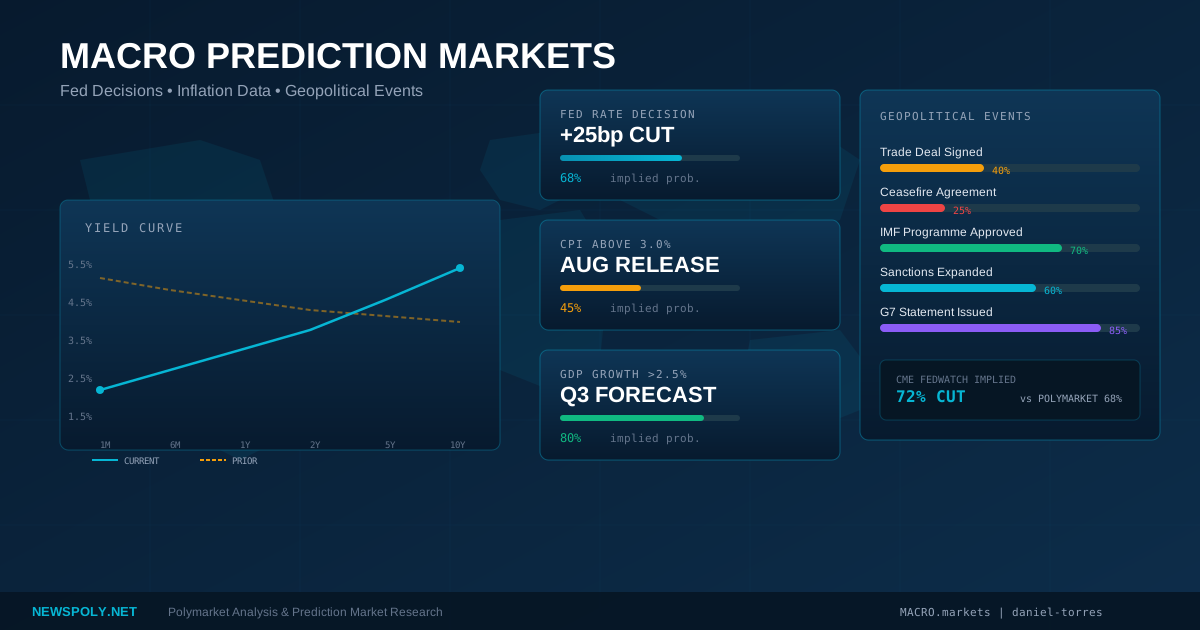
- Geopolitical markets — "Will [Country] hold a snap election?", "Will [Leader] leave office?" These are the wildest-ranging in terms of information asymmetry. Genuine domain expertise — or access to quality regional analysts — can produce outsized returns. Macro-driven geopolitical events often overlap with the macro markets category, which is worth tracking in parallel. Alternatively, automate your Polymarket trades by copying specialists who already have deep expertise in these markets.
Building a Research Framework: Polls vs. Prices
The single most common mistake new traders make is treating poll numbers as if they were market prices. Polls measure stated voter preference at a point in time. Polymarket prices are probability estimates aggregated from thousands of traders who each have real money at stake — our guide on how to read prediction market odds explains this in full. The two are related but not identical, and the gap between them is where alpha lives.
A practical research stack for U.S. electoral markets looks like this:
- Silver Bulletin / Nate Silver's model — For topline win probabilities that account for electoral-college mechanics and polling error distributions. Use the model output, not just the national polling average.
- RealClearPolitics averages — For raw polling averages in key states. Useful for spotting which polls are moving the aggregate and whether it is a persistent trend or a single outlier.
- PredictIt / Metaculus / Manifold — Cross-referencing prices across platforms exposes how to find mispriced markets. If Polymarket has a candidate at 58% and every other liquid market has them at 64%, that gap deserves scrutiny.
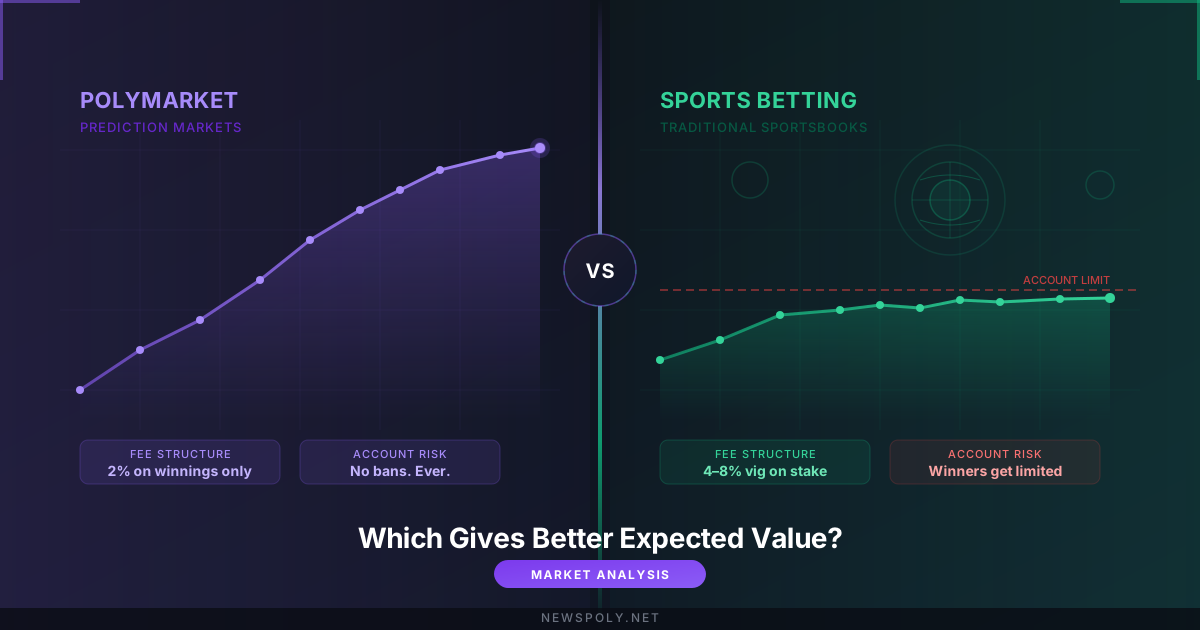
- Betting markets (Betfair, Pinnacle) — International sportsbooks often price political events with substantial liquidity. Divergence from Polymarket can signal either an arbitrage opportunity or a genuine informational difference — for a deeper look at how the two platforms compare, see Polymarket vs sports betting.
- Primary sources — State election authority websites, FEC filings, legislative tracking tools like GovTrack. For late-stage markets, reading the actual resolution criteria against primary sources often reveals whether the market is fairly priced.
The goal is not to find the "most accurate" single source. It is to triangulate a consensus probability and then ask whether Polymarket is materially above or below that consensus — and why. Our Polymarket charts guide explains how to read the probability charts and volume indicators on each market page, which helps you spot price momentum shifts as new information comes in.
The Meta-Narrative Effect: How Media Cycles Move Prices
Political markets are uniquely vulnerable to what traders call the meta-narrative effect: the tendency for market prices to overshoot in the direction of the dominant news story, regardless of whether the underlying fundamentals have changed. A candidate has one bad debate performance, cable news runs the same clip on loop for 72 hours, and their Polymarket probability collapses — sometimes far more than the actual evidence warrants.
Experienced traders learn to ask: "Has the news cycle changed the underlying probability, or has it only changed the perceived narrative?" When the answer is the latter, the overreaction creates an opportunity. Conversely, when a slow-moving development (an early-state poll trend, a money-race filing, a quiet legislative procedural move) fails to generate media attention, prices can lag the real signal by days. For tactics on acting quickly when news breaks — including how to position before events and fade overreactions — see our Polymarket news trading guide.
Practical tactics: follow regional political journalists whose beats cover specific states or policy areas. Their granular reporting often contains actionable information weeks before national outlets pick up the story.
Timing Your Entries: Early vs. Late
The timing question in political markets has no universal answer, but a few principles hold consistently.
Early entries carry information risk but offer the best prices. If you have genuine research conviction 12 months before an election, you can enter at prices that reflect maximum uncertainty. The risk is that the information landscape will change dramatically, and your initial thesis may not survive contact with reality. Position sizing should be conservative in early markets.
Late entries offer more certainty but compressed upside. In the final two weeks before a major election, markets often converge tightly around the polling consensus. The opportunity here is less about outright directional bets and more about identifying specific markets where the resolution criteria create asymmetries — for example, a market where you have high confidence in the direction but the current price still implies meaningful doubt.
The sweet spot for most traders is the mid-cycle period: after primaries have resolved and the field is set, but before the final polling consensus has hardened. This window typically offers the best combination of information richness and pricing inefficiency.
Hedging Correlated Political Positions
Political markets are highly correlated across instruments — a dynamic covered in depth in our guide to prediction market risk management. Before entering correlated political positions, applying the expected value framework to each ensures you are only taking trades where the edge justifies the risk given your aggregate exposure. If you hold long positions in three Senate race markets from the same cycle, you are effectively running a concentrated macro bet on the direction of that entire political environment. A single systemic shock — an October surprise, a major economic event, a scandal — will move all three simultaneously.
Hedging tactics include holding positions in adjacent markets that would benefit from the same shock moving against you (e.g., long on a candidate in State A, short on a closely correlated candidate in State B), or using approval rating markets as partial hedges against electoral positions. Explicit portfolio-level thinking — asking "what is my total exposure to [Party] winning?" — prevents inadvertent concentration risk.
Common Mistakes in Political Markets
Even experienced traders fall into predictable traps in political markets.
- Overweighting polls. Polling has known structural failures: non-response bias, likely-voter screen methodology, herding behavior among pollsters near election day. Market prices already incorporate polling data; the edge comes from adjusting for its known weaknesses, not from treating the latest poll as gospel.
- Ignoring electoral mechanics. In winner-takes-all systems, a candidate leading national polls by 2 points may still be an underdog due to electoral college geography. Resolution criteria for Polymarket political markets are specific — always read them before trading.
- Overconfidence in "obvious" outcomes. Political markets have a long history of punishing traders who assumed a result was foregone. Maintain calibrated uncertainty even when the evidence looks one-sided. Our cognitive biases guide covers the specific mental traps that distort political market judgments most often.
- Averaging down without a thesis update. If a market moves against you, the question is not "should I buy more at the lower price?" but "has new information changed the probability, or has my original analysis been invalidated?" Only average down if the fundamentals still support your original thesis and the price movement appears to be driven by sentiment rather than substance.
Understanding Resolution Criteria
Political market resolution on Polymarket is governed by specific rules that are sometimes poorly understood by traders who rely on headlines. Close elections in particular can create resolution ambiguity: a market that resolves on "called by major networks" will settle differently from one that resolves on "certified by the relevant state authority." Read the resolution source specified in each market's rules before entering a position, and be especially cautious in markets where the gap between "apparent winner" and "official winner" could be days or weeks.
For legislative markets, pay attention to whether resolution requires a bill to be signed into law, to pass both chambers, or merely to receive a floor vote. These distinctions are material and are often priced incorrectly by traders who skim the question title without reading the fine print.
Frequently Asked Questions
Are Polymarket politics markets legal to trade in the United States?
Polymarket operates under a CFTC no-action letter and restricts U.S. residents from trading on its platform directly. U.S.-based users should review the platform's current terms of service and consult applicable regulations in their jurisdiction. Traders outside the U.S. generally face fewer restrictions. This article is for informational purposes and does not constitute legal or financial advice.
How does Polymarket decide who wins a disputed election market?
Each market's resolution criteria are defined in the question rules. Most major election markets specify resolution based on the outcome as reported by a designated authoritative source — typically the Associated Press, a named state election authority, or official certification. In the event of a genuinely contested outcome, Polymarket's resolution committee reviews the situation and may extend the resolution date. Always read the specific resolution rules for each market before trading.
What is a good starting position size for political markets?
Position sizing in political markets should reflect your confidence level and the market's time horizon. A reasonable starting framework: no more than 5–10% of your total Polymarket bankroll in any single political market, with smaller allocations for markets that are many months from resolution and larger allocations for high-conviction late-stage positions. Because political markets are highly correlated within a given cycle, track your total exposure to directional political risk across all open positions, not just individual market sizes.