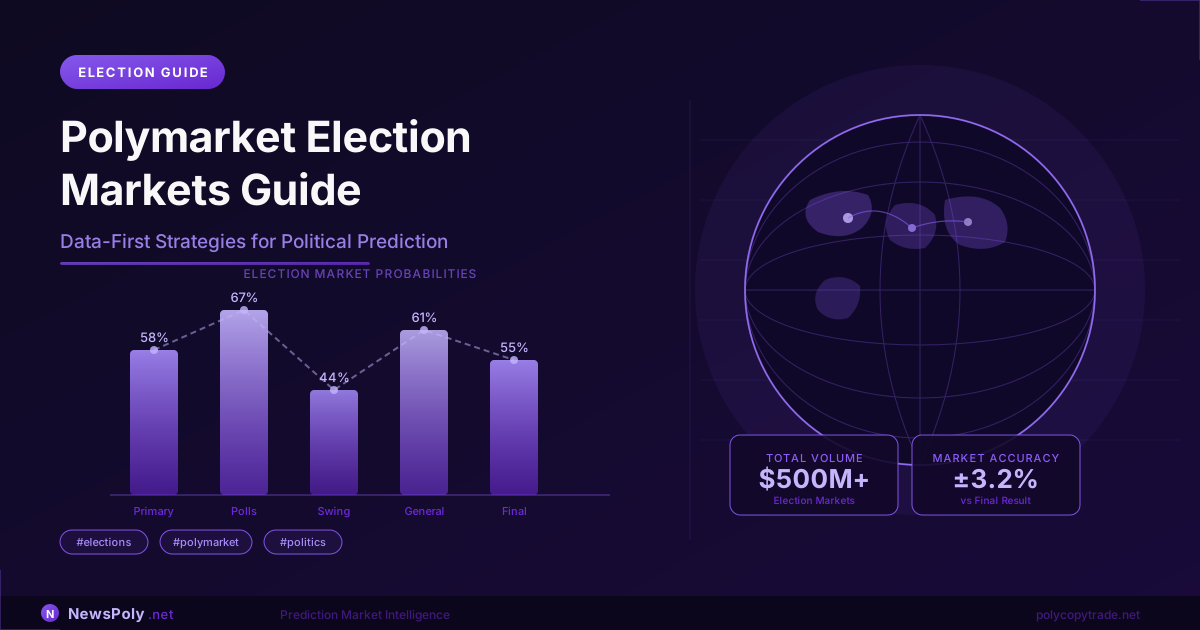
Election markets are the crown jewel of Polymarket. They generate more trading volume, attract more sophisticated participants, and produce more public discussion than any other category on the platform. They are also systematically mispriced in predictable, exploitable ways — if you know what data to use and when to act.
This guide covers the complete framework for trading political prediction markets: the best data sources, how to time entries across the election cycle, the narrative traps that catch most traders, and why the crowd's instincts about political outcomes are reliably wrong in specific, recurring patterns. For a broader grounding in prediction market mechanics, start with our guide to reading Polymarket odds.
Why Election Markets Are Different
Most Polymarket markets resolve on clear, measurable criteria — a price level, a regulatory decision, a statistical threshold. Election markets are different: they are resolved on human choices, aggregated across millions of voters, under conditions that shift continuously over weeks and months.
This creates specific dynamics that don't exist in other market types:
- Long resolution timelines — presidential election markets can run for 12+ months, creating enormous opportunities for price drift and correction
- Narrative sensitivity — prices move dramatically on news events that, historically, have minimal impact on actual voter behaviour
- Structural information asymmetries — a former policy analyst, election lawyer, or regional political scientist has genuine edges that retail traders simply don't have
- High liquidity — major election markets have millions in liquidity, meaning you can take meaningful positions without moving the market
All four of these factors create edges that a disciplined, data-first trader can exploit. Understanding how to identify mispriced markets is especially important in political contexts, where the gap between market price and true probability is often large and persistent.
The Primary Data Sources
The single most important skill in political prediction markets is source hierarchy — knowing which data to weight and which to discount. Most traders over-weight media narrative and under-weight systematic polling and structural models.
1. Polling Aggregators
Individual polls are noisy. Aggregators are significantly more accurate. The most reliable sources:
- FiveThirtyEight — The gold standard for US election polling aggregation, with house-effect adjustments and historical accuracy metrics for each pollster
- RealClearPolitics — Simpler unweighted average, useful for cross-referencing but less sophisticated than FiveThirtyEight
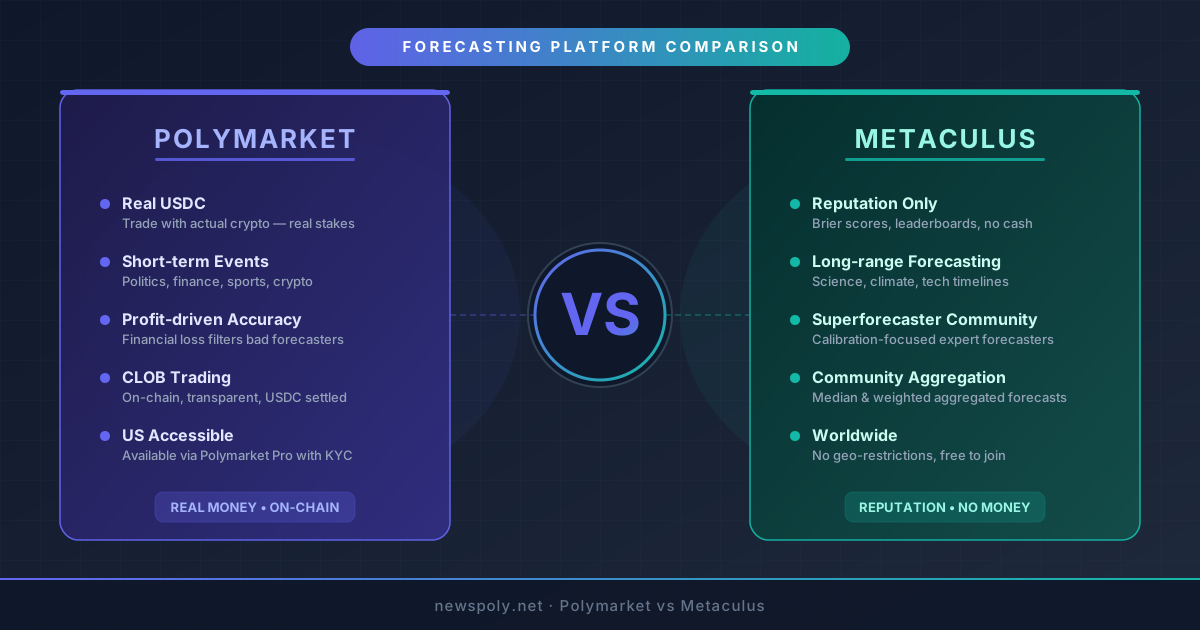
- Metaculus — Community-based superforecasting platform with strong track records on political questions; often leads market prices by days
- The Economist's election models — Structural models incorporating economic fundamentals alongside polling
2. Prediction Market Cross-References
Polymarket doesn't exist in isolation. Comparing prices across platforms surfaces genuine mispricing signals:
- Kalshi — CFTC-regulated US market; tends to be more conservative on political uncertainty. See our Polymarket vs Kalshi comparison for structural differences
- Betfair — The world's largest prediction exchange by volume; particularly strong on UK and European political markets
- Manifold Markets — Play-money but high-quality forecasters; useful for early signals before real-money markets form
A persistent 5–8 percentage-point gap between Polymarket and Betfair on the same candidate is worth investigating seriously. Usually one market is right and the other is catching up.
3. Structural and Fundamentals Models
Electoral models that incorporate GDP growth, presidential approval ratings, and incumbency factors have historically outperformed polling-only models in US presidential elections. These structural signals are systematically under-priced in short-term market movements driven by the news cycle. Traders comfortable with macro data will find the same analytical framework applies in Polymarket macro markets, where economic fundamentals also tend to be underweighted by the broader market.
How to Time Your Entries Across the Election Cycle
Where you enter relative to the election date matters enormously. Different phases of the cycle present different risk/reward profiles.
12–18 Months Out: The Structural Phase
Markets this far out are priced primarily on name recognition, polling, and intuition. Structural factors — economic conditions, historical base rates for incumbents — are underweighted. This is when mean-reversion trades work best: fading extreme overreactions to early polls or preliminary announcements.
Liquidity is lower this far out, so apply stricter risk management rules — position sizes should be at the lower end of your normal range.
3–6 Months Out: The Primary and Convention Phase
Candidate fields consolidate. Markets become more liquid. This is when cross-platform arbitrage opportunities are most common, as different markets digest the same information at different speeds. Look for divergences between Polymarket and Betfair following major primary results. The arbitrage and mean-reversion approaches that work best here are covered in the top Polymarket trading strategies guide.
Final 60 Days: The High-Volatility Sprint
The final two months before an election are the most dangerous for undisciplined traders and the most profitable for disciplined ones. Debate performances, late-breaking news, and endorsements create massive short-term price swings — most of which revert within 48–72 hours as the market integrates the information more accurately.
The key insight: price impact of debate moments typically overshoots by 2–3x what the actual voter-behaviour impact will be. Fading dramatic post-debate moves is statistically profitable, but requires the nerve to act quickly and the discipline to size correctly. Using limit orders rather than market orders when entering these fading trades lets you set your target entry price precisely and avoid paying an inflated spread on a fast-moving market. Traders who want election market exposure without personally managing the news-cycle volatility can use PolyCopyTrade to automatically copy verified political market traders — professionals who are already executing these fading strategies in real time.
The Five Narrative Traps That Destroy Political Traders
These patterns repeat across every election cycle. They are rooted in the cognitive biases — recency bias, narrative fallacy, and overconfidence — that consistently cause traders to over-react to news events with minimal actual impact on outcomes.
1. Overweighting Fundraising Numbers
Fundraising is a signal of enthusiasm among donors — a small, unrepresentative subset of the electorate. Markets consistently over-react to strong fundraising quarters for insurgent candidates. Historical base rates show minimal correlation between fundraising leads and general election outcomes.
2. Endorsement Inflation
Political endorsements generate enormous media coverage and typically move Polymarket prices by 3–7 percentage points. The historical effect on vote share: approximately 1–2 points, if any. Every high-profile endorsement is a potential fading opportunity.
3. Debate Momentum Overextension
Post-debate "momentum" is a media construct. Research consistently shows that debate effects on vote share are small (typically under 2 points) and decay within two weeks. Markets price these events as if they had 5–10x their actual effect on outcomes.
4. Early State Generalisation
Iowa and New Hampshire are not America. A win in either state has historically been a weak predictor of the general election outcome. Markets regularly over-extrapolate from early state results to national probability shifts that the underlying data doesn't support.
5. Scandal Discounting
Markets dramatically over-price the probability of a candidate dropping out following scandal revelations. The base rate for major-party candidates withdrawing due to scandal is historically very low — yet markets consistently price 15–25% probability on scandal-exit scenarios that almost never materialise.
Multi-Outcome and Contingent Markets
Many election markets on Polymarket are not simple binary YES/NO on a winner — they include state-level outcomes, electoral vote ranges, and contingent questions. These multi-outcome markets are often the most mispriced because they require more sophisticated probability reasoning.
Key principle: the sum of all outcome probabilities in a multi-outcome market must equal 100%. When markets drift out of this balance due to uneven trading, arbitrage opportunities appear. Checking outcome probability sums across related markets is a simple but powerful screen for mispricing — the same logic that underlies general political market strategy. Reading the probability chart for each outcome over time helps identify whether a price move is a genuine trend or a short-lived spike worth fading.
Position Management Through Volatility
Election markets require more active position management than most. Breaking news can move prices 20+ percentage points in minutes. Before entering any political market, decide in advance:
- Your target exit price if the market moves in your favour
- Your stop-loss level if it moves against you
- Whether you will average down on adverse moves — and if so, your maximum total exposure
- Whether your expected value calculation still holds if the price moves 5 percentage points against you before you enter
Markets that are already at 85%+ "Yes" for a candidate present the specific trap of near-certainty pricing discussed in our risk management guide. The implied 15% probability on a loss may represent genuine political uncertainty rather than mathematical noise — always check what scenarios would need to occur for the "No" outcome to resolve.
Frequently Asked Questions
Are US election markets accessible on Polymarket?
US users are currently geo-blocked from Polymarket's main interface. The platform is fully accessible to international users. US-based traders seeking regulated alternatives should see our Polymarket vs Kalshi comparison — Kalshi is CFTC-registered and legally available to US residents for political event contracts.
How far in advance do election markets open on Polymarket?
Major US federal election markets typically open 12–18 months before election day. Midterm and state-level markets often open 6–12 months out. Markets for international elections — UK general elections, French presidential elections — typically open 3–6 months ahead of the vote.
What's the most common mistake election market traders make?
Over-reacting to individual polls. A single poll that shows an outlier result will move Polymarket prices significantly, even when that poll contradicts the broader polling consensus. Checking aggregators rather than individual polls before acting on a price move is the single highest-leverage habit you can develop for political trading.