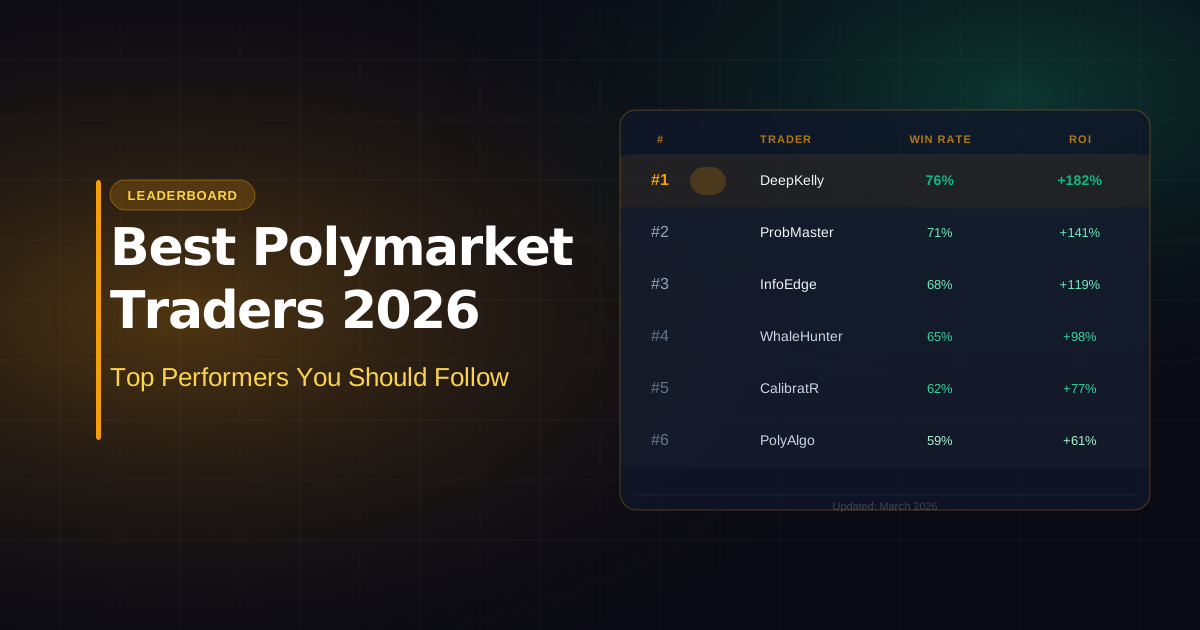
Every prediction market has a small cohort of traders who genuinely outperform — people who consistently beat the market’s implied probabilities across hundreds of resolved markets, not just on a lucky streak. On Polymarket, those traders are theoretically visible to everyone: their wallets, their positions, their full trade history are permanently recorded on the Polygon blockchain. The problem is knowing how to identify them, what metrics actually distinguish skill from luck, and what to do once you find them.
This guide covers all three. It explains what “best” really means in a prediction market context, where to find high-performing traders, which metrics separate signal from noise, and how copy trading converts this research into a practical strategy you can execute without spending hours per day on analysis.
What Makes a Polymarket Trader “the Best”?
The answer depends entirely on what you are optimising for — and the most common mistake beginners make is conflating volume with skill. A wallet that has traded $2 million in USDC volume may be a professional market-maker earning the bid-ask spread rather than a directional forecaster. A wallet sitting at the top of the volume leaderboard may have taken massive positions in one or two high-profile markets and gotten lucky. Neither of these tells you what you actually want to know: can this trader reliably identify mispriced probabilities and profit from them consistently?
The three most commonly cited dimensions of Polymarket performance are ROI, volume, and consistency. Each measures something different, and none is sufficient on its own.
- ROI (return on investment) — The percentage gain on capital deployed across all resolved markets. ROI is the closest thing to a pure skill signal, but it is enormously sensitive to sample size. A 90% ROI on 12 trades is meaningless. A 22% ROI on 400 trades is exceptional.
- Volume — Total USDC traded. Volume indicates activity and market participation but says almost nothing about skill. High-volume market-makers may have near-zero directional ROI while still extracting value through spread capture.
- Consistency — Whether a trader’s positive returns are spread evenly across time and market types, or concentrated in a few large wins. Consistency is the hardest metric to find on a standard leaderboard but is arguably the most predictive of future performance.
The genuinely best traders combine all three: meaningful positive ROI over a large sample, spread across diverse market categories, with no single enormous win distorting the record. Finding wallets that meet all these criteria requires going beyond the surface-level leaderboard.
How to Find Top Polymarket Traders
There are three main channels for discovering high-performing Polymarket wallets: the native Polymarket leaderboard, direct on-chain wallet tracking, and third-party analytics tools.
The Polymarket Leaderboard
Polymarket’s native leaderboard is the most accessible starting point. It surfaces top traders by total profit and by return percentage within defined time windows. It’s a useful first filter, but comes with significant limitations: it does not distinguish directional traders from market-makers, does not surface calibration data, and cannot tell you whether a wallet’s top performance came from one market or fifty. The leaderboard is a shortlist generator, not a final verdict. Our dedicated Polymarket leaderboard guide covers its structure and limitations in detail.
On-Chain Wallet Tracking
Because Polymarket is built on the Polygon blockchain, every wallet’s complete trade history is publicly queryable — no API key required, no data gating. Tools like PolygonScan let you inspect any wallet address directly: which outcome tokens it holds, what positions it has opened, and the full resolved P&L history. The Polymarket REST API provides higher-level aggregated metrics per wallet, including win rate, total volume, and per-market position data. This is the methodology underlying any serious whale-tracking approach — our Polymarket whale tracking guide covers it step by step.
Third-Party Analytics Tools
Several community-built tools aggregate on-chain data and surface wallet performance metrics in more readable formats than raw PolygonScan queries. These include leaderboard aggregators that weight performance by trade count, dashboards that show rolling 30-day and 90-day ROI alongside all-time figures, and alert systems that notify when specific wallets open new positions. For a full breakdown of which tools exist and how to use them, see our Polymarket API and on-chain data guide. If you want to analyse a trader’s long-term record, our Polymarket historical data guide explains where to access and query resolved market data going back to the platform’s launch.
What Metrics to Look at When Evaluating a Trader
Once you have a candidate wallet from the leaderboard or on-chain tools, these are the metrics that actually matter for evaluating whether the performance reflects genuine skill.
| Metric | What It Measures | Minimum Threshold | Why It Matters |
|---|---|---|---|
| All-time ROI% | Total return on capital across all resolved markets | >10% (meaningful positive) | Core skill signal — must be positive over full history |
| Resolved trade count | Number of completed (resolved) markets traded | 100+ resolved trades | Sample size determines whether ROI is luck or skill |
| Win rate | Percentage of resolved positions that were profitable | 55%+ (weighted for size) | High win rate with consistent sizing signals calibration |
| Market diversity | How many distinct market categories the trader has won in | 3+ categories | Category specialists may have narrow, non-repeatable edges |
| Maximum drawdown | Largest peak-to-trough capital decline in the history | <40% drawdown | High drawdown signals reckless position sizing or poor risk management |
| Calibration | Whether the trader’s confidence matches actual outcomes | Positive Brier score improvement | True skill in prediction markets = accurate probability estimation, not just picking winners |
| Activity recency | Whether the trader is currently active | Trades in last 60 days | Historical performance decays; you want currently active traders |
Of these, resolved trade count is the hardest filter — and the most important one most people skip. A wallet showing 95% ROI on 14 trades is not evidence of skill; it is a lucky run. The same 95% ROI across 300 diverse resolved trades is extraordinary and worth taking seriously.
Calibration is the subtlest metric. In a prediction market, skill means not just being right, but being right by the right amount — correctly identifying that a 40% market is actually 55% likely is far more valuable than blindly betting “yes” on high-confidence markets that were already correctly priced. Calibration data is harder to find than raw ROI but is increasingly surfaced by third-party tools and the Polymarket API.
The Problem with Leaderboard Gaming
Any leaderboard with real money attached will be gamed. Polymarket’s leaderboard is not immune. The most common exploitation patterns:
- Binary market cherry-picking — A trader enters only one or two extremely high-confidence markets near their resolution dates, capturing the final probability compression from 95% to 100%. The ROI looks outsized relative to the actual insight required.
- Small-sample amplification — Short leaderboard windows (7-day or 30-day) allow wallets with a single large correct call to sit at the top. These wallets disappear from the rankings as soon as the window resets.
- Multi-wallet splitting — A single trader operating several wallets can appear as multiple distinct top performers, inflating the apparent signal from their strategy.
- Near-resolution timing — Entering markets in their final hours when outcomes are almost certain generates high win rates with minimal analytical content, but looks impressive on a simple win rate metric.
None of these patterns survive the filter of “100+ resolved trades across diverse categories over an extended period.” That requirement is not arbitrary — it is specifically designed to be ungameable by short-term manipulation, because building a falsely impressive record of 100+ diverse resolved trades costs more capital and time than it is worth.
Anonymous Wallets and Pseudonymous Traders
Polymarket wallets are pseudonymous, not anonymous. While you may not know the real-world identity behind a top-performing address, several high-performing wallets have become well-known within the Polymarket community and are discussed openly on Twitter/X, Polymarket’s Discord, and in prediction market forums. Some wallets have developed reputations spanning years of consistent on-chain performance.
Pseudonymity cuts both ways. It means you cannot verify whether a specific wallet belongs to a professional forecasting firm, a domain expert, or an individual. But it also means wallet performance data is purely on-chain and cannot be selectively disclosed — the record is complete, permanent, and publicly verifiable by anyone. This is actually a higher standard of transparency than most traditional investment vehicles provide. A fund manager can report audited returns; a Polymarket wallet’s returns are directly readable from the blockchain without trusting any intermediary.
The practical implication: evaluate wallets on their on-chain record, not on claimed identity. A wallet with 350 resolved trades at 28% ROI across politics, crypto, and macro categories is worth copying regardless of who owns it.
How Copy Trading Solves the Research Problem
The logical conclusion of the above analysis is that identifying genuinely skilled Polymarket traders requires significant ongoing work: leaderboard monitoring, on-chain data querying, multi-metric evaluation, and regular watchlist updates as traders go inactive or their performance drifts. For most people, this research burden is the real barrier — not capital, not platform access, not understanding how Polymarket works.
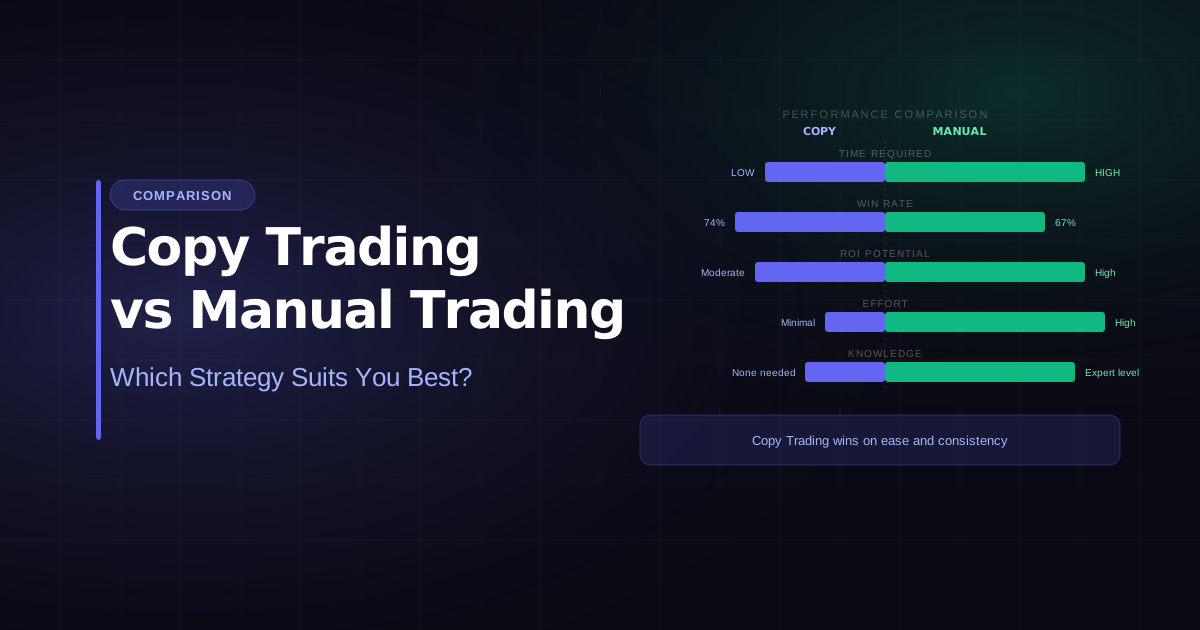
Copy trading inverts the model. Rather than doing the research yourself, you select a platform that has already applied the evaluation methodology described in this article to identify consistently top-performing wallets — and then automatically mirrors their positions to your account, proportionally scaled to your capital. Our complete copy trading guide explains the mechanics in detail; our copy trading vs manual trading comparison shows where each approach wins.
The key distinction between good and poor copy trading implementations is the trader selection methodology. Copying leaderboard positions blindly — without filtering for trade count, diversity, or maximum drawdown — reproduces all the leaderboard gaming problems described above. Platforms that apply rigorous on-chain screening criteria before surfacing any trader for copying eliminate this problem at the source.
PolyCopyTrade’s Trader Selection Methodology
Understanding how a copy trading platform selects its traders is essential before allocating capital. PolyCopyTrade’s screening process is built directly on on-chain Polymarket data and applies the following criteria before any wallet is made available for copying:
- Minimum 100 resolved markets across at least three distinct category types (politics, crypto, macro, sports, science, or other) — ensuring the sample is meaningful and the trader is not a single-category specialist
- Positive all-time ROI using position-weighted returns, not simple trade count weighted — a trader who correctly sizes large positions deserves more credit than one who bets uniformly regardless of confidence
- Maximum drawdown screening — wallets with historical drawdowns above threshold are excluded regardless of overall ROI, because drawdown behaviour predicts future risk more reliably than returns alone
- Activity recency requirement — traders inactive for more than 60 days are de-listed until they resume consistent activity, preventing you from copying wallets that have retired or changed strategy
- Ongoing live monitoring — trader metrics are recalculated continuously as new markets resolve, so the roster reflects current performance rather than historical snapshots
This selection process is more stringent than anything a retail trader could feasibly apply manually at scale. The result is a curated shortlist of verifiably skilled wallets rather than a raw leaderboard export.
How to Evaluate a Trader Before Copying
Whether you are using a copy trading platform or building your own watchlist, the practical due diligence process for any candidate trader looks like this:
- Pull the full resolved trade history. Use the Polymarket API or a third-party aggregator. Do not rely on the leaderboard summary — look at the underlying trade-by-trade record. Count the resolved markets, check the date range, note the category spread.
- Calculate position-weighted ROI. Simple trade count averages flatter traders who place many small safe bets. Weight each trade’s return by the capital committed to get an accurate picture of actual capital efficiency.
- Check the drawdown history. Identify the worst losing run in the record. A trader who lost 60% of their capital over six weeks before recovering may have been lucky, not skilled. The drawdown tolerance you apply depends on your own risk appetite, but anything above 50% peak-to-trough is a significant caution signal.
- Verify recency. Check the timestamp of the most recent resolved trade. A two-year-old performance record from a wallet that has not traded since is close to worthless as a predictor of future performance.
- Look for category concentration. A wallet with 200 resolved trades, 180 of which are in US politics markets, is not a generalist — it’s a single-category specialist whose edge may disappear when that category’s dynamics shift. Prefer wallets with demonstrated cross-category performance.
- Compare to platform alternatives. If you are using a copy trading platform, compare the candidate’s metrics to the full roster. Copying the fifth-best available trader is not obviously worse than copying the first — the diversification benefit of spreading across two or three traders often outweighs the marginal performance difference at the top.
This process takes 20–40 minutes per trader when done rigorously. For a watchlist of 15 traders, that is 5–10 hours of initial research — which is exactly the research overhead that a well-designed copy trading platform eliminates.
Frequently Asked Questions
Who is the best trader on Polymarket?
There is no single definitive answer because “best” depends on the metrics and time window you use. By all-time position-weighted ROI across 100+ resolved trades in diverse categories, a small number of pseudonymous wallets consistently appear near the top — but their identities are not publicly confirmed. What is knowable is the on-chain performance record, which is publicly verifiable by anyone using the Polymarket API or a blockchain explorer.
Can I see Polymarket traders’ full trade histories?
Yes. Because Polymarket is built on the Polygon blockchain, every wallet’s complete transaction history is publicly readable. You can query it directly via PolygonScan, the Polymarket REST API, or third-party analytics tools. No permission or API key is required to read on-chain data — it is fully public by design.
How many resolved trades does a Polymarket trader need before their performance is meaningful?
A minimum of 100 resolved trades across at least three market categories is a reasonable threshold for separating signal from luck. Below 50 trades, even a 70% ROI could be consistent with chance. Above 200 trades with sustained positive ROI across diverse categories, the probability that the performance is skill-driven becomes very high.
Is it possible to copy Polymarket traders manually without a platform?
Technically yes — you can monitor a wallet’s positions via the Polymarket API, receive alerts when new positions open, and manually replicate the trade. In practice, the execution delay between a whale opening a position and you replicating it manually can be 5–30 minutes, during which price may have moved significantly in liquid markets. Automated copy trading via a platform like PolyCopyTrade eliminates this execution lag.