Polymarket is not just a prediction market — it is a fully transparent, on-chain financial system. Every trade, every order, every resolution is recorded on the Polygon blockchain and queryable in real time. This architecture — and how Polymarket's on-chain model works — is not just a technical detail; it is a competitive advantage waiting to be exploited by traders who know how to read the data.
Most participants on Polymarket trade on instinct, news headlines, or gut feel. A smaller group uses the platform's own interface to check prices. But a third group — consistently the most profitable — treats Polymarket like a quantitative analyst treats a stock exchange: they consume raw data, track order flow, and identify structural edges before the crowd catches on.
This guide covers everything you need to join that third group, from the Polymarket REST API to Dune Analytics dashboards to Polygon explorer tricks.
Why On-Chain Data Is a Competitive Advantage
Traditional financial markets hide most of their data behind paywalls, latency tiers, and institutional access agreements. Bloomberg terminals cost tens of thousands per year. Level 2 order book data requires brokerage relationships. Dark pool activity is essentially invisible to retail traders.
Polymarket flips this entirely. Because the protocol runs on Polygon — a public EVM blockchain — every single transaction is permanently and freely accessible. You can see:
- Every wallet that has ever traded on the platform
- The exact size and timing of every position taken
- Which wallets consistently resolve profitable trades
- How liquidity clusters around resolution dates
- Where institutional-sized positions are quietly accumulating
This is the kind of market microstructure data that Wall Street pays millions to access — and on Polymarket, it is entirely free and public.
The Polymarket REST API: An Overview
Polymarket provides a public REST API (documented at docs.polymarket.com) that abstracts the on-chain data into accessible JSON endpoints. No API key is required for most read operations, making it straightforward to start pulling data immediately.
The base URL for the Gamma Markets API (market metadata) is https://gamma-api.polymarket.com, while trade and price data flows through the CLOB (Central Limit Order Book) API at https://clob.polymarket.com. If terms like CLOB, condition ID, or UMA oracle are unfamiliar, the Polymarket glossary has plain-English definitions for all of them.
Key Endpoints to Know
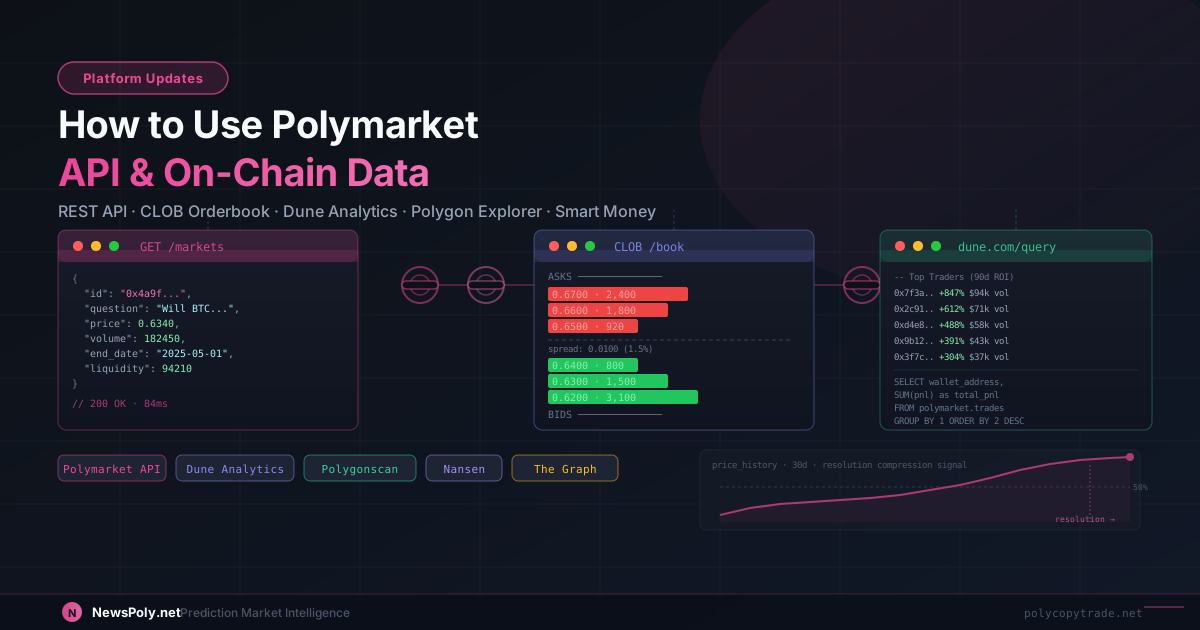
GET /markets — Returns a paginated list of all markets with metadata including question text, category, end date, volume, and current liquidity. Use query parameters like ?active=true to filter to live markets, or ?order=volume&ascending=false to surface high-volume opportunities.
GET /prices-history — Accepts a market_slug or condition ID and returns time-series price data. This is your primary tool for charting historical probability movements. You can specify intervals (1m, 5m, 1h, 1d) to build candlestick-style charts for any market. If you prefer to read these charts directly in the Polymarket interface rather than via the API, see our Polymarket charts guide.
GET /trades — Returns individual trade records with taker wallet address, size, price, and timestamp. This endpoint is the starting point for any whale-tracking or smart money analysis workflow.
GET /book — Returns the live order book snapshot for a given token, showing all open bids and asks with size. Analyzing the bid-ask spread and order book depth reveals whether a market is thinly traded (high opportunity, high slippage risk) or deep (tighter spreads, more accurate pricing).
Reading CLOB Order Book Data
The Central Limit Order Book is where serious price discovery happens on Polymarket. Unlike a simple AMM where prices are calculated by formula, CLOB markets aggregate real limit orders from real traders. Understanding the book gives you insight that raw price feeds cannot provide.
When you query /book?token_id={id}, you receive a JSON object with two arrays: bids and asks, each containing price-size pairs. A healthy market has tight spreads (bid-ask difference under 2%) and reasonable depth at multiple price levels. A distressed or thinly-traded market may show wide spreads of 5–15%, which can either be a risk or an opportunity depending on your thesis.
Pay close attention to large resting orders. A whale placing a 10,000 USDC limit buy at 45 cents is communicating a strong belief that the outcome probability is above 45%. These signals often precede significant price moves as informed money pushes back against mispriced markets — the same dynamic covered in depth in the guide to finding mispriced Polymarket markets.
Dune Analytics: Dashboards Without Code
If you are not a developer, Dune Analytics is your most powerful gateway to Polymarket on-chain data. Dune indexes Polygon blockchain data and provides a SQL query interface with a library of community-built dashboards — many of which focus specifically on Polymarket.
Searching "Polymarket" on Dune Analytics surfaces dozens of dashboards tracking:
- Total platform volume over time and by category
- Daily active traders and wallet retention metrics
- Top traders by profit and loss over rolling 30/90-day windows
- Market resolution accuracy by category (politics vs. crypto vs. sports)
- USDC liquidity inflows and outflows to the protocol
The top traders leaderboard dashboards are particularly valuable. They surface wallet addresses with consistent track records — wallets you can then watch on Polygonscan for new position entries.
Tracking Whale Wallets on Polygon Explorer
Once you have identified a high-performing wallet address from Dune Analytics or the /trades API endpoint, you can monitor it directly on Polygonscan (polygonscan.com). Set up a free account to create watchlists and receive email alerts whenever a tracked wallet interacts with the Polymarket smart contracts. For a dedicated deep-dive into monitoring large-position traders, see our Polymarket whale tracking guide.
Tools like Nansen take this further, labeling wallets by entity type and providing portfolio analytics across DeFi protocols. While Nansen requires a paid subscription, its Polymarket-specific smart money signals can identify when sophisticated funds are taking large positions hours before prices reflect the new information.
A practical workflow: identify the top 20 wallets by 90-day ROI on Dune, add them to a Polygonscan watchlist, and check for new Polymarket contract interactions each morning. Any wallet on that list entering a market significantly below current price is a signal worth investigating.
Price History Analysis: Patterns Worth Knowing
Pulling price history via the API for hundreds of resolved markets reveals several repeatable patterns. For a dedicated deep-dive into accessing, cleaning, and analysing Polymarket's complete historical dataset — including backtesting workflows and Dune SQL examples — see the Polymarket historical data guide.
Resolution compression: In the final 48–72 hours before a scheduled resolution event, markets tend to compress toward the expected outcome. If you identify a market trading at 60 cents with resolution imminent and strong confirmatory signals, the remaining 40 cents of uncertainty may be largely noise — representing a potential edge.
Liquidity withdrawal before resolution: Sophisticated market makers often pull their orders in the 24 hours before resolution, widening spreads. This can create brief mispricings for nimble traders willing to provide liquidity in that window.
Post-event drift: Some markets — particularly those relying on official certification or bureaucratic confirmation — resolve later than traders expect. Price can drift down from 90 cents toward 70 as impatient holders exit, only to snap back to 99 cents when the official resolution finally occurs.
Essential Tools Summary
- Polymarket API Docs —
docs.polymarket.com— REST API reference for market, trade, and order book data - Dune Analytics —
dune.com— SQL dashboards over on-chain data, no coding required - Polygonscan —
polygonscan.com— Raw transaction explorer, wallet watchlists, contract interaction history - Nansen —
nansen.ai— Labeled wallet intelligence and smart money tracking across Polygon - The Graph Protocol — Subgraph queries for Polymarket contract data in GraphQL format
Using Data to Find Structural Edges
The three most actionable use cases for this data stack are. For traders who want to act on these signals automatically, see our guides on Polymarket trading bots and copy trading automation setup.
Thinly-traded markets: Sort markets by volume ascending. Low-liquidity markets with wide spreads are often ignored by professional market makers, leaving pricing inefficiencies for informed traders willing to research the underlying question carefully.
Smart money flows: When multiple top-performing wallets independently enter the same position within a short window, that confluence is a meaningful signal — and a core reason to consider Polymarket copy trading — especially when it diverges from the current market price. PolyCopyTrade is built on exactly this on-chain data infrastructure, automatically detecting and copying those smart money signals so you benefit from them without building the tracking pipeline yourself.
Resolution-approaching markets: Filter for markets expiring within 7 days. Cross-reference their current prices against available public information about the likely resolution. Markets priced at 60–70 cents on outcomes that are 90% likely based on public data represent the clearest edge in the ecosystem — this applies to any category, but is especially pronounced in the Polymarket crypto markets guide space where derivatives data provides an additional calibration signal. For on-chain resolution data specifically — including how to query UMA oracle settlement transactions and dispute history — see our Polymarket UMA oracle guide.
Frequently Asked Questions
Does the Polymarket API require an API key or authentication?
Most read endpoints on both the Gamma Markets API and the CLOB API are publicly accessible without any API key or account registration. You can start querying market data, price history, and trade records immediately with a simple HTTP client or browser. Write operations — such as placing orders — require wallet authentication via the standard Web3 signing flow.
How accurate is Dune Analytics data for Polymarket analysis?
Dune Analytics indexes directly from Polygon blockchain data, making it highly accurate for historical trade records, volume figures, and wallet activity. However, there is typically a 1–2 hour indexing lag for the most recent data. For real-time order book and price data, the Polymarket CLOB API is more appropriate. Use Dune for historical trend analysis and wallet research, and the API for live trading signals.
Is it legal and ethical to track other traders' wallets on Polymarket?
Yes, completely. All Polymarket transactions occur on a public blockchain — there is no private data being accessed. Blockchain explorers like Polygonscan simply display data that is inherently public by design. This is fundamentally different from front-running in traditional markets; you are reading publicly broadcast information, not accessing privileged order flow. Polymarket's own terms of service do not restrict on-chain data analysis, and the practice is standard across DeFi trading.