Most people who lose money on Polymarket lose it the same way: they make impulsive trades on markets they haven't researched, size their positions too aggressively, and have no systematic approach to managing risk. Copy trading solves all three problems at once.
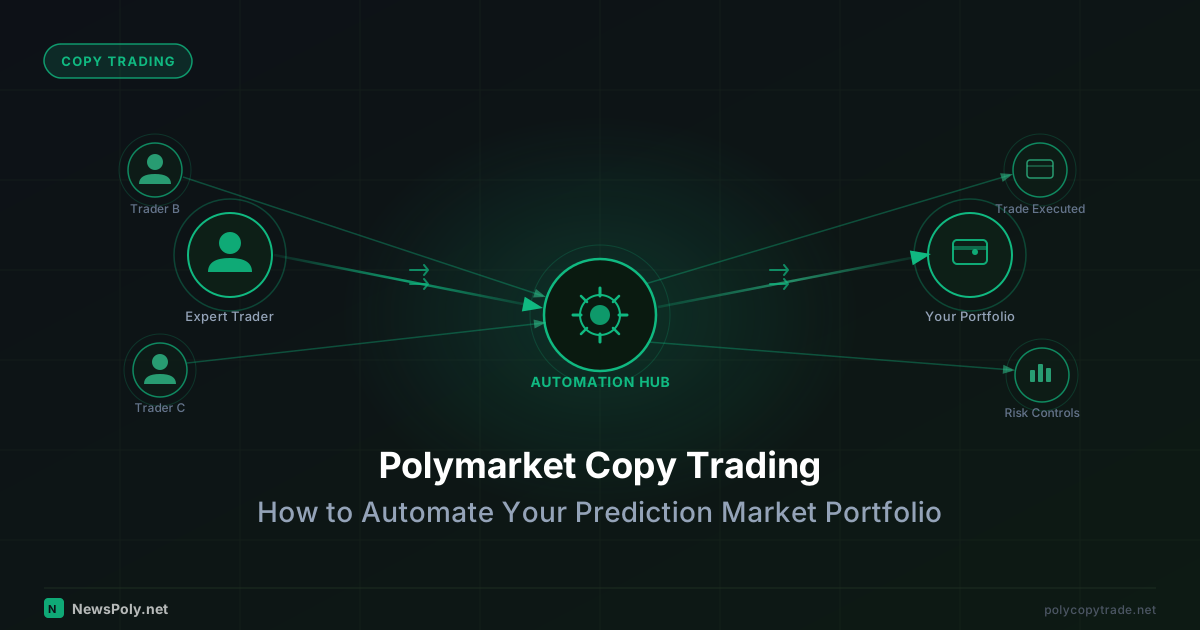
Instead of doing your own research for every political event, economic release, or sports outcome, you identify traders who have already proven they can beat the market — and then a bot automatically mirrors their positions in your account, in real time, with your own capital. Your keys, your funds, fully automated. (For a full primer, see our guide to what Polymarket copy trading is.)
This guide walks you through the complete setup: from choosing the best Polymarket copy trading platform to configuring position sizing, setting risk controls, and knowing when to stop copying a trader who has lost their edge.
What Polymarket Copy Trading Automation Actually Means
Traditional copy trading on stock platforms like eToro works through a centralized broker who holds your funds. Polymarket copy trading is different. Because Polymarket runs on-chain (Polygon), any copy trading system has to interact with your wallet directly — which means the best implementations are non-custodial smart contract-based. You connect your wallet, set your parameters, and a bot executes trades on your behalf without the platform ever holding your USDC.
This matters for two reasons. First, you're not trusting a third party with custody of your funds. Second, execution is genuinely automated — positions are opened and closed without you having to approve each transaction manually. When a trader you're copying buys YES on an election market, the bot replicates that trade in your account within seconds, proportionally sized to your configuration. The on-chain infrastructure that makes this possible is explained in detail in the Polymarket API and on-chain data guide.
Step 1: Choose Your Copy Trading Platform
Not all copy trading tools for Polymarket are built equally. The core things to evaluate are: whether execution is truly non-custodial, how up-to-date their trader performance data is, what risk controls are available, and whether you can copy multiple traders simultaneously.
The most fully-featured platform currently available for Polymarket copy trading is PolyCopyTrade. It supports non-custodial wallet connection, provides detailed analytics on every trader in its network, and gives you granular control over position sizing and risk limits — all in a single dashboard. We'll use it as the reference implementation throughout this guide, but the principles apply regardless of which tool you use.
Step 2: Evaluate Traders to Copy
This is the most consequential decision you'll make. Choosing the wrong traders to copy is worse than not copy trading at all, because it combines someone else's bad judgment with automation speed. Focus on these metrics:
ROI over a meaningful time period. A trader with 40% ROI over 15 trades is not the same as one with 40% ROI over 200 trades. Minimum threshold: look for at least 3 months of activity and 50+ completed markets before trusting the number.
Win rate vs. return per trade. These tell different stories. A trader with a 70% win rate but tiny average return might be grinding small edges. A trader with a 55% win rate but large average return is likely finding bigger pricing inefficiencies. Both can be profitable; understand which profile you're backing.
Market diversity. Traders who only bet on one category — say, crypto prices — have a narrow edge that may not survive regime changes. Traders who perform well across politics, economics, and sports have demonstrated broader analytical skill. For context on proven trading strategies across categories, it helps to understand what approaches hold up over time.
Maximum drawdown. Look at the worst losing streak in their history. A trader who once lost 60% of their bankroll over a month, even if they recovered, is a different risk profile than someone whose worst drawdown was 15%. Your automation will replicate that behavior.
Position sizing discipline. Avoid traders who routinely make all-in or near-all-in positions. Outsized single bets suggest either overconfidence or a willingness to gamble that will eventually destroy a bankroll — yours, in this case.
Step 3: Configure Position Sizing
Position sizing is the lever that determines how much of your bankroll is exposed on any single trade. Most copy trading platforms express this as a percentage of your allocated capital per position.
A conservative starting configuration is 2–5% of your allocated bankroll per trade. This means even a sustained losing streak of ten consecutive trades only draws down your account by 20–40% — painful, but survivable. More aggressive traders sometimes run 10% per trade, which accelerates gains but also concentrates risk significantly.
If you're copying multiple traders, you'll want to think about aggregate exposure. If Trader A and Trader B both enter the same market at the same time, your bot may execute two separate positions. A well-configured platform will let you set a total market exposure cap so you don't accidentally stack correlated bets.
Step 4: Set Risk Controls
Risk controls are the guardrails that protect you when a trader loses their edge — or when market conditions make their strategy temporarily ineffective. For a deeper dive into sizing and loss limits, see the full guide to Polymarket risk management. Set these before you activate automation, not after you've already lost money.
Daily loss cap. Define the maximum dollar amount you're willing to lose in a single day across all copy trades. When that threshold is hit, the bot pauses until the next day. This prevents a single bad session from wiping out a week's worth of gains.
Maximum position size. Regardless of what percentage a trader allocates to a trade, cap the absolute dollar amount your bot will deploy per position. If a trader goes all-in and you haven't capped this, your automation will follow.
Stop-loss per trader. Set a maximum cumulative loss per copied trader. If Trader A's positions have cost you more than X% of what you allocated to copying them, pause copying automatically and review. This is different from the daily cap — it's a longer-term performance circuit breaker.
Step 5: Monitor Performance
Automation doesn't mean set-and-forget. Markets change, trader edges erode, and sometimes someone who was excellent three months ago has simply been lucky. Build a weekly review habit:
Every Sunday, check each trader's performance over the prior 30 days specifically — not their all-time stats, which can mask recent deterioration. If a trader's 30-day ROI has turned negative while their all-time ROI remains positive, that's a warning sign worth investigating. Markets are seasonal and trend-dependent; what worked during an election cycle may not work during a quiet news period.
Tracking this performance data systematically is a core part of managing your Polymarket portfolio — knowing which positions to hold, which traders to keep copying, and when to rotate is as important as entry decisions. Look at the markets they've been entering recently. Have they stayed in their area of expertise, or are they branching into unfamiliar territory? Scope creep in a prediction market trader's portfolio is often a precursor to a losing streak. Advanced users can supplement this review with on-chain whale tracking techniques to independently verify whether the traders you're copying are still positioning with conviction.
Red Flags to Watch For
Before you copy anyone, screen for these disqualifying patterns:
- Very short track records. A trader with 2 weeks of history and 90% ROI has almost certainly been on a lucky run. Wait for at least 3 months before trusting the signal.
- All-in or near-all-in positions. Regular 80–100% allocation bets are gambling, not trading. The wins look spectacular; the inevitable loss is catastrophic.
- Single market focus. A trader who only bets on one specific politician's approval rating, or only crypto price markets, has a narrow edge. One regime change and their entire track record becomes worthless.
- Inconsistent activity. Traders who go weeks without entering any positions, then suddenly make 20 trades in a day, often lack a systematic approach. You want methodical, consistent activity.
Advanced: Copying Multiple Traders for Diversification
Once you're comfortable with the basics, consider allocating your capital across three to five traders instead of concentrating on one. This is the prediction market equivalent of portfolio diversification: if one trader has a bad month, the others may offset the drawdown. If you're also weighing which platform to use, the Polymarket vs Kalshi comparison explains why Polymarket's on-chain structure makes copy trading automation uniquely feasible.
When building a multi-trader portfolio, aim for diversity in strategy style, not just performance numbers. One trader who specializes in political markets, one in economic indicators, and one with a broader generalist approach gives you exposure to different types of pricing inefficiencies. Avoid copying multiple traders who are all heavily concentrated in the same market categories, as their positions will often be correlated.
Frequently Asked Questions
Is Polymarket copy trading non-custodial — does the platform hold my funds?
On reputable platforms like PolyCopyTrade, yes — execution is non-custodial. You connect your own wallet and the bot executes trades using your on-chain wallet credentials. The platform never takes custody of your USDC. You can verify every transaction on-chain and revoke wallet permissions at any time. Always confirm non-custodial execution before using any copy trading service with real capital. Bear in mind that profits generated through copy trading are taxable in most jurisdictions — see our Polymarket tax guide for how on-chain trading income is treated in the US and UK.
How much capital do I need to start copy trading on Polymarket?
There's no hard minimum, but practically speaking you need enough to make meaningful position sizes while maintaining diversification. If you're allocating 3% per trade and copying three traders, a $500 account produces $5 positions — functional but with limited upside. Most serious copy traders start with $1,000–$5,000 to get proportional exposure. The more important factor is that you only allocate what you can afford to lose entirely.
What's the difference between copy trading and a prediction market bot?
A prediction market bot typically uses algorithmic signals — statistical models, news feeds, or on-chain data — to generate its own trade ideas. Copy trading mirrors the decisions of human traders who are already active on the platform. Copy trading is generally more accessible (you're evaluating human track records rather than building models), while trading bots require technical sophistication and ongoing maintenance. Both can be automated; the source of the trade signal is different.
How do I know when to stop copying a trader?
The clearest signal is a sustained decline in 30-day rolling performance while your stop-loss threshold approaches. Beyond the numbers, watch for behavioral changes: traders who start entering markets outside their historical expertise, who dramatically increase position sizes, or who go quiet for weeks and then trade erratically are often compensating for a losing streak. Your pre-set stop-loss per trader should trigger automatically; the behavioral review is a qualitative layer on top of that protection.