Yes — Polymarket winnings are taxable in most jurisdictions, including the United States and the United Kingdom. Prediction market profits do not sit in a legal grey zone the way offshore casino winnings once did: you traded on-chain, every transaction is publicly logged on Polygon, and the IRS and HMRC both have explicit guidance that covers crypto-denominated financial activity. Ignoring the tax question is not an option. Getting it right, however, is more straightforward than it sounds — and this guide walks you through everything you need to know.
Disclaimer: This article is for informational purposes only and does not constitute tax advice. Consult a qualified tax professional for advice specific to your situation.
How the IRS Treats Prediction Market Winnings (US)
The Internal Revenue Service does not yet have a dedicated ruling that addresses prediction markets by name, but existing guidance on crypto assets and event contracts makes the analysis reasonably clear. The IRS treats cryptocurrency — including USDC — as property under Notice 2014-21. That foundational position means every Polymarket outcome that changes your USDC balance is a taxable event, regardless of whether you ever converted USDC back to dollars.
When a Polymarket market resolves in your favour, the consensus view among US tax practitioners is that the gain is treated as a capital gain: the difference between what you paid for the YES or NO shares (your cost basis, denominated in USD at the time of purchase) and what you received at resolution. If you sold shares on the order book before resolution, the same analysis applies — you realised a capital gain or loss at the moment of sale.
The legal status of Polymarket for US persons adds a layer of complexity: Polymarket blocks US IP addresses, and some practitioners argue this affects the enforceability of any resulting contracts. That said, tax obligations do not disappear because a platform restricts access — the IRS taxes income and gains wherever they arise.
Short-Term vs. Long-Term Capital Gains
The length of time you hold your position before realisation determines which capital gains rate applies:
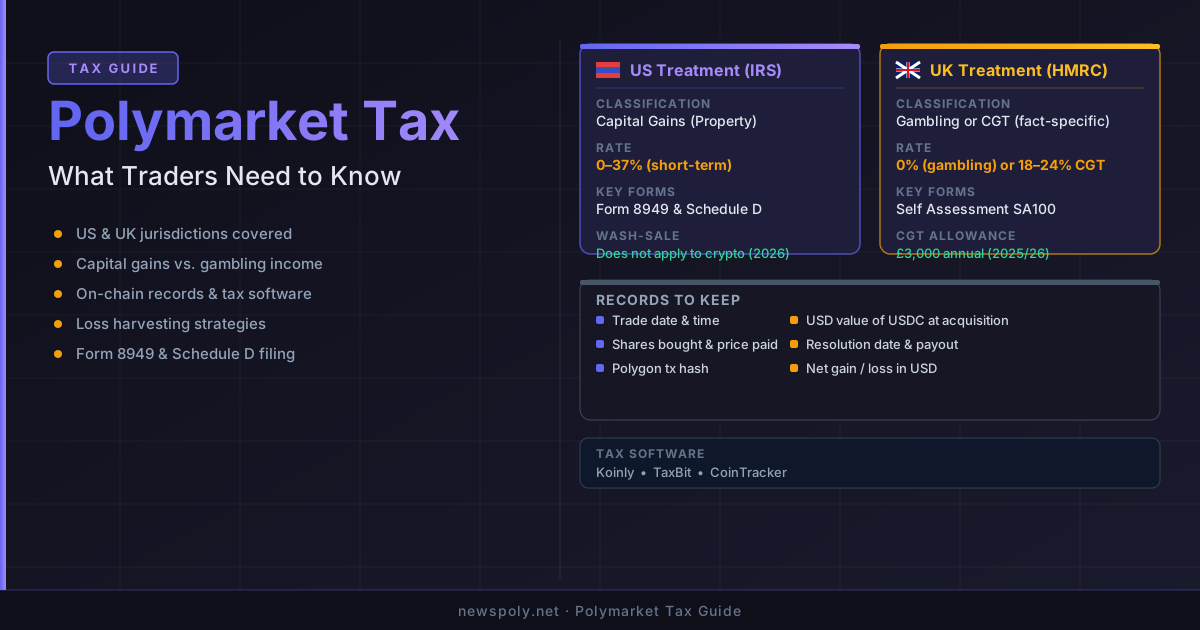
- Short-term capital gains apply to positions held for one year or less. These are taxed at your ordinary income rate — up to 37% for high earners in 2026.
- Long-term capital gains apply to positions held for more than one year. The preferential rates are 0%, 15%, or 20% depending on your taxable income bracket.
In practice, nearly all Polymarket positions are short-term. Most markets resolve within days, weeks, or a few months — well inside the 12-month threshold. The only scenario where long-term treatment becomes plausible is a very long-dated market (say, a multi-year macroeconomic contract) where you hold shares from purchase to resolution across a calendar-year boundary and beyond. For the vast majority of active traders, expect to pay short-term rates on your net gains.
The holding period starts on the day after you acquire the shares and ends on the day you sell or the market resolves. Keep exact dates for every position — this is the difference between a 15% rate and a 37% rate on the same gain.
Let your trades run on autopilot while you handle the paperwork. PolyCopyTrade executes trades automatically from your own wallet — your on-chain record stays clean and fully auditable for tax purposes.
The Gambling Income Question and IRS Form W-2G
A common question from new Polymarket users is whether winnings should be reported as gambling income rather than capital gains. The distinction matters because gambling income is reported on Schedule 1 as ordinary income, losses are only deductible up to the amount of winnings (no net loss deduction), and professional gamblers face self-employment tax.
The IRS requires payers to issue Form W-2G when gambling winnings exceed certain thresholds (e.g., $600 or more at certain odds, or $1,200 from slots). Polymarket, as a decentralised protocol, issues no W-2G and has no reporting relationship with the IRS — which means you bear the full self-reporting obligation.
Whether Polymarket activity constitutes "gambling" in the tax sense is genuinely unsettled. The better-reasoned argument — increasingly accepted by practitioners — is that prediction market contracts are closer to financial instruments than to casino wagers, supporting capital gains treatment. Our dedicated piece on gambling vs investment classification covers the legal and regulatory arguments in detail. The CFTC's treatment of event contracts (discussed below) reinforces the investment framing. Until the IRS issues formal guidance, the capital gains position appears more defensible for most traders, but this is precisely the kind of question where professional advice earns its cost.
CFTC Event Contract Classification and Tax Implications
The Commodity Futures Trading Commission classifies certain prediction market contracts as event contracts — a subset of derivatives regulated under the Commodity Exchange Act. Kalshi, Polymarket's US-regulated competitor, operates under CFTC oversight as a Designated Contract Market. Polymarket itself is an unregulated decentralised protocol, but the underlying contracts closely resemble CFTC-regulated event contracts in economic terms.
Why does this matter for taxes? CFTC-regulated futures and options on futures are subject to the 60/40 rule under IRC Section 1256: 60% of gains are treated as long-term regardless of holding period, and 40% as short-term. This is a genuinely favourable treatment. However, Section 1256 applies specifically to "regulated futures contracts" and "foreign currency contracts" — it does not automatically extend to all event contracts or to unregulated decentralised protocols. Whether any Polymarket positions could qualify for Section 1256 treatment is a nuanced question that tax counsel with derivatives experience should evaluate. Most practitioners advising on Polymarket positions default to straight capital gains treatment absent clear authority for Section 1256.
UK Tax Treatment: HMRC's Gambling vs. Investment Question
In the United Kingdom, HM Revenue & Customs draws a meaningful distinction between gambling and investment income — and where your Polymarket activity falls determines your liability entirely.
If HMRC classifies your activity as gambling: Gambling winnings are not subject to income tax or capital gains tax in the UK. HMRC's longstanding position is that betting and gambling profits are not taxable for the punter (the bookmaker pays Gambling Duty instead). If a tribunal determined that Polymarket trading is legally equivalent to gambling, UK traders might owe nothing on their winnings.
If HMRC classifies your activity as investment: Gains would be subject to Capital Gains Tax (CGT) at 18% (basic rate) or 24% (higher/additional rate) for the 2025/26 tax year. The annual CGT allowance is £3,000 for 2025/26; gains below this threshold are tax-free.
The classification test turns on substance and regularity. Occasional participation that resembles speculative punting leans toward gambling treatment. Systematic, high-frequency trading with analytical frameworks and large volumes leans toward investment. HMRC has not published specific guidance on decentralised prediction markets, so the analysis is fact-specific. UK traders with significant Polymarket activity should obtain a professional opinion before filing — the outcome can shift an entire liability to zero or create a substantial CGT bill.
Note also that USDC itself is a cryptoasset under HMRC's Cryptoassets Manual. Acquiring USDC, using it to buy prediction market shares, and receiving USDC at resolution each constitute taxable disposals of cryptoassets under HMRC's existing framework, even if the investment vs. gambling debate is unresolved.
What Records to Keep
Good record-keeping is not optional — it is the foundation of a defensible tax return. For every Polymarket position, you should retain:
- Date of purchase: The exact date (and ideally time) you acquired the shares. This sets the start of your holding period.
- Number of shares purchased: The quantity of YES or NO shares.
- Purchase price per share in USDC: The price you paid, which is your cost basis per share.
- USD value of USDC at time of purchase: USDC is nominally $1.00 but can deviate fractionally. Use the spot rate on the transaction date.
- Total cost basis in USD: Shares × price per share × USDC/USD rate on that date.
- Date of resolution or sale: When the position closed.
- Payout received in USDC: The gross amount before the 2% Polymarket fee.
- USD value of payout USDC: Again, USDC spot rate on the resolution date.
- Net gain or loss: Payout (USD) minus cost basis (USD).
- Transaction hashes: The Polygon transaction IDs for every on-chain action. These are your audit trail.
The USDC acquisition cost matters too — if you bought USDC on an exchange at a time when it briefly traded at $0.999 rather than $1.000, that fractional difference is technically relevant to your basis. Our USDC guide covers the mechanics of acquiring and managing USDC on Polygon.
Let your trades run on autopilot while you handle the paperwork. PolyCopyTrade executes trades automatically from your own wallet — your on-chain record stays clean and fully auditable for tax purposes.
How On-Chain Transactions Create a Tax Trail
One of the most important things to understand about Polymarket is that everything is permanently public. Every trade, every deposit, every withdrawal, every payout — all recorded immutably on the Polygon blockchain and queryable by anyone at Polygonscan.com. There is no privacy mode, no transaction deletion, and no way to dispute the record.
This has a dual implication. First, it is the strongest possible audit trail: if the IRS or HMRC ever asks, every transaction in your wallet history is independently verifiable down to the second. Second, it means that tax authorities with blockchain analytics capabilities (and both agencies now use them) can reconstruct your full trading history from your wallet address alone. Claiming ignorance of a profitable year is implausible when the on-chain record shows every payout.
From a record-keeping standpoint, this is actually helpful: you never need to rely solely on a platform’s export feature (which may change) because Polygonscan will always have your data. Bookmark your wallet address on Polygonscan and export your full transaction history at year-end. The CSV export includes timestamps, contract interactions, and USDC amounts — exactly what tax software needs.
For traders using withdrawal to move funds between wallets, keep a record of which wallet addresses you control. Moving funds between your own wallets is not a taxable event, but you must be able to demonstrate the wallets are under common ownership if questioned.
Crypto Tax Software That Handles Prediction Markets
Manual record-keeping for dozens or hundreds of Polymarket positions is error-prone and time-consuming. Crypto tax software can import your transaction history directly from Polygon and calculate gains, losses, and holding periods automatically. The main options as of 2026:
- Koinly — Wide Polygon support, handles ERC-20 tokens including USDC, generates IRS Form 8949 and Schedule D. Good for US filers. Also produces HMRC-compatible reports for UK users. Import via wallet address or CSV.
- TaxBit — Enterprise-grade platform with strong regulatory compliance focus. Handles Polygon transactions and supports US tax forms. Often used by traders with complex multi-exchange activity. Pricing is higher than Koinly for individual filers.
- CoinTracker — User-friendly interface, Polygon wallet sync, supports both US and UK tax regimes. Useful if your crypto activity spans multiple chains and exchanges. Produces Form 8949, Schedule D, and HMRC Section 104 pool calculations.
A caveat: none of these tools has native intelligence about Polymarket-specific contract interactions. They will typically classify inbound USDC from market resolution as a "receive" event — correct for tracking the proceeds, but you may need to manually tag the corresponding cost basis. Cross-reference the software’s output against your own position records before filing.
Loss Harvesting: Offsetting Polymarket Losses Against Gains
Capital losses on Polymarket positions can be used to offset capital gains elsewhere in your portfolio — including gains from stocks, crypto, or other prediction market positions. This is called tax-loss harvesting, and it is entirely legal and encouraged by the tax code. Before pursuing aggressive loss harvesting, it is worth understanding the full Polymarket fee structure, since the 2% resolution fee affects the net payout on every winning position and therefore your reportable gain.
For traders looking to maximise net returns before tax, our guide on how to make money on Polymarket covers the core strategies that generate consistent positive expectation. In the US, the loss harvesting mechanics work as follows:
- Short-term losses offset short-term gains first, then long-term gains.
- Long-term losses offset long-term gains first, then short-term gains.
- If total losses exceed total gains, up to $3,000 of net capital loss can be deducted against ordinary income per year. Excess losses carry forward to future years indefinitely.
The wash-sale rule — which disallows a loss if you repurchase the same security within 30 days — currently applies to securities but not to crypto assets under US law as of early 2026. This means you could realise a Polymarket loss by exiting a position at a loss, immediately re-enter a similar position, and still claim the loss. This advantage may not last: Congress has introduced wash-sale legislation for crypto in multiple sessions. Check current law before acting.
In the UK, HMRC has a bed and breakfasting rule (30-day rule) that does apply to cryptoassets: if you dispose of a cryptoasset and reacquire it within 30 days, the loss is matched against the reacquisition rather than earlier holdings, preventing artificial loss creation. UK traders should be aware of this when planning year-end tax harvesting.
Frequently Asked Questions
Do I owe tax on Polymarket winnings even if I never converted USDC to dollars?
In the US, yes. The IRS treats USDC as property. Receiving USDC at market resolution is a taxable realisation event measured by the USD value of the USDC you received, regardless of whether you converted it to fiat. The same logic applies in the UK under HMRC’s cryptoasset guidance. The "I didn’t cash out" argument has been rejected in multiple IRS guidance documents and does not provide protection.
What if Polymarket is blocked in my country — does that affect my tax obligation?
No. Tax obligations are determined by your residency and the nature of the income, not by whether the platform complies with your country’s access rules. If you used a VPN or other method to access Polymarket from a restricted jurisdiction, your tax obligation on any resulting gains is unchanged. You may also face separate compliance issues related to accessing a restricted platform, which is an additional reason to consult a professional.
How do I report Polymarket gains on my US tax return?
Capital gains from Polymarket positions are reported on IRS Form 8949 (Sales and Other Dispositions of Capital Assets) and summarised on Schedule D of Form 1040. Each position is listed individually on Form 8949 with the acquisition date, sale/resolution date, proceeds, cost basis, and resulting gain or loss. Crypto tax software can generate a pre-populated Form 8949 from your transaction history. If you have a very large number of transactions, you can aggregate by category with a summary line and attach a transaction detail statement.
Can I deduct the Polymarket 2% resolution fee as a trading cost?
Yes. Fees paid to execute or close a transaction are generally deductible as part of the cost of the transaction. The 2% Polymarket fee reduces your net proceeds, which reduces your reportable gain (or increases your reportable loss). In practice, crypto tax software should account for this automatically if it correctly identifies the fee deduction from your USDC payout. If calculating manually, subtract the fee from your gross payout before computing the gain.
Let your trades run on autopilot while you handle the paperwork. PolyCopyTrade executes trades automatically from your own wallet — your on-chain record stays clean and fully auditable for tax purposes.