Whether Polymarket counts as gambling is not just a philosophical question — it determines which regulator has jurisdiction, whether participation is legal where you live, how your profits are taxed, and whether banks and payment processors will work with the platform. The answer, across most of the legal frameworks that matter, is no: Polymarket is not gambling. But the reasoning behind that answer is worth understanding in detail.
The Legal Definition of Gambling
Most gambling laws, across jurisdictions ranging from US states to EU member states to the UK Gambling Commission, define gambling around three core elements:
- Consideration — You pay something to participate
- Chance — The outcome is determined at least partly by chance
- Prize — You can win money or something of value
Polymarket satisfies elements one and three — you put up USDC to participate and you can profit. The critical question is element two: is the outcome determined by chance?
For casino games, the answer is clearly yes — a roulette wheel, a slot machine, or a blackjack hand has an element of chance that cannot be eliminated by skill or information. For prediction markets, the answer is substantially different. Whether Joe Biden will be re-elected, whether Bitcoin will reach $100,000, or whether a specific court case will resolve in a particular way — these are not random events. They are outcomes driven by real-world causation that can be researched, analysed, and forecast with varying degrees of accuracy. Information and skill directly affect your expected outcome in a way that is categorically different from a casino game.
How Does the CFTC Classify Polymarket?
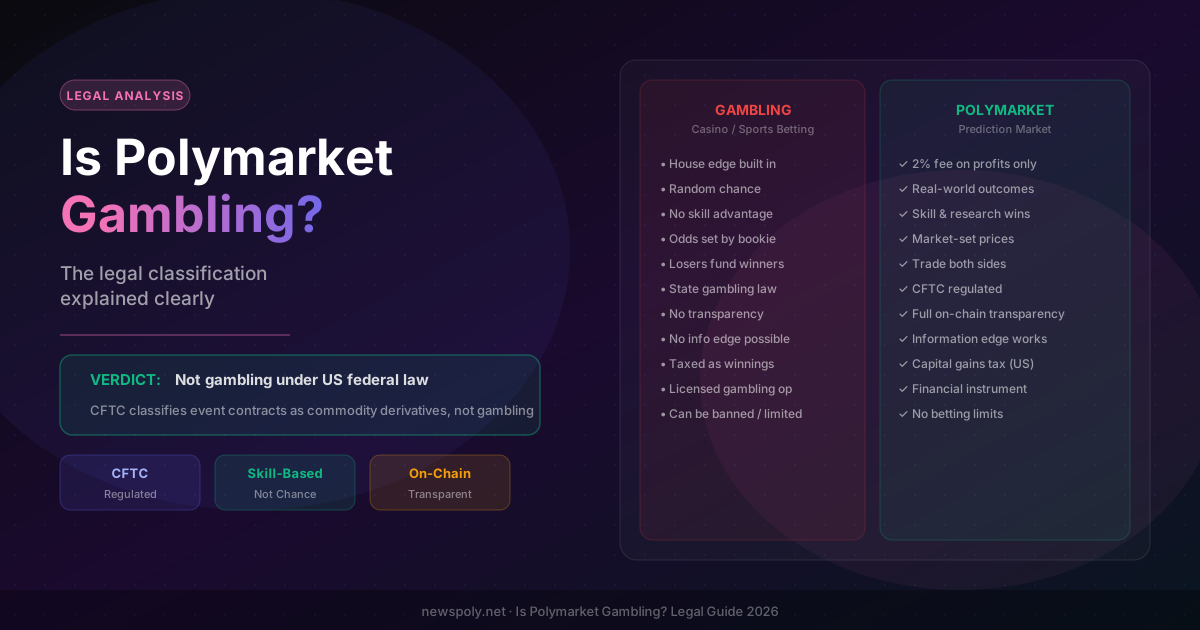
The Commodity Futures Trading Commission (CFTC) — the primary US regulator with jurisdiction over Polymarket — classifies event contracts as commodity derivatives, not gambling products. The CFTC's regulatory framework treats prediction market contracts the same way it treats futures contracts on commodity prices: as financial instruments where participants take positions on future outcomes.
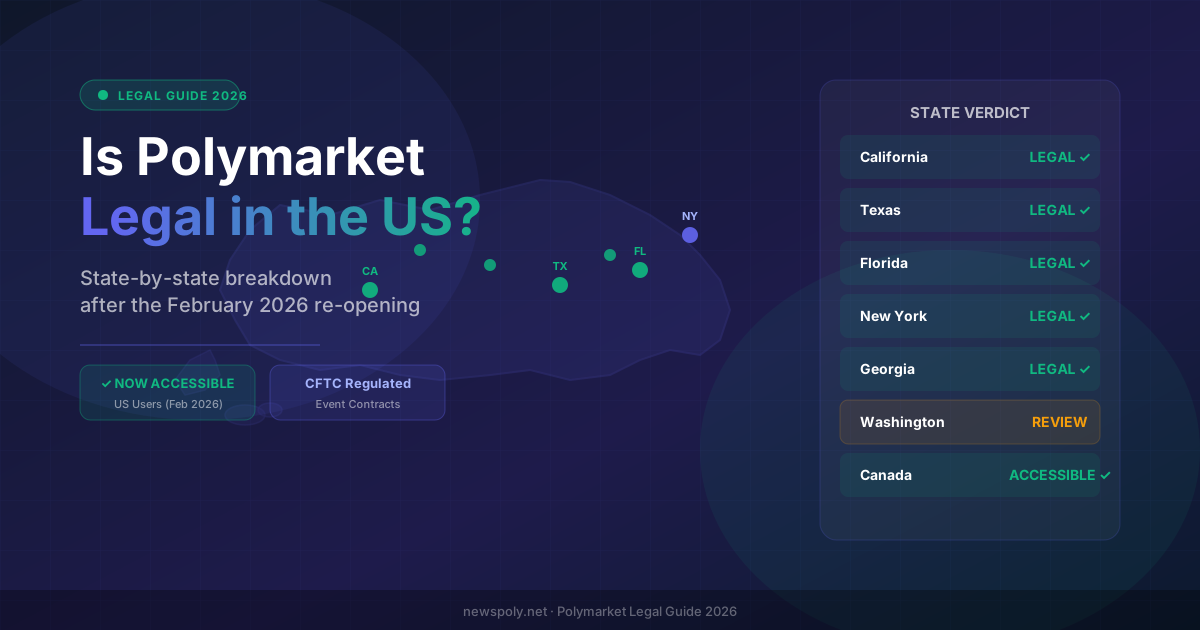
This classification is legally significant: it places Polymarket under the CFTC's jurisdiction rather than state gambling regulators. In 2022, the CFTC fined Polymarket for operating an unregistered facility — not for operating an illegal gambling site. The enforcement action was about registration requirements for financial instruments, not a finding that prediction markets are gambling. Following the settlement, Polymarket restructured its compliance approach and re-opened to US users in February 2026. For the complete state-by-state breakdown of Polymarket’s US legal status, see our guide to whether Polymarket is legal in the US.
Prediction Markets vs Sports Betting: The Key Differences
Sports betting is the closest analogue to prediction markets that most people are familiar with. The differences are substantial:
- House edge — Sportsbooks charge vig (typically 4–10%) on every bet. Polymarket charges a 2% fee on profits only, and prices are set by market participants rather than a bookmaker. There is no guaranteed house profit margin baked into every market
- Market-making — In sports betting, you bet against the house. On Polymarket, you trade against other market participants. Sophisticated participants can be market-makers and earn the spread, not just takers
- Information edge — Sports betting lines are set by professional oddsmakers who adjust for public money and sharp action. Polymarket prices are set by the crowd, creating persistent mispricings that information-driven traders can exploit consistently
- On-chain transparency — All Polymarket positions are publicly visible on the blockchain. There are no private institutional positions hidden from retail traders
For a full comparison, see our Polymarket vs sports betting guide. If you are considering alternatives to Polymarket — whether for regulatory reasons, market selection, or geographic access — our Polymarket alternatives guide covers Kalshi, Betfair, Metaculus, and Manifold side by side.
Is Polymarket a Legal Gambling Site?
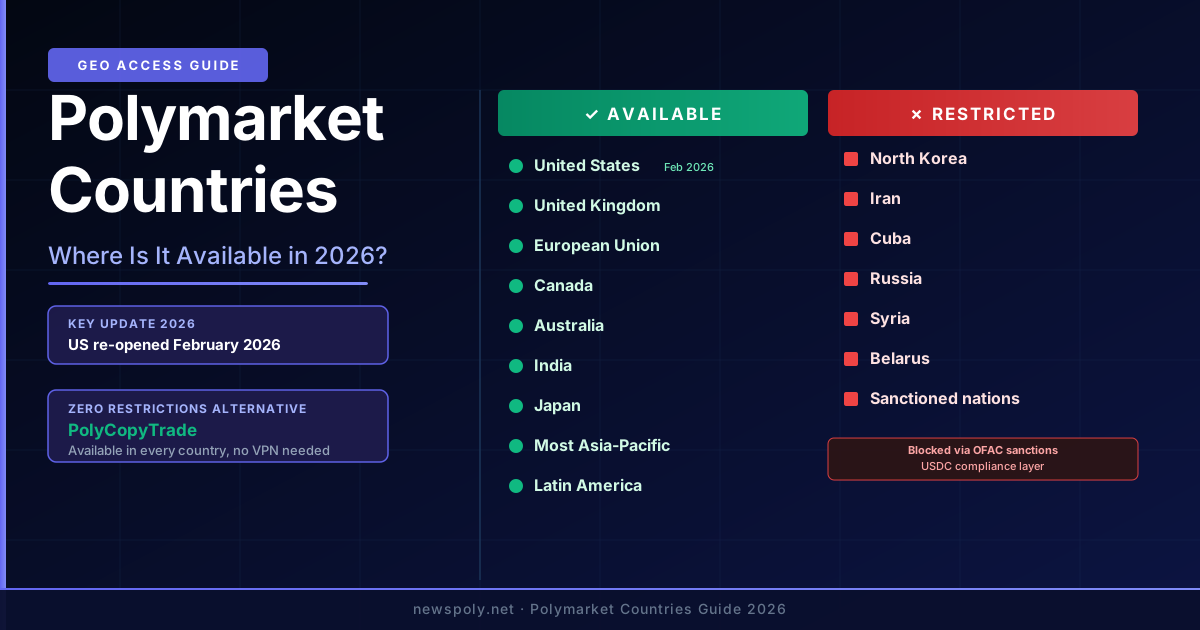
No. Polymarket is not licensed as a gambling operator in any jurisdiction. It operates as a prediction market platform offering event contracts regulated as financial instruments under CFTC oversight. Accessing Polymarket does not constitute gambling under the regulatory frameworks of the United States (federal), the United Kingdom, most EU member states, Canada, or Australia. If you are evaluating whether to trade on the platform, our Polymarket review 2026 provides an independent assessment of platform safety, fees, and legitimacy — our guide to whether Polymarket is safe covers the smart contract security model and wallet risks in detail — and our guide to whether Polymarket is legit covers the on-chain trust model.
There are jurisdictions where the legal picture is less clear, typically countries where gambling law is broad enough to potentially capture any form of online wagering. In those jurisdictions, the practical question of whether prediction market participation constitutes gambling depends on local legal interpretation rather than any settled law. However, the mainstream regulatory view — particularly in the US and UK where the most developed legal frameworks exist — treats prediction markets as financial instruments rather than gambling products.
What Does This Mean for Taxes?
Tax treatment of Polymarket profits varies by country, but the non-gambling classification has significant implications:
- United States — Polymarket profits are generally treated as capital gains or ordinary income depending on holding period and trading frequency, not as gambling winnings. The CFTC's classification as commodity derivatives is the relevant framework. Consult a US tax professional for your specific situation
- United Kingdom — Gambling winnings are tax-free in the UK. If HMRC were to classify Polymarket as gambling, profits would be tax-exempt. If classified as investment income or trading profit, they would be taxable. The UK regulatory status of prediction markets is actively evolving. For a detailed breakdown of both US and UK treatment, see our Polymarket tax guide
- European Union — Treatment varies by member state. Most EU countries classify prediction market income as capital gains or investment income rather than gambling winnings
Tax law changes frequently and varies by individual circumstances. The above is general information, not tax advice — consult a qualified tax professional in your jurisdiction.
Is Polymarket Accurate? Does Skill Actually Matter?
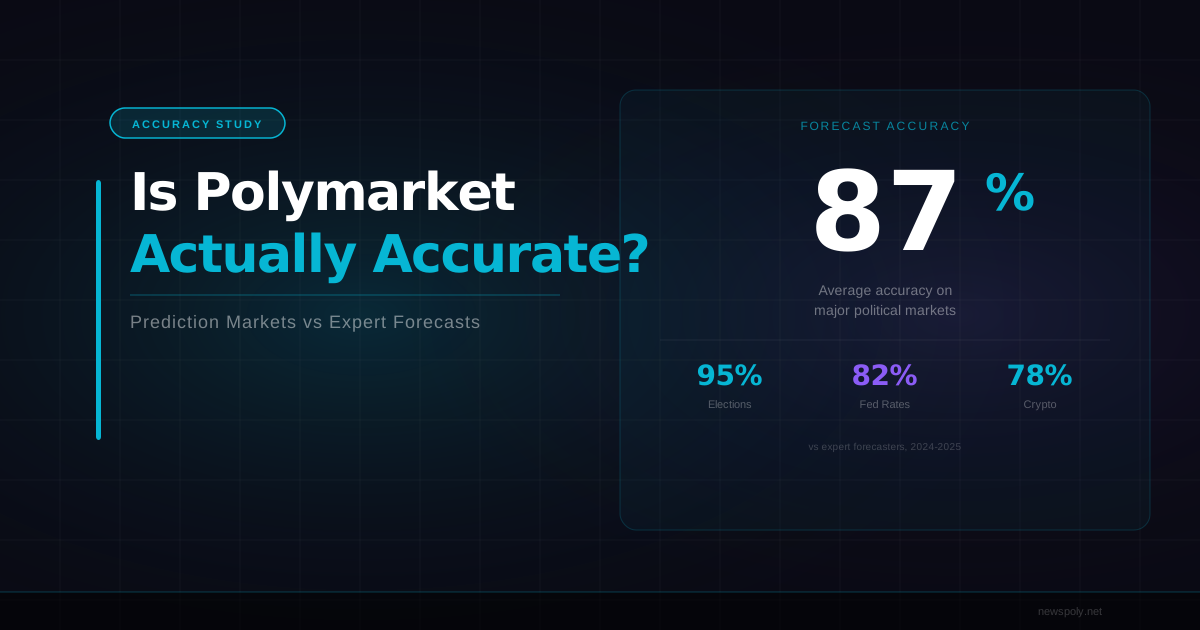
The claim that prediction markets are skill-based rather than chance-based requires empirical support. The evidence is strong:
- Persistent top performers — A minority of Polymarket wallets consistently outperform across hundreds of resolved trades, over timeframes too long to explain by luck alone. The statistical likelihood of a wallet maintaining 20%+ ROI across 300+ diverse markets through chance alone is negligibly small
- Information-driven price movements — Polymarket prices demonstrably move in response to real-world information: new polling data, regulatory announcements, on-chain protocol developments. Participants who access and correctly interpret this information before the market incorporates it earn consistent returns
- Superforecaster performance — Academic research on forecasting tournaments, including superforecaster studies, confirms that some individuals have demonstrable, repeatable skill at probabilistic forecasting. Prediction markets are the financial implementation of this skill
The existence of skill does not mean chance is absent. Events can resolve against even the best-calibrated probability estimates. But the distribution of outcomes in prediction markets is systematically influenced by participant skill in a way that casino games are not.
Frequently Asked Questions
Is Polymarket gambling?
Under most legal frameworks, no. Polymarket is classified as a prediction market offering event contracts — financial instruments regulated by the CFTC in the US. The outcome of events traded on Polymarket is driven by real-world causation, not random chance, and information and skill directly affect expected returns. This distinguishes it legally and practically from gambling.
Is Polymarket a legal gambling site?
No. Polymarket is not a licensed gambling operator. It operates as a prediction market platform under CFTC oversight in the US. It is not registered with any gambling regulator and is not subject to gambling law in the US, UK, or most major jurisdictions.
Can you lose money on Polymarket?
Yes. Prediction markets carry real financial risk. Even well-calibrated probability assessments will lose a meaningful percentage of the time — a market at 80% YES resolves NO 20% of the time on average. Applying sound risk management practices is essential for anyone trading on Polymarket with meaningful capital.
Is using PolyCopyTrade considered gambling?
No. PolyCopyTrade is an automated copy trading tool that mirrors the positions of verified high-performing Polymarket traders. The underlying positions it copies are event contracts — financial instruments, not gambling products. The automation layer does not change the legal classification of the underlying trades.