If you've spent any time beating sportsbooks — line shopping, tracking CLV, running positive EV models — you've probably noticed the walls closing in. Accounts get limited. Limits shrink. The edges that took months to find get arbitraged out within hours. A growing number of sharp bettors are looking at Polymarket and asking: could prediction markets be a better game?
The honest answer is nuanced. Polymarket and sports betting are genuinely different beasts, and each has real advantages and drawbacks. This comparison cuts through the noise and gives you the numbers that matter.
The House Edge: Vig vs. Polymarket's Fee Structure
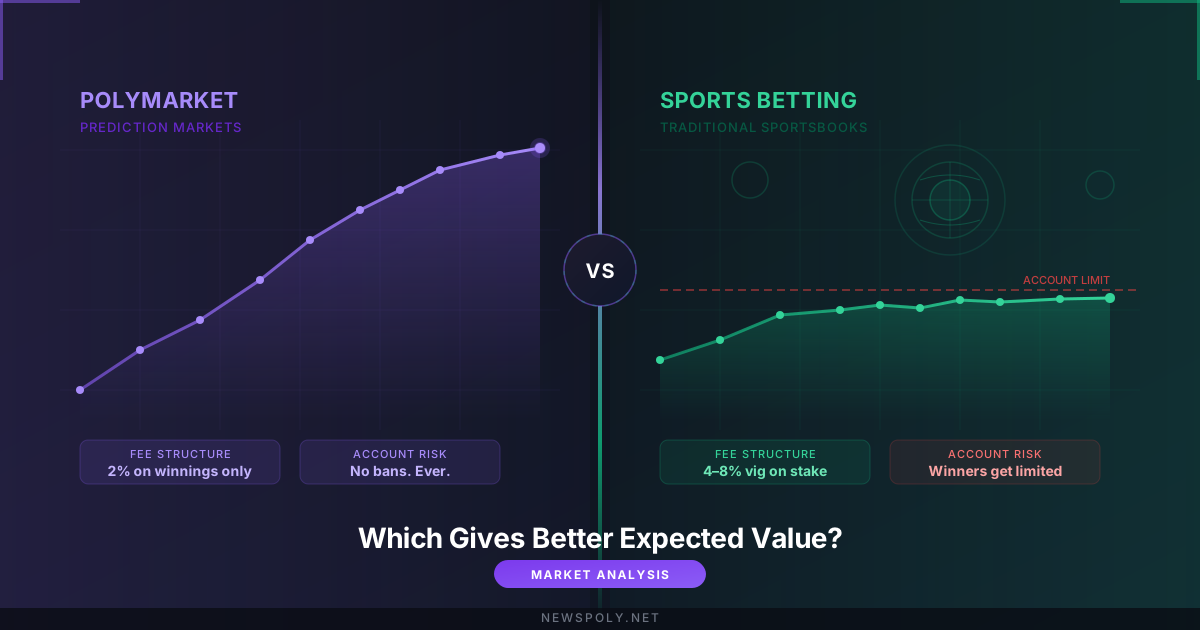
In traditional sports betting, the house edge is built into the spread through the vigorish (vig). On a standard -110/-110 two-sided market, the bookmaker retains roughly 4.5% of every dollar wagered. On single-game parlays, player props with juice, and futures markets, that figure climbs to 8–15% or higher. Even the best offshore books rarely get below 3–4% on mainline markets.
Polymarket operates on a fundamentally different model. The platform charges a 2% fee on winnings only — not on the notional stake. If you buy shares at $0.70 and they resolve at $1.00, you pay 2% of your $0.30 profit, not 2% of your $0.70 buy-in. On a risk-adjusted basis, this is dramatically cheaper than traditional vig. For a bettor operating at scale, this fee difference compounds into a significant annual cost advantage.
There's also a market-maker spread to account for — the gap between the best bid and best ask. On high-liquidity Polymarket markets (major election outcomes, Fed rate decisions), this spread is often just 1–2 cents. On thin political or science markets it can reach 5–10 cents, which partially offsets the fee advantage. Liquidity-aware sizing is essential.
Account Restrictions: The Biggest Hidden Cost in Sports Betting
Sharp bettors know the real cost of sports betting isn't the vig — it's the account lifecycle. Recreational books will limit a winning player after just a few weeks of positive results. Sharp books tolerate more action but cap limits on known winners. Getting banned from five books means your entire edge-finding operation has a shelf life.
Polymarket is permissionless and non-custodial. It runs on the Polygon blockchain, and no centralized authority can restrict your position size based on past profitability. A wallet that has correctly called 50 consecutive elections faces zero additional friction compared to a brand new wallet. The protocol does not distinguish winners from losers. For a sharp player, this is not a minor convenience — it is a structural advantage that changes the long-run expected value calculation entirely.
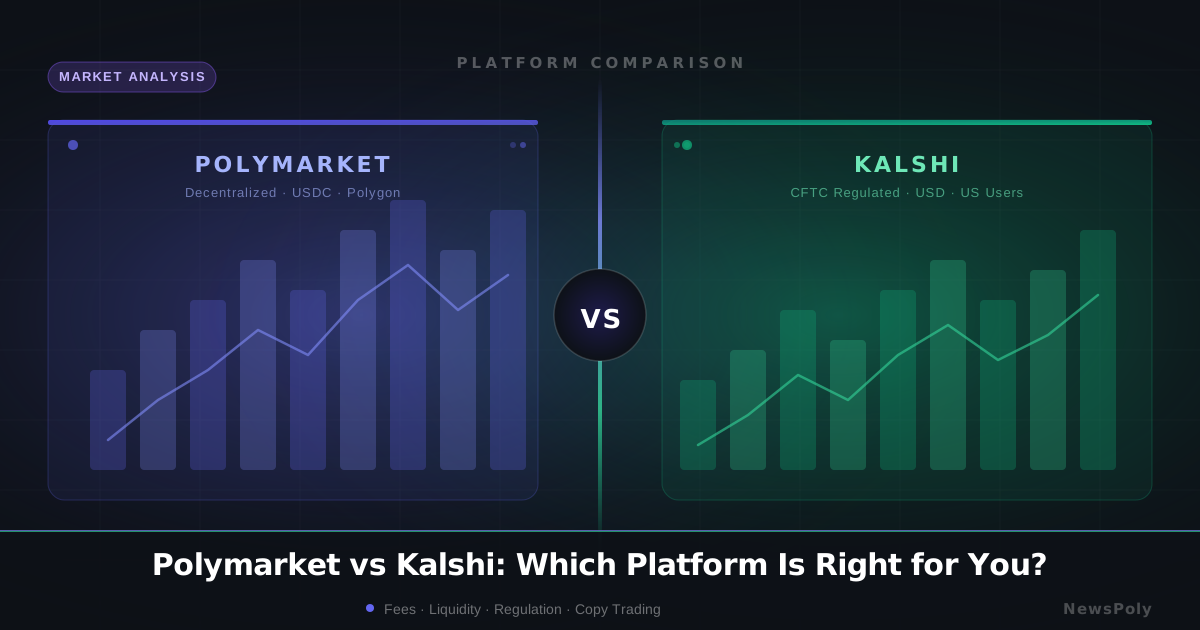
The only current restriction is geographic: US residents are blocked from the main interface via IP and KYC, though the underlying contracts remain accessible. Our Polymarket vs Kalshi comparison shows how the CFTC-regulated alternative compares for US traders, while our Polymarket vs Betfair comparison covers the European exchange-betting angle. For a broader overview of all available prediction market platforms, see our Polymarket alternatives guide covering Kalshi, Betfair, Metaculus, and Manifold. This regulatory environment is evolving rapidly.
Market Efficiency: Where Is the Edge Larger?
Sports betting markets — particularly NFL, NBA, and major soccer — are among the most efficient wagering markets on earth. Sophisticated syndicates and quant shops move lines within seconds of sharp action. Public information gets priced in almost instantly. The edge available to individual sharp bettors has compressed significantly over the past decade.
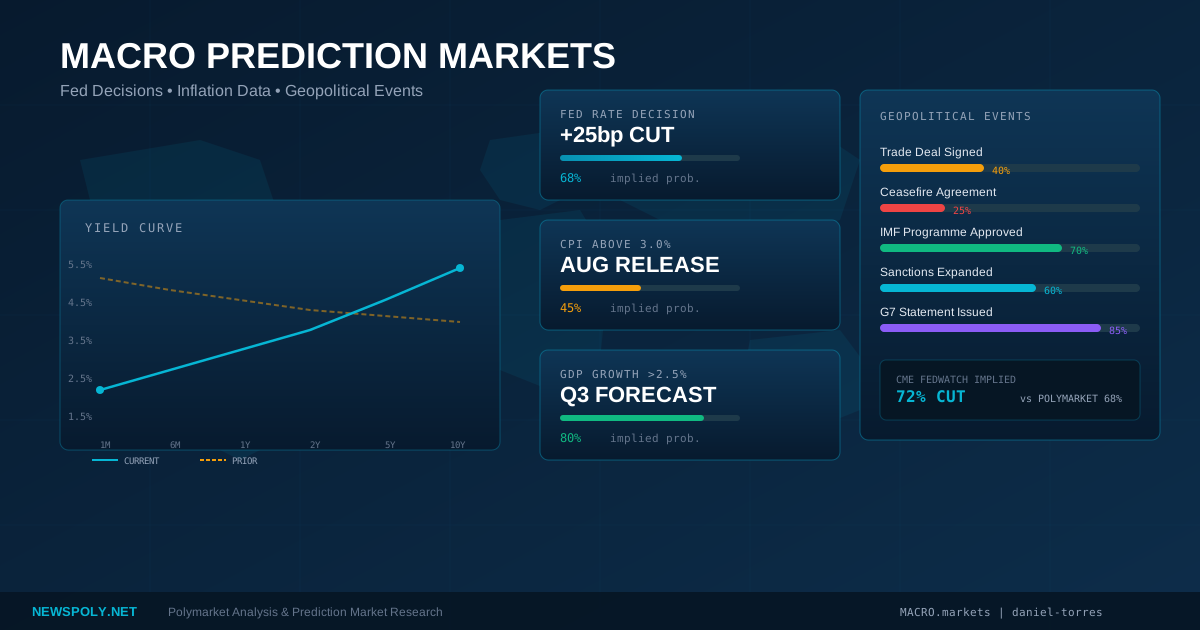
Prediction markets tell a different story. Academic research consistently documents finding mispriced markets on prediction platforms — mispricings that persist for days or weeks, particularly on:
- Low-salience political events — state-level races, regulatory decisions, legislative votes
- Scientific and economic outcomes — GDP prints, CPI releases, FDA approval timelines
- Recency-biased markets — where the crowd over-weights recent news
- Long-duration contracts — where patient capital has a genuine edge over speculative traders
Sports markets on Polymarket itself are relatively thin, which means the efficiency advantage of traditional sportsbooks actually applies here — major sporting events on Polymarket tend to track sharp book lines closely, so that's not where the Polymarket alpha lives. (Our Polymarket sports markets guide covers which sporting events attract the most liquidity and where opportunities exist.) The edge is in non-sports domains.
Market Variety and Topic Breadth
A sports bettor's universe is defined by schedules. No NFL games means no NFL action for months. Polymarket's market catalog spans politics, economics, technology, science, geopolitics, and yes, some sports — and unlike sportsbooks, Polymarket is permissionless and transparent in how it works and whether it's legitimate. At any given moment there are hundreds of active markets across entirely different domains. For a researcher-type bettor who builds edges through information asymmetry rather than model speed, this breadth is a major advantage — your edge in one domain doesn't crowd out your edge in another.
On-Chain Transparency vs. Sportsbook Opacity
Every Polymarket trade is recorded on-chain and publicly auditable. You can see the full order book history, track how large wallets have positioned, and verify resolution outcomes against on-chain data. There are no hidden fees, no "bet acceptance" delays, and no ambiguity about whether your order was filled at the quoted price.
Compare this to sportsbooks, where you have no visibility into the line movement logic, no guarantee your bet won't be voided post-settlement under obscure house rules, and no recourse if the book decides to withhold winnings. On-chain settlement is simply more trustworthy — and for large positions, that trustworthiness has real dollar value.
Tax and Regulatory Considerations
Sports betting winnings in the US are taxed as ordinary income. Books issue W-2Gs above certain thresholds and the tax treatment is well-established. Polymarket's on-chain transactions are also taxable events (capital gains or income depending on treatment), but the regulatory framework is still evolving. Currently, US users face access restrictions that make this moot domestically — but international users operating in permissive jurisdictions may find prediction markets offer cleaner regulatory treatment than licensed sportsbooks.
Always consult a tax professional familiar with both crypto and gambling regulations in your jurisdiction before making decisions based on tax treatment.
Head-to-Head Comparison
| Factor | Sports Betting | Polymarket |
|---|---|---|
| House Edge | 4–8% vig on stake | 2% on winnings only |
| Account Restrictions | Winners routinely banned | Permissionless, no bans |
| Market Efficiency | Very high (mainline markets) | Moderate — mispricings exist |
| Market Variety | Sports only | Politics, finance, science, sports |
| Transparency | Opaque (book-side logic hidden) | Full on-chain audit trail |
| Liquidity (top markets) | Very high | High (majors), low (niche) |
| Profit Ceiling | Low (accounts get limited) | Uncapped per protocol |
| Settlement Trust | Book-controlled | On-chain, auditable |
Who Should Switch — and Who Shouldn't
If you're a recreational bettor who bets primarily for entertainment on your local team, Polymarket is probably not a natural fit. The markets require genuine research and probabilistic thinking — they're not fun in the same social way that sports betting can be.
But if you're a sharp bettor who already uses CLV tracking, runs EV models, or approaches betting as a systematic process, Polymarket will feel immediately familiar. The core skill set transfers directly: finding mispricings, sizing positions by edge, managing exposure across correlated markets, and applying the top Polymarket trading strategies used by experienced participants. One hidden edge to be aware of is cognitive biases in prediction market trading — understanding these gives sharp bettors an additional advantage over the crowd. The difference is that your skills won't get you banned, and the markets you're exploiting are genuinely less efficient than the NFL lines you've been grinding. Tools like Polymarket copy trading bots let you go further still — automatically mirroring the positions of the platform's top-performing wallets so systematic execution keeps pace with your research.
The optimal path for many serious bettors isn't "switch" — it's "add." Polymarket adds a second venue where your edge has a longer runway and your account has no lifecycle limit.
The Bottom Line on Expected Value
For a practical framework on calculating your edge and applying the EV formula to Polymarket positions, see our guide on Polymarket expected value.
For a sophisticated bettor focused purely on long-run EV, Polymarket has a structurally better deal: lower fees, no account restrictions, genuine mispricings to exploit, and full transparency. Sports betting has better liquidity on specific events and a more established regulatory framework, but the profit ceiling for winning players is artificially capped by account management.
The sharpest edge in 2025 isn't choosing between sports betting and prediction markets. It's recognizing that the skills developed beating sportsbooks translate almost perfectly to Polymarket — a venue where those same skills face less competition and have no ban risk. The players who understand this earliest will have the longest edge windows.
Frequently Asked Questions
Is Polymarket's 2% fee actually cheaper than sportsbook vig?
Yes, in most cases. Sportsbook vig of 4.5% applies to your entire stake on every bet. Polymarket's 2% fee applies only to your profit on winning positions. On a 50/50 bet where you risk $100 to win $100, the effective sportsbook cost is $4.50 per bet. The effective Polymarket cost is $2.00 — less than half — and that gap widens as the implied probability of your position increases.
Can I bet on sports through Polymarket?
Yes, Polymarket lists some sports outcome markets, particularly for major events. However, sports markets on Polymarket tend to be less liquid than dedicated sportsbooks, and the spread between bid and ask can erode the fee advantage. For sports specifically, a sharp book may still offer better prices. Polymarket's strongest value proposition for bettors is in political, economic, and other non-sports markets where inefficiency is greater.
What happens if Polymarket limits my account like sportsbooks do?
Polymarket cannot limit your account. The platform is a decentralized protocol built on the Polygon blockchain. Position sizes, wallet addresses, and trading history are all on-chain, but the protocol has no mechanism to restrict profitable traders. This is one of the most significant structural advantages Polymarket holds over traditional sportsbooks for serious bettors.