The average Polymarket trader is not irrational. They can define probability, understand implied odds, and articulate why a market might be mispriced. And then they lose money anyway — because knowing about biases and being immune to them are entirely different things. The biases below are structural features of human cognition, not personal failings, and they require structural solutions, not just awareness.
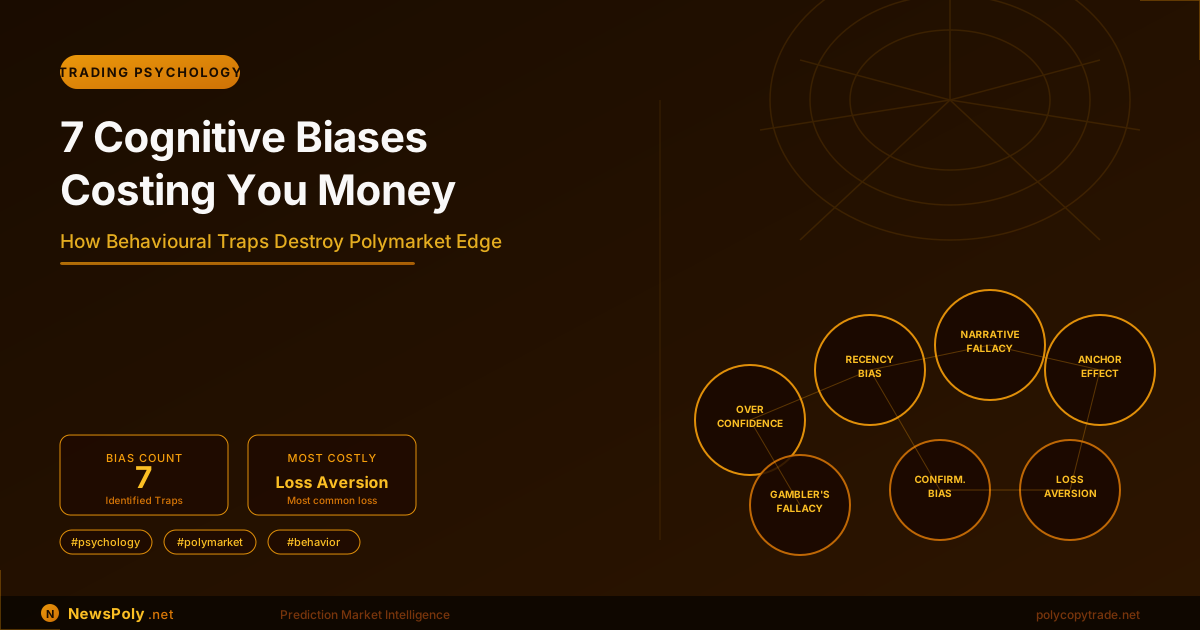
This guide walks through the seven cognitive biases most destructive to prediction market performance, with concrete countermeasures for each. The underlying research draws on behavioural economics — particularly the work of Daniel Kahneman and Amos Tversky — applied specifically to the Polymarket environment.
1. Overconfidence Bias: The Most Expensive Mistake
Overconfidence is the systematic tendency to overestimate the accuracy of your own probability assessments. Studies show that when people say they're "90% sure" of something, they're right only about 70–75% of the time. This gap — between stated confidence and actual accuracy — costs prediction market traders more than any other bias.
On Polymarket, overconfidence manifests as:
- Sizing positions larger than your actual edge justifies
- Entering markets without accounting for how much you might be missing
- Dismissing markets as "obviously mispriced" without rigorous investigation
The fix: Keep a calibration log. For every trade, record your estimated probability at entry. After 50+ trades, calculate what percentage of your "70% confident" picks actually resolved in your favour. If it's below 70%, you're overconfident and must reduce position sizes accordingly. This calibration directly affects your expected value calculations — an overconfident edge estimate produces a misleadingly positive EV number that will cost you over time. This also connects to the tracking log recommended in our risk management guide.
2. Recency Bias: Over-Weighting What Just Happened
Recency bias leads traders to assign disproportionate weight to recent events when forming probability estimates. A political candidate who just won a debate will see Polymarket prices surge as traders update primarily on the recent visible event — ignoring the longer historical base rate of debate effects on election outcomes.
This is particularly destructive in:
- Election markets — debate moments, gaffe reactions, and endorsements move markets far more than their actual electoral impact warrants
- Crypto markets — recent price action heavily influences bets on future price levels, even when on-chain fundamentals haven't changed
- Sports markets — teams on recent winning streaks are systematically over-priced relative to their underlying win probability
The fix: When forming a probability estimate, explicitly ask: "What is the base rate for this type of event over the last 20 instances?" Before updating on a recent event, ask: "How much should this actually move my probability, based on historical data?" You will almost always find the market has already moved more than the evidence warrants — which is a fading opportunity, not a confirmation signal. This is a key tool for finding mispriced markets.
3. The Narrative Fallacy: Stories Feel Like Evidence
The narrative fallacy, described by Nassim Nicholas Taleb, is the tendency to impose a coherent story on a sequence of random events — and then treat that story as causal evidence rather than post-hoc rationalisation. If any of the terms used in this guide — calibration, disposition effect, base rate, or edge — are unfamiliar, the Polymarket glossary has clear definitions for each. On Polymarket, this is the bias that makes a trader think they "understand" a market when they've actually just consumed a narrative.
A compelling news story about why a candidate will win, why a regulatory decision will go a certain way, or why a crypto token will hit a price target feels like genuine analysis. It isn't. It's a narrative. The question isn't whether the story makes sense — it's whether the story is already priced in, and whether the probability implied by the story matches the base rate for similar situations.
The fix: Separate your qualitative narrative from your probability estimate. Write down both. Then ask: "If I removed this narrative and just looked at the statistical base rate for this type of outcome, what probability would I assign?" The gap between narrative-driven probability and base-rate probability is where overpricing most commonly occurs.
4. The Anchoring Effect: First Prices Stick
Anchoring is the cognitive tendency to rely too heavily on the first piece of information encountered — in this case, the price you first saw a market at. If you saw a market at 60% last week and it's now at 45%, you will instinctively feel the market is "cheap" at 45% — even if 45% is the correct probability and 60% was the mispricing.
This is especially dangerous when:
- Re-entering a market you previously traded
- Averaging down after an adverse price move
- Setting mental "target" prices based on where a market was rather than where it should be
The fix: Evaluate every market from scratch using current information. Before looking at price history, form an independent probability estimate. Then compare your estimate to the current price — not to historical prices. The chart history can be useful for understanding market dynamics, but it should never be the primary input for your probability assessment. This approach aligns with the strategies in our top Polymarket trading strategies guide.
5. The Gambler's Fallacy: Patterns in Random Sequences
The gambler's fallacy is the belief that a random process is "due" to change direction because of recent results. In the context of Polymarket, it appears as:
- "This market has resolved 'No' three times in a row — it must resolve 'Yes' soon"
- "My last five trades lost, so my edge must assert itself soon"
- "This coin has flipped heads eight times — tails is overdue"
Each outcome in an independent market is exactly that — independent. The market has no memory of its previous resolutions. A 30% probability outcome is 30% probable regardless of whether the last four instances resolved "Yes" or "No."
The fix: For each new position, treat it as if it were your first trade ever. Ask only: "What is the probability that this specific market, at this specific moment, resolves in my favour?" Any answer that references the resolution history of other, similar markets is introducing gambler's fallacy thinking.
6. Confirmation Bias: Seeking Evidence You're Right
Confirmation bias is the tendency to search for, interpret, and remember information in a way that confirms your existing beliefs. After entering a Polymarket position, your brain will begin filtering information: good news about your position will feel significant, bad news will feel like an anomaly.
This is most dangerous in long-duration markets — election markets, crypto price targets, geopolitical event timelines — where there's a constant stream of new information to selectively interpret.
The fix: When you are in a position, actively seek out the strongest possible arguments for why you are wrong. Read the bear case. Find the traders on the other side and understand their reasoning. If you can't articulate a compelling case against your own position, you haven't done thorough enough analysis — and you're probably just confirming what you already believed. This steel-manning practice is especially important when trading election markets, where every day brings new confirmation material.
7. Loss Aversion and the Disposition Effect
Loss aversion — the finding that losses feel approximately twice as painful as equivalent gains feel pleasurable — is the bias that most directly translates into bad position management decisions.
On Polymarket, it manifests primarily as the disposition effect: the tendency to take profits too early (to lock in the good feeling of a win) and to hold losing positions too long (to avoid realising the pain of a loss). The result is a portfolio that systematically cuts winners short and lets losers run — exactly the opposite of what disciplined trading requires.
Specific manifestations to watch for:
- Selling a winning position at 70% profit when your analysis says it should reach 85%
- Holding a position that has moved against your thesis because "it might come back"
- Increasing position size after a loss to "make it back faster" — the most dangerous iteration, covered in depth in our risk management guide
The fix: Pre-commit to exit rules before entering any position. Write down: "I will take profit at X. I will cut losses at Y." Make these rules before you have skin in the game, when your judgement is uncontaminated by the emotional weight of an open position. The rules must be non-negotiable — the moment they become negotiable, loss aversion will always find a compelling reason to renegotiate them in the worst direction.
Building a System That Fights Bias
Knowing about these biases is necessary but not sufficient. The research on debiasing consistently shows that awareness alone produces only modest improvement. What produces significant improvement is process design: pre-committing to rules, keeping a calibration log, and creating friction between impulse and action.
Concretely:
- Calibration log — Track every probability estimate and compare to outcomes. This is the only way to measure and correct overconfidence
- Pre-trade checklist — Before each trade: what is my base-rate estimate? What is the strongest argument against my position? Am I anchoring on a historical price?
- Pre-committed exit rules — Profit target and stop-loss written down before entry, not negotiated after
- Trading journal — Note which bias, if any, you felt pulling at you during each trade. Pattern recognition across trades is the most powerful debiasing tool available
- Portfolio review — Regular portfolio management reviews surface whether bias-driven trades are clustering in specific market categories, helping you identify where your reasoning is most vulnerable
Many of the patterns that emerge from unchecked cognitive bias — over-sizing positions, chasing losses, trading unfamiliar markets — appear directly in the list of common beginner mistakes on Polymarket. Reading that list alongside this guide is a practical way to map abstract biases to the concrete errors they produce. For the complementary perspective on emotional discipline — tilt management, session limits, and journaling — see our Polymarket trading psychology guide, which covers the behavioural mechanics that sit alongside the cognitive biases described here.
For traders who want these guardrails enforced at the system level rather than relying on willpower, PolyCopyTrade removes the moment-to-moment decision-making that most cognitive biases exploit. By automating the execution of pre-selected trader strategies, the platform eliminates the discretionary entry and exit points where loss aversion and overconfidence do their worst damage. Learn how to set it up in our copy trading automation guide.
Frequently Asked Questions
Which cognitive bias is most costly for Polymarket traders?
Loss aversion produces the most consistently damaging patterns in prediction market trading — specifically through the disposition effect (selling winners early, holding losers too long) and through revenge trading after losses. However, overconfidence is a close second because it affects the foundational input to every trade: your probability estimate. A trader who is both overconfident and loss-averse is in particularly difficult territory.
Can you train yourself out of cognitive biases?
Partially. Research shows that with deliberate practice and feedback, traders can meaningfully improve calibration and reduce the magnitude of bias effects — but not eliminate them. The most reliable approach is system design: creating processes and rules that limit the degree to which biases can influence decisions, rather than trying to overcome them through willpower alone.
Does copy trading on Polymarket avoid these biases?
It shifts rather than eliminates them. When copy trading, the same biases apply to your trader selection decisions — overconfidence in a trader's past performance, recency bias toward traders who recently performed well, and anchoring on their peak ROI. The key is to apply the same disciplined, base-rate framework to evaluating copy traders as you would to evaluating individual market positions. PolyCopyTrade addresses this by ranking traders on verified long-run ROI across diverse market types — filtering out lucky-run wallets using exactly the base-rate criteria described in this guide, so your copy trader selection starts from a pre-screened, bias-resistant pool. See how PolyCopyTrade selects traders →