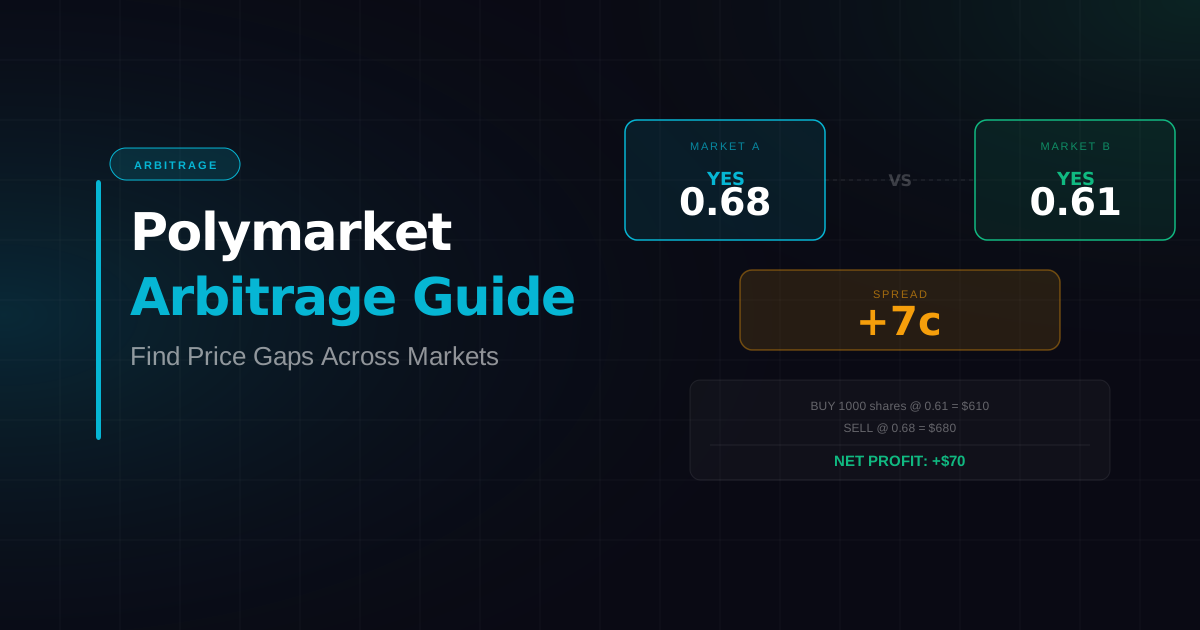
Arbitrage is the closest thing to risk-free profit in financial markets: you simultaneously buy low on one platform and sell high on another, locking in the difference before prices converge. In prediction markets, the same logic applies — when Polymarket prices an event at 65% and Kalshi prices the same event at 71%, a disciplined trader can capture that 6-point gap. The challenge is that fees, execution speed, capital constraints, and thin liquidity mean pure arb is far rarer in practice than it looks on a spreadsheet. This guide breaks down every type of Polymarket arbitrage, shows you the real maths including costs, and explains what “soft arb” looks like when pure arb disappears.
Before diving into mechanics, note that arbitrage interacts directly with fees and liquidity — two topics covered in detail in our Polymarket fees guide and liquidity guide. Understanding those first will make the calculations here much cleaner.
What Is Prediction Market Arbitrage?
In traditional finance, arbitrage means buying an asset on one exchange where it is cheaper and simultaneously selling it on another where it is more expensive, pocketing the spread with zero net risk. In prediction markets, the same principle applies but the mechanics differ because positions are held until a binary event resolves — you cannot always exit instantly.
There are three distinct types of Polymarket arbitrage, each with different risk profiles and execution requirements:
- Cross-platform arbitrage — same event priced differently on Polymarket vs Kalshi, Betfair, or another platform
- Same-platform multi-outcome arbitrage — all YES shares across mutually exclusive outcomes sum to less than $1.00
- Related-market arbitrage — logically linked markets on the same platform are priced inconsistently
Each type requires different tools and capital structures. We will work through all three.
Type 1: Cross-Platform Arbitrage (Polymarket vs Kalshi vs Betfair)
This is the most intuitive form of arb. The same underlying event — “Will the Fed cut rates in May?” for example — is traded on multiple platforms simultaneously. If Polymarket prices YES at 65 cents and Kalshi prices the same outcome YES at 71 cents, you buy YES on Polymarket and sell (or buy NO) on Kalshi to lock in the gap.
The mechanics depend on whether you are:
- Buying YES on the cheaper platform (Polymarket at 65 cents) and buying NO on the expensive platform (Kalshi NO at 29 cents, since YES is 71 cents)
- Total outlay: $0.65 + $0.29 = $0.94 per share pair
- Guaranteed payout when the event resolves: $1.00 on whichever side is correct
- Gross profit: $0.06 per dollar pair, or roughly 6.4% on outlay
Before celebrating: fees, FX conversion costs (Polymarket uses USDC; Kalshi uses USD), gas fees for on-chain settlement, and execution risk all eat into that 6.4%. See the worked example below for the full net calculation.
For a detailed comparison of how these platforms differ in structure, fees, and market depth, see our Polymarket vs Kalshi and Polymarket vs Betfair comparisons.
Type 2: Same-Platform Multi-Outcome Arbitrage
On Polymarket, many markets have more than two outcomes. For example: “Which party wins the 2026 Senate majority?” with outcomes Democrat, Republican, and Tied. In a perfectly efficient market, the YES prices across all outcomes should sum to exactly $1.00 (ignoring fees). When they sum to less than $1.00, an arbitrage exists.
Example: Democrat YES = $0.48, Republican YES = $0.44, Tied YES = $0.06. Total = $0.98. You buy one YES share in each outcome for a combined outlay of $0.98. Exactly one will resolve at $1.00. Gross profit: $0.02 per set, or approximately 2.0% on outlay.
In practice, this is usually eaten entirely by Polymarket’s 2% fee on winnings. The fee applies to the profit portion of your winning share — so if you paid $0.48 for a YES that resolves at $1.00, you pay 2% on the $0.52 profit, which is roughly $0.0104. On a $0.02 gross profit, this almost eliminates your edge entirely. Same-platform multi-outcome arb is therefore essentially zero-profit once fees are counted unless the sum of YES prices is notably below $0.98.
Type 3: Related-Market Arbitrage
This is subtler and potentially more durable than the other two types. Related markets should be logically constrained by each other, but market participants do not always enforce that constraint in real time.
Classic examples:
- “BTC above $100K by December” is priced at 55%. “BTC above $90K by December” should logically be priced higher (since $100K > $90K, the second is a more likely outcome). If “BTC above $90K” is priced at 52%, that is a mispricing.
- “Fed cuts rates in 2026” is priced at 80%. “Fed cuts rates by 0.50% or more in 2026” should be lower because it is a stricter condition. If it is priced at 85%, something is wrong.
- A candidate’s probability of winning a primary and their probability of winning the general election should be linked by conditional probability logic. If the markets imply inconsistent figures, a soft arb exists.
Related-market arbitrage is usually “soft arb” — meaning it is not risk-free (you cannot simultaneously guarantee a payout from both sides) but it is a directional bet with a logical edge. You are not arbitraging the price gap away by holding offsetting positions; you are trading the mispriced market in the direction that logic requires. This is closely related to the expected value framework.
Worked Example: Cross-Platform Arb With Fees
Let us run a full cost calculation on a realistic cross-platform arb between Polymarket and Kalshi.
Setup: Market — “Will the Federal Reserve cut rates at its June 2026 meeting?”
- Polymarket: YES = $0.65 per share
- Kalshi: YES = $0.72 per share (equivalent: NO = $0.28 per share)
- Trade size: 100 shares on each platform
Outlay:
Polymarket: 100 x $0.65 = $65.00 (buy YES)
Kalshi NO:  100 x $0.28 = $28.00 (buy NO)
Total outlay: $93.00
Guaranteed payout: $100.00 (one side resolves at $1 per share)
Gross profit before fees: $7.00
Now subtract real costs:
Polymarket 2% fee on profits if YES wins:
  Profit per share = $1.00 - $0.65 = $0.35
  Fee = 100 x $0.35 x 0.02 = $0.70

Kalshi fee (approx 1% on net profit):
  Profit per share on NO = $1.00 - $0.28 = $0.72
  Fee = 100 x $0.72 x 0.01 = $0.72

Polygon gas fees (Polymarket on-chain settlement): ~$0.10 (low when gas is cheap)

USDC/USD conversion spread (Polymarket uses USDC): ~$0.15 on $65

Execution slippage (conservative): ~$0.50
Total estimated costs: $0.70 (or $0.72) + $0.10 + $0.15 + $0.50 = approximately $1.47 to $1.49
Net profit: $7.00 − $1.49 = approximately $5.51 on $93.00 outlay = 5.9% net return
This looks attractive — and it is, if you can execute it. The critical word is if. By the time you have noticed the gap, funded both accounts, and placed the trades, the 7-cent gap may have already closed to 3 or 4 cents, which after fees is essentially breakeven or negative. That is the real challenge of cross-platform arb.
Skip the arb hunt entirely. PolyCopyTrade automatically mirrors the positions of Polymarket’s top-performing wallets — verified by on-chain track record — so you capture edges that experienced traders have already identified without monitoring multiple platforms around the clock.
Real Costs That Destroy Arbitrage Profits
Arb calculations look clean on paper but real execution encounters a wall of friction costs. Here is a full inventory of what eats into your profit:
Polymarket 2% Fee
Polymarket charges 2% of profits on winning positions. This is deducted when a market resolves, not at execution. On a position that cost $0.65 and pays out $1.00, the fee is 2% of $0.35 = $0.007 per share. Small per-share but meaningful at scale. Full detail in our fees guide.
Betfair Commission
Betfair charges 5% on net winnings by default, though premium charges can push this to 20% or more for high-volume profitable traders. This is significantly higher than Polymarket and Kalshi, making Betfair arb legs expensive unless you are on a reduced commission rate.
Gas Fees
Polymarket operates on Polygon. Gas fees are typically very low (fractions of a cent), but during network congestion they can spike. For large positions this rarely matters; for small arb attempts on thin margins it can be the difference between profit and loss.
USDC Conversion
Polymarket requires USDC, not USD. Converting USD to USDC via an exchange incurs a spread (typically 0.1–0.5%) plus any withdrawal fee to get USDC to your Polymarket wallet. Round-trip this cost is often 0.3–1.0% of capital deployed.
Execution Timing Risk
Unless you can execute both sides of the arb simultaneously — which requires accounts already funded on both platforms — there is a window where you are exposed on one side while placing the other. If the price moves against you during that window, your locked-in profit can evaporate or turn negative.
Liquidity Limits
A 7-cent gap with available liquidity of 50 shares on each side produces a maximum gross profit of $3.50 before fees. After fees, this is often not worth the operational effort. Large arbs require large liquidity depth, which is usually exactly when the arb has already been closed by other traders.
Why Pure Arb Is Rare on Liquid Markets
The prediction market ecosystem is actively watched by sophisticated participants — algorithmic traders, professional bettors, and dedicated arb bots that scan price feeds continuously. On high-profile, high-liquidity markets (US elections, major macro events, top sports), any cross-platform gap tends to close within seconds of opening. The arb that “exists” when you spot it at 9:47 AM may already be gone by 9:47 AM and 15 seconds.
This does not mean arb is impossible. It means:
- Pure arb on liquid markets requires automation and pre-funded accounts on all platforms
- The most exploitable gaps appear in lower-liquidity, niche markets where fewer bots are watching
- Manual arb hunting is almost always a step behind algorithmic competition on mainstream markets
For context on how liquidity depth affects both arb opportunity and execution difficulty, see our Polymarket liquidity guide.
Soft Arb: The Practical Alternative
Most traders who describe themselves as “doing arb” on Polymarket are actually doing something more nuanced: soft arbitrage. This means identifying persistent price discrepancies between platforms and taking a directional position on the market you believe is mispriced, rather than hedging with an offsetting position on the other platform.
Soft arb is not risk-free. The event can still resolve against you. But it is a systematic approach with a clear logical edge:
- Polymarket prices a political outcome at 58%, Kalshi prices it at 66%. You believe both platforms have access to the same information, so one must be wrong. You buy YES on Polymarket because it looks cheaper relative to the cross-platform consensus.
- You are not perfectly hedged, but you have a specific, data-backed reason to take the position beyond gut feeling.
Soft arb is closely related to expected value trading and sits within the broader framework described in our top trading strategies guide. The difference is that your probability estimate is derived from cross-platform price comparison rather than an independent model.
Tools and Setup for Arb Trading
To pursue any form of Polymarket arbitrage seriously, you need:
Multiple Funded Accounts
For cross-platform arb you need simultaneous capital sitting idle on every platform you want to trade. Capital locked on Kalshi cannot be used to fund a Polymarket position at the same moment. This means your effective capital requirement for arb is the sum of both sides of each trade, not just one side.
Price Monitoring
Manual price checking is too slow for liquid markets. Options include:
- Polymarket API: Real-time price feeds for all active markets. Full setup guide in our API and on-chain data guide.
- Kalshi API: Similar REST API with websocket support for real-time updates
- Custom alert tools: Python scripts or no-code tools (like Zapier or Make) that ping you when a price differential exceeds your threshold
- Third-party aggregators: Some prediction market aggregators display cross-platform prices side-by-side for manual comparison
Fast Execution
Both platforms offer web interfaces and APIs. For serious arb, API execution is essentially mandatory on liquid markets — the gap closes before you can click through a web UI. On niche, less-watched markets, manual execution may be fast enough.
Capital Requirements for Arb Trading
Unlike directional trading where you deploy capital on one side of one market, cross-platform arb requires you to hold capital on multiple platforms simultaneously. Consider a trader who wants to run $1,000 in cross-platform arb capacity:
- $500 on Polymarket (USDC in wallet, ready to deploy)
- $300 on Kalshi (USD balance, ready to deploy)
- $200 on Betfair (GBP or EUR balance, already converted)
At any point in time, most of this capital is sitting idle waiting for an arb opportunity. The effective capital utilisation rate for arb traders tends to be low — capital is tied up in positions or sitting uninvested, earning nothing while waiting for gaps to appear. This makes the annualised return on total capital much lower than the per-trade return suggests.
For context on general capital allocation and position sizing, see our risk management guide.
Practical Workflow: Daily Arb Scanning Routine
For traders who want to pursue arb systematically without full automation:
- Morning scan (10 minutes): Open Polymarket and Kalshi side-by-side. Check all shared markets in major categories (macro, politics, crypto). Note any gaps greater than 5 percentage points.
- Threshold filter: Only pursue gaps where the gross spread exceeds estimated total fees by at least 2x. Anything tighter is not worth the execution risk.
- Liquidity check: Confirm there is enough depth on both sides to execute your intended position size without moving the market against yourself.
- Execution checklist:
- Both accounts funded ✓
- Gross spread still intact at time of execution ✓
- Fee calculation confirmed ✓
- Both legs executable at quoted prices ✓
- Post-trade logging: Record entry prices, fees paid, and resolution outcome. Over time this data tells you whether your arb identification process is actually generating positive returns net of all costs.
Prefer a simpler edge? Instead of managing cross-platform accounts and monitoring price feeds, PolyCopyTrade runs automated copy trading on Polymarket — replicating positions from wallets with verified track records while you sleep. No multi-platform setup required.
Is Polymarket Arbitrage Legal?
Arbitrage is a legal and widely practised trading strategy in all financial markets globally. There is nothing legally problematic about buying on one platform and selling on another to capture a price difference. The legal questions around Polymarket relate to jurisdiction and residency restrictions (covered in our countries guide), not to trading strategies.
If you are eligible to use both platforms you want to arb across, the strategy is entirely legal. Using the API or automated tools to execute does not change this — both Polymarket and Kalshi offer public APIs and allow automated trading.
Frequently Asked Questions
Is Polymarket arbitrage legal?
Yes. Arbitrage — buying on one platform where a price is lower and selling (or buying the opposite outcome) on another platform where the price is higher — is a legitimate trading strategy. It is not market manipulation; it is price discovery. If you are legally permitted to trade on both platforms, cross-platform arb is fully permitted. Always verify you meet the residency and eligibility requirements for each platform separately.
How often do real arb opportunities appear on Polymarket?
On major, high-liquidity markets, exploitable gaps are rare and brief — often closing within seconds. Serious arb opportunities most frequently appear on lower-liquidity markets, immediately after major news breaks (before all platforms update), and during periods of high market activity when some platforms update prices faster than others. A manual scanner might find 2–5 genuinely profitable opportunities per week across all platforms; an automated system running continuously might find more, but competition from other bots compresses returns.
What software do arb traders use on Polymarket?
Most serious arb traders build their own tools using the Polymarket CLOB API and Kalshi API, combined with a Python script that monitors price feeds and triggers alerts or automated trades when thresholds are met. There is no widely adopted off-the-shelf arb tool specifically for Polymarket as of 2026, though general prediction market monitoring aggregators exist. Custom API setups are described in detail in our on-chain data and API guide.
Can I arb Polymarket against sports books?
Technically yes, if the same underlying event is covered by both. Sports events are the most common cross-over. However, the platforms have different settlement mechanics, different resolution rules, and different timelines — meaning what looks like the same event can resolve differently (e.g., a match abandoned due to weather resolves differently on Betfair vs Polymarket). This execution risk makes sports book arb against Polymarket more complex than pure cross-prediction-market arb. See our Polymarket vs Betfair comparison for full detail on how these platforms differ.
What is the minimum capital needed for cross-platform arb?
You need enough capital pre-positioned on each platform to execute both legs simultaneously. The absolute minimum is the combined outlay for a single arb trade, but in practice you want enough cushion to cover multiple simultaneous opportunities and avoid being unable to act when a gap appears. Most arb traders treat their per-platform float as their arb capacity limit and keep it funded at a level that makes the effort worthwhile — typically at least $500–$1,000 per platform.
All the edge, none of the complexity. Arbitrage requires accounts on multiple platforms, real-time monitoring tools, and split-second execution. PolyCopyTrade gives you access to verified Polymarket edges without the infrastructure overhead — it automatically copies top traders’ positions directly into your wallet. Start copying top traders now →