Why News Trading on Polymarket Is Different
News trading in crypto or forex is relatively forgiving: prices move continuously, you can exit at any moment, and liquidity is deep enough to absorb most retail-sized positions without slippage. Polymarket is fundamentally different. Every market resolves to exactly $1.00 or $0.00 at a defined date based on specific resolution criteria. That binary structure changes everything about how news events affect prices.
When a Fed rate decision breaks, EUR/USD might move 0.5% and you can close your position immediately for a small gain. On Polymarket, the same event could swing a "Will the Fed cut rates in March?" market from 45¢ to 92¢ — but only if the resolution criteria match what actually happened. Misread the resolution wording and you can be holding a position that pays out $0 even when you correctly predicted the economic outcome.
The second major difference is liquidity. Deep Polymarket markets (major elections, high-profile Fed decisions) can handle four- and five-figure positions without much slippage. But most markets are far thinner. When news breaks and prices move fast, the liquidity often isn't there to fill large market orders at a reasonable price. Understanding this before you trade around news is essential. See our Polymarket charts guide for how to read depth and activity levels before entering.
Scheduled Events vs. Unscheduled Breaking News
News trading on Polymarket splits into two very different situations, each requiring a different approach.
Scheduled events
Fed meetings, CPI releases, election days, central bank announcements, earnings dates — these are all known in advance. The market has time to price in expectations. Your edge comes from having a better probability estimate than the crowd before the number drops, not from reacting faster than everyone else when it does.
For scheduled events, the most important work happens days or hours before the announcement. Study the consensus, compare Polymarket prices to forecasting aggregators, and decide whether the current price represents fair value or a misprice. Our Polymarket macro markets guide covers the specific data releases and Fed events that generate the most trading volume.
Unscheduled breaking news
A surprise resignation, a geopolitical development, an unexpected court ruling — these events hit with no warning. Speed matters far more here. The first traders to correctly reprice an affected market can capture large gains. But the window is short, and chasers who arrive after the initial repricing often take on risk without proportional reward.
How Fast Does Polymarket Reprice After News?
Price reaction speed varies significantly by market category. Based on observed market behaviour, here is a rough breakdown:
- Crypto markets (fastest): BTC price targets, ETH ETF approvals, exchange hack news — these markets can fully reprice within 15–60 seconds of a major development. Crypto traders are already watching prices in real time, and the overlap with DeFi-native Polymarket users is high. Our Polymarket crypto markets guide covers how to research and trade this category specifically.
- Sports markets (fast): Live score updates and injury news typically reprice within 30 seconds to 2 minutes. The relevant community is tracking live feeds directly.
- Macro / Fed markets (medium): FOMC decisions, CPI prints, and GDP releases usually reprice over 1–5 minutes. There's more analysis required to interpret the data correctly before traders commit capital.
- Politics markets (slowest): Election results, legislative votes, and political appointments can take 5–20+ minutes to fully reprice. Interpreting political developments is complex, and many Polymarket politics traders are researchers rather than fast-twitch reactors. For a deeper look at how to research and position in this category, see our Polymarket politics markets guide.
Thin markets reprice even more slowly — not because traders are slow to understand the news, but because there is no liquidity to absorb large position changes. This is actually an opportunity: you can enter at a stale price if you act before other traders do.
Pre-Event Positioning Strategy
The most reliable news trading strategy on Polymarket does not require you to react fast at all. It requires you to be positioned correctly before the event.
Buy uncertainty premium before decisions
In the days before a major scheduled event, markets often drift toward a consensus price that underweights tail outcomes. Traders who have been holding positions for weeks want to lock in gains and exit. This creates an opportunity: buying the less-popular outcome before the event can give you a better entry price than you'd get if you waited for the result to look likely.
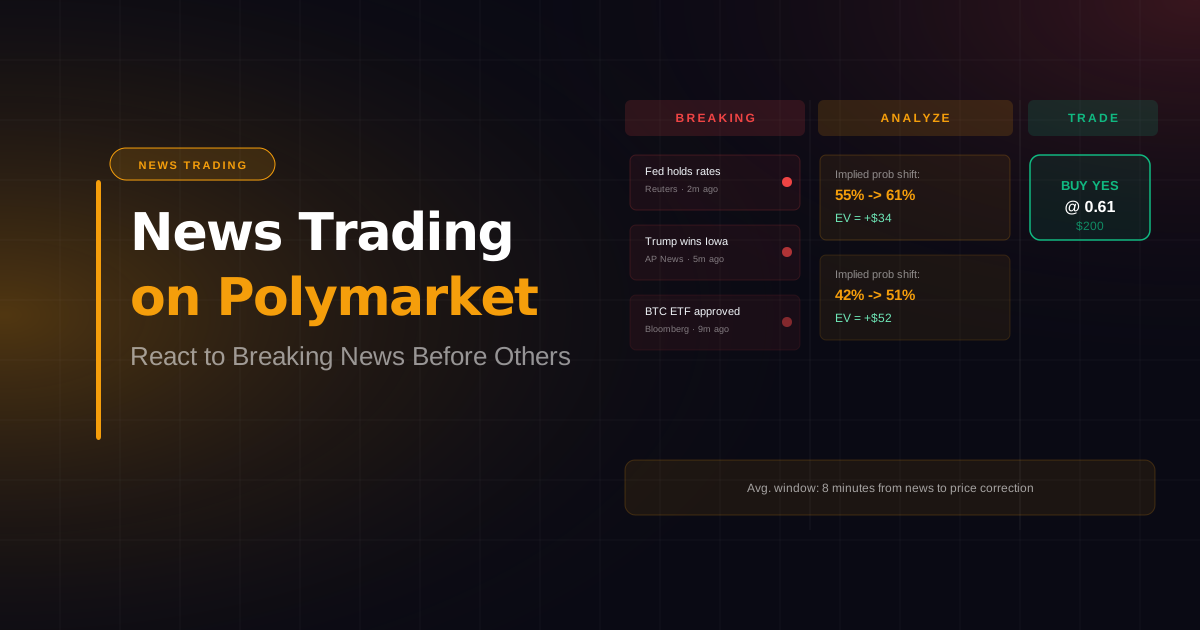
For example: a Fed meeting is pricing a 25bp cut at 60%. The true probability based on your research is 70%. Entering at 60¢ before the meeting is far better than entering at 85¢ in the two minutes after the statement drops and other traders reprice. For a framework on using limit orders to get precise entry prices before events, see our dedicated guide.
Fade overreaction before announcements
Markets sometimes overshoot in the days before a major event due to one-sided news flow or pundit commentary. A single influential analyst predicting a 50bp cut can push a market from 60% to 75% within hours, even without any new actual data. If your research suggests the market has overpriced the outcome, entering on the fade — selling the overpriced side before the event — is a viable pre-event strategy.
Breaking News Strategy: The First-Mover Window
When unscheduled news breaks, there is a narrow window — typically under two minutes for liquid markets, potentially longer for thin ones — where Polymarket prices have not yet caught up to the new reality. This is the first-mover window.
To exploit it, you need:
- Fast information sources (covered in the section below)
- Pre-identified markets that would be affected by the type of news you're monitoring
- Pre-set position sizes so you aren't making capital allocation decisions under pressure
- Clear resolution criteria knowledge — knowing exactly what the market resolves on before you trade it
When NOT to chase
Once the first-mover window has closed, the risk/reward of chasing a fast-moving market deteriorates rapidly. If BTC just dumped 15% and a "Will BTC be above $70k at month end?" market has already moved from 65¢ to 20¢, entering at 20¢ means you need BTC to stage a significant recovery to profit — and you're paying slippage to get in. The traders who were already positioned at 65¢ captured the move. Chasing them is a different, riskier trade.
The rule: if you weren't watching when news broke and you're seeing the price already moved, assume the first-mover window is closed. Evaluate the market at its current price on its own merits, not relative to where it was.
Fade the News: Markets That Overreact
Not every news-driven price move is correct. Markets regularly overreact to news that is less significant than it appears, especially when headlines are ambiguous or when a development is less certain than the initial reporting suggests.
Classic overreaction scenarios:
- A rumour gets reported as fact before confirmation, pushing a market to an extreme, then the market partially reverses when uncertainty re-emerges
- An initial headline is technically correct but the resolution criteria for a related Polymarket market require a higher bar than the headline implies
- A development is real but priced in before it officially satisfies the market's resolution condition
Fading overreactions requires patience. The snap-back is rarely immediate; it often takes hours as more accurate information circulates and traders reassess. Position sizing matters here: you may need to hold through further short-term movement before the fade works. This is where solid Polymarket risk management discipline separates profitable traders from those who get squeezed out of correct positions too early.
For more on how elections specifically tend to overreact and snap back, see our Polymarket election markets guide.
Information Sources for News Trading
Speed of information is a genuine edge on Polymarket. Here is what the best news traders monitor:
Tier 1: Fastest and most reliable
- Reuters and Bloomberg terminal alerts — professional-grade, sub-minute headline delivery for major macro and political events
- Federal Reserve website (federalreserve.gov) — FOMC statements are posted directly; refreshing during the blackout period window is how many traders get the data fastest
- Bureau of Labor Statistics (bls.gov) and Bureau of Economic Analysis (bea.gov) — CPI and GDP data are released on these sites at exactly the scheduled time
- Twitter/X (following key accounts) — breaking political, geopolitical, and crypto news often surfaces here first, minutes before traditional outlets
Tier 2: Useful for context and confirmation
- Associated Press and Reuters wire feeds (available through aggregators)
- Official government and court websites for regulatory and legal decisions
- Exchange announcements for crypto listings and delistings
- Congressional and parliamentary live feeds for legislative votes
Tools for Monitoring Polymarket Prices in Real Time
Watching individual market pages during a news event is too slow. More effective approaches:
- Polymarket API — the Polymarket API guide covers how to pull real-time prices programmatically for markets you're monitoring. You can set up a simple script to alert you when a price moves more than a set threshold.
- Browser alert setups — several community-built tools allow price change alerts on specific markets via Telegram or Discord notifications
- Pre-loaded browser tabs — for scheduled events, having your target markets open in tabs before the announcement lets you place orders within seconds of the news hitting
News Sources That Move Polymarket Markets Most
Not all news is equal in terms of Polymarket price impact. The highest-impact sources by category:
- Fed statements and dot plots — move macro markets more than almost any other single event; the language of the statement (not just the decision) drives extended repricing in related markets
- Election night results — the biggest single-night volume events on Polymarket; county-level results and AP calls drive rapid moves across multiple related markets simultaneously
- Corporate announcements — CEO changes, earnings beats/misses, and M&A news that was the subject of a Polymarket market can move prices to near-resolution levels instantly
- Supreme Court and major court decisions — often released with no warning mid-day; markets on pending decisions can move from 40¢ to 95¢ within minutes
- Exchange and protocol announcements in crypto — SEC rulings on ETFs, major exchange insolvencies, and protocol upgrades drive some of the fastest Polymarket moves on record
Common Mistakes News Traders Make on Polymarket
1. Chasing after the price has already moved
Entering a market after the first-mover window has closed is the most common and costly mistake. You pay elevated prices and face worse expected value than traders who were positioned before the news.
2. Ignoring resolution criteria
Polymarket markets resolve on specific, often technical criteria. "Will the Fed cut rates?" may resolve on the federal funds rate target range, not on any individual FOMC member's comments. "Will Candidate X win the election?" may resolve only after a specific official certification, not on election night projections. Always read the full resolution criteria before trading a news-affected market.
3. Ignoring liquidity
Entering a large position in a thin market during a fast-moving news event guarantees slippage. Check the order book depth before sizing your position. A market showing a 15¢ spread during normal conditions might gap to 40¢ under news flow.
4. Over-leveraging into uncertainty
News events create short-term uncertainty even when the eventual outcome seems obvious. Over-sizing a position before or immediately after news means that a short-term adverse move can force an early exit at a loss on a trade that would eventually have been profitable.
Risk Management for News Trading
Fast markets require pre-defined risk management rules, not real-time improvisation:
- Position sizing before the event — decide your maximum position size before news breaks, not after. This prevents emotional over-allocation when prices are moving fast.
- Pre-set exit prices — know what price would indicate your thesis is wrong and commit to exiting at that level. Use the limit order system to set exit orders in advance.
- Never use more than 5–10% of your bankroll on a single news event — even high-conviction news trades carry resolution uncertainty that can produce a $0 outcome.
- Account for slippage in your expected value calculation — if the spread is wide during the news event, factor that cost into whether the trade is worthwhile.
Frequently Asked Questions
How fast do Polymarket prices move after news breaks?
It depends on the category and the liquidity depth of the specific market. Crypto markets can fully reprice within 15–60 seconds. Sports markets typically take 30 seconds to 2 minutes. Macro and Fed markets usually reprice over 1–5 minutes. Politics markets are the slowest, often taking 5–20 minutes or more. Thin markets with low liquidity can take longer at every tier because there simply aren't enough active traders to move the price quickly.
Is it too late to trade after news has already broken?
For the initial first-mover move, usually yes. If you're seeing a price that has already substantially moved, the easy money has been made. However, it is not too late to evaluate whether the market has overreacted or underreacted — and to position for the correction. Fading overreactions after the initial move is a distinct and often profitable strategy. Always evaluate the current price on its own merits rather than relative to where it was before the news.
How do I get news faster for Polymarket trading?
For scheduled economic data, bookmark the official source websites (Fed, BLS, BEA) and refresh them at release time rather than waiting for news wires to rebroadcast the data. For political and breaking news, build a curated Twitter/X list of high-signal accounts covering your target categories. For crypto, exchange announcement channels on Telegram and Discord are often faster than traditional news outlets. Reuters and Bloomberg terminal access provides the most comprehensive professional-grade speed but comes at significant cost.
Which Polymarket categories are best for news trading?
Macro and Fed markets offer the best balance of liquidity and repricing opportunity for most traders. The events are scheduled, the data is publicly available simultaneously to all traders, and the markets are liquid enough to enter meaningful positions. Crypto markets reprice faster but require a direct information edge. Politics markets offer the largest repricing opportunities on election nights but require deep familiarity with resolution criteria and result-reporting timelines.
How is news trading on Polymarket different from sports betting?
The core difference is that Polymarket markets cover events with broadly available public information, making information-based edges legitimate and legal (where Polymarket operates). The binary resolution structure is similar to sports betting, but the asset class and information environment are different. For a direct comparison, see our election markets guide and the breakdown of how different event categories behave.