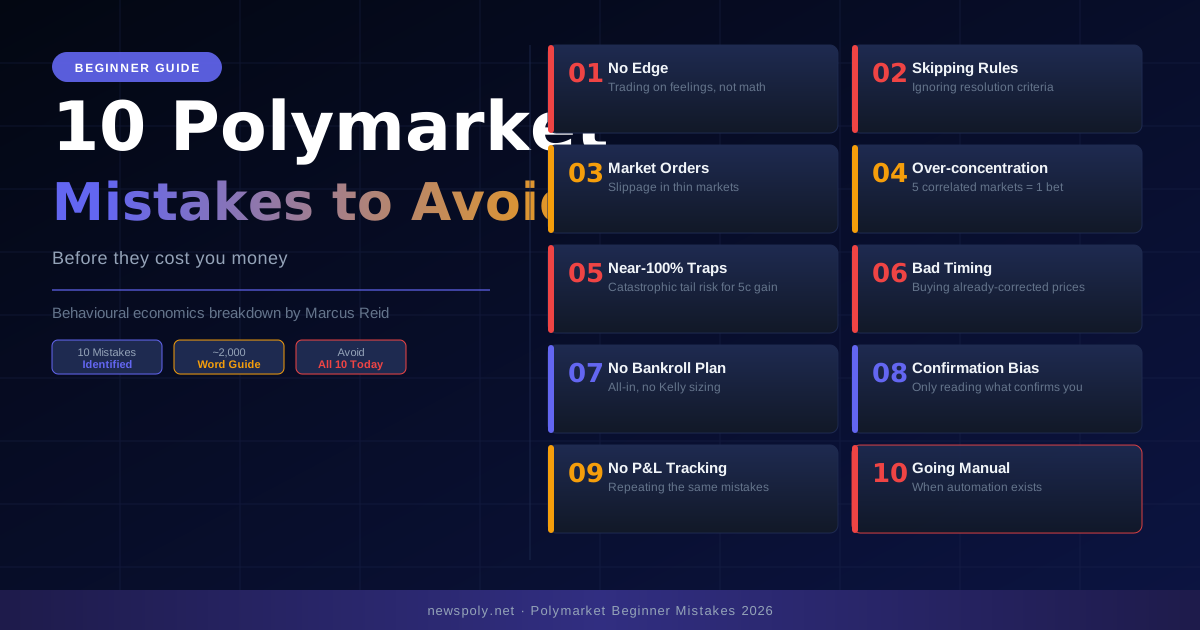
Most Polymarket beginners lose money in their first 30 days — not because the markets are unfair, but because they repeat the same ten behavioural mistakes that experienced traders have already learned to avoid. These mistakes are not random. They are predictable patterns rooted in cognitive bias, poor process, and misunderstood mechanics. If you can name them before you make them, you can sidestep losses that would otherwise act as an expensive and demoralising education.
As a behavioural economist who studies decision-making under uncertainty, I find prediction markets like Polymarket fascinating precisely because they surface these biases so clearly — and so painfully. What follows is a structured breakdown of the ten mistakes I see most consistently among new traders, the psychological mechanism behind each one, and what to do instead.
Mistake 1: Trading Without a Defined Edge
The most common mistake is also the most fundamental: entering a market because something "feels likely" rather than because you have a quantified probability advantage over the current market price. Our guide to expected value on Polymarket walks through the EV formula and how to calculate your edge before every trade.
This is intuitive thinking bias — Daniel Kahneman's System 1 in full control. Your brain pattern-matches a headline to a familiar narrative and produces a strong feeling of confidence. But feeling confident is not the same as having an edge. An edge exists only when your assessed probability is meaningfully different from the market price and you have a sound reason for that divergence.
- Before entering any market, write down your probability estimate and your reason for it
- Compare it to the current market price — if they're within 2–3 percentage points, there is no trade
- Ask yourself: what information do I have that the aggregate market does not?
- If you cannot answer that question specifically, do not trade
Markets with millions of dollars of volume are aggregating the views of thousands of informed participants. Beating them requires genuine informational or analytical edge, not a hunch.
Mistake 2: Ignoring Resolution Rules
Every Polymarket market resolves according to specific, written criteria — not according to what "should" have happened or what the media reported. Beginners routinely lose money by trading a market they have never actually read the resolution rules for.
This is a form of optimism bias: we assume our intuitive understanding of what a market means is correct without verifying it. The resolution rules are the only thing that matters. A market asking "Will Candidate X win the election?" might resolve NO even if Candidate X wins, if the resolution criteria specify a particular vote threshold or certification date.
- Read the full resolution rules before placing any trade — not after
- Look for edge cases: what happens in a tie, a recount, a disqualification?
- Check the resolution source: which specific outlet or data provider is cited?
- If the rules are ambiguous, treat that ambiguity as risk and size accordingly
Resolution disputes are more common than beginners expect. Understanding the rules is not optional homework — it is the foundation of every trade. If you are unfamiliar with terms like "CLOB," "UMA oracle," or "open interest," our Polymarket glossary defines all the key terminology.
Mistake 3: Using Market Orders in Thin Markets
Market orders execute at whatever price is available in the order book. In liquid markets with tight spreads, this is fine. In thin Polymarket markets — which describes a large proportion of active markets — a market order can result in devastating slippage, filling at prices 5, 10, or even 20 cents away from where you expected. Our guide to Polymarket limit orders explains exactly how to set and manage limit orders to avoid this.
The bias here is action bias: a desire to execute immediately rather than patiently. New traders see a price they like and click buy without checking the depth of the order book. By the time the order fills, they are already underwater.
- Always use limit orders — specify the exact maximum price you are willing to pay
- Before placing any order, look at the order book depth; if there are fewer than 10 orders visible, the market is thin
- In thin markets, set your limit conservatively — you may not get filled immediately, but you will not get destroyed by slippage
- Treat an unfilled limit order as a free option: if the price never reaches your level, that's fine
Slippage costs compound quickly. A trader using market orders in thin markets is effectively paying a hidden tax on every single trade.
Mistake 4: Overconcentrating in One Market Category
Beginners often believe they are diversifying by trading in five different markets, not realising that four of those markets are Trump-related politics bets. Five correlated markets are not five independent bets — they are one bet with five tickets.
This is clustering illusion combined with false diversification. When the underlying factor (political news about one person or event) moves, all correlated positions move together. A single unexpected news event can trigger losses across your entire portfolio simultaneously.
- Map your positions by underlying driver, not by market name
- If multiple markets would all resolve the same way given a single news event, they are correlated
- Aim for positions driven by genuinely independent information sources: politics, sports, economics, science
- No single thematic cluster should represent more than 30–40% of total capital at risk
True diversification on Polymarket means thinking about what information would cause you to lose everything at once — and structuring your book so that no single event can do that.
Mistake 5: Chasing Near-100% Markets for Yield
A YES contract trading at $0.95 looks like a safe 5% return. New traders see this as a way to earn "easy money" with minimal risk. It is not. The expected value of buying a $0.95 contract that should be priced at $0.95 is exactly zero — you pay 95 cents and receive $1 on resolution. The 5% return is the correct compensation for the residual 5% probability of failure, which is not zero.
This is neglect of tail probability — systematically underweighting low-probability catastrophic outcomes. When that 5% event arrives, you lose 95 cents on a position you entered to earn 5 cents. The asymmetry is brutal.
- Calculate your risk/reward explicitly: a $0.95 contract risks $0.95 to earn $0.05 — a 19:1 risk ratio
- Only trade near-certainty markets if you have strong reason to believe the market is still overpriced (e.g., true probability is 99%, not 95%)
- Never use these positions as "yield accounts" — they are not savings deposits
- If you need yield, consider the expected value: even a tiny miscalibration wipes out many periods of returns
The graveyard of prediction market accounts is full of traders who earned steady 5% returns for months and then lost everything on one 95-cent contract that went to zero.
Mistake 6: Ignoring Timing and Information Lags
Polymarket prices move fast after news breaks. Experienced traders are watching feeds and have automated alerts. By the time a beginner reads the news, opens Polymarket, and places a trade, prices have already fully corrected — or overshot. They are not getting in early on the move; they are providing exit liquidity for the people who did.
This is availability heuristic combined with information lag blindness: the news feels fresh and actionable to you precisely because you just read it, not because it is fresh to the market. The market's reaction time is measured in seconds.
- Before trading on news, check how much the price has already moved since the event time
- If the market has already moved 10+ percentage points, the opportunity has passed
- The best trades on Polymarket are made before news, not after — through superior analysis, not speed
- Look for markets that are slow to update: niche events, low-volume markets, or questions requiring domain expertise
The edge available to a casual trader is not speed. It is depth of analysis in markets where other participants are lazy or uniformed. Focus your energy there.
Mistake 7: No Bankroll Management
Many beginners treat their Polymarket account like a casino chip stack, going all-in or near all-in on individual markets they feel strongly about. One loss in this mode can wipe out months of gains — or the entire account.
The psychological mechanism is overconfidence merging with loss aversion inversion: when traders feel highly confident, they suppress risk awareness and size up dramatically. The irony is that the markets they feel most confident about are often where their overconfidence bias is working hardest against them.
- Never risk more than 5% of your total capital on a single market — ideally 1–3% for most trades
- Use Kelly Criterion sizing as a framework: if your edge is small, your position should be small
- Define your maximum drawdown threshold before you start: if you lose X%, stop trading and review
- Treat bankroll management as a rule system, not a feeling — the rules apply especially when you "feel sure"
Sustainable prediction market trading requires surviving long enough to let your edge compound. One all-in loss ends the game before it begins. For a structured framework, read our dedicated Polymarket risk management guide.
Mistake 8: Confirmation Bias in Research
When you have already formed a view on a market outcome, the natural tendency is to search for evidence that confirms it and to discount or ignore evidence that contradicts it. This is confirmation bias — one of the most well-documented and destructive cognitive errors in decision-making under uncertainty.
On Polymarket, confirmation bias research looks like this: you think a candidate will win, so you read the supportive polls, dismiss the unfavourable ones as "outliers", and end up even more confident than when you started — without having actually processed contrary information.
- Actively seek out the strongest argument against your current position before entering any trade
- Ask yourself: what would change my mind? If nothing would, you have a belief, not a trade thesis
- Read the bear case first, then the bull case — reversing the order reduces anchoring to your initial view
- Use structured adversarial thinking: write out the three most compelling reasons you are wrong
The traders who perform best on prediction markets over time are those who genuinely update on new information — including information that hurts their position. This is not natural; it requires deliberate practice. Our guide to cognitive biases on Polymarket covers the full range of mental errors that affect prediction market traders.
Mistake 9: Not Tracking P&L and Learning From Losses
Without a systematic record of every trade, every loss, and every reasoning error, a beginner is destined to repeat the same mistakes indefinitely. Memory is unreliable and self-serving: we remember our wins more vividly than our losses and reconstruct our reasoning in hindsight to make it look better than it was. Our guide to Polymarket portfolio management covers how to track positions, measure P&L accurately, and manage correlation risk across your open trades.
This is hindsight bias operating on our own trading history. You believe you "knew" a trade was risky only after it loses; you believed the same trade was obvious after it wins. Without a written record, this bias prevents any genuine improvement.
- Log every trade: market, entry price, position size, your probability estimate, and your reasoning
- After each resolution, record what actually happened and whether your reasoning was correct or not
- Review your log monthly: look for patterns in where you lose most, what types of markets you misjudge, which biases appear repeatedly
- Calibration analysis — comparing your stated confidence levels to actual outcomes — is the single most powerful tool for improving prediction market performance over time
A trading log transforms random experience into structured learning. Without it, you are paying tuition without attending the class.
Mistake 10: Doing Everything Manually When Automation Exists
The final and perhaps most avoidable mistake is insisting on manual execution when the entire process — market selection, probability assessment, position sizing, execution — can be systematised or delegated entirely. For beginners especially, the cognitive load of managing a manual Polymarket strategy while simultaneously learning the platform, managing biases, and tracking performance is enormous. Most cannot sustain it.
The illusion of control bias drives this mistake: we prefer to feel in control, even when relinquishing control to a better system produces superior outcomes. The reality is that professional-grade Polymarket performance is increasingly driven by systematic approaches, not individual discretion.
- Consider copy trading as a structured entry point: mirror wallets with verified track records rather than reinventing the wheel
- Automated strategies eliminate the emotional execution errors that compound all nine mistakes above
- Use the manual learning phase to understand why strategies work — not as your primary profit mechanism
The fastest way to avoid beginner mistakes? Copy traders who have already made them. PolyCopyTrade automatically mirrors Polymarket's top-performing wallets — their experience, your account. Skip the expensive learning curve entirely.
How to Avoid All 10 Mistakes Systematically
Each of the ten mistakes above is addressable with a process change. The problem is that process changes are hard to maintain when you are relying on willpower alone. The research on behavioural change is clear: systems outperform intentions. Pairing this checklist with a review of proven Polymarket trading strategies gives you both the defensive and offensive frameworks you need. Here is a consolidated checklist to run through before entering any Polymarket trade:
- Edge check: What is my probability estimate, and how does it differ from market price? Why am I right where the market is wrong?
- Resolution check: Have I read the full resolution rules? Do I understand every edge case?
- Order type check: Am I using a limit order? Have I checked order book depth?
- Correlation check: How many of my current positions would lose simultaneously if the same event occurred?
- Risk/reward check: What is my maximum loss? Is it worth it relative to the expected gain?
- Timing check: Is this news already priced in? Am I the last to know?
- Size check: Is this position within my bankroll management rules?
- Contrary evidence check: What is the strongest argument against this trade?
- Log check: Have I recorded my reasoning so I can review it later?
Running this checklist before every trade takes approximately two minutes. In exchange, it systematically blocks the nine cognitive and mechanical errors that destroy beginner accounts. The tenth — going manual when automation exists — is addressed by considering whether you should be trading this market at all, or mirroring someone better placed to do so.
Prediction markets reward discipline and process above all else. The traders who succeed over long periods are not necessarily the most informed or the most intelligent. They are the most systematic — and the most honest with themselves about when they have an edge and when they do not.
Not ready to trade manually yet? That's a rational position. PolyCopyTrade lets you put capital to work on Polymarket by automatically mirroring wallets with proven performance records — no checklists required, no biases to manage.
Frequently Asked Questions
How long does it take to become consistently profitable on Polymarket?
Most traders need at least 200–300 resolved trades before they have a statistically meaningful read on their own performance. At typical trading frequencies, this is 6–12 months of active participation. Profitability before that point is largely luck. The key metric to track is calibration — whether your stated confidence levels predict actual outcomes — rather than P&L in the early phase, which is too noisy to be informative.
Is Polymarket harder to beat than traditional financial markets?
In some ways, yes. Polymarket markets aggregate information efficiently and quickly, and many participants are sophisticated analysts with domain expertise. However, prediction markets also have structural inefficiencies that financial markets do not: thin liquidity in niche markets, slow price updates on non-mainstream events, and resolution criteria ambiguities that create exploitable mispricings. The key is finding markets where your specific knowledge creates a genuine edge — not competing in the most liquid, most-watched markets where your informational disadvantage is largest.
What is the single most important change a beginner can make to improve their Polymarket results?
Start a trading log today, before your next trade. Record your probability estimate and reasoning for every single position. Review it after 50 resolved trades. The gap between what you thought you knew and what the log reveals about your actual performance and biases is the most valuable information you can generate — and it is free. Everything else — better position sizing, bias correction, market selection — flows from honest self-assessment, which is impossible without a written record.