Most prediction market traders obsess over entries. They research events, analyse probabilities, hunt for mispriced markets — and then stop thinking. Once a position is open, they check prices occasionally, hope for resolution, and collect winnings if they were right. That approach leaves enormous edge on the table. The traders who compound consistently are the ones who treat portfolio management as seriously as they treat trade selection. Tracking your open positions, measuring real P&L, controlling correlation risk, and knowing when an early exit beats waiting for resolution — this is where amateur accounts plateau and serious accounts grow.
Viewing Your Open Positions on Polymarket
Polymarket's portfolio interface is straightforward once you know where to look. After connecting your wallet, navigate to your profile page by clicking your wallet address in the top right. The Positions tab shows every market where you hold a live stake.
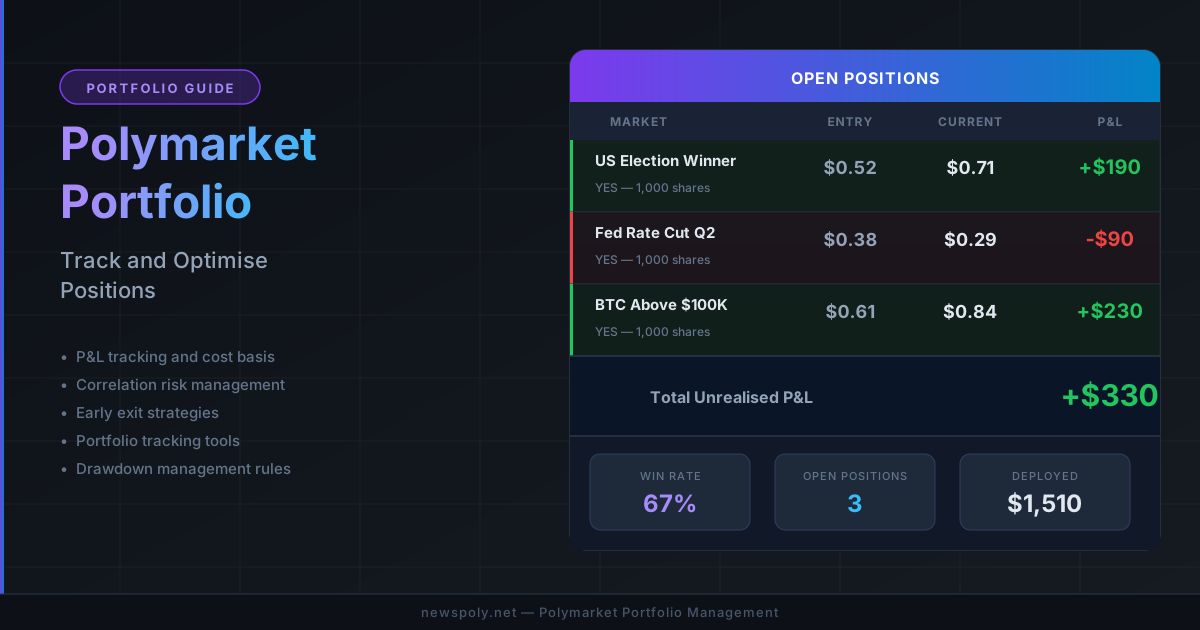
Each row displays the market name, your position (YES or NO), the number of shares you hold, the average entry price per share, and the current market price. The interface is read-only — you cannot resize or exit positions from this view. To manage a position you click through to the individual market page and use the order panel. Using limit orders rather than market orders when resizing positions helps you avoid paying wide spreads in thinner markets.
One practical limitation: Polymarket does not aggregate positions by theme or tag. If you hold five separate election markets, they appear as five unrelated rows. Spotting concentration risk requires you to do that analysis yourself, which is exactly what the next section covers.
Portfolio management on autopilot. PolyCopyTrade manages position sizing, correlation, and exits automatically by mirroring traders who already have optimised portfolios.
Tracking Unrealised P&L
Your unrealised P&L is the difference between what you paid for your shares and what those shares are worth right now at the current market price. The formula is simple:
Unrealised P&L = (Current Price — Entry Price) × Shares Held
Example: you bought 500 YES shares at $0.52 average. The market is currently pricing YES at $0.71. Your unrealised gain is ($0.71 — $0.52) × 500 = $95.
Polymarket shows you the current price and your share count. It does not automatically calculate cost basis. You need to record your entry prices separately — either in a spreadsheet or by checking your transaction history on PolygonScan.
Distinguishing unrealised from realised P&L matters for two reasons. First, unrealised gains can evaporate if a market moves against you before resolution. Second, positions that show paper profits can mask deteriorating probability — a YES share worth $0.71 today might be worth $0.20 next week if new information arrives. Track the number, but do not treat it as banked.
Correlation Risk: Five Trump Positions Are Really One Trade
The single most underappreciated risk in prediction market portfolios is correlation. Traders diversify by count — ten open positions feels like diversification — but if eight of those positions share the same underlying driver, you have not diversified at all.
Consider a typical politically-focused portfolio in 2026:
- Will Trump sign the spending bill by April?
- Will Republicans hold the Senate majority?
- Will Trump's approval rating exceed 45%?
- Will the US impose new tariffs on China this quarter?
- Will Trump fire the Fed Chair?
These look like five separate markets. They are functionally one large bet on political sentiment around one administration. If a major negative event hits — a scandal, a health story, a policy reversal — all five positions move against you simultaneously. Your "diversified" portfolio drawdowns as if it were a single concentrated trade.
Identifying correlation requires you to ask: what single event would cause most of my open positions to lose value at once? If you can name one event — a political figure, an economic report, a geopolitical development — that wipes out three or more positions, those positions are correlated and must be counted as a single exposure bucket.
This links directly to the broader discipline of risk management. Correlation is an often-overlooked dimension of that discipline.
Maximum Exposure Rules for Correlated Markets
Once you have mapped your correlation buckets, you need hard rules about how much of your total bankroll can sit in a single bucket. A reasonable framework:
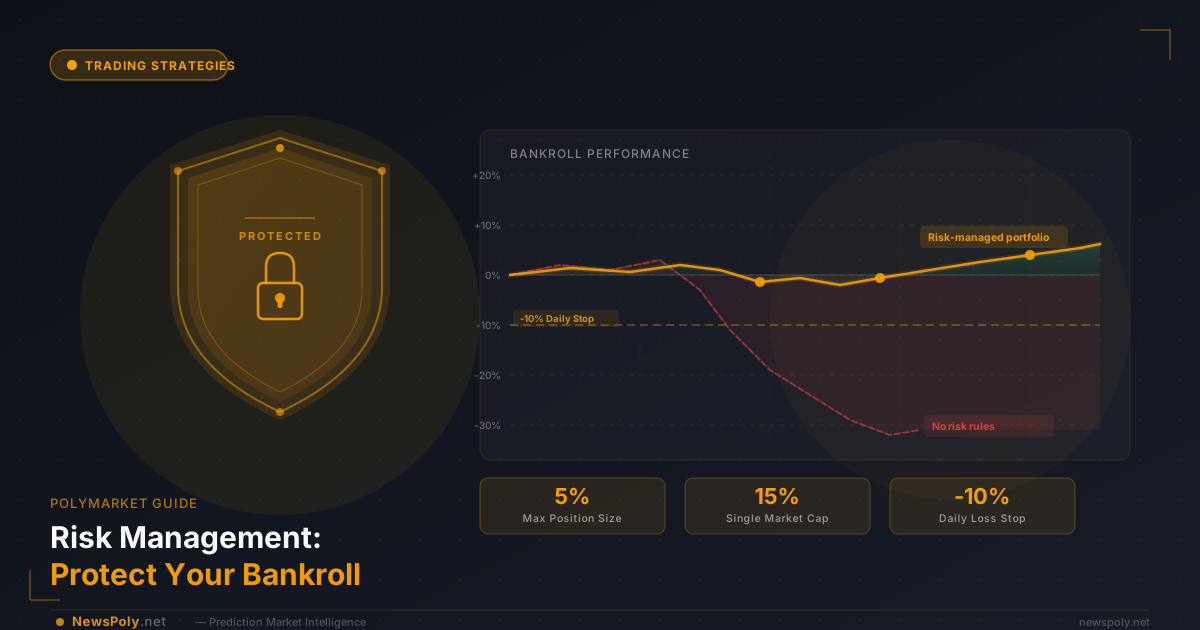
- Single market cap: No more than 10–15% of total capital in any one market.
- Correlated bucket cap: No more than 25–30% of total capital in any correlated cluster of markets.
- Theme cap: No more than 40% of total capital in any single broad theme (politics, macro, crypto).
These are guidelines, not laws. A high-conviction trade might justify bending the single-market cap. But bending the correlated-bucket cap is how traders blow up their accounts. If you have 60% of your capital in correlated Trump administration markets, you are not running a diversified portfolio — you are running a leveraged political bet with extra steps.
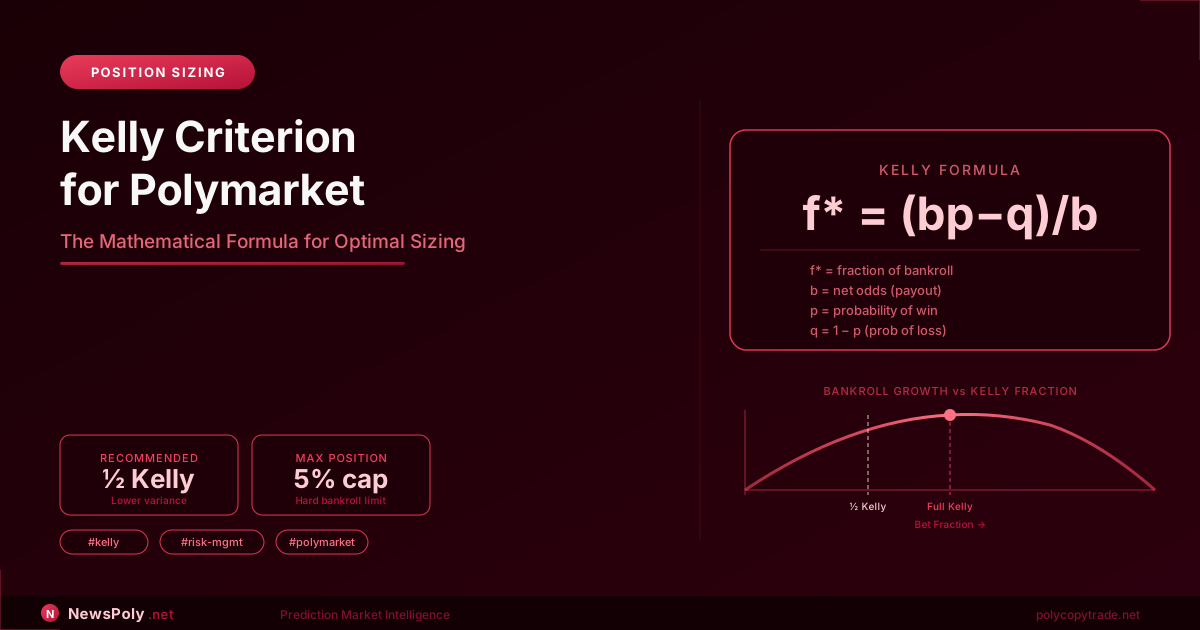
Sizing each position correctly before entry is equally important. Kelly Criterion sizing gives you a mathematically grounded method for determining optimal stake size based on your estimated edge and the odds on offer.
When to Exit Early: The Core Decision
Every position you hold has two possible closing mechanisms: wait for resolution, or sell your shares in the secondary market before the event concludes. Knowing when early exit beats resolution is one of the most valuable skills in portfolio management.
The case for waiting until resolution is straightforward: you collect full face value on winning shares ($1.00 per share) and pay no secondary market fee beyond the standard Polymarket fee at resolution. If you believe your position will resolve YES, waiting is usually the highest expected value path.
Early exit makes sense in three scenarios:
- Your edge has been largely captured. You bought YES at $0.30 because you thought the true probability was 50%. The market is now at $0.72. Your original thesis has played out. The remaining upside from $0.72 to $1.00 is $0.28 per share, but you carry the full remaining event risk. Locking in gains is rational.
- Better opportunities exist. Capital locked in a nearly-resolved position at $0.88 earns very little marginal return. That capital deployed into a fresh mispriced market could generate far more. Opportunity cost is real.
- Your original thesis has changed. New information has emerged that makes your original probability estimate wrong. Exit regardless of your current P&L level.
Early Exit Maths: A Worked Example
You bought 1,000 YES shares at $0.60 average cost. Total invested: $600. The market is now pricing YES at $0.92 with the event resolving in two weeks.
Option A: Exit now at $0.92. You sell 1,000 shares at $0.92. Gross proceeds: $920. Profit: $320. You pay Polymarket's secondary market fee (typically around 2% of trade value, so roughly $18). Net profit: approximately $302.
Option B: Wait for YES resolution. If the market resolves YES, you receive $1,000. Profit: $400. Resolution fees are lower than secondary market fees. Net profit: approximately $392.
Waiting appears better by about $90 — but only if YES resolves correctly. At $0.92 the market is implying an 8% chance the position resolves NO. That 8% risk of losing your entire $600 stake has to be weighed against the incremental $90 gain. For a position where you have high conviction the $0.92 price is still too low, waiting makes sense. For a position where your research edge is exhausted and you simply need to ride out the final days, exiting early to redeploy capital is often the smarter portfolio decision.
Rebalancing: Adding to Winners vs Cutting Losers
Prediction markets have a structural feature that makes rebalancing counterintuitive: markets resolve at binary outcomes. Unlike equities, where averaging down on a falling stock can be rational, averaging down on a YES position that has moved from $0.60 to $0.25 means you believe the market has mispriced the probability even more than when you entered. That requires a fresh research justification — not a reflexive desire to lower your cost basis.
The general rule: add to positions where your edge has increased, cut positions where your original thesis is no longer valid.
Adding to a winner — a YES position that has moved from $0.45 to $0.65 — is only justified if the market is still below your estimated true probability. If you originally thought true probability was 70% and the market has moved to 65%, there is still edge to press. If the market has moved past your estimate, adding at $0.65 buys you less expected value than the original entry.
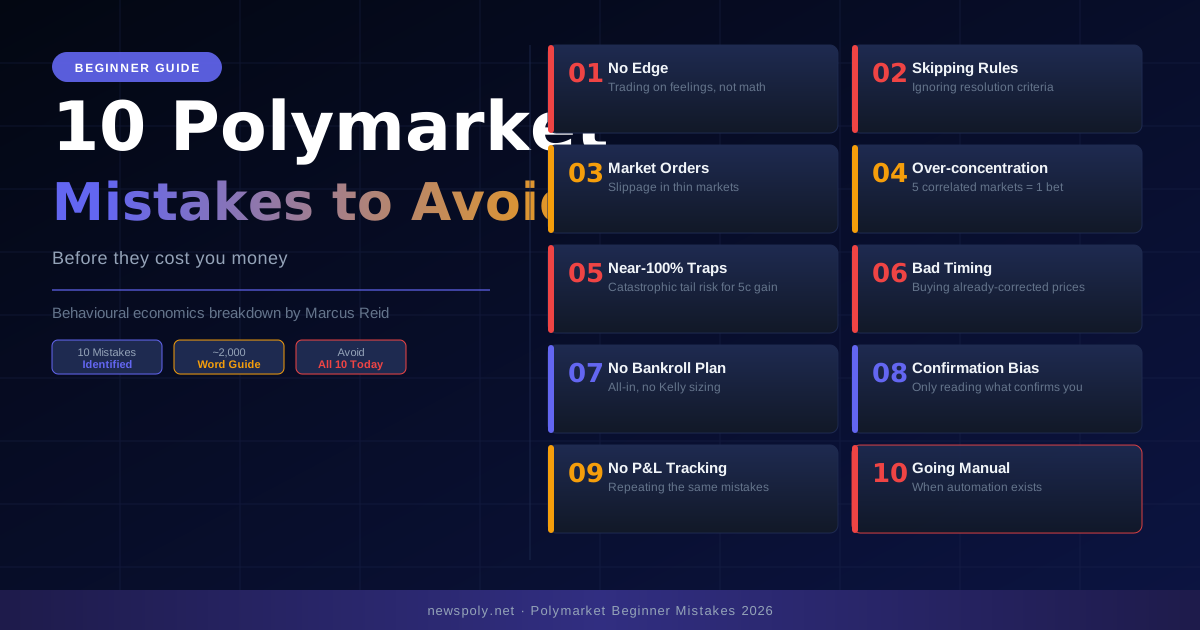
Cutting losers requires honesty. The hardest portfolio management habit is exiting positions that have gone against you because you were wrong rather than because of bad luck. Over-concentration and refusal to cut losing positions are two of the most common beginner errors that prevent accounts from growing.
Portfolio Tracking Tools
Polymarket's Built-In Portfolio View
The native interface shows current positions, share counts, and current market prices. It is the fastest way to get a snapshot of your open book. Limitations: no cost basis tracking, no P&L calculation, no correlation view, no historical performance data.
PolygonScan Wallet Tracking
Because Polymarket operates on Polygon, every transaction is publicly recorded. Enter your wallet address at polygonscan.com to see a complete history of every trade: timestamp, market contract address, shares bought or sold, USDC amounts. This gives you the raw data to reconstruct exact cost basis for every position. It is slow and manual, but it is the ground truth if you want to verify what Polymarket's interface shows you. These are also the on-chain data tools used for more advanced analytics and automated tracking. For a broader overview of how to grow your account systematically, the top Polymarket trading strategies guide covers how portfolio management fits alongside market selection and position sizing.
Custom Spreadsheets
A basic tracking spreadsheet needs seven columns: Market Name, Position (YES/NO), Entry Date, Shares, Average Entry Price, Current Price, Unrealised P&L. Add a column for Correlation Bucket to flag related positions. Add a final column for your original probability estimate so you can compare it against current market price at any time. Update the Current Price column manually whenever you review the portfolio.
Dune Analytics
Dune Analytics hosts community-built dashboards that aggregate Polymarket activity across wallets. Some public dashboards allow you to enter your wallet address and see aggregated performance metrics, win rates by category, and historical P&L curves. The quality and availability of these dashboards varies, but searching Dune for "Polymarket portfolio" will surface the most maintained options. These are more useful for historical analysis than live position tracking.
Portfolio management on autopilot. PolyCopyTrade manages position sizing, correlation, and exits automatically by mirroring traders who already have optimised portfolios.
Drawdown Management: When to Reduce Exposure
Every portfolio experiences drawdowns. The question is whether a drawdown reflects bad luck in well-reasoned positions or a structural problem with how you are selecting and sizing trades. The response should differ.
A useful trigger rule: if your total portfolio value drops more than 20% from peak, pause new entries and audit every open position. Ask whether each position still has positive expected value at current prices given current information. Close the ones that no longer do. Only resume new entries once you have a clear account of why the drawdown happened.
A second rule: cap maximum drawdown at 30–40% of peak capital. If you hit that level, stop trading entirely for a defined period — one week minimum. Drawdown periods trigger cognitive biases that cause traders to chase losses with increasingly reckless positions. A forced pause breaks that cycle.
Position Review Cadence
Daily review is appropriate only for positions in markets resolving within the next 48 hours or for markets that are highly sensitive to fast-moving news (political events, economic releases). Checking these positions daily allows you to exit before resolution if the probability shifts against you.
Weekly review is the right cadence for most open positions. Each week: update current prices in your tracking spreadsheet, recalculate P&L, check for new information that changes your probability estimates, assess whether any positions have grown disproportionately large as a share of the total portfolio, and flag any positions approaching resolution date.
Monthly review should focus on overall portfolio construction: correlation bucket analysis, theme concentration, win rate by category, and whether your sizing rules are being followed consistently.
Record Keeping for Tax Purposes
In most jurisdictions, prediction market profits are taxable as capital gains or income. The exact classification depends on your country's treatment of gambling or financial instrument income — consult a local tax adviser for your specific situation.
Regardless of classification, you need to record every trade: date, market, shares bought or sold, price per share, USDC value, and any fees paid. PolygonScan transaction history is your primary source. Export or screenshot this data regularly — do not rely on Polymarket's interface to retain historical data indefinitely.
Keep records by tax year. Calculate your total realised gains and losses separately from unrealised positions. Positions that are open at year end are unrealised and typically not taxable until closed. For a complete treatment of what you need to track, see the tax record keeping guide.
Frequently Asked Questions
How often should I check my Polymarket portfolio?
For most traders, a weekly review is sufficient for positions with resolution dates more than two weeks away. Increase to daily monitoring for positions approaching resolution or in markets sensitive to rapidly changing news. Checking more frequently than necessary tends to trigger emotional reactions to short-term price noise rather than systematic decision-making.
What is the best way to track cost basis on Polymarket?
Polymarket's native interface does not display cost basis. The most reliable method is maintaining a spreadsheet where you log each trade as you make it — market name, date, shares, price per share. PolygonScan provides the transaction history to reconstruct cost basis retroactively if you have not been logging trades in real time. Some third-party Dune Analytics dashboards also attempt to calculate this automatically, though accuracy varies.
Should I exit a position early if I am up significantly?
It depends on whether your edge is exhausted. If you bought YES at $0.30 because you estimated true probability at 55%, and the market is now pricing YES at $0.75, the market has moved well past your original estimate. Your edge has been captured and the remaining upside is smaller relative to the remaining event risk. Early exit at that point is rational. If the market is still below your estimated true probability, staying in the position and waiting for resolution maximises expected value.
Portfolio management on autopilot. PolyCopyTrade manages position sizing, correlation, and exits automatically by mirroring traders who already have optimised portfolios.