Expected value is the single most important concept in profitable Polymarket trading. Every other consideration — market selection, position sizing, timing — is secondary to one question: does this trade have positive EV? If the answer is yes, you should be in. If the answer is no, walk away regardless of how confident your gut feels. Understanding and applying EV correctly separates traders who profit over the long run from those who break even or lose.
This guide walks through the EV formula in full, provides worked examples for both positive and negative EV trades, explains how to account for Polymarket’s 2% fee, and covers the harder question of where your probability estimate actually comes from. For context on reading odds on Polymarket before applying EV calculations, start there first.
What Is Expected Value?
Expected value is the probability-weighted average of all possible outcomes from a decision. In simple terms: if you made the same bet an infinite number of times under identical conditions, EV tells you what you would earn per dollar staked on average.
A positive EV (+EV) means the bet returns more than it costs over time. A negative EV (−EV) means it costs more than it returns. Zero EV means you break even. Casinos profit because every game they offer has negative EV for the player. Successful traders profit because they only take positions with positive EV.
EV does not guarantee you win any individual trade. A +EV trade can and will lose sometimes. What EV guarantees is that, across a large enough sample of +EV trades, you will come out ahead. This is why tracking EV discipline is more valuable than tracking individual wins and losses. For a practical overview of how EV fits alongside other approaches, see the guide to top Polymarket trading strategies.
The EV Formula for Polymarket
For a binary outcome market on Polymarket, the expected value formula is:
EV = (P_win × profit_per_dollar) − (P_lose × stake_per_dollar)Breaking this down for a YES share purchased at price c (expressed as a decimal between 0 and 1):
- Profit per dollar if you win: (1 − c) — you paid c and receive $1, so profit is $1 − c
- Loss per dollar if you lose: c — you lose your entire stake
- P_win: your estimated probability the event resolves YES
- P_lose: 1 − P_win
So the full formula is:
EV = (P_win × (1 − c)) − ((1 − P_win) × c)This simplifies to:
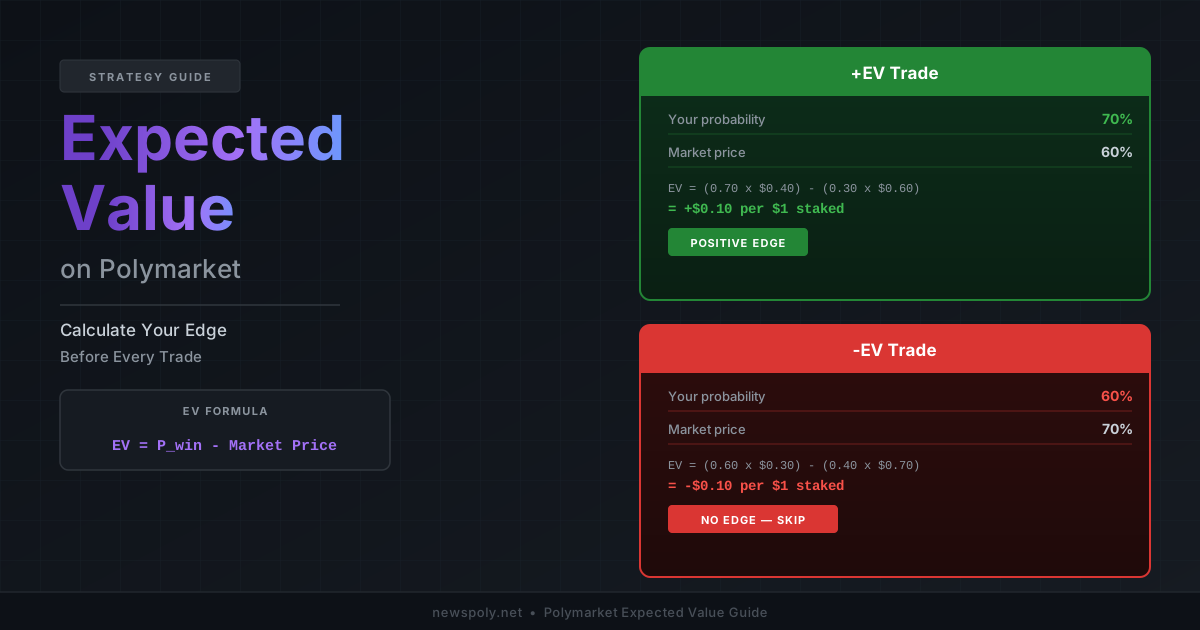
EV = P_win − cThis simplified form is elegant: your edge is simply the difference between your probability estimate and the market price. If you believe an event has a 70% chance of occurring and the market prices it at 60 cents (60%), your raw EV per dollar staked is +0.10, or 10 cents per dollar.
Worked Example 1: Positive EV Trade
Suppose a market asks: “Will the Federal Reserve cut rates at its next meeting?” The current YES price is $0.60 (60%). After doing your research — reading the Fed’s dot plot, recent inflation data, and analyst commentary — you estimate the true probability at 70%.
Applying the formula:
EV = (0.70 × $0.40) − (0.30 × $0.60)
EV = $0.28 − $0.18
EV = +$0.10 per $1 staked
You have a 10-cent edge per dollar. This is a positive EV trade. If you staked $100, your expected profit before fees is $10. Note that you will lose this trade 30% of the time — but the math says you should take it.
Worked Example 2: Negative EV Trade
Now reverse the scenario. The same market prices YES at $0.70 (70%). You estimate the true probability at 60%.
EV = (0.60 × $0.30) − (0.40 × $0.70)
EV = $0.18 − $0.28
EV = −$0.10 per $1 staked
You are losing 10 cents per dollar on average. Despite the fact that you still think the event is more likely to happen than not, the market has already priced in more optimism than your estimate justifies. This is a trade you skip — full stop.
This example illustrates a common mistake: confusing “I think this will happen” with “this is a good trade.” A trade is only good if the price is below your probability estimate.
Accounting for the 2% Fee
Polymarket charges a 2% fee on profits when a market resolves. This fee applies to your winnings, not your stake, so it reduces the effective profit per dollar won. See our Polymarket fees guide for the full breakdown.
To account for the fee, adjust the profit side of the formula:
EV (after fee) = (P_win × (1 − c) × 0.98) − ((1 − P_win) × c)Using Worked Example 1 again:
EV = (0.70 × $0.40 × 0.98) − (0.30 × $0.60)
EV = $0.2744 − $0.18
EV = +$0.0944 per $1 staked
The fee reduces your edge from +$0.10 to roughly +$0.094 per dollar. For large edges this barely matters, but for thin-edge trades it can tip a marginally positive EV trade into breakeven or negative territory. As a rule of thumb: any trade where your raw edge is less than 3% is probably not worth taking once fees are factored in.
Positive EV without the calculation. PolyCopyTrade copies wallets with verified positive EV track records — you get their edge without building your own probability models from scratch.
Where Does Your Probability Estimate Come From?
The EV formula is simple. The hard part is the number you plug in for P_win. Your edge only exists if your probability estimate is more accurate than the market’s implied probability. If you are just guessing, you have no systematic edge.
There are three main sources of probability estimates:
- Base rates: Historical frequency of similar events. How often does the Fed cut rates when inflation is above 3%? How often does a sports team win when favoured at this margin? Base rates anchor your estimate in data rather than intuition.
- Model-based estimates: Building or using a quantitative model that processes inputs (economic data, polling, expert forecasts) into a probability. This is how superforecasters and professional traders operate.
- Information advantage: You have access to or have processed information the broader market has not fully priced in yet. This is the edge behind finding mispriced markets — typically found in lower-liquidity, niche markets where fewer traders are paying attention.
Calibration: Measuring Your Own Accuracy
Calibration is the measure of how well your probability estimates match reality. A perfectly calibrated forecaster who says “70% probability” on one hundred independent events should see roughly seventy of them occur. If you consistently say 70% and only 50% happen, you are overconfident. If 90% happen, you are underconfident.
To measure your calibration on Polymarket:
- Record your probability estimate before entering every trade (not just the market price — your independent estimate)
- Track outcomes over at least 50 trades before drawing conclusions
- Group trades by probability bucket (50–60%, 60–70%, 70–80%, etc.) and compare your win rate in each bucket to the midpoint probability
Calibration work takes discipline. Most traders skip it entirely. But it is the only way to know whether your P_win estimates are reliable inputs into the EV formula or just noise. For more on the psychological traps that distort probability estimates, see our guide on calibration and bias.
Base Rate Research as an EV Source
One of the most systematic ways to develop accurate probability estimates is base rate research: finding the historical frequency of events in the same reference class as the market you are trading.
For example, if you are trading a market on whether a bill will pass Congress within 60 days of introduction, research how often similar bills have passed in that timeframe historically. If the historical rate is 12% but the market is pricing YES at 30%, that is a strong signal of a negative EV trade on the YES side — and potentially a positive EV trade on the NO side at 70 cents.
Base rate research does not require insider knowledge or proprietary models. It requires deliberate effort that most retail traders do not bother with. That gap is your edge opportunity.
How Market Efficiency Affects EV
Polymarket markets vary significantly in how efficiently they are priced. High-profile markets — US elections, major Fed decisions, prominent sports events — attract large trading volumes and sophisticated participants. These markets are harder to find edge in because the price already incorporates most publicly available information.
Lower-liquidity, niche markets are where mispricing is most common. Fewer traders are paying attention, information is less uniformly distributed, and the market price may lag meaningful new developments for hours or even days. If you are looking for +EV opportunities, narrower markets on specific policy outcomes, international elections, or emerging topics are more fertile hunting ground than the most-traded markets on the platform.
This is why volume alone is not a signal. A market with $10 million in liquidity and tight spreads has probably been arbitraged close to fair value. A market with $50K in volume may have 10 cents of edge sitting in it for a prepared trader.
Kelly Criterion: EV’s Sizing Partner
Calculating EV tells you whether to trade. It does not tell you how much to stake. That is where the Kelly Criterion comes in. Kelly uses your edge and the odds to compute the theoretically optimal fraction of your bankroll to risk. To see the full profit and ROI maths for any given entry price before you apply EV, our Polymarket profit calculator guide walks through the formulas with five worked examples.
The Kelly formula for Polymarket is:
f* = (P_win × (1/c) − 1) / ((1/c) − 1)Where c is the cost per share and P_win is your estimated probability. In practice, most traders use a fractional Kelly (25–50% of the full Kelly recommendation) to reduce variance and protect against edge estimation errors. The key point: EV and Kelly work together. EV tells you the sign of the trade (take it or skip it); Kelly tells you the magnitude.
EV vs Variance: Positive EV Trades Still Lose
A critically important mental model: EV is a long-run concept. Individual trades are dominated by variance. A +EV trade with a 70% win probability still loses 30% of the time. Strings of 5 or 10 losses in a row are entirely consistent with a positive EV strategy.
This creates a psychological challenge. After a losing streak, it is tempting to conclude your strategy is broken and either abandon it or start increasing stakes to “catch up.” Both responses are destructive. The correct response is to verify your probability estimates are still sound, maintain consistent sizing, and trust the math.
This is why risk management infrastructure matters so much. Proper bankroll management ensures that variance cannot wipe you out before the positive EV expectation has time to materialise. EV without risk management is a formula that works in theory and blows up in practice.
Positive EV without the calculation. PolyCopyTrade copies wallets with verified positive EV track records — you get their edge without building your own probability models from scratch.
Common EV Calculation Mistakes
Even traders who understand EV in theory make these mistakes in practice:
- Using the market price as your probability estimate. The market price is what you are betting against, not your independent assessment. If your estimate equals the market price, your EV is zero. You need to form your own view first.
- Ignoring the fee. On thin-edge trades, the 2% fee converts a slightly positive EV trade into a breakeven or negative one. Always run the fee-adjusted calculation.
- Anchoring to your entry price. Whether you entered at 60 cents or 80 cents is irrelevant to whether the trade has positive EV right now. EV calculations are always forward-looking from the current market price.
- Overestimating edge in liquid markets. If a market has millions of dollars in volume, assume the price is close to fair value unless you have a specific, concrete reason your estimate is better than the aggregate of all active traders.
- Not tracking your estimates. Without a record of your probability estimates and outcomes, you cannot measure your calibration. Without calibration data, your P_win inputs are guesses rather than estimates.
Frequently Asked Questions
Can I have positive EV on both the YES and NO side of the same market?
No. If you believe YES has a 70% probability and the market prices YES at 60%, then NO is priced at 40% and your estimate implies NO has a 30% probability. The YES side is +EV and the NO side is −EV from your perspective. You cannot have genuine +EV on both sides simultaneously — that would imply your probabilities sum to more than 100%, which is mathematically impossible.
How many +EV trades do I need before the EV expectation reliably shows up in my results?
The law of large numbers requires a meaningful sample to converge. With high-variance trades (edge of 5–10%), you generally need at least 100–200 trades to see EV reliably overcome variance in your results. With thinner edge and higher variance markets, the sample requirement is even larger. This underscores why consistent bet sizing and disciplined record-keeping matter from day one.
Is EV the same as expected profit in dollars?
EV as calculated here is expressed per dollar staked, which is essentially a percentage return expectation. To convert to expected dollar profit, multiply EV by your stake size. If your EV is +$0.10 per dollar and you stake $200, your expected profit is $20. The dollar figure scales linearly with stake; the EV percentage does not change based on how much you bet (although Kelly sizing does account for bankroll size to determine optimal stake).
Positive EV without the calculation. PolyCopyTrade copies wallets with verified positive EV track records — you get their edge without building your own probability models from scratch.