Knowing how to research Polymarket markets before you place a trade is the single most important habit that separates profitable forecasters from recreational ones. Most new traders lose not because they pick wrong outcomes, but because they never verify what "winning" actually means, never check the historical base rate, and never confirm that the current price is genuinely wrong. This guide walks you through a repeatable, five-step Polymarket research process you can apply to every market - whether it is a short-term election call or a months-long macroeconomic question.
Polymarket research is not glamorous. It involves reading rules documents, cross-referencing data sources, and doing a little arithmetic before every entry. But traders who follow this process consistently outperform those who trade on instinct. By the end of this article you will have a concrete checklist you can work through in under fifteen minutes per market.
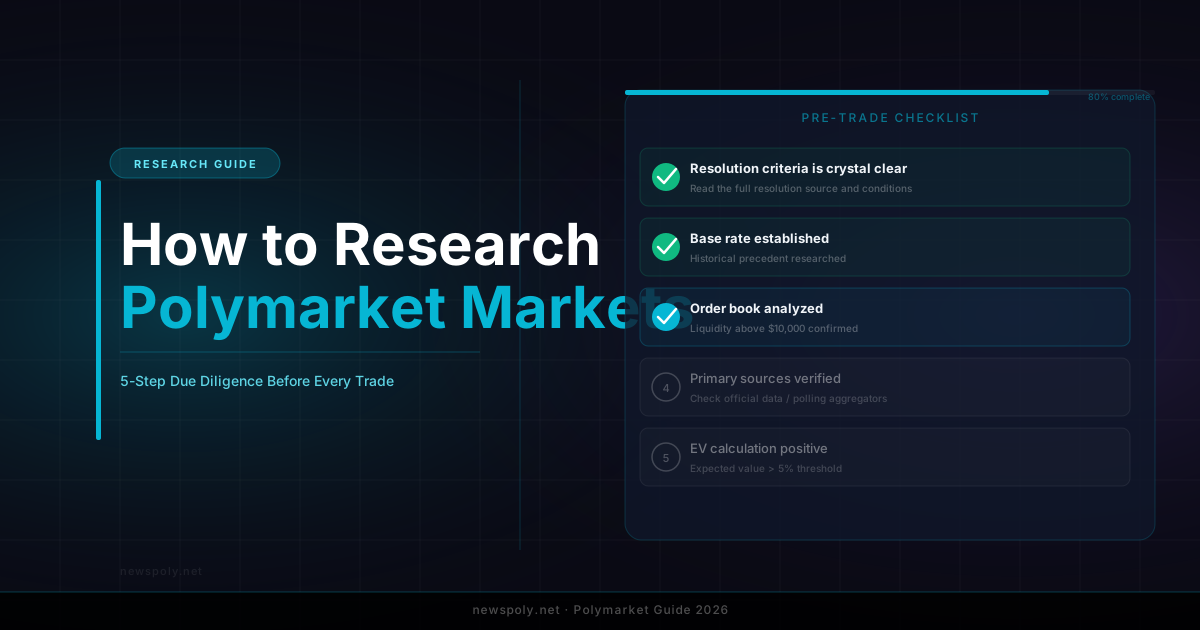
Step 1 - Understand Exactly What the Market Is Asking
The first and most underrated step in any Polymarket research process is reading the resolution criteria in full - not just the headline. Polymarket markets resolve on specific, often narrow definitions. A market titled "Will the Fed cut rates in March?" might resolve YES only if the cut is announced at the official FOMC meeting, not at an emergency session. A market titled "Will Country X hold elections by June?" might resolve NO if elections are announced but delayed past midnight UTC on the resolution date.
Resolution criteria misreads are one of the most common sources of avoidable loss on prediction markets. Before you do any probability work, open the market detail page, expand the resolution rules, and ask yourself three questions:
- What is the exact event that triggers YES resolution?
- Who is the designated resolver - Polymarket's UMA system, a specific news source, or an official government body?
- Are there any edge cases or ambiguities in the wording that could lead to an unexpected N/A resolution?
If there is genuine ambiguity, check the Polymarket Discord or the UMA governance forum for prior interpretations on similar markets. A market that could resolve N/A refunds your stake but wastes your capital allocation for weeks. Factor that risk in before you enter.
Understanding resolution criteria also helps you identify source risk - the possibility that the resolver's data source differs from the consensus you are tracking. If the market resolves on official CPI data from the Bureau of Labor Statistics and you are following a real-time inflation tracker, you may be right on the underlying trend and still lose on resolution day.
Step 2 - Establish Your Base Rate
Once you know what you are trading on, you need a prior probability that is independent of the current market price. This is your base rate - the historical frequency at which events like this one have occurred.
For political markets, base rates come from election history, polling aggregators like FiveThirtyEight or Nate Silver's Substack, and academic models. For economic markets, you can pull historical data series from FRED, the BLS, or the World Bank. For sports markets, team statistics and head-to-head records are your starting point. For crypto markets, check on-chain volatility history and prior cycle behavior.
Your base rate is not the final answer - it is your anchor. From there you update based on new information. This is the core of Bayesian reasoning: start with a prior, update with evidence, arrive at a posterior probability. If your posterior diverges significantly from the current market price, you may have found an edge.
A few base rate traps to avoid:
- Too short a reference class: Using only the last two years of data when the question has a longer historical pattern.
- Wrong reference class: Comparing a parliamentary confidence vote to a general election when the dynamics are completely different.
- Ignoring base rate drift: Some phenomena change over time - interest rate cycles in 2010 are not a reliable guide to 2026 Fed behavior.
For a deeper look at using historical data in your research process, see our guide to Polymarket historical data and how to pull it systematically.
Step 3 - Read the Order Book and Volume
After establishing your independent probability, check what the market is actually saying and how much conviction is behind it. The current market price represents the aggregate belief of all active traders - but the order book tells you how stable that price is and how much capital is supporting each side.
Key things to read in the order book:
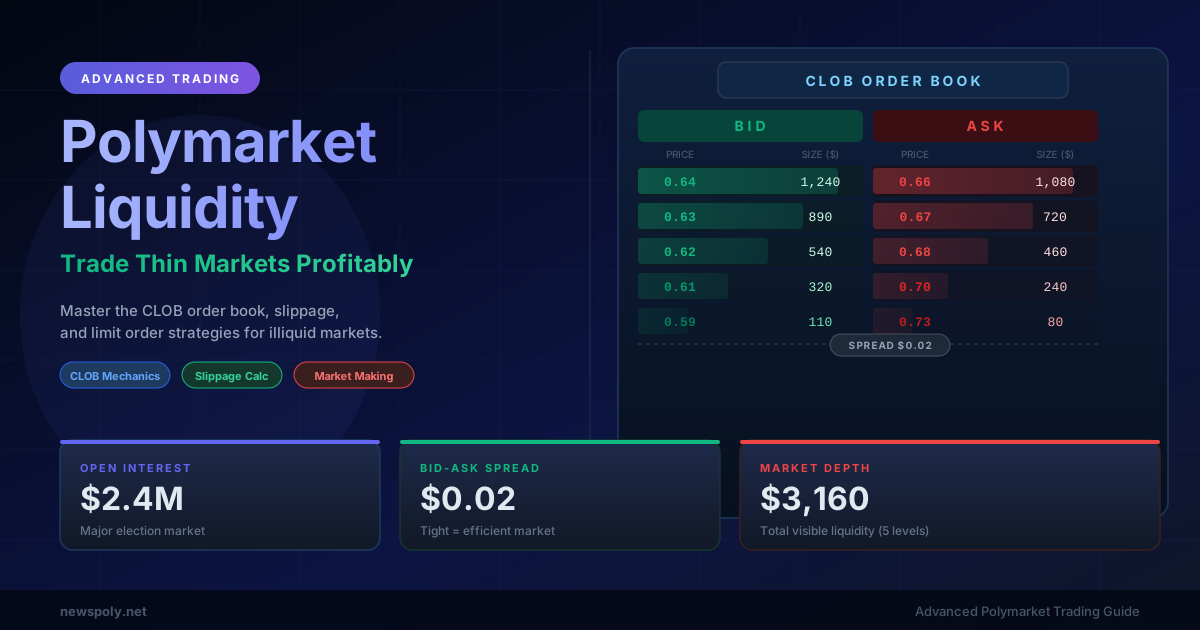
- Bid-ask spread: A wide spread signals low liquidity and high uncertainty. You will pay a larger transaction cost to enter and exit.
- Order depth: Large limit orders close to the current price suggest market makers are confident. Thin depth means prices can move sharply on small trades.
- Volume trend: Rising volume into a resolution date often means informed traders are taking positions. Sudden volume spikes may signal a news event you have missed.
- Price history: Has the market drifted steadily to its current price, or did it jump there on a single news event? Gradual drift often reflects aggregating information; sudden jumps may reflect overreaction.
Our Polymarket charts guide explains how to read price history and volume on the platform in detail. The Polymarket liquidity guide covers how to assess whether a market has enough depth for your position size without moving the price against yourself.
If you want to go deeper, on-chain data gives you wallet-level transparency. You can see exactly how many unique addresses hold YES vs NO, which wallets entered recently, and whether large traders are accumulating or distributing. The Polymarket API and on-chain data guide walks through how to pull this data programmatically.
Step 4 - Identify Your Information Sources
Good Polymarket research depends on knowing which sources to trust for which types of markets. Using the wrong source - or a secondary source that lags primary data - can give you a false sense of confidence.
Build a personal source stack by market category:
Political and electoral markets: Polling aggregators (270toWin, RealClearPolitics), academic election models, official election authority websites for registration and results data, court document trackers for legal/political events.
Economic and macro markets: FRED (Federal Reserve Economic Data), Bureau of Labor Statistics release calendar, Congressional Budget Office projections, central bank minutes and meeting schedules.
Crypto markets: Glassnode, Nansen, Dune Analytics for on-chain metrics; CME futures term structure for institutional positioning; CoinGlass for liquidation data.
Sports markets: Official league statistics, injury report feeds, team press conferences, advanced analytics sites relevant to the sport.
Geopolitical and international markets: ACLED for conflict data, UN treaty databases, official government gazette feeds, reputable wire services (Reuters, AP) as primary sources rather than aggregated news sites.
The key discipline here is always tracing information back to the primary source. If a news article says "the report showed X," find the actual report. Secondary sources introduce latency and interpretation errors. On Polymarket, the resolver uses specific primary sources - if you are reading secondhand summaries, you may miss nuances that affect resolution.
Tracking Polymarket whale activity is another form of source intelligence: large, historically accurate traders act as a signal in themselves.
Step 5 - Calculate Your Probability vs Market Price
The final step before any trade is the expected value calculation. This is where your independent probability estimate meets the current market price to determine whether there is a positive-EV entry.
The formula is straightforward:
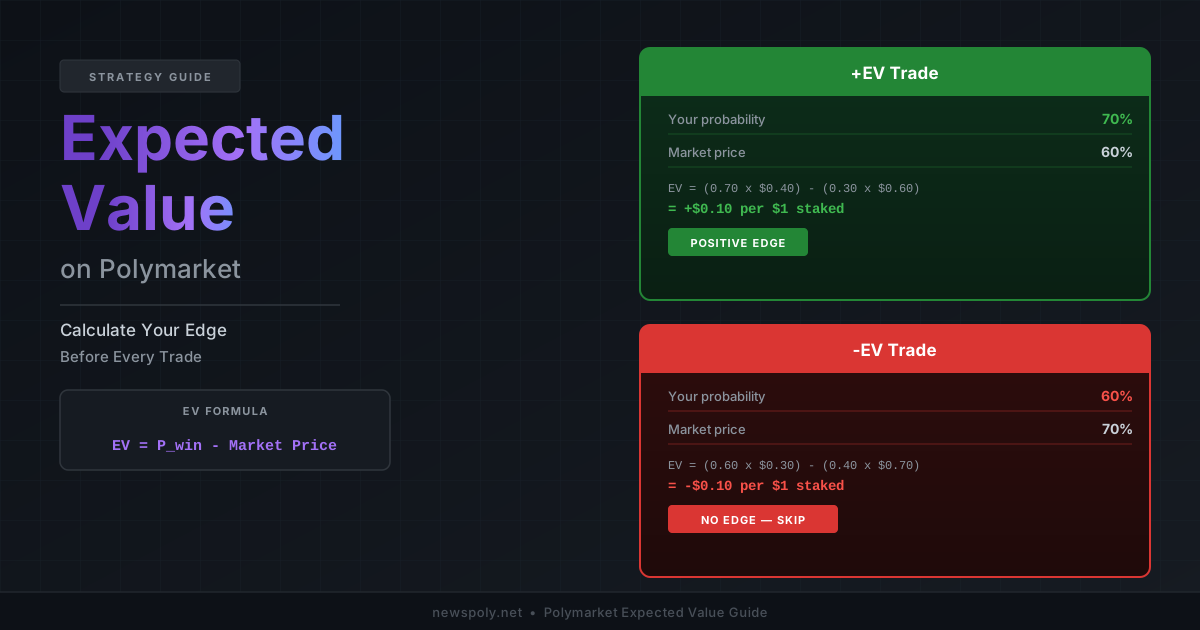
EV = (Your probability of YES) x (Profit per share if YES) - (1 - Your probability of YES) x (Cost per share)
On Polymarket, shares price between $0 and $1. If YES shares cost $0.60 and you believe the true probability is 72%, your EV per share is:
EV = 0.72 x $0.40 - 0.28 x $0.60 = $0.288 - $0.168 = $0.12 per share
That is a 20% edge before transaction costs. Whether that justifies an entry depends on your position sizing rules, the liquidity available, and how confident you are in your probability estimate.
A few EV thresholds used by serious forecasters:
- Less than 5% edge: skip - transaction costs and model error eat the margin
- 5-10% edge: small position only, high uncertainty
- 10-20% edge: standard position
- Over 20% edge: consider sizing up, but verify your research is not missing something obvious
Our detailed walkthrough of expected value on Polymarket covers position sizing, Kelly criterion, and how to calibrate your probability estimates over time.
Polymarket Research Checklist
Use this table before every trade. Each row is a gate - if you cannot answer the "What to Look For" column confidently, do more work before entering.
| Research Step | What to Look For |
|---|---|
| Resolution criteria | Exact YES trigger, resolver identity, N/A risk, edge cases |
| Base rate | Historical frequency of comparable events, correct reference class |
| Order book depth | Bid-ask spread, limit order depth near current price, slippage estimate |
| Volume and price trend | Rising or falling volume, sudden price jumps that need explaining |
| Primary source verification | Data traced to official/primary source, not a secondary summary |
| Independent probability estimate | Your posterior probability formed before checking market price |
| EV calculation | Minimum 5% positive edge after transaction costs before entry |
| Position size | Sized relative to edge, liquidity, and total bankroll - not emotion |
Common Research Mistakes to Avoid
Even traders who follow a research process make predictable errors. Knowing these patterns helps you catch them in your own work.
Overconfidence after one confirming source. Finding a single article or data point that supports your view and stopping there is the most common mistake. Serious researchers deliberately seek out the best counter-argument before finalizing a probability. If you cannot articulate the strongest case for the other side, you have not done enough research.
Recency bias in base rates. Weighting recent events too heavily because they feel more salient leads to skewed priors. The last Fed pivot, the last election upset, the last market bubble - these are vivid but may not be representative of the broader historical distribution you should be drawing from.
Ignoring resolution risk. Traders focus on the underlying event but ignore the probability that the market resolves in an unexpected way - N/A, disputed, or delayed. Resolution risk is especially high for markets that depend on a single news source or a specific government body's action. Price this risk into your EV calculation.
Anchoring to the current market price. Many traders form their probability estimate by starting from the current price and adjusting slightly. This is anchor bias. Your independent probability should be formed from your own research before you look at what the market says. Only then should you compare the two.
Neglecting time value of capital. A 10% edge over six months is much less attractive than a 10% edge over two weeks. Factor in how long your capital will be locked up and what other opportunities you are passing on.
Tools and Resources for Polymarket Research
These are the tools most frequently used by serious Polymarket traders in 2026:
Metaculus and Good Judgment Open: Community forecasting platforms where aggregated human predictions often track well-calibrated probabilities. Useful for cross-referencing Polymarket prices on major events.
Polymarket's own analytics: The platform provides price history, volume, and unique trader counts on each market page. The charts guide explains how to use these features.
FRED (Federal Reserve Economic Data): The authoritative free source for US macroeconomic time series. Essential for any market involving inflation, employment, or interest rates.
Dune Analytics: On-chain query platform where the community publishes dashboards tracking Polymarket market positions, whale wallets, and historical accuracy by trader. Free tier is sufficient for most research needs.
Kalshi and Manifold Markets: Competitor prediction markets can serve as independent price signals. When Kalshi prices diverge significantly from Polymarket on the same event, it is worth understanding why before entering.
Google Alerts and RSS feeds: Set alerts on the specific entities relevant to your open positions. Automated monitoring is faster than manual news checking and reduces the risk of missing a resolution-triggering event.
For the full landscape of Polymarket markets worth trading, see our guide to the best Polymarket markets by category and expected liquidity.
Frequently Asked Questions
How long does proper Polymarket research take?
For a familiar market category, the five-step process takes 10-20 minutes once you have your source stack set up. For an unfamiliar topic or a market with complex resolution criteria, budget 45-60 minutes. The investment is worth it: a single avoidable loss on a poorly researched trade can wipe out the returns from ten well-researched ones.
Do I need to be an expert on every topic I trade?
No. You need to know enough to identify reliable primary sources, form a reasonable base rate, and recognize when a market is outside your competence. Specializing in two or three market categories and building deep source stacks in those areas is more profitable than spreading research attention across every topic on the platform.
How do I know if my probability estimate is calibrated?
Track your predictions over time. If you say 70% probability and the event happens 70% of the time across a large sample, you are calibrated. Most new forecasters are overconfident - they assign 80% to things that happen 60% of the time. Platforms like Metaculus let you practice calibration publicly. You can also review your own Polymarket trading history and compare your entry prices to your actual win rates by market category.
What is resolution risk and how do I account for it?
Resolution risk is the probability that a market resolves differently from the underlying event due to wording, source disputes, or unforeseen circumstances. To account for it, read resolution criteria carefully, check UMA dispute history for similar markets, and apply a small probability haircut (typically 2-5%) to your EV calculation when resolution criteria are ambiguous. Markets that resolve N/A return capital but consume time.
Should I use Polymarket whale activity as a research signal?
Yes, with caution. Large traders with strong track records can be useful secondary signals, particularly when they move against the prevailing market price. However, whale activity is not a substitute for your own research - large traders can be wrong, and following them blindly creates crowd effects that distort the market. Use whale data to prompt deeper investigation, not as a standalone reason to enter. Our whale tracking guide covers how to identify and interpret large trader movements on-chain.