Placing a Polymarket trade without running the numbers first is like accepting a contract without reading it. The platform’s binary payout structure makes the maths genuinely simple — every winning share pays exactly $1.00 USDC — but the profit you keep depends on your entry price, your stake size, the 2% resolution fee, and whether the market’s implied probability actually matches reality. This guide gives you every formula you need, five worked examples across different price points, and a decision framework for sizing positions before you click “Buy.”
How Polymarket Payouts Work
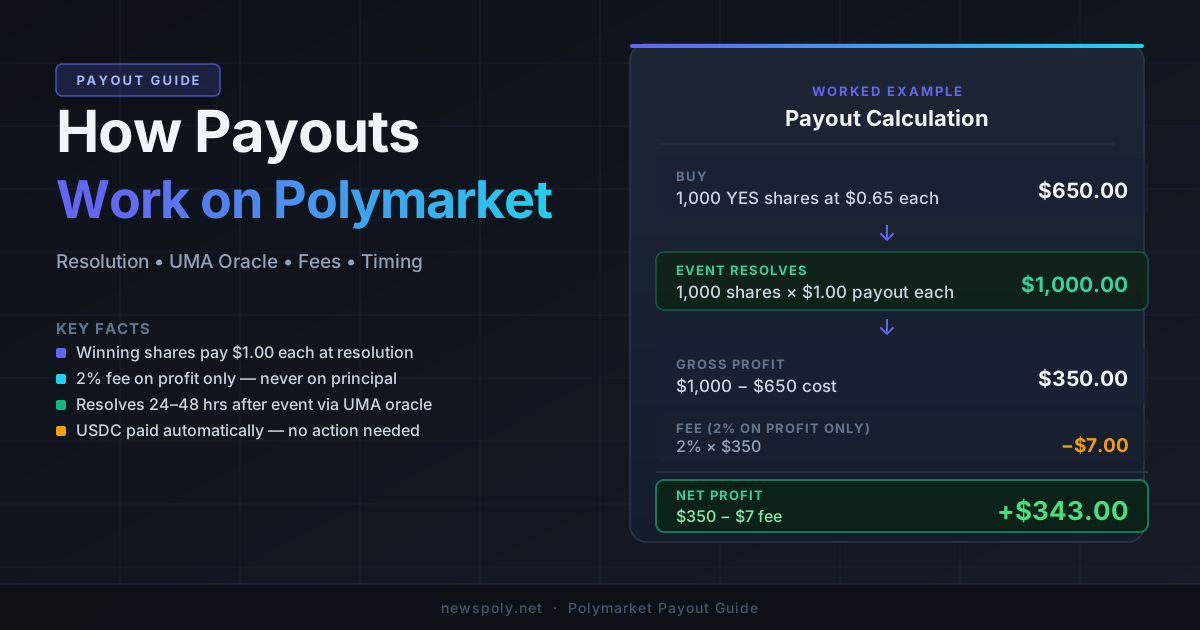
Polymarket is a binary prediction market. Every market has two outcomes: Yes and No. At resolution, each winning share pays exactly $1.00 USDC and each losing share pays $0.00. There are no partial payouts, no overtime bonuses, no adjustments. The payout is always one dollar or zero.
Shares trade on a Central Limit Order Book (CLOB) at prices between $0.01 and $0.99. The price of a share is the market’s collective estimate of the probability that outcome will occur. A Yes share trading at $0.72 means the crowd believes there is roughly a 72% chance the event resolves Yes. If you agree — or believe the true probability is higher — buying at $0.72 and collecting $1.00 if correct is the trade. For a deeper look at how the order book works, see our Polymarket fees guide, which covers the CLOB mechanics alongside cost structure.
The Core Profit Formula
Because every winning share pays $1.00, the profit formula is straightforward:
Shares held = Stake ÷ Price per share
Gross payout = Shares held × $1.00
Gross profit = Gross payout − Stake
Or in a single expression:
Gross profit = (Stake ÷ Price) − Stake
For example: you stake $200 on Yes at a share price of $0.40.
- Shares = $200 ÷ $0.40 = 500 shares
- Gross payout = 500 × $1.00 = $500
- Gross profit = $500 − $200 = $300
The formula works identically for No shares. If you buy No at $0.35 and the market resolves No, each No share also pays $1.00. The maths is the same — only the outcome side differs.
Accounting for the 2% Resolution Fee
Polymarket deducts a 2% fee from the gross payout at resolution. This is applied to the entire payout amount, not just the profit portion. The fee reduces your net payout as follows:
Net payout = Gross payout × 0.98
Net profit = Net payout − Stake
Using the same $200 stake at $0.40:
- Gross payout: $500.00
- Fee (2% of $500): −$10.00
- Net payout: $490.00
- Net profit: $490 − $200 = $290
That $10 fee represents 3.3% of your gross profit of $300 — a meaningful but not ruinous drag. At lower price points (higher potential upside) the fee is proportionally smaller relative to profit. At higher price points the fee eats a larger slice. The full breakdown of how this fee impacts different price scenarios is covered in our Polymarket fees guide.
Calculating ROI%
Return on investment expresses your net profit as a percentage of your original stake:
ROI% = (Net profit ÷ Stake) × 100
For the $200 at $0.40 example: ROI% = ($290 ÷ $200) × 100 = 145%
ROI% is useful for comparing trades of different sizes. A $50 trade returning $40 profit and a $500 trade returning $400 profit have identical 80% ROIs — the same quality of edge, just different dollar amounts.
Five Worked Examples Across Price Points
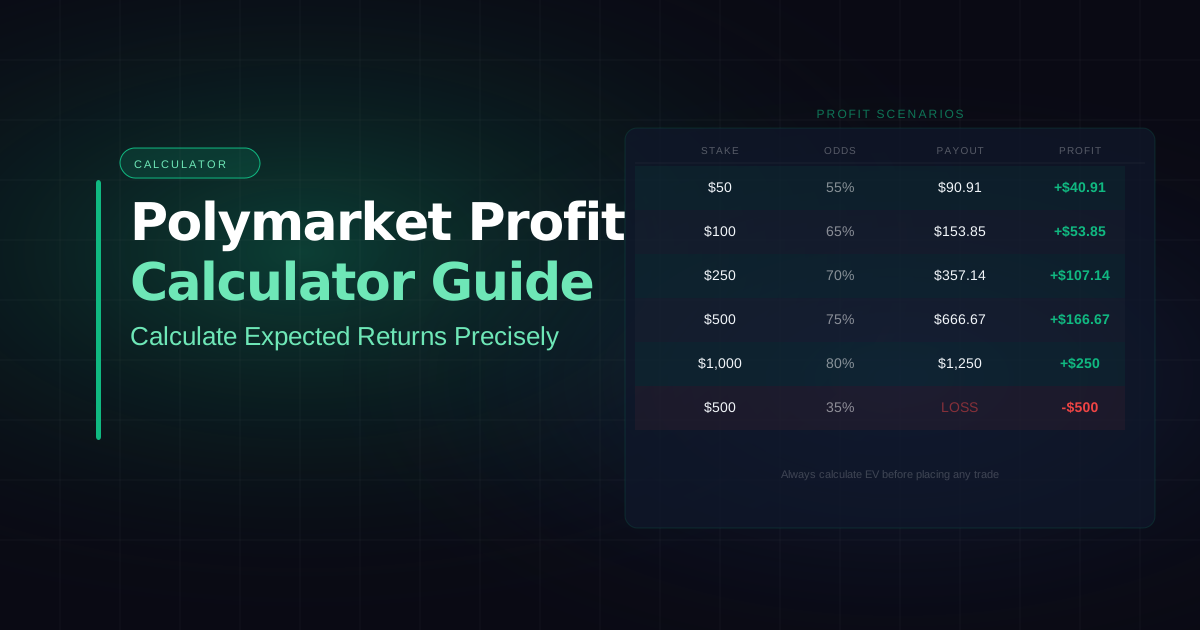
The table below shows how profit, net payout, and ROI change as entry price varies, using a fixed $100 stake throughout. All figures assume the market resolves in your favour and apply the 2% fee.
| Entry Price | Stake | Shares | Gross Payout | Fee (2%) | Net Payout | Net Profit | ROI% |
|---|---|---|---|---|---|---|---|
| $0.10 | $100 | 1,000 | $1,000.00 | $20.00 | $980.00 | $880.00 | 880% |
| $0.25 | $100 | 400 | $400.00 | $8.00 | $392.00 | $292.00 | 292% |
| $0.50 | $100 | 200 | $200.00 | $4.00 | $196.00 | $96.00 | 96% |
| $0.75 | $100 | 133.33 | $133.33 | $2.67 | $130.67 | $30.67 | 30.7% |
| $0.90 | $100 | 111.11 | $111.11 | $2.22 | $108.89 | $8.89 | 8.9% |
Two patterns are immediately visible. First, potential profit is highly non-linear — moving from $0.25 to $0.10 nearly triples the ROI. Second, the 2% fee has roughly proportional dollar impact at all price points, but as a share of profit it becomes more significant at high prices where profit margins are thin. A $0.90 entry winning gives you only $8.89 on a $100 stake after fees. If you are regularly trading at those levels, fee awareness is critical.
Calculating Expected Value Before You Enter
Profit calculations tell you what you earn if you win. Expected value (EV) tells you what you earn on average accounting for the probability you are wrong. A large potential profit means nothing if the outcome is unlikely.
The EV formula for a binary trade is:
EV = (Pwin × Net profit) − (Plose × Stake)
Where Pwin is your estimated probability of winning (not the market price), and Plose = 1 − Pwin.
Example: you stake $100 on Yes at $0.40 (so the market implies a 40% probability). You believe the true probability is 55%.
- Net profit if correct: $490 − $100 = $390 (using 2% fee from earlier)
- Stake lost if wrong: $100
- EV = (0.55 × $390) − (0.45 × $100)
- EV = $214.50 − $45.00 = +$169.50
A positive EV means the trade is theoretically profitable over many repetitions. A negative EV means you are paying for entertainment, not building an edge. For a comprehensive walkthrough of expected value on Polymarket, including multi-outcome markets, see our Polymarket expected value guide.
EV vs. Profit: Understanding the Difference
Profit and expected value answer different questions. Profit answers: “How much do I make if this trade wins?” EV answers: “How much is this trade worth, in expectation, given the probability I assign?”
| Metric | What It Tells You | When It Matters |
|---|---|---|
| Net Profit | Dollar gain if the outcome is correct | Setting price targets, celebrating wins |
| ROI% | Profit relative to stake, for comparison across trade sizes | Comparing opportunity quality across markets |
| Expected Value | Probability-weighted average outcome | Deciding whether to place the trade at all |
A trade can have a spectacular 900% ROI and still be negative EV if your true win probability is below the price. Conversely, a boring 15% ROI trade can be strongly positive EV if the market is dramatically underpricing an event. Always calculate both before entering.
Break-Even Price Calculation
The break-even price is the maximum share price at which you can enter and still expect to profit, given your probability estimate. It solves for the price where EV equals zero.
Setting EV = 0 and solving:
Break-even price = Pwin × 0.98
The 0.98 multiplier accounts for the 2% resolution fee. If you believe an event has a 60% probability of occurring, your break-even entry price is:
Break-even = 0.60 × 0.98 = $0.588
If the current market price for Yes is below $0.588, the trade has positive EV at your assumed probability. If it’s above $0.588, you are paying more than your edge justifies — the trade is negative EV even though you believe the outcome is more likely than not.
| Your Estimated Probability | Break-Even Price (after 2% fee) | Trade Has Edge If Market Price Is Below |
|---|---|---|
| 40% | $0.392 | $0.392 |
| 50% | $0.490 | $0.490 |
| 60% | $0.588 | $0.588 |
| 70% | $0.686 | $0.686 |
| 80% | $0.784 | $0.784 |
This table makes the break-even concept concrete: if you think an event is 80% likely, you need the market to be pricing it below $0.784 to have an edge. If the market already agrees with you and has priced it at $0.81, there’s no exploitable discrepancy even if you turn out to be right.
Using Profit Calculations to Size Positions
Once you know your edge — the gap between your estimated probability and the market price — you can use that to determine how much to stake. Two frameworks are popular among serious Polymarket traders.
Fixed fractional sizing keeps a consistent percentage of your bankroll at risk on any single trade. A common ceiling is 2–5% per trade. On a $2,000 bankroll, that is $40–$100 per position. Simple, easy to track, and it prevents any single loss from being catastrophic. The tradeoff is that it ignores edge size — a trade with marginal EV gets the same stake as a trade with massive EV.
Kelly Criterion sizing scales position size to edge magnitude. The Kelly formula tells you the theoretically optimal fraction of bankroll to risk for maximum long-run growth. Our dedicated Polymarket Kelly Criterion guide walks through the full formula with worked examples. In short: larger edge, larger stake; smaller edge, smaller stake; zero edge, zero stake. For broader position-sizing strategy across your Polymarket portfolio, see our Polymarket position sizing guide.
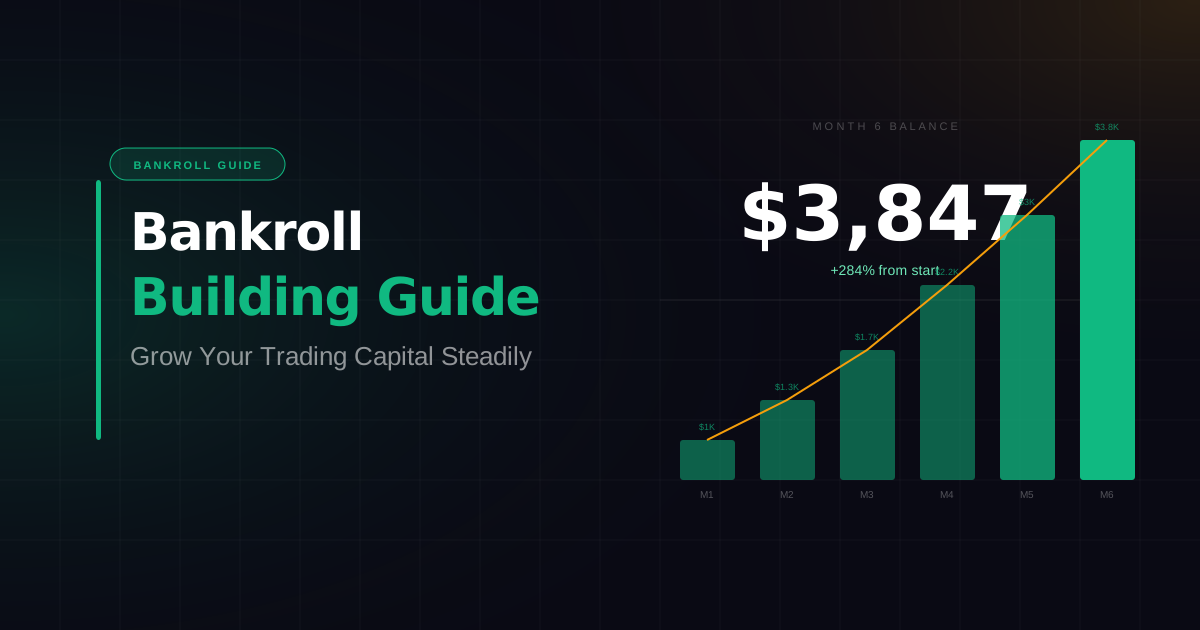
Combining profit calculations with a sizing framework is how you turn individual trade analysis into a consistent system. The formula tells you what a trade is worth; the sizing rule tells you how much of your capital to commit. For practical guidance on growing your account over time, see our Polymarket bankroll building guide.
A Full Worked Comparison: $500 Stake Across Five Scenarios
The following table extends the earlier five price points to a $500 stake and includes both net profit and EV, assuming your estimated probability is always 5 percentage points above the market price. For instance, if the market prices Yes at 50%, you believe the true probability is 55%.
| Market Price | Your Probability Estimate | Stake | Net Profit (if win) | Net Loss (if lose) | EV |
|---|---|---|---|---|---|
| $0.10 | 15% | $500 | $4,400 | −$500 | +$235 |
| $0.25 | 30% | $500 | $1,460 | −$500 | +$88 |
| $0.50 | 55% | $500 | $480 | −$500 | +$39 |
| $0.75 | 80% | $500 | $153 | −$500 | +$22 |
| $0.90 | 95% | $500 | $44 | −$500 | −$67 |
The final row is instructive: even if you are highly confident an event is 95% likely, buying Yes at $0.90 is negative EV after the 2% fee is applied. The edge is too thin relative to the downside risk. This is a critical insight for traders who gravitate toward “safe” high-probability markets — the maths can work against you at extreme prices. For a full treatment of managing tail risk across your portfolio, see our Polymarket risk management guide.
Putting It All Together: Pre-Trade Checklist
Before placing any Polymarket trade, run through these five steps in order:
- Identify the market price. This is the market’s implied probability for your chosen outcome.
- Estimate your true probability. This is your independent assessment, based on research or modelling, not the crowd’s view.
- Calculate break-even price. Multiply your probability by 0.98. If the market price exceeds this, the trade is negative EV.
- Calculate net profit and ROI%. Use the formula (Stake ÷ Price − Stake) × 0.98 to find net profit. Divide by stake for ROI%.
- Calculate EV and size accordingly. Apply your probability estimate to find EV. If positive, size using your chosen framework (fixed fractional or Kelly). If negative, skip the trade.
Following this checklist consistently does not guarantee every trade wins. It does guarantee that over hundreds of trades, you are only taking positions where the maths favours you — which is the only sustainable path to long-run profitability on Polymarket. For a broader look at turning that discipline into consistent income, see our guide on how to make money on Polymarket.