Most people who deposit $100 into Polymarket either double it quickly and get reckless, or grind it down to zero chasing bad markets. The ones who actually build serious bankrolls do something different: they treat that first hundred dollars as the foundation of a system, not a lottery ticket. This guide maps out the exact milestones, reinvestment rules, and risk controls that turn a modest starting stake into $10,000 of genuine trading capital.
Why Starting Capital Matters Less Than You Think
There’s a persistent myth in prediction markets that you need substantial capital to make meaningful returns. In reality, the habits you build at $100 are the same habits that will protect you at $10,000. Starting small is actually an advantage: your mistakes are cheap, your learning curve costs you tens of dollars rather than thousands, and the discipline you develop compounds just as surely as your balance does.
That said, starting capital does affect your strategy in one important way: position sizing. With $100, a single 5% position is just $5 — not enough to move the needle on most markets with wide spreads. You’ll want to focus on high-liquidity markets where even small positions get filled cleanly, and you’ll need to be patient about the pace of growth. See our guide on Polymarket minimum deposit requirements for details on how much you actually need to get started effectively.
The core principle: your first goal is not to make money. Your first goal is to not lose money. Capital preservation at the early stages is what gives compounding a chance to work.
How Compounding Works in Prediction Markets
Compounding in prediction markets is more nuanced than in traditional investing, because your “return” isn’t a passive percentage — it’s the result of active decisions across dozens of individual markets. But the math still applies.
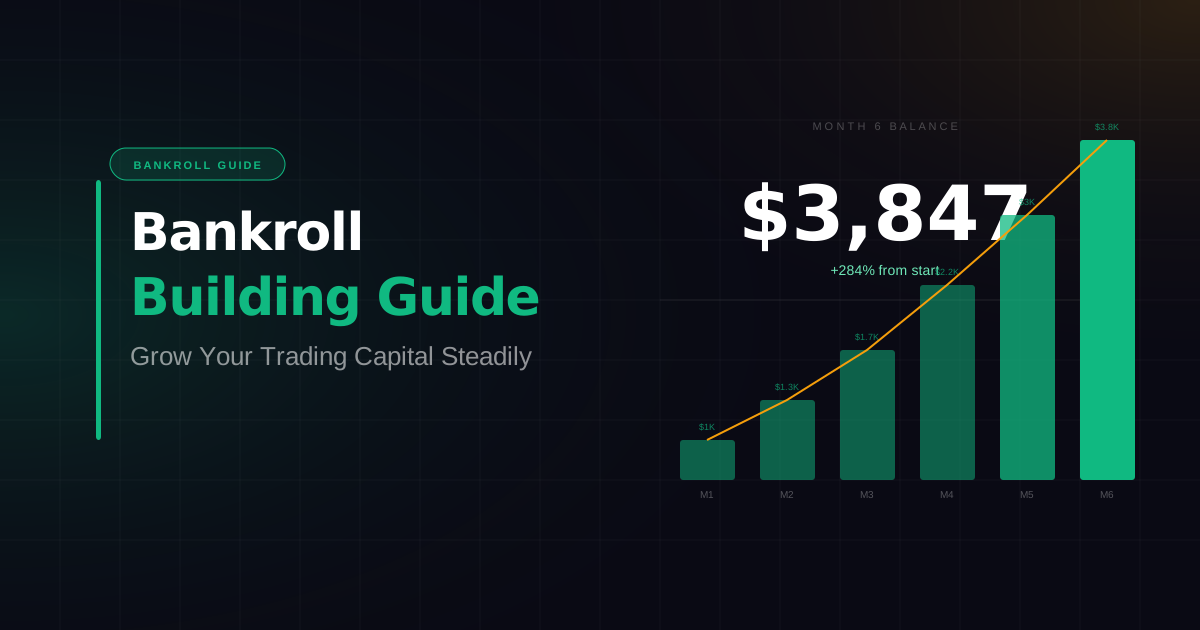
If you grow your bankroll by 10% per month and reinvest all profits, here’s what happens over time:
| Month | Starting Bankroll | 10% Monthly Return | Ending Bankroll |
|---|---|---|---|
| 1 | $100 | $10 | $110 |
| 2 | $110 | $11 | $121 |
| 3 | $121 | $12.10 | $133 |
| 6 | $161 | $16.10 | $177 |
| 9 | $214 | $21.40 | $236 |
| 12 | $285 | $28.50 | $314 |
| 24 | $985 | $98.50 | $1,083 |
| 36 | $3,091 | $309 | $3,400 |
A consistent 10% monthly return — which is achievable but requires genuine edge and discipline — turns $100 into over $3,000 in three years purely through reinvestment. The key word is consistent. A single month of reckless trading that wipes out 50% of your bankroll sets you back six months of gains. This is why Polymarket risk management isn’t just a nice-to-have: it’s the engine of compounding.
Tiered Bankroll Milestones: $100 → $10,000
Breaking your growth journey into milestones makes the goal feel achievable and gives you natural checkpoints to reassess your strategy. Here’s how each stage looks in practice.
Stage 1: $100 → $500 (The Learning Phase)
At this stage, your primary currency is information, not money. Every trade teaches you something about market efficiency, your own biases, and where you actually have edge. Keep positions small — no more than 5–8% of bankroll per trade — and focus on markets you genuinely understand. Sports, politics, or economic data releases in your area of expertise are better starting points than obscure crypto markets.
Treat every loss as tuition. Track every trade in a simple spreadsheet: market, entry price, exit price, your reasoning, and the outcome. Patterns in your winners and losers will tell you more than any strategy guide. The broader how to make money on Polymarket guide covers the mindset shifts required to profit consistently from the very beginning.
Stage 2: $500 → $1,000 (The Consistency Phase)
By the time you reach $500, you should have at least 30–50 completed trades to analyze. Look at your win rate and average edge per trade. If you’re profitable, this stage is about repeating what works, not experimenting. Resist the urge to diversify into new market types or increase position sizes dramatically. The biggest bankroll killers at this stage are overconfidence and boredom.
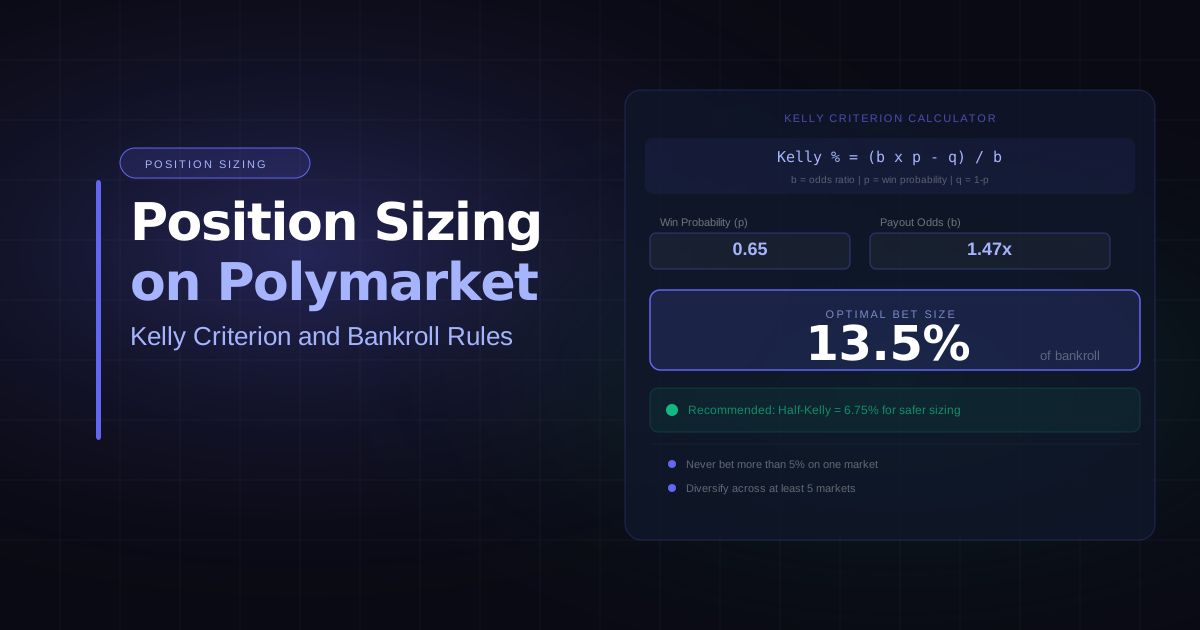
This is also when the Kelly Criterion becomes worth learning in earnest. Rather than flat-betting a fixed percentage, sizing your positions based on your estimated edge and the market odds will optimize your growth rate while limiting drawdown risk. Start with half-Kelly to keep variance manageable.
Stage 3: $1,000 → $5,000 (The Scaling Phase)
This is where bankroll management gets serious. With four figures at stake, a single bad week can feel devastating emotionally — and emotional trading is the enemy of systematic growth. Allocate your bankroll across three buckets: 60% in your highest-confidence market categories, 30% in markets where you have some edge but less certainty, and 10% reserved as “dry powder” for exceptional opportunities or short-term liquidity needs.
At this stage, position sizing based on Kelly becomes essential rather than optional. Every percentage point of unnecessary risk you take erodes the compounding curve. Apply the rules from Polymarket risk management with strict discipline: no single position should exceed 5% of bankroll, and total exposure in any one market category should stay under 25%.
Stage 4: $5,000 → $10,000 (The Optimization Phase)
Once you’re operating with $5,000+, you have enough capital to access better markets, take meaningful positions, and start thinking about whether prediction market trading could become a serious income stream. Read our deep dive on trading Polymarket full-time to understand what this transition actually involves. At this level, your edge needs to be documented, repeatable, and scalable — not just a lucky run.
Segment your capital formally: a core bucket (60–70%) in proven categories with normal Kelly sizing, a speculative bucket (20–30%) for higher-variance opportunities at half-Kelly, and a 10% reserve never deployed. This structure smooths returns and prevents any single bad sequence from derailing years of compounding work.
The Reinvestment Strategy That Maximizes Long-Term Growth
How you handle profits at each milestone determines whether you compound aggressively or leave gains on the table. Here’s a framework that works for most serious bankroll builders:
Reinvest 100% until $1,000. At sub-$1,000 bankrolls, the absolute dollar amounts are small enough that withdrawing profits is counterproductive. Let everything ride. The compounding effect is most powerful in the early stages.
At $1,000–$5,000, reinvest 80%, withdraw 20%. Taking some profits off the table serves two purposes: it gives you real-world evidence that your strategy works, which reinforces discipline, and it removes some risk from the table. That 20% is yours — don’t let it sit in a prediction market account where it can be eroded by bad months.
Above $5,000, reinvest based on your goals. If you’re building toward full-time trading income, keep reinvestment high. If you’re treating Polymarket as a side income generator, you might flip the ratio: withdraw 70%, reinvest 30% to maintain and grow your working capital.
Avoiding the Bankroll Blowups That Reset Your Progress
For every trader who compounds $100 into $10,000, there are dozens who compound $100 into $500 and then blow it in a single overconfident week. The patterns that cause blowups are almost always the same:
Chasing losses. You have a bad week and try to “make it back” by taking larger positions in higher-risk markets. This is how $500 becomes $200 in 48 hours. Implement a hard rule: if you lose more than 20% of your bankroll in any seven-day period, you stop trading for the rest of that week. No exceptions.
Concentration risk. Putting 30–40% of your bankroll into a single market, no matter how confident you are, is a bankroll blowup waiting to happen. Even 80% probability markets resolve against you 20% of the time. Diversification across markets and categories is essential in every stage of bankroll growth.
Ignoring liquidity. Entering illiquid markets where the spread between yes and no is wide means you’re paying a large implicit fee on every trade. At small bankroll sizes, this erodes your edge quickly. Stick to markets with meaningful trading volume, especially while you’re in the $100–$500 range.
Emotional over-trading. Boredom and excitement are both enemies of bankroll growth. Set specific criteria for entering a trade — a minimum edge threshold, a maximum position size, a market category you understand — and only trade when all criteria are met. Most days, the right number of trades is zero.
Using Copy Trading to Build Your Bankroll Passively
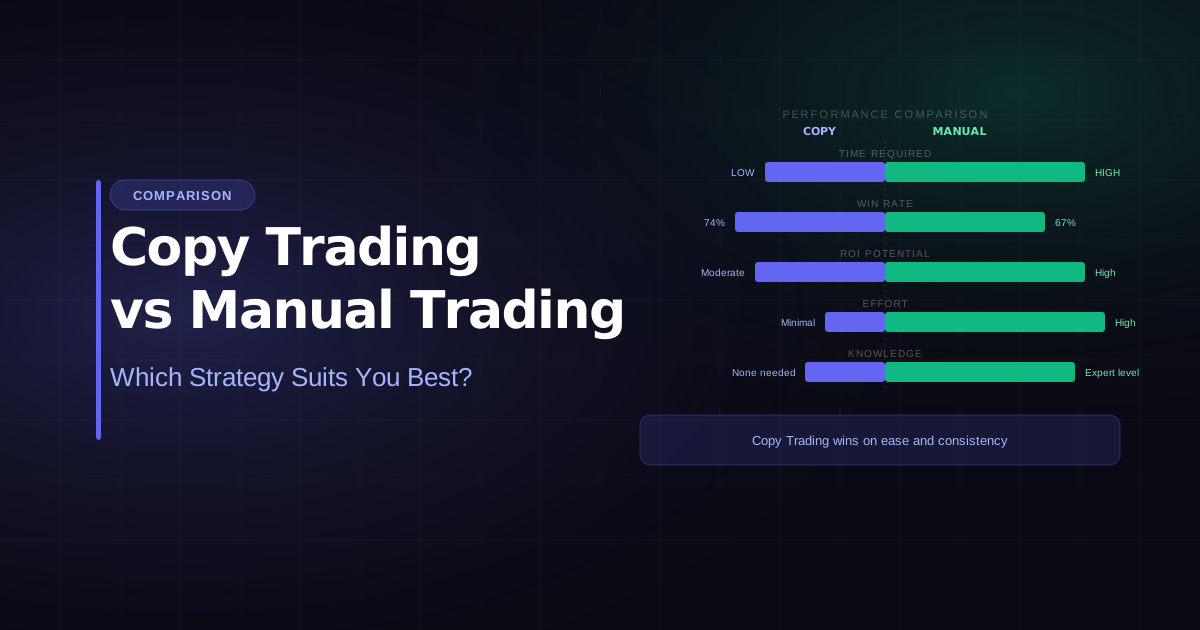
One of the most underutilized bankroll-building strategies on Polymarket is leveraging the expertise of others while you build your own. Copy trading platforms let you allocate capital to experienced traders and earn proportional returns on their positions, without having to research and monitor every market yourself.
This approach is particularly powerful at two stages of your bankroll journey:
Early stage ($100–$500): Copy trading lets you generate returns while you’re still learning. Instead of making expensive mistakes as you figure out which markets you have edge in, you let proven traders work your capital while you observe their strategies and build your own market knowledge.
Scaling stage ($1,000+): As your bankroll grows, you can split your capital: actively trade markets where you have genuine edge, and allocate a portion to copy trading as a diversification strategy. This reduces your dependence on any single approach and smooths out the volatility of your overall returns.
The key to using copy trading well is selecting traders based on verified track records, not recent hot streaks. Look for consistent performance over six months or more, reasonable drawdown limits, and a trading style that matches your risk tolerance. Short-term variance is high in prediction markets — you want traders with demonstrated edge over hundreds of trades, not dozens.
Tracking Bankroll Growth: The Metrics That Matter
You can’t improve what you don’t measure. These are the four metrics every serious bankroll builder should track:
Return on invested capital (ROIC). Not just overall profit, but profit as a percentage of the capital you actually had at risk. A 10% monthly ROIC on $500 is more meaningful than a $200 profit if you put $2,000 at risk to get it.
Win rate vs. average edge. A 60% win rate with small average wins can underperform a 40% win rate with large average wins. Track both, and compare your actual outcomes to the implied probabilities of your entries. If you’re consistently entering markets at 70% and they’re resolving at 65%, that’s useful data about your calibration.
Maximum drawdown. The largest peak-to-trough drop in your bankroll over any rolling period. Keep this number visible. If your max drawdown is creeping up, it’s a warning sign that your risk controls are slipping before your overall balance shows the damage.
Bankroll growth rate (monthly). Simple but important. Compare this month to last month and to your rolling three-month average. Trends matter more than any single month’s result.
Linking your tracking habit to a regular strategy review creates a feedback loop that’s hard to replicate any other way. The traders who make it to $10,000 are almost universally the ones who have a trade log stretching back to their first $100 position.
The Long Game: Patience as a Bankroll-Building Edge
The traders who consistently build large Polymarket bankrolls share one trait above all others: patience. They don’t force trades. They don’t chase the market. They wait for genuine edge, size appropriately, and let compounding do the heavy lifting over months and years rather than weeks.
The $100-to-$10,000 journey isn’t a sprint — it’s a systematic accumulation of small advantages, carefully protected and methodically reinvested. Set realistic milestones, track your progress honestly, protect your downside aggressively, and use every tool available — including copy trading — to build returns even when you’re not actively trading.
The compounding math is real. The question is whether your discipline is consistent enough to let it work.