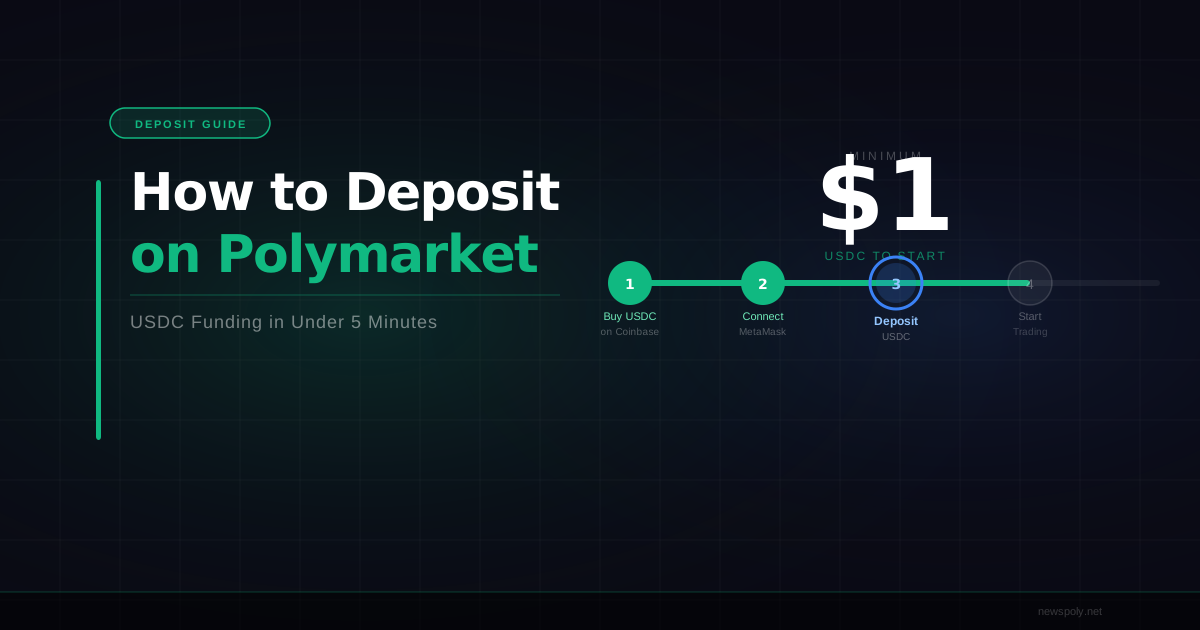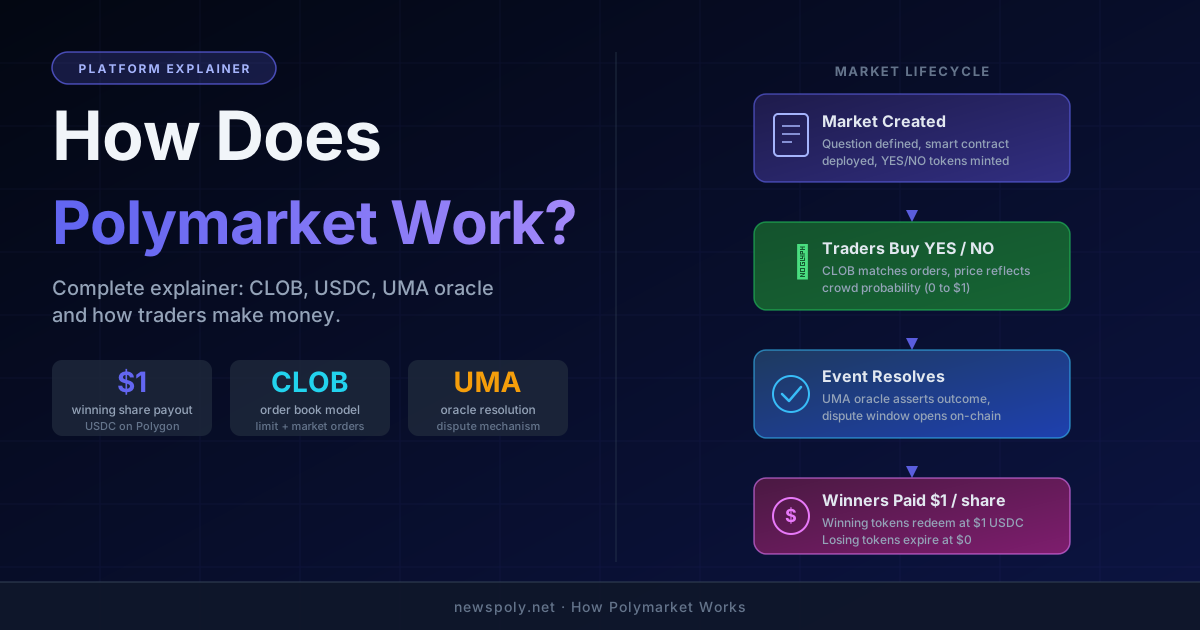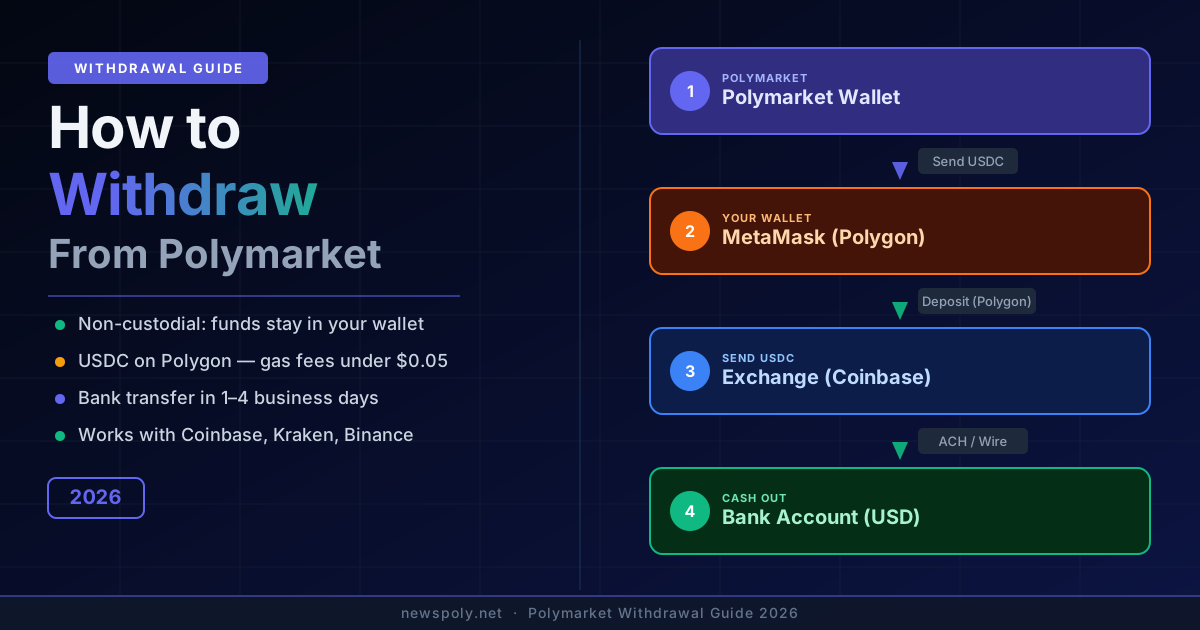
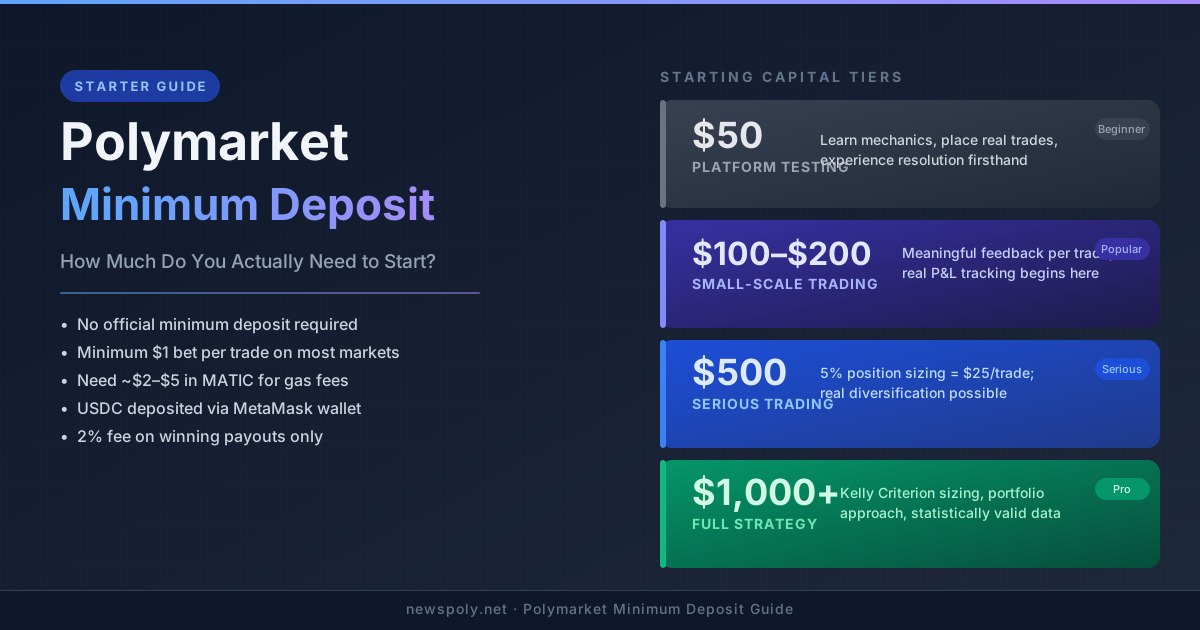
There is no official minimum deposit on Polymarket — the smart contract will accept any amount of USDC you send to it. But "technically zero" is not the same as "practically zero." Gas fees, order-book minimums, and basic fee efficiency all create a soft floor that most real traders bump into immediately. This guide gives you the honest numbers so you can fund your account at the right level from day one.
The Official Answer: No Minimum Deposit
Polymarket does not enforce a minimum deposit in its smart contracts or interface. You could, in theory, deposit $5 in USDC and your account would be funded. There is no registration fee, no tier system, and no gating based on account size. The platform is open to anyone with a compatible wallet and USDC. If you are new to the platform entirely, our beginner guide walks through every step from account creation to your first trade.
This openness is one of Polymarket's strengths as a decentralised protocol. The code does not care how much money you have. What the code does not care about, however, economics still does — and that is where practical minimums come in.
Why Practical Minimums Exist
Three forces push your effective starting amount above zero, even when the platform imposes no floor.
Gas Fees on Polygon
Polymarket runs on the Polygon network, which keeps gas costs low — typically around $0.01 per transaction. You also need a small separate balance of MATIC (Polygon's native token) in your wallet to pay those gas fees. A deposit of $2–$5 worth of MATIC is enough to cover hundreds of transactions, but it is a prerequisite you need to organise before you can do anything on-chain. Forgetting this step is the single most common stumbling block for new traders. Our MetaMask setup guide covers exactly how to get MATIC into your wallet alongside USDC.
Order-Book Minimums
Polymarket runs a Central Limit Order Book (CLOB). Most markets enforce a minimum order size of $1 per trade, though some larger or more liquid markets may enforce slightly higher floors. This is not a deposit requirement — it applies per trade. With a $10 account, you could theoretically place ten $1 trades. But with only ten positions of that size, diversification is nonexistent and you are one bad outcome away from losing 10% of your account in a single trade.
Fee Efficiency
Polymarket's fee structure charges 2% on winning payouts. On a $10 position that wins $2 in profit, the fee is $0.04 — negligible. But consider the full picture: you spent time researching the market, monitoring it, and managing the position. If your total profit across ten small trades is $5 before fees, the 2% fee is not your problem. Your problem is that the time and cognitive effort spent earning $5 could have earned ten times that on a properly sized account. Fee drag becomes proportionally meaningful only when position sizes are too small to generate worthwhile absolute returns.
Start small, grow smart. PolyCopyTrade works with any account size — it automatically copies top Polymarket traders proportionally to your balance, whether you start with $100 or $10,000.
Practical Starting Amounts: A Tier Breakdown
Think of your starting capital not as a minimum but as a capability level. Each tier unlocks different types of trading behaviour.
$50: Platform Testing
A $50 deposit is entirely reasonable if your goal is to learn the platform mechanics before committing real money. At this level you can place real trades (not simulations), experience how the order book works, watch a market resolve, and receive your first payout. You will not build meaningful profits at $50, but you will build the knowledge that makes larger trades more confident. Treat it as the cost of a thorough education that no guide can fully replace. This tier is ideal for anyone who has read a beginner guide and wants to convert theory into practice.
$100–$200: Small-Scale Real Trading
At $100–$200 you can start trading with meaningful feedback. A $20 position that wins $10 in profit is genuinely informative — you can feel the size of the gain and loss, start tracking your performance, and begin developing a repeatable process. Position sizing becomes slightly more meaningful: a $200 account with $20 positions is running 10% per trade, which is aggressive but not reckless for an early learner. Most people who get serious about Polymarket after an initial $50 test will refund to this level as their first "real" trading account.
$500: Serious Trading
At $500 you can start applying actual position-sizing discipline. With a $500 account, a conservative 5% position is $25 per trade — enough to generate $10–$20 in profit on a clean call, which is worth the effort. You can hold several positions simultaneously without any single position dominating your risk. This is the threshold where researching markets for 30 minutes to earn $15 makes economic sense, and where a losing streak of three trades does not threaten the account.
$1,000+: Full Strategy Deployment
Above $1,000, position sizing with Kelly Criterion starts to have real impact. You can size positions differently based on edge strength, diversify across many simultaneous markets, and begin measuring your performance with statistically meaningful data over time. At $1,000+ you can also comfortably absorb the variance of longer-duration political or macro markets without your account balance creating psychological pressure to exit early. This is the level where Polymarket trading transitions from a hobby into a disciplined, data-driven activity.
What You Need Beyond the USDC Deposit
Your USDC balance is not the only thing you need to fund before trading. Two additional items are easy to overlook.
MATIC for Gas (~$2–$5)
Every on-chain transaction on Polygon requires MATIC. Even though individual gas costs are fractions of a cent, you need MATIC in your wallet to authorise them at all. Without MATIC, your wallet cannot send, receive, or interact with smart contracts regardless of your USDC balance. Buy $3–$5 of MATIC on any major exchange and send it to your wallet. It will last for months of normal trading activity.
A Compatible Wallet
Polymarket requires a Web3-compatible wallet. MetaMask is the most commonly used option. You connect your wallet to the Polymarket interface, and all funds remain under your control in non-custodial smart contracts — Polymarket never holds your money in a centralised account. Our MetaMask setup guide covers installation, configuration for Polygon, and connecting to Polymarket step by step.
How to Get USDC Cheaply
Not all USDC on-ramps are equal. The cheapest path in 2026 is to buy USDC directly on Coinbase or Kraken, which offer near-zero conversion fees for USD-to-USDC. Both exchanges support direct withdrawals to Polygon, avoiding the need to bridge from Ethereum mainnet (which would cost significantly more in gas). Our full guide to getting USDC covers every on-ramp option with current fee comparisons.
What to avoid: credit-card purchases of crypto on exchange apps typically charge 3–4% convenience fees. PayPal and similar platforms add similar premiums. For amounts above $50, those fees represent a meaningful drag on your starting capital before you have placed a single trade.
Not sure which markets to trade first? PolyCopyTrade lets you automatically mirror the positions of Polymarket's most profitable wallets — a proven shortcut for new traders who want real exposure while they learn.
What Is the Minimum Bet Per Trade?
On the vast majority of Polymarket markets, the minimum order size is $1. This is enforced by the order book, not by your account balance. You can place a $1 YES order on almost any active market. A handful of low-liquidity markets may have slightly higher effective minimums because no counterparty will fill a tiny order at a reasonable price, but this is a liquidity issue rather than a hard rule.
In practice, the $1 floor matters only when your account is very small. If your account is $50, placing $1 trades makes sense for learning. At $200+, you will naturally gravitate toward $10–$25 per position where the returns are worth the research time.
Is Polymarket Worth It With a Small Account?
Honestly: yes, as a learning tool, and marginal at best as a profit-generating activity. A $50 account can teach you everything you need to know about how prediction markets work, how to read odds, how to place and manage orders, and how resolution mechanics feel in practice. That education is genuinely valuable and inexpensive.
As a profit centre, a $50–$100 account is constrained by mathematics. Even if you generate a 20% monthly return — an exceptional outcome — that is $10–$20 per month. The same analytical effort applied to a $1,000 account returns $200. The skill is the same; only the capital changes the outcome.
The right approach for most people is to start with $50–$100 to learn without the pressure of large stakes, then scale up once you have a positive track record across 20–30 trades. Two to three months of small-account trading is usually enough to decide whether you have an edge worth funding at scale.
Scaling Up Your Account Over Time
Experienced Polymarket traders almost universally recommend funding your account in stages rather than depositing a large lump sum upfront. A sensible progression looks like this:
- Month 1–2: Deposit $50–$100. Focus entirely on learning. Track every trade with the reasoning behind it.
- Month 3: Review your track record objectively. Did you beat random chance? Did you identify any market types where your predictions were consistently better?
- Month 4+: If your record supports it, increase to $300–$500 and apply basic position sizing. If it does not, continue at the small level or adjust your research approach.
- Year 2: Scale to $1,000+ only after you have documented evidence of edge across at least 50 resolved markets.
This staged approach protects you from the biggest mistake new Polymarket traders make: depositing a large amount before they understand the platform and losing it to preventable errors. Pairing this progression with a sound risk management framework — covering bankroll allocation, maximum exposure per market, and loss limits — is what separates traders who survive early mistakes from those who blow up their first account.
Frequently Asked Questions
Does Polymarket require KYC to deposit?
Polymarket does not require identity verification (KYC) to trade. You connect a wallet, deposit USDC, and trade. However, Polymarket does block access from certain jurisdictions. US residents face significant legal restrictions; our guide to Polymarket's US legality covers the current situation in detail. If you are outside a restricted region, no identity documents are needed.
Can I withdraw my deposit immediately if I change my mind?
Yes. Polymarket is non-custodial, which means your USDC sits in a smart contract you control. If you deposit $100 and then decide you do not want to trade, you can withdraw the full balance (minus any tiny gas fees) back to your wallet at any time. There is no lock-up period, no withdrawal waiting period, and no penalty for early exit. Our withdrawal guide covers the full process step by step.
What happens to my deposit if Polymarket shuts down?
Because Polymarket is decentralised and non-custodial, funds in your wallet are yours regardless of what happens to the Polymarket company or interface. Your USDC sits on the Polygon blockchain, not on Polymarket's servers. If the front-end went dark tomorrow, you could interact with the underlying smart contracts directly or withdraw to your wallet. This is one of the structural advantages of decentralised prediction markets over centralised alternatives.
Ready to put your starting capital to work? PolyCopyTrade automatically copies the top-performing Polymarket wallets in proportion to your balance — so your $100 or $1,000 is always positioned alongside the platform's most consistent winners.