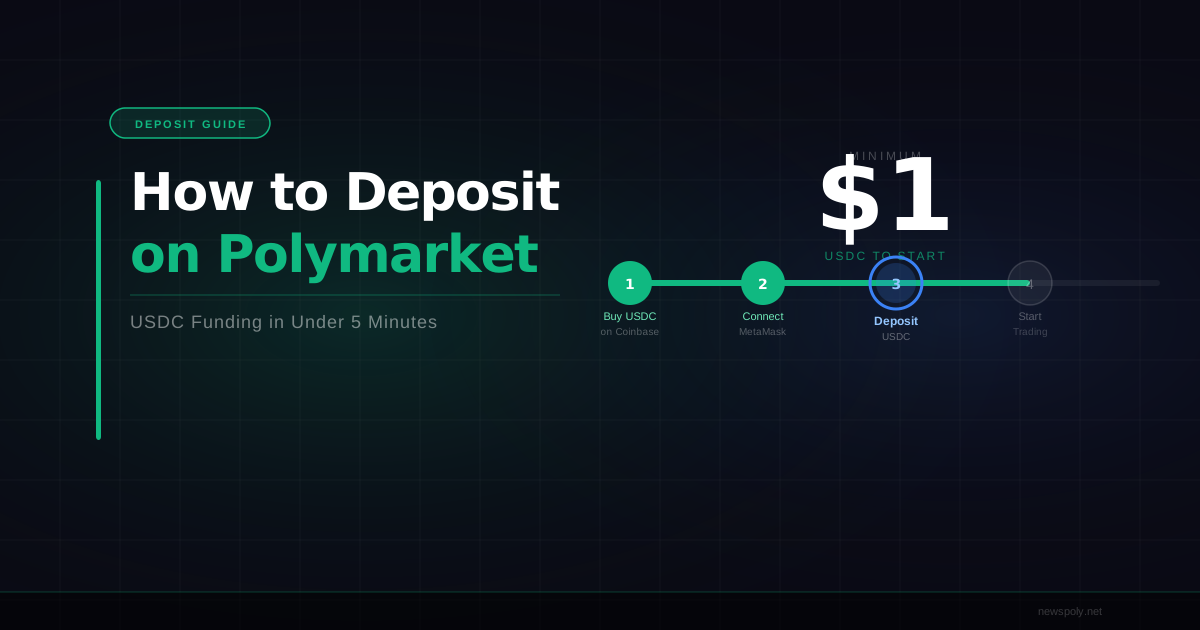
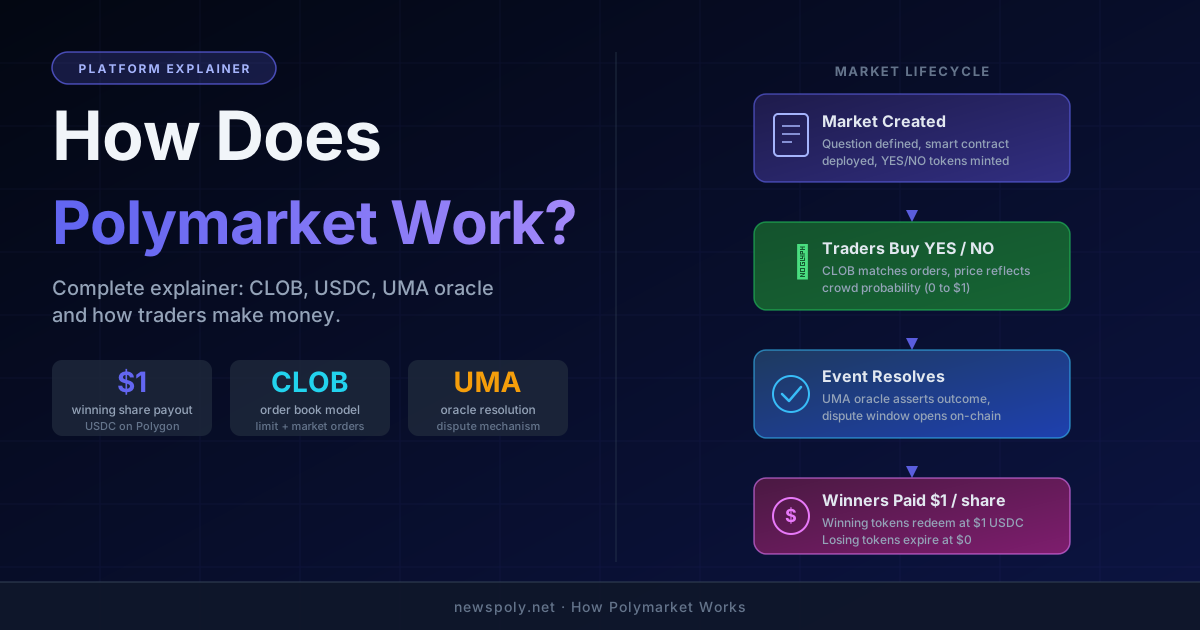
Polymarket is a decentralised prediction market built on the Polygon blockchain. You deposit USDC, browse markets on real-world events, and buy YES or NO shares priced between $0 and $1. That price is the crowd's implied probability. If the event resolves in your favour, each winning share pays exactly $1. If it resolves against you, those shares pay $0. The gap between what you paid and the $1 payout — or the $0 loss — is your profit or loss.
What Is a Prediction Market?
A prediction market is a financial market where contracts are tied to real-world outcomes rather than company equity or currency pairs. Participants buy and sell shares based on whether they think an event will happen. Because money is at stake, participants have a strong incentive to research carefully, which means aggregate prices tend to be highly accurate probability estimates — often outperforming traditional polling and expert forecasts.
Polymarket is the largest decentralised prediction market by trading volume. In 2025 it processed billions of dollars in volume across events ranging from US elections to sports championships, Fed rate decisions, and geopolitical conflicts.
How Polymarket Markets Work
Every market on Polymarket is structured as a binary outcome: the event either happens (YES) or it does not (NO). Each outcome is represented by a token. At any moment, the YES price and the NO price sum to $1 (or very close to it, accounting for the spread).
- YES price of $0.72 means the crowd estimates a 72% probability the event occurs.
- NO price of $0.28 means the crowd estimates a 28% probability it does not occur.
If you buy YES at $0.72 and the event happens, your share pays out $1 — a profit of $0.28 per share. If the event does not happen, your share pays $0 — a loss of $0.72 per share. This simple mechanic converts every trade into an expression of your probability estimate, making reading odds on Polymarket intuitive once you understand the basics.
Already understand how Polymarket works? PolyCopyTrade automatically mirrors the top-performing wallets on Polymarket — so you benefit from their market knowledge without doing the analysis yourself.
The CLOB: Central Limit Order Book Explained
Polymarket does not use an automated market maker (AMM) like many DeFi protocols. Instead it runs a Central Limit Order Book (CLOB), the same fundamental mechanism used by the New York Stock Exchange and most traditional financial exchanges. Understanding how it works is key to trading efficiently — for a deep dive, see our guide on the CLOB order book.
Here is how orders flow through the system:
- Limit order placed. You submit an order specifying a price (e.g., buy YES at $0.68) and a quantity (e.g., 500 shares). Your order sits in the book until it is matched.
- Counterparty matches. When another trader places a sell order at $0.68 or lower, the system matches the two orders and executes the trade at that price.
- Market order. If you want to fill immediately, you submit a market order that takes the best available price from the existing book. The trade executes instantly but you may face a wider spread.
- Settlement. Matched trades are settled on-chain via smart contracts. You receive your outcome tokens in your connected wallet.
The CLOB model benefits active traders because it supports precise price targeting, tighter spreads in liquid markets, and transparent order depth. It also means Polymarket behaves more like a professional trading venue than a simple betting interface.
USDC on Polygon: Why This Blockchain and Currency?
Polymarket requires you to fund your account with USDC (USD Coin), a dollar-pegged stablecoin, on the Polygon network. There are two core reasons for this choice.
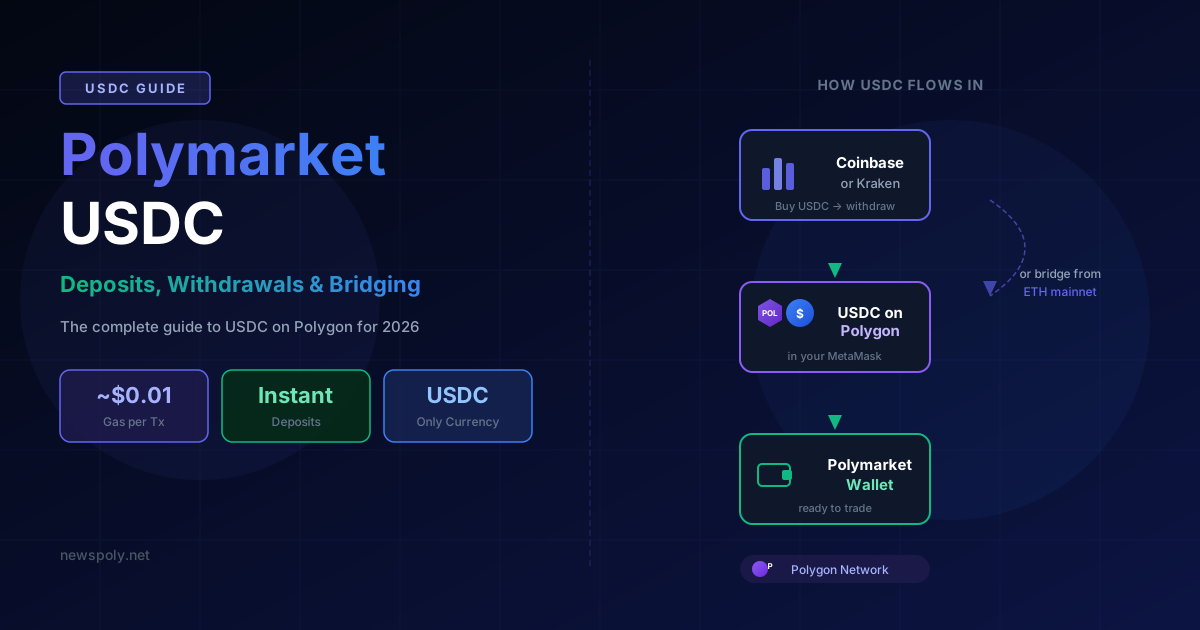
Why USDC? Using a stablecoin eliminates crypto price volatility from your P&L. Your gains and losses are expressed purely in terms of your probability edge, not in whether Bitcoin went up or down. USDC is also widely available on major exchanges and can be bridged to Polygon within minutes. See our full USDC on Polygon guide for step-by-step funding instructions.
Why Polygon? Ethereum mainnet gas fees would make small trades uneconomical — a single transaction might cost $5–$20 in gas. Polygon is an Ethereum Layer-2 network with transaction costs measured in fractions of a cent, making it practical to place $10 trades, adjust positions frequently, and collect small payouts without fees eating your returns.
All smart contracts are deployed on Polygon, meaning trades and payouts happen on-chain without any intermediary holding your funds. You maintain custody of your assets throughout.
How Resolution Works: The UMA Oracle and Dispute Mechanism
When a market's resolution date arrives, Polymarket needs a trustworthy, tamper-resistant source of truth to determine the correct outcome. It uses the UMA (Universal Market Access) optimistic oracle.
The resolution process works like this:
- Assertion. A market resolver (initially Polymarket's own operators) asserts the outcome — for example, "YES, the event happened."
- Challenge window. The assertion is published on-chain and a dispute window opens (typically two hours). During this window anyone can challenge the assertion by posting a bond.
- Dispute resolution. If challenged, UMA token holders vote on the correct outcome. UMA's design makes lying economically irrational: voters who agree with the majority earn rewards, while voters who disagree lose their bond. This crowd-sourced verification is Schelling-point based — rational voters converge on the objectively correct answer.
- Finalization. Once the assertion is finalized (either unchallenged or after a dispute vote), winning outcome tokens are redeemable for $1 each and losing tokens become worthless.
This mechanism keeps resolution decentralised and resistant to manipulation, even for politically sensitive markets where an operator might face external pressure to misreport.
How Traders Make Money
Profit on Polymarket comes from identifying markets where the current price (implied probability) is wrong relative to your own probability estimate.
Example: A market prices the chance of a Fed rate cut at $0.40 (40%). You have researched the macro data carefully and believe the true probability is 65%. You buy YES shares at $0.40. If you are right and the cut happens, each share pays $1 — a $0.60 gain per share. If the cut does not happen, you lose $0.40 per share.
Profitable traders on Polymarket typically fall into one of these categories:
- Information edge traders — specialists in a domain (politics, economics, sports) who can assess probabilities more accurately than the crowd.
- Market makers — traders who place both buy and sell orders to capture the spread, profiting from the bid-ask difference on high-volume markets.
- Arbitrageurs — traders who exploit inconsistencies between related markets (e.g., a presidential election winner market and a policy outcome market that should be correlated).
Note that Polymarket charges a small fee on trades. See our fees guide for a current breakdown so you can factor costs into your edge calculations.
Want to profit from Polymarket without doing the research yourself? PolyCopyTrade identifies the wallets with the strongest verified track records and automatically copies their trades into your account in real time.
Market Lifecycle: Creation to Payout
Every Polymarket market moves through four distinct phases:
- Creation. A market is created with a defined question, resolution criteria, resolution date, and initial liquidity. Smart contracts are deployed on Polygon and outcome tokens are minted.
- Trading. The market opens and traders buy YES and NO shares via the CLOB. Prices shift continuously as new information emerges and orders fill. This phase can last hours, days, or months depending on the event timeline.
- Resolution. After the event occurs and the resolution date passes, the UMA oracle process begins. The correct outcome is asserted, the challenge window opens, and the result is finalized on-chain.
- Payout. Once resolved, winning share holders can redeem each share for exactly $1 USDC. Losing shares are worth $0. Redemption happens through the Polymarket interface or directly via the smart contract — see our guide on how Polymarket payouts work for the full process.
Who Creates the Markets?
Markets are created in two ways. The majority are created by the Polymarket team, who identify high-interest topics, write clear resolution criteria, and seed initial liquidity. Community members can also propose and create their own markets, though the process requires approval to maintain quality standards and prevent manipulation through vague resolution criteria.
The quality of resolution criteria is critically important. A well-written market specifies exactly what source will be used to determine the outcome (e.g., "as reported by the Associated Press"), what happens in ambiguous scenarios, and a clear resolution date. Poorly specified markets can lead to disputes and delayed payouts.
What Happens When a Market Resolves?
Resolution is binary and absolute:
- Winning outcome tokens become redeemable for exactly $1.00 USDC each.
- Losing outcome tokens become worthless ($0.00).
There is no partial payout or middle ground. A market that resolves YES pays every YES share at $1 regardless of whether you bought at $0.10 or $0.90. Your profit or loss depends entirely on what you paid. This is why a trader who bought YES at $0.10 on a long-shot that eventually resolved YES makes $0.90 per share, while a trader who bought YES at $0.90 on the same market makes only $0.10 per share.
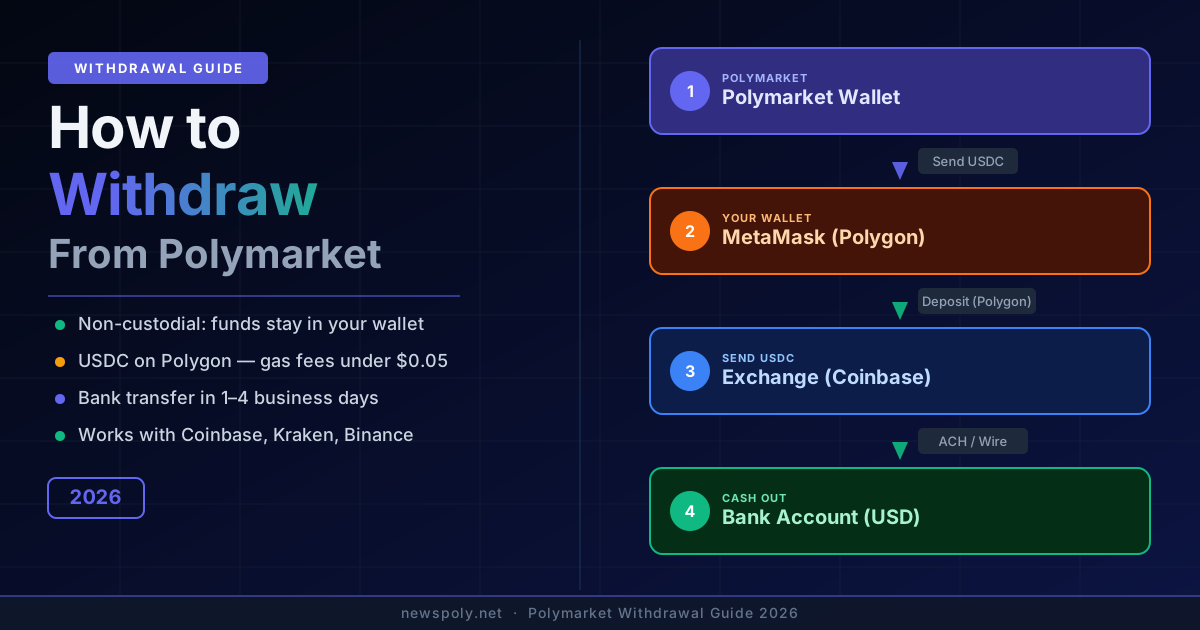
Payouts are received in USDC to your connected wallet and can be withdrawn to any exchange or wallet that supports USDC on Polygon.
Is Polymarket Decentralised?
Polymarket is often described as decentralised, and in important ways it is: all trades settle via on-chain smart contracts, you hold your own assets throughout, and the UMA oracle provides decentralised dispute resolution. For a full assessment of its regulatory history and trustworthiness, see our piece on whether Polymarket is legit. No single entity can freeze your funds or reverse a completed trade.
However, there are centralised elements:
- The CLOB matching engine is operated off-chain by Polymarket for performance reasons.
- The Polymarket team controls which markets are listed and can delist markets in early stages.
- Initial market resolution is asserted by Polymarket operators (though anyone can dispute).
- The front-end interface (polymarket.com) is operated by Polymarket and subject to geoblocking in restricted jurisdictions.
This hybrid model — on-chain settlement with off-chain operational components — is a pragmatic trade-off between decentralisation and usability. For most traders, the key assurance is that funds are secured by smart contracts and cannot be misappropriated by the operator.
Getting Started on Polymarket
If you are new to the platform, the mechanics above may feel like a lot to absorb before placing your first trade. Our step-by-step beginner guide walks you through creating a wallet, bridging USDC to Polygon, making your first trade, and managing your portfolio — with screenshots at every step.
The core loop is straightforward once you have done it once: fund your account, find a market where you have an edge, buy the appropriate outcome, and wait for resolution. The complexity lies in finding that edge consistently.
Skip the learning curve. PolyCopyTrade lets you automatically mirror the trades of Polymarket's top-performing wallets. You get the benefit of expert analysis without spending hours researching every market yourself.
Frequently Asked Questions
Do I need a crypto wallet to use Polymarket?
Yes. Polymarket requires a Web3 wallet such as MetaMask or Coinbase Wallet to interact with the smart contracts. You can also sign in with email using Magic Link, which creates a non-custodial wallet for you automatically. In all cases your funds are held in your own wallet, not by Polymarket.
What is the minimum trade size on Polymarket?
There is no enforced minimum trade size at the protocol level, but gas fees and the CLOB structure make very small trades (under $5) impractical. Most active traders work with positions of $50 or more to ensure fees are a small fraction of potential profit.
Can markets resolve as N/A (cancelled)?
Yes. If the underlying event becomes impossible to resolve — for example, if a scheduled event is cancelled entirely — Polymarket can resolve the market as N/A. In this case all shares are redeemed at $0.50 each, regardless of whether they were YES or NO shares, effectively returning everyone's capital proportionally.
Is Polymarket available in the United States?
As of early 2026, Polymarket is accessible to US users following a settlement with the CFTC and the launch of a regulated US market product. The regulatory landscape continues to evolve. Always check the current terms of service for your jurisdiction before trading.