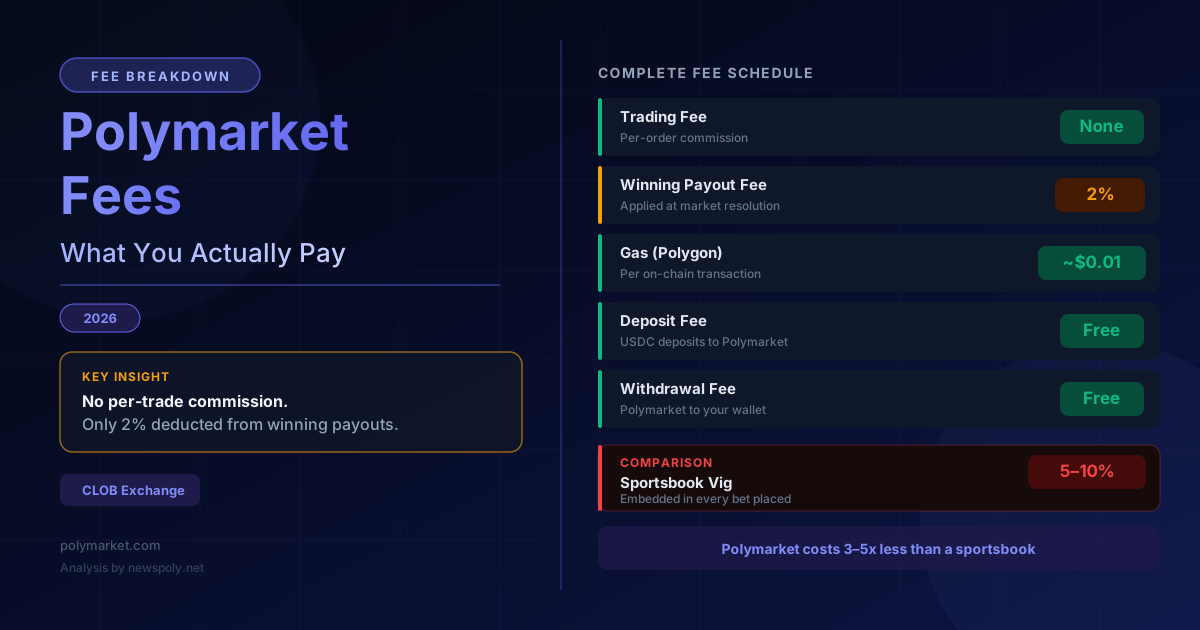
Polymarket has one of the cleanest fee structures in prediction markets — but "clean" does not mean "zero." The platform charges no per-trade commission, yet a 2% fee is quietly applied whenever you win. Gas costs on Polygon run about a penny. Deposits are free. Once you understand these three numbers, you can plan every trade with accurate profit expectations and stop leaving money on the table.
How Polymarket Makes Money
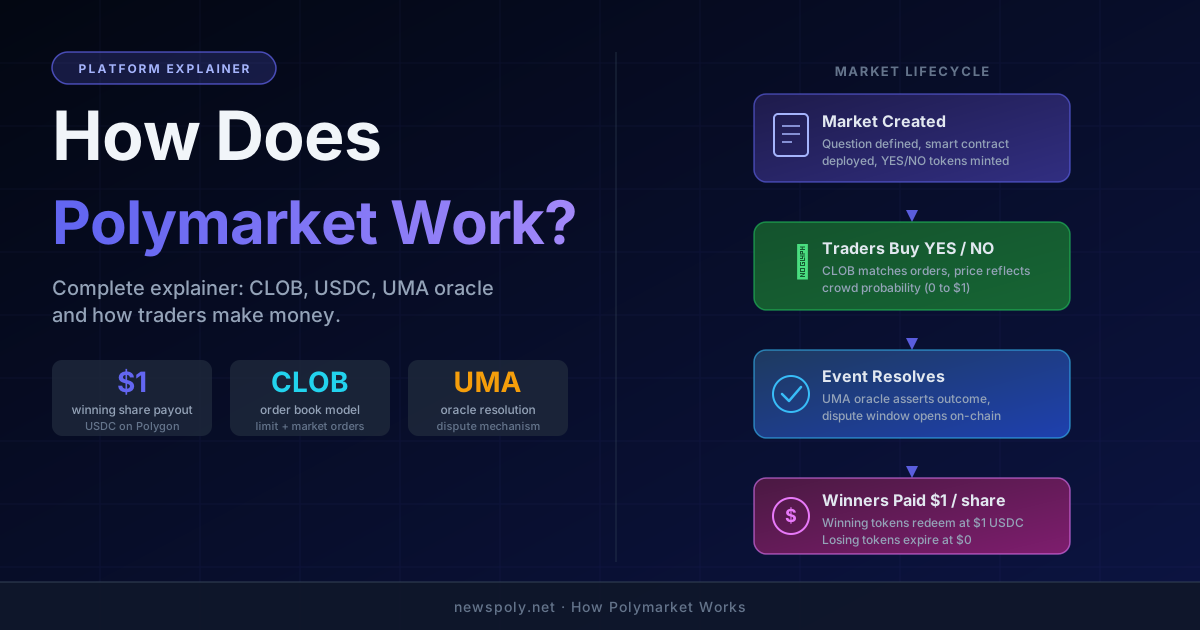
Polymarket operates as a decentralised prediction market built on the Polygon blockchain. Rather than charging a spread on every order or a percentage of trade size, Polymarket takes a 2% fee on winning payouts at market resolution. That single mechanism is how the platform funds operations, covers smart-contract audits, and sustains liquidity incentives. If you are evaluating the platform more broadly, our full Polymarket review covers fees alongside all other platform factors.
The fee is deducted automatically when the smart contract distributes winnings. You never see a separate line item during trading — it simply appears as a slightly reduced payout after a market settles. For most traders this is intuitive once explained, but many newcomers assume they are getting 100% of their theoretical winnings only to be surprised at resolution. If you are asking whether the platform itself can be trusted, see our guide to whether Polymarket is legit.
The 2% Fee Explained With a Real Example
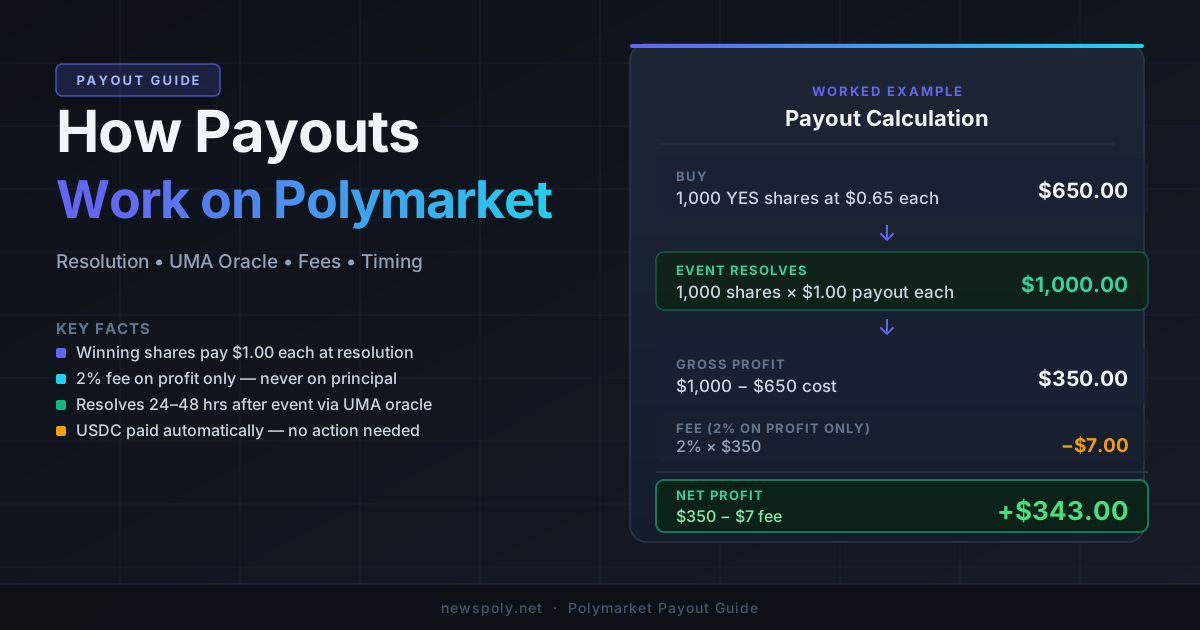
Suppose you believe a particular candidate will win a primary election. You buy $100 of YES shares at $0.80 each. That means you hold 125 shares (100 ÷ 0.80). If the market resolves YES, each share pays $1.00, giving a gross payout of $125.
The 2% fee is applied to the profit portion of the payout. Your profit is $25 (the $125 gross minus your $100 cost). Two percent of $125 gross is $2.50, so your net payout is:
- Gross payout: $125.00
- Polymarket fee (2% of gross): −$2.50
- Net payout: $122.50
Your net profit is therefore $22.50 on a $100 stake, or an effective 22.5% return instead of 25%. The platform kept 10% of your profit as its fee. That is the honest way to think about it: Polymarket's cut is roughly 10% of your profits when you are trading near 0.80, and the percentage of profits taken rises as the share price approaches $1.00 (because profit margins compress while the 2%-of-gross formula stays fixed).
At the other extreme, if you buy YES at $0.10 and win, your gross is $1 per share and your profit is $0.90. The 2% fee ($0.02) is only about 2.2% of your profit — a negligible drag compared to the potential upside.
The 2% fee still leaves room for serious profit — if you are backing the right positions. PolyCopyTrade automatically mirrors Polymarket's top-performing wallets — so you capture their edge without spending hours researching markets yourself.
Is There a Trading Fee on Polymarket?
No. Polymarket does not charge a per-trade commission. Placing a limit order, cancelling it, or executing a market order does not trigger any platform fee. This is a meaningful advantage over centralised prediction markets and most sportsbooks, where every single bet carries an embedded margin.
The only time Polymarket collects anything is at market resolution, and only if you hold winning shares. If you buy YES, the market resolves NO, and your shares are worth zero, Polymarket collects nothing from you — you simply lost your stake. Bear in mind that winning payouts may also generate tax obligations depending on your country; our Polymarket tax guide covers US and UK treatment of prediction market profits.
This structure aligns Polymarket's incentives with traders: the platform earns more only when its markets produce more winning payouts, which happens when markets are popular and highly liquid.
Maker vs. Taker Dynamics on the CLOB
Polymarket runs a Central Limit Order Book (CLOB), the same mechanism used by stock exchanges. You can place:
- Limit orders (maker orders) — you set the price you want and wait for a counterparty. Your order rests in the book and adds liquidity.
- Market orders (taker orders) — you accept the current best available price. Your order removes liquidity immediately.
Polymarket currently does not differentiate fees between makers and takers — the 2% resolution fee applies equally. However, there is a hidden cost in market orders: the bid-ask spread. If YES shares are bid at $0.58 and offered at $0.62, buying at market means you pay $0.62. A limit order at $0.60 could save you 2 cents per share, which on a large position is significant.
For active traders, using limit orders is the single most effective way to reduce true trading costs on Polymarket. Patience is rewarded; chasing the market with market orders compounds costs before the resolution fee even enters the picture. For a complete guide to placing and managing limit orders effectively on Polymarket, see our Polymarket limit orders guide.
Gas Fees on Polygon
Every on-chain action on Polymarket — placing an order, cancelling an order, depositing funds, withdrawing funds — requires a tiny gas payment on the Polygon network. As of early 2026, typical gas costs run approximately $0.01 per transaction, sometimes less.
This is functionally negligible. Even if you execute 100 transactions in a month, your total gas cost is around $1. Compare that to Ethereum mainnet, where a single swap can cost $5–$50 depending on congestion. Polygon's design makes micro-transactions economically viable, which is one reason Polymarket chose it.
Gas is paid in MATIC (Polygon's native token). Polymarket automatically manages small MATIC balances for most users who deposit USDC via the standard on-ramp, so you rarely need to think about acquiring MATIC separately.
USDC Deposit Fees
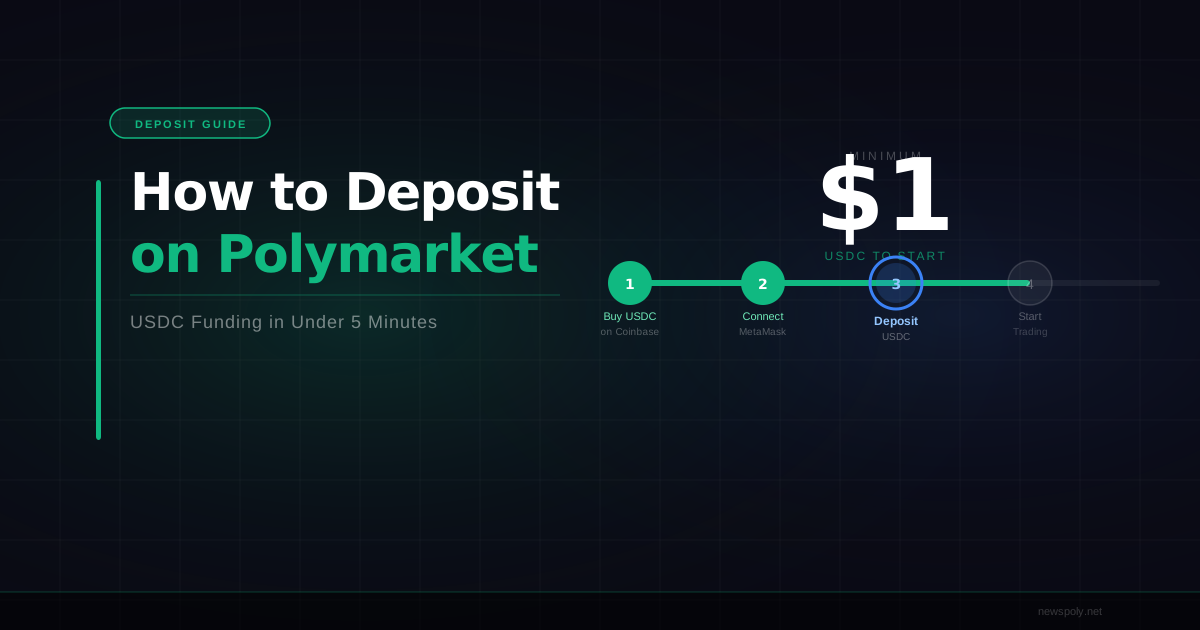
Polymarket itself charges nothing to deposit USDC. However, the cost of acquiring USDC depends on where you buy it:
- Centralised exchange (Coinbase, Kraken, etc.): buying USDC with fiat typically incurs a 0.5%–1.5% conversion fee at the exchange, not at Polymarket.
- Credit or debit card purchases: card processors often charge 3%–5% for crypto purchases.
- Bank transfer (ACH/SEPA): often the cheapest method, sometimes free on major exchanges.
Once USDC is in your wallet on Polygon, depositing into Polymarket costs only the minimal Polygon gas fee (~$0.01). Plan your USDC acquisition route carefully — the exchange conversion fee can dwarf all other Polymarket-related costs combined.
Withdrawal Fees
Polymarket charges no withdrawal fee. Moving USDC from your Polymarket balance back to your personal wallet on Polygon costs only the standard Polygon gas fee (~$0.01). From there, moving USDC to a centralised exchange or converting to fiat depends on that platform's own fee schedule.
If you want to cash out to a bank account, the typical path is: Polymarket → personal Polygon wallet → centralised exchange → bank. The Polymarket-to-wallet step is essentially free. The exchange-to-bank step may incur a wire or ACH fee depending on the exchange. See our full guide to withdrawing from Polymarket for a step-by-step walkthrough. For a deeper look at exactly how winning payouts are calculated and when they arrive, see our guide to how Polymarket payouts work.
Bridging Fees
If you hold USDC on Ethereum mainnet and want to use it on Polymarket (which runs on Polygon), you will need to bridge it. The official Polygon PoS bridge charges no protocol fee, but you will pay Ethereum mainnet gas to initiate the bridge transaction, which can range from $2 to $20+ during periods of network congestion.
To avoid bridging fees entirely:
- Buy USDC directly on Polygon via an exchange that supports Polygon withdrawals (Coinbase and Kraken both do).
- Use a cross-chain service like Squid or Li.Fi that often finds cheaper routes than the native bridge.
- Withdraw from a centralised exchange directly to the Polygon network, bypassing Ethereum mainnet entirely.
Minimising fees is only half the equation — picking winning markets is the other half. PolyCopyTrade tracks Polymarket's most profitable wallets in real time and lets you copy their positions automatically — no research required, no guesswork.
How Polymarket Fees Compare to Kalshi and Sportsbooks
Context matters. Here is how Polymarket stacks up against the main alternatives. For a deeper head-to-head on platform features beyond fees, see our Polymarket vs Kalshi comparison:
| Platform | Fee Type | Effective Cost |
|---|---|---|
| Polymarket | 2% on winning payout | ~2% of gross winnings |
| Kalshi | ~2% taker fee per trade | ~2% per transaction (win or lose) |
| Traditional Sportsbook | Vig / overround embedded in odds | 5%–10% per bet |
| DraftKings / FanDuel | Vig embedded in spread/total | ~8%–12% per bet |
| Stock Exchange (equity) | Commission (often $0) + spread | Near zero for liquid stocks |
Kalshi's fee structure applies on every trade, not just winning ones. If you trade actively — entering and exiting positions before resolution — Kalshi's per-trade fee compounds quickly. Polymarket's resolution-only fee is structurally friendlier for frequent traders who occasionally exit early (via the order book) without triggering any platform fee.
Sportsbooks are the starkest comparison. A standard NFL point spread bet at −110 means you risk $110 to win $100, representing a ~4.5% vig per side or ~9% total book margin. Polymarket's 2% is less than a quarter of that friction. For a dedicated exchange comparison, see our Polymarket vs Betfair breakdown.
How to Minimize Your Fees on Polymarket
- Use limit orders, not market orders. The bid-ask spread on thin markets can be 3%–8%. Patience with limit orders eliminates this hidden cost.
- Fund via Polygon-native USDC. Withdraw USDC from a centralised exchange directly to the Polygon network. This avoids Ethereum gas and bridging costs entirely.
- Batch actions where possible. If you plan to enter several positions, deposit one large amount rather than multiple small ones to minimise per-transaction gas.
- Trade high-probability markets carefully. At YES prices above $0.90, the 2% resolution fee represents a larger share of your profit margin. Model your expected return after fees before entering.
- Avoid unnecessary cancellations. Each on-chain cancellation costs a small gas fee. Use good-till-cancel orders thoughtfully.
True Cost Calculator: A $500 Trade Walk-Through
Let us walk through a realistic scenario to illustrate total costs from start to finish.
Scenario: You transfer $500 from your bank to Coinbase, buy USDC, withdraw to Polygon, deposit to Polymarket, buy YES shares, win, and withdraw.
- Coinbase ACH purchase of $500 USDC: $0 (ACH is typically free on Coinbase)
- Coinbase withdrawal to Polygon wallet: ~$0.50 network fee (Coinbase charges a fixed fee for Polygon withdrawals)
- Polymarket deposit (Polygon gas): ~$0.01
- Placing limit order (Polygon gas): ~$0.01
- Example: buy YES at $0.70, win — gross payout on $500 stake: $714.29 (500 ÷ 0.70)
- Polymarket 2% resolution fee: −$14.29
- Net payout: $700.00
- Profit: $200.00 on a $500 stake
- Withdrawal (Polygon gas): ~$0.01
Total fees paid: ~$14.82 (<3% of trade size). The overwhelming majority of that is the 2% resolution fee. Gas and exchange withdrawal fees are rounding errors on a $500 position. If you use a Polymarket referral code, you may be eligible for a fee reduction on your initial trades — worth checking before your first deposit.
For a losing trade, your total fee exposure is just ~$0.52 in gas and exchange costs. The platform takes nothing from your loss.
You have done the maths — now make it work for you. PolyCopyTrade connects your Polymarket account to the platform's top wallets, mirroring their trades automatically so your capital is always deployed where the smart money is moving — 2% fee and all.
Frequently Asked Questions
Does Polymarket charge a fee if I lose?
No. The 2% fee applies only to winning payouts. If you hold shares that resolve worthless, Polymarket collects nothing from your loss. You simply do not receive a payout.
Is the 2% fee taken from my stake or my profit?
The fee is calculated as 2% of your gross payout (the full amount returned to you at resolution, including your original stake). In practice this means the fee is always larger than 2% of your profit alone. For a share bought at $0.80, the fee is ~10% of profits; for a share bought at $0.10, the fee is ~2.2% of profits. The lower your entry price, the smaller the fee as a percentage of your profit.
Are there any hidden fees on Polymarket I should know about?
The only costs traders consistently encounter are: (1) the 2% resolution fee, (2) Polygon gas at ~$0.01 per transaction, and (3) the bid-ask spread when using market orders. There are no account fees, inactivity fees, deposit fees, or withdrawal fees charged by Polymarket itself. The main external cost is whatever your exchange charges to acquire or convert USDC.