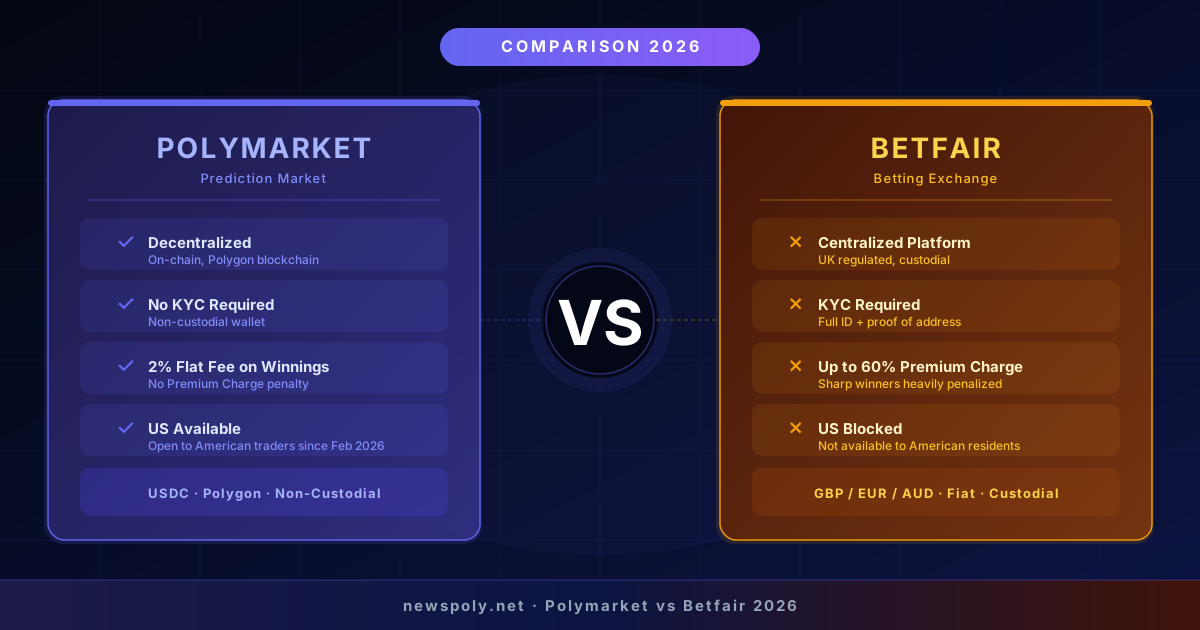
Polymarket and Betfair both operate on a peer-to-peer exchange model — you trade against other users rather than a bookmaker. That surface-level similarity is where the resemblance ends. Betfair is a licensed UK betting exchange with a deep focus on sports and horse racing, operating in GBP and EUR with mandatory KYC. Polymarket is a decentralized, on-chain prediction market built on Polygon, settling in USDC, covering politics, crypto, macro events, and sports — with no identity verification required. For US-based traders in particular, the choice is already made for you: Betfair is blocked in the United States, while Polymarket opened access to American users in February 2026. But wherever you trade from, the fee structures, liquidity profiles, and platform philosophies diverge significantly enough to matter.
Quick Comparison: Polymarket vs Betfair at a Glance
| Feature | Polymarket | Betfair |
|---|---|---|
| Market Types | Politics, crypto, macro, sports, entertainment | Sports, horse racing, some politics |
| Currency | USDC (stablecoin) | GBP, EUR, AUD (fiat) |
| KYC Required | No | Yes (full identity verification) |
| Fees | 2% flat on winnings | 2–5% market commission + Premium Charge up to 60% |
| US Access | Yes (since Feb 2026) | No (blocked) |
| Blockchain | Yes (Polygon, non-custodial) | No (centralized) |
| Liquidity (sports) | Moderate | Very deep |
| Liquidity (politics/crypto) | Deep | Thin or absent |
| Custody | Non-custodial (your wallet) | Custodial (Betfair holds funds) |
What Is Betfair?
Betfair launched in 2000 and is widely credited with inventing the modern betting exchange. Rather than setting odds itself, it acts as a marketplace where bettors can both back (bet for) and lay (bet against) outcomes, with Betfair taking a commission on net winnings. The model disrupted traditional bookmaking by offering tighter margins and giving sharp traders a genuine edge — at least in theory.
Betfair is headquartered in London and regulated by the UK Gambling Commission, as well as regulators in Ireland, Australia, Malta, and several other jurisdictions. It operates primarily in GBP and EUR, with an AUD-denominated exchange for Australian users. To open an account, you must pass full KYC: government-issued ID, proof of address, and in many cases source-of-funds checks for larger deposits.
The platform's dominant product is sports betting. It covers football, tennis, horse racing (its single largest liquidity pool), cricket, golf, and dozens of other sports. Its political markets exist — UK elections, major international votes — but are a small fraction of overall volume compared to sports. Betfair Exchange is available primarily in the UK, Ireland, and Australia, with a scaled-down product in some other regulated markets. It is not available to US residents under any circumstances.
What Is Polymarket?
Polymarket launched in 2020 as a decentralized prediction market running on the Ethereum-compatible Polygon blockchain. Users deposit USDC into a non-custodial smart contract wallet — powered by the Gnosis Safe standard — and trade binary outcome contracts. When a market resolves, winning shares pay out at $1.00 USDC each; losing shares expire worthless.
Unlike Betfair, Polymarket is not a licensed gambling operator. It describes itself as an information market and does not require KYC for standard usage. Because funds live in smart contracts rather than a company-controlled account, there is no custodial risk: Polymarket itself cannot freeze or confiscate your holdings. The platform's resolution is handled by UMA Protocol's optimistic oracle, providing a transparent dispute mechanism.
In February 2026, Polymarket formally opened access to US residents after a period of regulatory uncertainty, making it the first major prediction market to serve American traders at scale. The platform now covers hundreds of simultaneous markets across US and international politics, cryptocurrency prices, macroeconomic data releases, sports championships, and real-world events of all kinds.
Market Types Compared
Betfair Markets
Betfair's market depth is overwhelmingly concentrated in sports. Horse racing — particularly UK and Irish flat and jump racing — accounts for the largest share of exchange volume. Football (soccer) is the second-largest category, with deep pre-match and in-play markets for the Premier League, Champions League, and major international tournaments. Tennis, golf, cricket, American football, and basketball all have significant but thinner books.
Political markets on Betfair do exist. UK general elections and leadership contests attract meaningful liquidity, and major events like US elections or Brexit referendums have historically drawn large volumes. But outside of headline political events, Betfair's political coverage is sparse. There are no crypto markets, no macro data markets, no markets on corporate events or technology milestones, and no markets on the kind of niche real-world questions that define Polymarket's catalog.
Polymarket Markets
Polymarket's catalog is intentionally broad. US and international politics dominate by volume — markets on elections, legislation, cabinet appointments, geopolitical events, and approval ratings are live continuously. Cryptocurrency markets track Bitcoin and Ethereum price levels, project launches, regulatory decisions, and protocol upgrades. Macro markets cover CPI prints, Fed rate decisions, GDP growth, and central bank policy. Sports markets exist but occupy a smaller share of total volume than on Betfair.
The platform is particularly strong for long-duration markets. A political market might run for months before resolution, allowing position-builders to accumulate at favorable prices and trade in and out as the probability shifts. This is structurally different from Betfair, where most volume concentrates in the hours and minutes before an event starts.
Fees Compared
On the surface, Polymarket's fee structure is strikingly simple: a 2% fee on winnings, flat, regardless of how much you make or how frequently you trade. If your position resolves in your favor and earns $100, you pay $2. There are no trading fees, no deposit or withdrawal fees from the smart contract layer (though Polygon gas costs are negligible), and no penalties for winning too much.
Betfair is more complex. The headline commission rate is 2–5% on net winnings per market, varying by sport and market type. Betfair's Premium Discount system means frequent traders with good commission history pay less. So far, that's competitive. The problem is what happens to sharp, profitable traders.
Betfair applies a Premium Charge to any account that meets all three conditions: positive lifetime net winnings on the exchange, a high ratio of winnings to commission paid, and sufficient total lifetime commission. Premium Charge rates start at 20% of weekly net profits above a threshold and can reach 60% for the very sharpest accounts. In practice, this means a consistently profitable Betfair trader can face an effective tax of more than half their gains — a profound structural disadvantage that has driven many professional traders off the platform since the charge was introduced in 2008.
Polymarket has no equivalent mechanism. The 2% fee is fixed and identical for everyone. A trader who makes $1 million in a year pays the same percentage as one who makes $100. This makes Polymarket dramatically more favorable for sharp, high-volume profitable traders who focus on positive expected value rather than volume for its own sake.
Tired of researching every market yourself? PolyCopyTrade automatically mirrors Polymarket's elite traders across politics, crypto, macro, and sports markets — so you capture their edge without doing the legwork.
Liquidity Compared
Liquidity is where neither platform dominates across the board — each has clear areas of strength.
Betfair wins on sports. For horse racing, Premier League football, and Grand Slam tennis, Betfair offers liquidity that dwarfs any other exchange or prediction market in the world. Pre-race liquidity on major UK horse races routinely exceeds £1 million in a single market. In-play football markets can handle six-figure bets without significant slippage. If your primary interest is sports trading with large position sizes, Betfair is unmatched.
Polymarket wins on politics and crypto. Polymarket's US election markets in 2024 attracted over $1 billion in cumulative trading volume — orders of magnitude more than Betfair's equivalent political markets. Major cryptocurrency markets on Polymarket sustain millions of dollars in open interest continuously. For macro data markets, Polymarket is essentially the only game in town; Betfair offers nothing comparable.
For US-based traders, this comparison is one-sided: Betfair is not accessible, so Polymarket's sports liquidity — though thinner than Betfair's — is the only exchange-model option available.
Geographic Access
This is the starkest difference between the two platforms in 2026.
Betfair is blocked in the United States. US residents cannot open accounts, deposit funds, or trade on any Betfair product. This is a hard regulatory restriction with no workaround. Betfair is fully licensed and available in the UK, Ireland, and Australia, with more limited availability in certain other regulated markets.
Polymarket is now available in the US. Since February 2026, American residents can use Polymarket directly. The platform's decentralized architecture means there is no single corporate gatekeeper controlling access by geography in the same way a licensed operator would. Polymarket is available globally wherever users can access the platform, subject to any local regulations that may apply in specific jurisdictions.
For non-US traders in the UK, Ireland, or Australia, both platforms are technically accessible, though Betfair's fiat-only model and KYC requirements add friction that Polymarket avoids.
Ease of Use and Onboarding
Betfair onboarding follows a standard licensed-operator flow. You create an account, submit government-issued ID, provide proof of address, and wait for verification — which can take hours to days. Funding is via bank transfer, debit card, or e-wallet. The exchange interface is functional but not modern; it was built for desktop and shows its age compared to newer platforms. Mobile apps are available but primarily oriented toward sportsbook products rather than the exchange.
Polymarket onboarding requires a crypto-native setup. You need a browser wallet (MetaMask is the standard choice), USDC stablecoin in your wallet, and a small amount of MATIC for gas (though Polymarket's gasless transaction system minimizes this). The interface is clean and modern, with markets organized by category and probability-sorted. The learning curve is real for users who have never handled a Web3 wallet, but the onboarding friction is non-bureaucratic — no waiting for ID verification, no bank approval, no minimum balance requirements imposed by a compliance team. Once set up, using limit orders rather than market orders is the most important execution habit for managing costs on Polymarket.
Anonymity and Custody
Betfair is fully custodial and fully identified. Your funds sit in a Betfair-controlled account. Betfair can and does restrict accounts — particularly those that win consistently — by limiting stakes or closing accounts altogether. This is a well-documented phenomenon in the betting exchange world, though Betfair's peer-to-peer model makes it less aggressive about it than traditional bookmakers. You are still subject to Anti-Money Laundering requirements, source-of-funds requests, and account monitoring.
Polymarket is non-custodial and requires no identity verification. Your USDC sits in a smart contract controlled by your private keys. Polymarket the company cannot access your funds, freeze your account, or penalize you for winning. There is no mechanism to restrict profitable traders at the platform level; the smart contracts execute deterministically for everyone. For privacy-conscious traders or those in jurisdictions with uncertain gambling regulations, this is a meaningful advantage.
Want the edge of Polymarket's sharpest traders without the KYC or custody risk? PolyCopyTrade lets you copy elite Polymarket wallets automatically — fully non-custodial, no sign-up required, available to US traders.
Which Is Better for Politics?
Polymarket, by a wide margin. Politics is Polymarket's defining strength — the platform was essentially built around prediction markets for political events, and the depth of its political markets reflects years of community and liquidity development in that category. Betfair's political markets are sparse outside of major UK events, and even those lack the continuous liquidity and market variety that Polymarket provides.
For US political markets specifically, Betfair offers almost nothing; Polymarket is the primary venue globally. If you want to trade on Senate races, approval ratings, cabinet appointments, or international geopolitical events, Polymarket is the only serious option of the two.
Which Is Better for Sports?
Betfair, for non-US traders who can access it. Betfair's sports liquidity — especially for horse racing and football — is in a different league from anything Polymarket currently offers. A professional horse racing trader operating at scale simply cannot replicate their strategy on Polymarket; the order book is not deep enough for meaningful position sizes in most sports markets.
For US traders, this question is moot. Betfair is inaccessible, so Polymarket's sports offering — though thinner — is the available exchange-model alternative. Polymarket's sports markets cover major tournaments and championships adequately for recreational and moderate-sized traders.
The Betfair Premium Charge Problem
No comparison of Betfair to any other platform is complete without addressing the Premium Charge in detail. It is the single biggest reason professional traders have migrated away from Betfair over the past decade.
Here is how it works: Betfair tracks your lifetime net winnings, your total commission paid, and the ratio between them. If your ratio of net winnings to commission paid exceeds a threshold — meaning you are winning more than your commission payments would imply — you are assessed a Premium Charge. The charge starts at 20% of your weekly net profits above a threshold amount, and scales up in tiers to 60% for the highest earners.
In practice: a consistently sharp trader on Betfair, after beating the market and paying standard commission, may find that more than half of their remaining profit is extracted by the Premium Charge. The charge has no parallel in any other major trading venue, prediction market, or financial exchange. It is explicitly a penalty for being too good at trading.
Polymarket's 2% flat fee on winnings does not scale with profitability, does not penalize sharp traders, and has no tiered charge mechanism. A trader making $500,000 in a year on Polymarket pays $10,000 in fees — 2%, same as everyone else. On Betfair, the equivalent trader could face a combined burden of commission plus Premium Charge that exceeds 60% of their gross gains after the base commission is deducted.
This structural issue alone makes Polymarket categorically superior for any trader who is — or aspires to become — consistently profitable.
Verdict: Which Should You Use?
The answer depends on three factors: where you live, what you want to trade, and how seriously you take your edge.
Choose Polymarket if: you are based in the US; you trade political, crypto, or macro markets; you value privacy and non-custodial custody; you are a profitable trader who does not want to be penalized for winning; or you want a modern, fast-onboarding experience without KYC.
Choose Betfair if: you are in the UK, Ireland, or Australia; your primary interest is sports and horse racing trading; you operate at the scale where Betfair's sports liquidity depth is essential; and you are not yet profitable enough to trigger the Premium Charge.
For the majority of traders — particularly Americans, traders focused on non-sports markets, and anyone who expects to win consistently over time — Polymarket is the more favorable platform in 2026. Its combination of genuine decentralization, flat fee structure, no KYC, and deep political and crypto market liquidity represents a structural improvement over the licensed-exchange model that Betfair represents. For a broader platform assessment, see our full Polymarket review. For a direct accuracy comparison with a prominent forecasting platform, see our Polymarket vs Metaculus comparison.
Ready to trade Polymarket but want to start with an edge? PolyCopyTrade mirrors the on-chain positions of Polymarket's most consistently profitable wallets — automatically, non-custodially, and available to US traders starting today.
Frequently Asked Questions
Can I use Betfair and Polymarket at the same time?
If you are in the UK, Ireland, or Australia, you can access both platforms. US residents can only access Polymarket; Betfair does not accept US accounts under any circumstances. Some international traders use both platforms to cover different market categories — Betfair for sports, Polymarket for politics and crypto. Traders evaluating other alternatives may also want to read our Polymarket vs Kalshi and Polymarket vs sports betting comparisons, or the broader Polymarket alternatives guide covering Kalshi, Betfair, Metaculus, and Manifold side by side.
Is Polymarket safer than Betfair for large amounts?
They carry different risk profiles. Betfair is a licensed, regulated entity with deposit protection schemes in some jurisdictions, but it can restrict or close profitable accounts. Polymarket is non-custodial — funds live in smart contracts and cannot be seized by the platform — but smart contract risk is always theoretically present, and there is no regulatory deposit protection. For traders primarily concerned about platform solvency or account restrictions, Polymarket's non-custodial model is structurally safer.
Does Polymarket have a Premium Charge like Betfair?
No. Polymarket charges a flat 2% fee on winnings, with no tiered system, no profitability penalty, and no mechanism equivalent to Betfair's Premium Charge. This makes Polymarket significantly more favorable for profitable traders. Betfair's Premium Charge can reach 60% of net profits for the sharpest accounts, making it one of the most punitive fee structures in any trading environment.