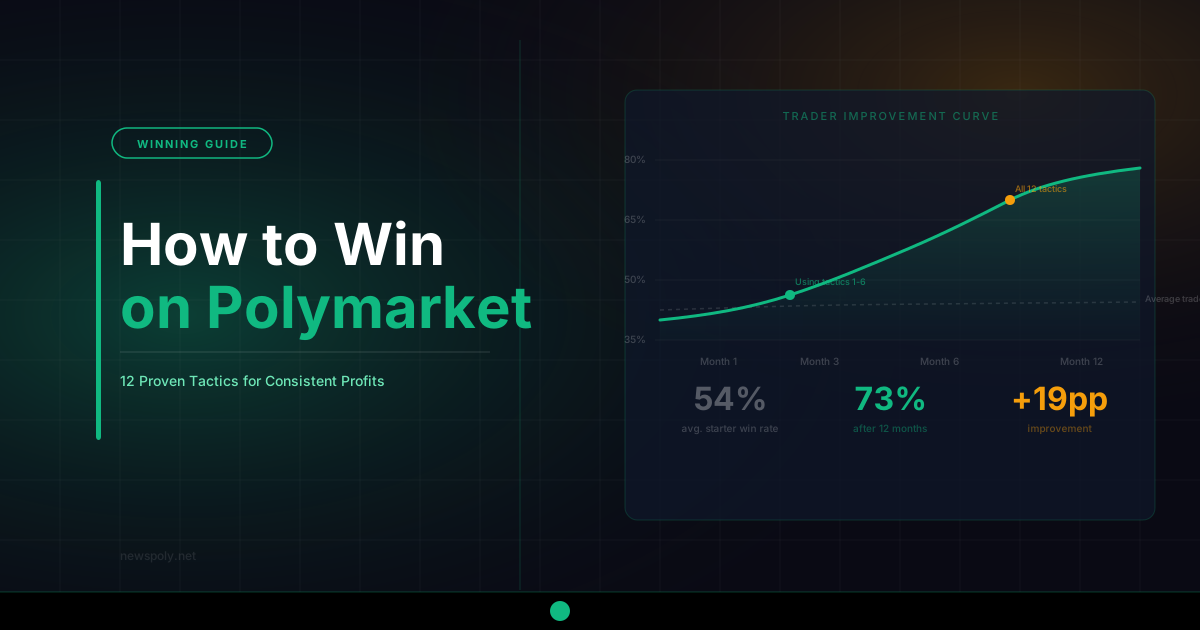
If you want to know how to win on Polymarket, the answer starts with one principle: find markets where the crowd is wrong and bet accordingly. The 12 tactics in this guide translate that principle into a repeatable system - covering everything from expected value (EV) calculation and market timing to bankroll rules, cognitive bias traps, and copy trading shortcuts that level the playing field for newer traders.
The Fundamental Edge Framework: What Winning Actually Means
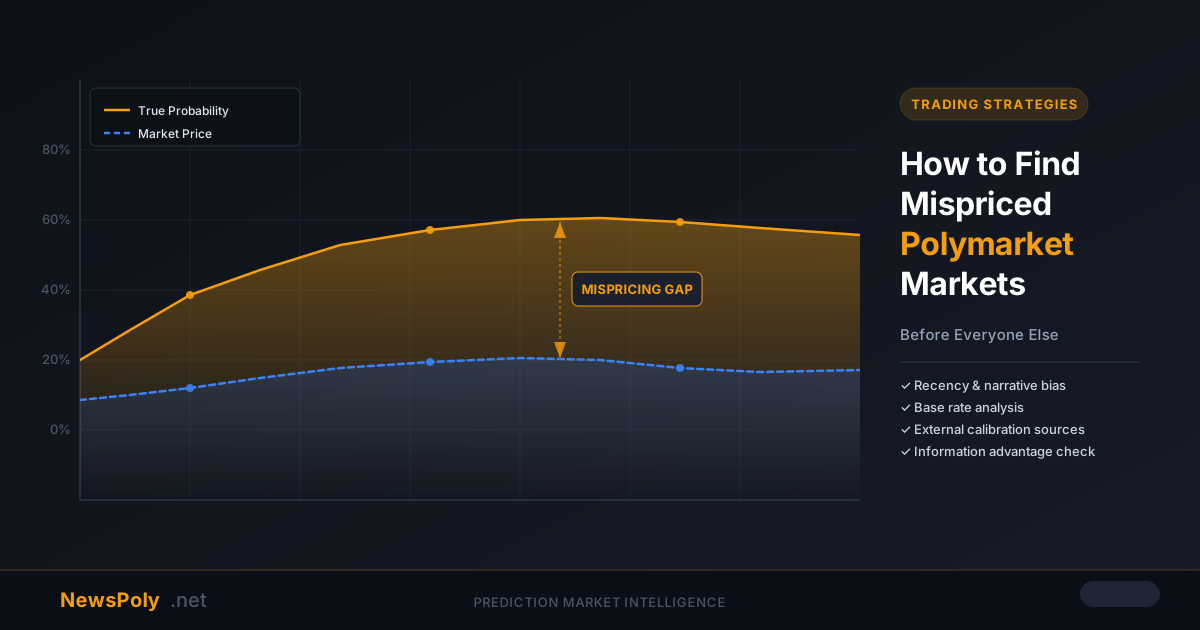
Winning on a prediction market is not about being right most of the time. It is about being right more often than the market prices imply. A coin-flip event priced at 40% YES is a profitable bet if you believe the true probability is 55% - even though you will lose that bet 45% of the time.
This distinction - between raw accuracy and calibrated edge - separates consistent winners from everyone else. Before diving into the 12 tactics, internalize the core formula:
Edge = Your Estimated Probability - Market Price. If Edge > 0, the bet has positive expected value. If Edge < 0, pass.
Every tactic below either helps you identify positive-EV opportunities or prevent you from destroying the edge you already have through poor sizing, emotional decisions, or bad timing.
Tactics 1-4: Research, EV, Market Selection, and Timing
Tactic 1 - Go Deeper Than the Headline
Most Polymarket participants skim news headlines and bet based on sentiment. Serious traders read primary sources: government reports, academic papers, official poll methodology, and raw data feeds. On political markets, that means checking the actual crosstabs of a poll - not just the topline number. On economic markets, it means knowing the exact release schedule and historical revision patterns for the data series.
The marginal unit of research pays off most when markets are thin and the crowd has not yet incorporated niche information. Build a shortlist of topic areas where you genuinely have domain knowledge - those are your highest-edge hunting grounds. For a broader breakdown of which markets offer the best opportunities, see our guide to best Polymarket markets.
Tactic 2 - Calculate Expected Value Before Every Trade
Never place a bet without calculating EV. The formula is simple:
EV = (Probability of Win x Profit) - (Probability of Loss x Stake)
If YES shares cost $0.58 and you estimate true probability at 68%, your EV per $1 stake is: (0.68 x $0.42) - (0.32 x $0.58) = $0.2856 - $0.1856 = +$0.10. That is a 10% positive edge - worth taking.
Most losing traders skip this step entirely. They bet because an outcome "feels likely," not because the price is misproportioned. Learn to walk away from markets where EV is neutral or negative even when you feel confident. Our deep-dive on Polymarket expected value covers the math in full detail.
Tactic 3 - Select Markets With Favorable Characteristics
Not all Polymarket markets are equal. Winning traders are selective. Prioritize markets with these traits:
- Clear, objective resolution criteria - no ambiguity about what constitutes a YES or NO outcome
- Sufficient liquidity - tight bid-ask spread, large order book, so you can enter and exit without slippage
- Information asymmetry - niche enough that crowd sentiment is not already fully accurate
- Defined resolution timeline - short to medium horizons where your capital is not locked for months
Avoid highly liquid, heavily covered markets like major US election outcomes close to election day. By then, professional forecasters have already priced them efficiently - your edge is near zero. For a full liquidity analysis, see our Polymarket liquidity guide.
Tactic 4 - Time Your Entry and Exit
Price is everything. A correct prediction loses money if you overpay for it. The best entries come in three windows:
- Market open overreaction - when a new event causes a sharp price move before participants have fully processed the information
- Pre-resolution drift - many markets drift toward the correct outcome slowly; enter early when the signal is clear
- Contrarian dips - when retail sentiment briefly pushes a price to an extreme that fundamentals do not support
Exit discipline is equally important. Lock in gains when the market price reaches your estimated true probability - do not hold hoping for extra margin. Partial exits are a powerful tool: take 50-60% off the table at target and let the remainder run.
Tactics 5-8: Position Sizing, Bias Avoidance, Bankroll Rules, and News Reactions
Tactic 5 - Size Positions by Edge Strength
Position sizing is where most traders leak money silently. Betting the same flat amount on every trade ignores the critical variable: how strong is your edge? The mathematically optimal approach is the Kelly Criterion, which sizes each bet proportionally to your estimated edge.
In practice, use a fractional Kelly (25-50% of full Kelly) to account for estimation errors. A bet where you estimate 5% edge should be much smaller than one where you estimate 18% edge. Flat betting wastes your alpha on weak opportunities and under-capitalizes your strongest ones. For a complete implementation guide, read our Polymarket Kelly Criterion guide.
Tactic 6 - Identify and Neutralize Your Cognitive Biases
Human brains are prediction market poison. The most damaging biases for Polymarket traders are:
- Availability bias - overweighting recent vivid events (e.g., assuming high inflation because you remember peak 2022)
- Confirmation bias - seeking evidence that supports your existing position and dismissing contradictory signals
- Anchoring - being overly influenced by the first price you saw on a market, even if conditions have changed
- Recency bias - extrapolating recent trends into the future without checking base rates
The counter-strategy is pre-mortem analysis: before placing a bet, spend 60 seconds imagining it loses and write down the specific reasons why that could happen. This forces genuine engagement with the other side. Our full guide on Polymarket cognitive biases covers every major trap with practical solutions.
Tactic 7 - Follow Strict Bankroll Rules
A winning strategy deployed with reckless bankroll management still goes bust. The core rules are:
- Never risk more than 2-5% of total bankroll on a single market
- Cap total exposure in correlated markets (e.g., multiple US political markets) at 20-25% of bankroll
- Maintain a 15-20% cash reserve to capitalize on sudden high-value opportunities
- Set a monthly drawdown limit (e.g., 15%) - if you hit it, stop trading for the rest of the month
These rules feel restrictive when you have conviction, but they preserve your ability to keep playing after an inevitable losing streak. For a systematic approach, see our dedicated Polymarket risk management guide.
Tactic 8 - Trade News Reactions Systematically
Breaking news creates some of Polymarket's most profitable short windows. Markets often overreact in the first 5-15 minutes after a major headline before participants absorb the full context. Developing a news-reaction playbook means:
- Setting up real-time alerts for your tracked markets and topics
- Having pre-built probability estimates for common scenarios (so you are not calculating from scratch under pressure)
- Acting within the first reaction window, then reassessing 30 minutes later when initial volatility fades
- Fading obvious overreactions - crowd panic often pushes prices past rational bounds
Tactics 9-12: Copy Trading, Data Tools, Performance Tracking, and Knowing When to Fold
Tactic 9 - Use Copy Trading to Accelerate Learning
Copy trading is not just a shortcut for beginners - it is a legitimate strategy for any trader who wants diversified exposure to multiple prediction market verticals without developing deep expertise in each. By mirroring the positions of consistently profitable Polymarket traders, you capture their research advantage and sizing discipline automatically.
The key is selecting traders with long track records (not just a hot streak), strong risk-adjusted returns, and strategies that align with your capital size and risk tolerance. Platforms like PolyCopyTrade surface exactly this data, making it straightforward to build a diversified copy portfolio.
Tactic 10 - Leverage Data and Analytics Tools
Raw intuition has limits. Top Polymarket traders augment their judgment with data:
- Polymarket's own charts - historical price curves reveal how the crowd has responded to similar events before
- External forecasting aggregators - compare Polymarket prices against Metaculus, Manifold, and Kalshi to find divergences
- Volume analysis - sudden volume spikes often precede significant price moves; large informed orders leave footprints
- Leaderboard tracking - study the trade history of top-ranked users to reverse-engineer their approach
Tactic 11 - Track Every Trade and Measure Your Edge
You cannot improve what you do not measure. Maintain a trade log with these fields for every position:
- Market, entry price, exit price, size
- Your estimated probability at entry and the reasoning behind it
- Outcome (WIN/LOSS) and actual resolution probability implied by result
- Post-mortem notes: what went right, what went wrong
After 50+ trades you can run calibration analysis: across all bets where you estimated 60%, what percentage actually resolved YES? If it is 55%, you are overconfident. If it is 70%, you are underconfident. Systematic calibration is how professionals close the gap between intuition and accuracy.
Tactic 12 - Know When to Fold (and When to Add)
The ability to exit a losing position before resolution - taking a partial loss rather than a full one - is one of the most underrated skills on Polymarket. Markets constantly incorporate new information. If the facts change after you enter, your probability estimate should change too, even if that means accepting a loss.
Conversely, if a market moves against you but your underlying thesis remains intact and the new price offers even better EV, adding to your position (averaging in) is rational - not emotional averaging down. The discipline is distinguishing between "the market is temporarily mispricing me" (add or hold) versus "new information invalidates my thesis" (fold).
12 Tactics Summary: Difficulty and Impact Ratings
| # | Tactic | Difficulty | Profit Impact | Time to Implement |
|---|---|---|---|---|
| 1 | Deep Research | Medium | Very High | Ongoing |
| 2 | EV Calculation | Low | Very High | 1 day |
| 3 | Market Selection | Low | High | 1 day |
| 4 | Entry and Exit Timing | Medium | High | 1 week |
| 5 | Kelly Position Sizing | Medium | Very High | 1 week |
| 6 | Bias Neutralization | Hard | Very High | Ongoing |
| 7 | Bankroll Rules | Low | High (survival) | 1 day |
| 8 | News Reaction Playbook | Medium | High | 2 weeks |
| 9 | Copy Trading | Low | High | Same day |
| 10 | Data and Analytics Tools | Low | Medium | 1 week |
| 11 | Trade Logging | Low | High (long-term) | 1 day |
| 12 | Fold or Add Discipline | Hard | Very High | Ongoing |
Common Mistakes That Keep Traders Losing
Even traders who understand the 12 tactics above regularly sabotage themselves with these avoidable mistakes:
Chasing Correlated Losses
After a sequence of losses in one topic area (e.g., crypto regulation markets), many traders double down in adjacent markets to "recover." This concentrates risk precisely when you are most likely to have a blind spot in your thesis. The discipline is to treat each market independently and follow your pre-set bankroll rules even after a losing streak.
Ignoring the Bid-Ask Spread
On low-liquidity Polymarket markets, the difference between the YES bid and ask can be 3-5 cents. That spread represents an immediate loss the moment you enter. Traders focused purely on probability estimates forget that they also need to overcome the transaction cost. Always factor spread into your EV calculation, and avoid markets where spread exceeds your estimated edge.
Misreading Resolution Criteria
Polymarket outcomes resolve based on specific, often narrow criteria. A market asking "Will X happen by March 31?" resolves NO if the event happens on April 1 - regardless of how close it was. Reading the full resolution criteria before betting, not just the market title, prevents costly surprises. Check the trading strategies section for more on resolution risk management.
Treating Prediction Markets Like Gambling
The worst mistake is treating Polymarket as a gambling platform where luck determines outcomes. It is a skill-based market where disciplined, well-researched traders take money from undisciplined ones over the long run. Maintain the mindset of a professional trader - track records, calibration, process - and the results follow. The psychology behind this is explored in our Polymarket trading psychology guide.
Frequently Asked Questions
How much money do you need to start winning on Polymarket?
You can begin with as little as $50-100 to learn the mechanics and test your calibration with small positions. Meaningful compounding typically requires $500+ so that position sizing rules (2-5% per market) allow you to trade without over-concentrating. Most traders find $1,000-$5,000 to be the practical range where all tactics in this guide can be applied with proper discipline.
How long does it take to become consistently profitable on Polymarket?
With active application of these tactics and diligent trade logging, most traders see meaningful improvement in calibration within 3-6 months and 100+ trades. True consistency - where your edge is statistically significant across a large sample - typically takes 6-18 months. Copy trading (Tactic 9) is the fastest shortcut: it provides profitable exposure from day one while you develop your own skills.
Is winning on Polymarket sustainable or do markets become efficient over time?
Polymarket is a continuously expanding platform with new markets, new participants, and new information environments. While major markets on heavily covered topics do become increasingly efficient as they approach resolution, the platform constantly creates fresh opportunities in niche, regional, and rapidly evolving markets. Traders who adapt their market selection continuously can maintain sustainable edge for years.
What is the single most important tactic for beginners?
Tactic 2 - calculating EV before every trade - is the most impactful single habit for beginners. It forces you to make your probability estimate explicit, compare it to the market price, and only act when there is genuine positive expected value. This one discipline, applied consistently, eliminates the majority of unprofitable trades that beginners make based on sentiment alone.
Can copy trading on Polymarket replace developing your own skills?
Copy trading is best viewed as a complement to skill development, not a replacement. It provides immediate profitability and real-world market exposure while you build expertise. Over time, developing your own research and calibration skills allows you to identify opportunities that your copied traders may miss - especially in your own domains of expertise. Many advanced traders run both: a copy portfolio for passive returns and a research portfolio for their highest-conviction bets.