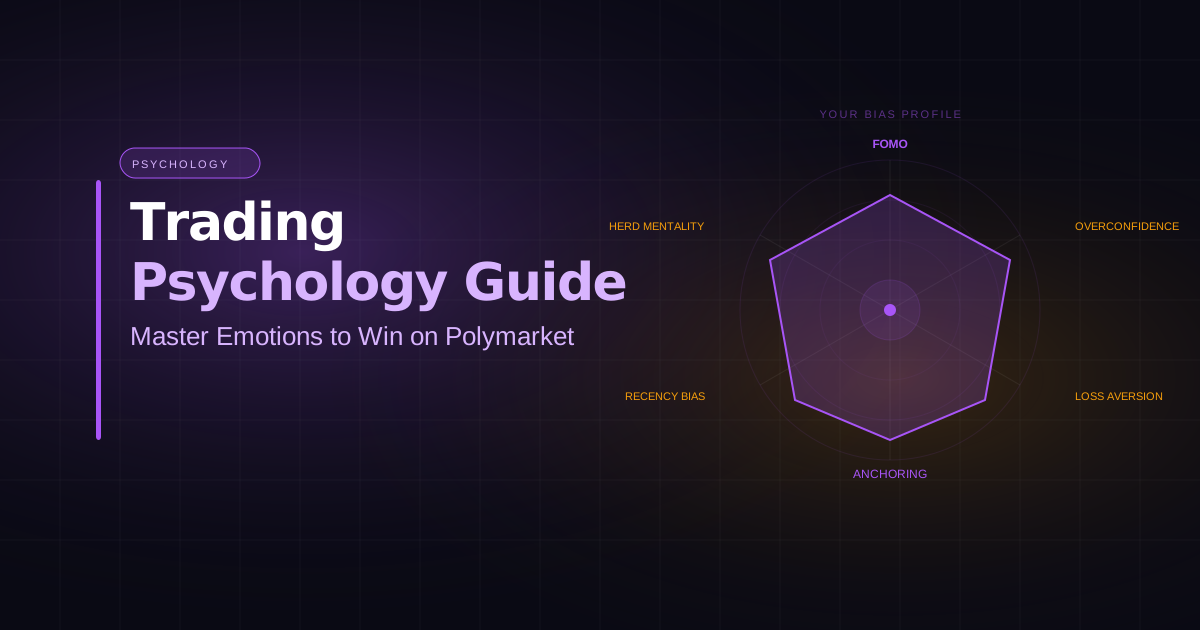
Most traders who lose money on Polymarket don’t lose because they misread the news or got unlucky on a coin-flip market. They lose because their emotions hijack their decision-making at exactly the wrong moments. Tilt after a bad beat, overconfidence after a hot streak, paralysis born of loss aversion — these are the real enemies of long-run profitability. Master the psychological side of prediction-market trading and the analytical edge you already have starts to compound.
Why Trading Psychology Matters More on Prediction Markets
Traditional financial markets punish emotional trading, but prediction markets punish it faster. Every market on Polymarket has a hard deadline: the event resolves, the contract settles at $1 or $0, and there is no “waiting for a recovery.” That binary outcome structure amplifies both the elation of winning and the pain of losing, making psychological discipline not a nice-to-have but a strict requirement.
Research on cognitive biases in prediction markets shows that even experienced forecasters are susceptible to anchoring on their initial probability estimate long after new evidence should have moved them. Recognising the mental traps is the first step; building systems that make it hard to fall into them is the second.
Tilt and Revenge Trading: The Fast Path to Ruin
Tilt is the state in which anger, frustration, or embarrassment after a loss drives you to make larger or more frequent bets than your strategy calls for. In poker it’s well-documented; in prediction markets it’s equally common but less discussed.
The revenge-trade pattern looks like this: you lose $40 on a political market that resolves against you. Instead of reviewing your process, you immediately open three new positions at inflated size, trying to “win back” your money in one session. You are no longer trading probabilities — you are gambling on urgency. The market does not care about your loss. It will not give you a sympathy resolution.
Practical countermeasures:
- Mandatory cool-down rule. After any loss above a preset threshold (e.g., 2× your average position size), you are not allowed to open a new position for at least 30 minutes.
- Position-size freeze. When on a losing streak of three or more consecutive markets, reduce your next position to half your normal unit size until you record a winner.
- Close the browser tab. Physical separation from the interface is underrated. If you can’t open a new market, you can’t revenge-trade.
Loss Aversion and the Disposition Effect
Humans feel losses roughly twice as intensely as equivalent gains. On Polymarket this manifests as the disposition effect: traders hold losing positions too long, hoping for a reversal, and exit winning positions too early to lock in the good feeling. Both behaviours destroy expected value.
If a market you entered at 60 cents has fallen to 35 cents because genuinely new information has shifted the underlying probability, the correct action is usually to exit — not to average down out of ego. Your entry price is irrelevant to the market’s future resolution. Sunk costs are not a reason to hold. See our guide to Polymarket risk management for a full framework on when to exit positions early.
Conversely, if you entered a market at 40 cents and it has risen to 72 cents without any new fundamental information, there is no psychological reason to exit early just because you’re sitting on a profit. Let your winners run to fair value.
Overconfidence After a Winning Streak
A run of successful predictions feels great, but it introduces a dangerous distortion: you start to believe you have an edge in areas where you don’t, or that your edge is larger than it really is. This leads to oversized positions, trades in unfamiliar market categories, and a loosening of the entry criteria that made the winning streak possible in the first place.
The statistical reality is that prediction markets contain genuine randomness. Even a well-calibrated forecaster expects to lose roughly 30–40% of well-researched positions simply due to variance. A five-trade winning streak is not strong evidence of a superior edge; it is consistent with normal variance for any competent trader.
Countermeasures for overconfidence:
- Keep position size rules fixed regardless of recent results. Your process determines size, not your mood.
- After five consecutive wins, deliberately review your last three losers to reground your calibration.
- Study the Kelly criterion — it mathematically limits position size based on estimated edge, providing a hard ceiling even when confidence is high.
The Pre-Trade Checklist
Professional traders in every domain use checklists to prevent emotional shortcuts from bypassing rational analysis. Before entering any Polymarket position, run through the following six points:
| # | Question | What a “No” Means |
|---|---|---|
| 1 | Have I identified a specific reason my probability estimate differs from the current market price? | No information edge — skip the trade |
| 2 | Is my position size within my standard unit range for this confidence level? | Resize before entering |
| 3 | Am I trading this market because of genuine analysis, not to recover a recent loss? | Possible tilt — take a break |
| 4 | Do I understand the resolution criteria clearly? | Read the rules before entering |
| 5 | Have I accounted for the liquidity and the spread cost? | Recalculate expected value |
| 6 | Is my total open exposure within my daily risk limit? | Do not open new positions |
This checklist takes under two minutes. It will save you from a significant number of low-quality trades driven by impatience or emotion. Pair it with the common beginner mistakes guide to build a comprehensive entry filter.
Session Limits and the Daily Stop-Loss
One of the most powerful psychological tools is a rule you set before you start trading: the daily stop-loss. This is a maximum amount you are willing to lose in a single session, expressed as a percentage of your bankroll. When you hit that number, your trading day is over — no exceptions, no negotiations with yourself.
A reasonable starting point is 5% of total bankroll per day. If you have $500 on Polymarket, you stop trading the moment cumulative losses reach $25 in a single session. This sounds conservative, but it prevents the catastrophic drawdowns that end most retail traders’ participation in markets.
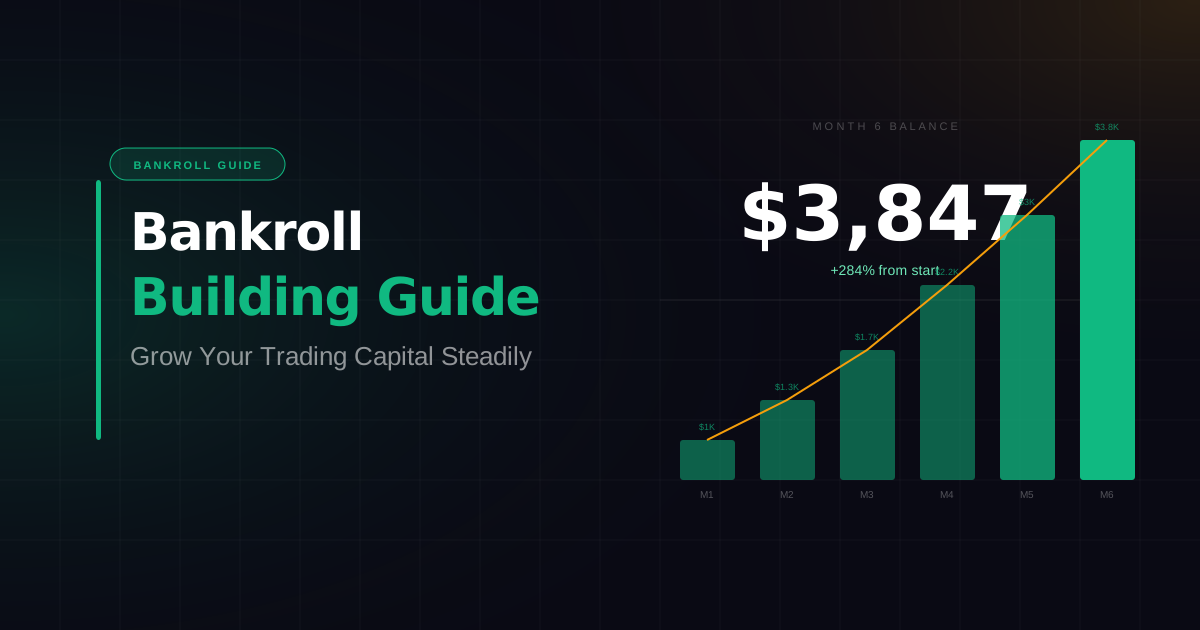
Session limits work for the same reason: set a maximum number of new positions per day (e.g., five) and a maximum total time in the interface (e.g., 90 minutes). Fatigue and boredom are underrated contributors to bad trades. A decision made in hour three of a trading session is typically worse than one made in the first 30 minutes. See our expected value framework and bankroll building guide for compatible money management structures.
The Trading Journal: Your Most Valuable Tool
A trading journal is not a performance log — it’s a psychological record. For every position you open, note the following:
- Your probability estimate and the market price at entry
- The specific reason you believe there is an edge
- Your emotional state at the time of entry (neutral, excited, frustrated, bored)
- The outcome and whether the result matched your reasoning
- What you would do differently in hindsight
After 20–30 trades, review the emotional state column. Most traders discover a clear pattern: their worst decisions cluster around specific emotional states — most commonly excitement after recent wins or frustration after recent losses. Once you can see the pattern, you can build rules around it.
The journal also combats hindsight bias, the tendency to remember your reasoning as being better-calibrated than it was. Writing down your reasoning before the resolution makes it impossible to retroactively “remember” that you knew the right answer all along.
Process Thinking vs Outcome Thinking
The deepest psychological shift a Polymarket trader can make is moving from outcome thinking to process thinking. Outcome thinking evaluates a trade by whether it won or lost. Process thinking evaluates a trade by whether the decision was correct given what you knew at the time of entry.
Consider this scenario: you correctly estimate a political market at 70% probability, enter at 65 cents, and the event resolves against you. Under outcome thinking, this was a bad trade — you lost money. Under process thinking, this was a good trade — you had a genuine edge, sized correctly, and exercised discipline. The loss was a statistically expected outcome from a well-made decision. Over hundreds of similar decisions, process thinking produces profits; outcome thinking produces tilt.
This is not rationalising losses. It requires honest self-assessment: did you actually have an edge, or are you telling yourself you did? Your trading journal provides the honest record to answer that question. Review position sizing principles to ensure your sizing matches your actual edge, not your desired outcome.
Building Psychological Resilience Over Time
Psychological discipline is not a fixed trait — it’s a skill that improves with deliberate practice. The traders who sustain long-run profitability on Polymarket are not emotionless robots; they are people who have learned to recognise their emotional triggers, built systems to limit the damage those triggers can cause, and consistently reviewed their own behaviour in writing.
Start with one rule this week: implement the daily stop-loss. Next week, add the pre-trade checklist. The week after, open a trading journal. Stack these habits gradually and they become automatic. The goal is not perfection — it is a decision-making process that outperforms the average Polymarket participant over hundreds of markets, not just the next five.
Your analytical skills and your psychological discipline must develop together. One without the other produces a trader who can identify good opportunities but can’t execute on them consistently, or one who executes mechanically without an underlying edge. Combine both, and prediction market trading becomes a genuinely profitable long-run activity.