Every Polymarket trader eventually faces the same fork in the road: grind through hours of daily research to build an edge manually, or automate your exposure by mirroring the positions of verified top performers. Both paths can generate returns. But they are not equally accessible, equally efficient, or equally suited to the same type of trader — and the on-chain data paints a clear picture of which approach produces better outcomes for the majority of people who try prediction markets.
What Manual Trading on Polymarket Actually Requires
Manual trading is often romanticised as the “real” way to trade prediction markets — the craft version, where deep research and sharp probabilistic thinking translate directly into profit. That framing is not wrong. The best manual traders on Polymarket are genuinely skilled, and their verified track records prove it. What the romanticised version leaves out is everything that sits beneath the surface of those results.
Effective manual trading on Polymarket requires, at minimum, the following:
- Domain expertise in at least one market category — political forecasting, crypto price dynamics, macroeconomic indicators, or sports outcomes. Generalists without a specialist edge tend to underperform the market’s implied probabilities over time.
- Consistent news monitoring to catch probability-moving events before they are fully priced in. In fast-moving markets, being ten minutes late to a news item is enough to eliminate an edge entirely.
- Calibrated probabilistic reasoning — not just knowing that something is likely, but knowing whether Polymarket’s current price undervalues or overvalues that likelihood, and by how much.
- Emotional discipline under loss variance. Even skilled traders go through multi-week drawdown periods. Most manual traders increase position size after losses to “recover” faster — a pattern that accelerates losses rather than reversing them. See our guide on Polymarket trading psychology for why this is so common and so costly, and our Polymarket risk management guide for the frameworks that prevent it.
- Active position management — monitoring open positions, deciding when to exit early, and rotating capital between markets as they resolve.
None of this is impossible. But it is a serious commitment, and most people who try manual trading underestimate how much of it is required before consistent positive returns materialise.
What Copy Trading Offers Instead
Copy trading replaces the research, timing, and emotional management components of manual trading with automation. Rather than identifying edges yourself, you select verified Polymarket traders whose on-chain track records demonstrate consistent, risk-adjusted outperformance — and the platform automatically mirrors their positions to your wallet, proportionally scaled to your capital.
On PolyCopyTrade, trader selection is based on live, verifiable metrics pulled directly from Polymarket’s on-chain data: ROI over resolved markets, win rate, Sharpe ratio, maximum drawdown, and position consistency. You are not trusting a self-reported performance claim — you are reading a verifiable on-chain record that cannot be fabricated. For a full breakdown of the mechanics, see our Polymarket copy trading guide.
After a one-time setup — typically 20–30 minutes to connect your wallet, review trader metrics, and configure per-trade position sizing — the platform handles all execution automatically. No daily research, no order placement, no position monitoring. The ongoing time commitment is a weekly portfolio review of roughly 10–15 minutes.
Time Commitment: A Side-by-Side Reality Check
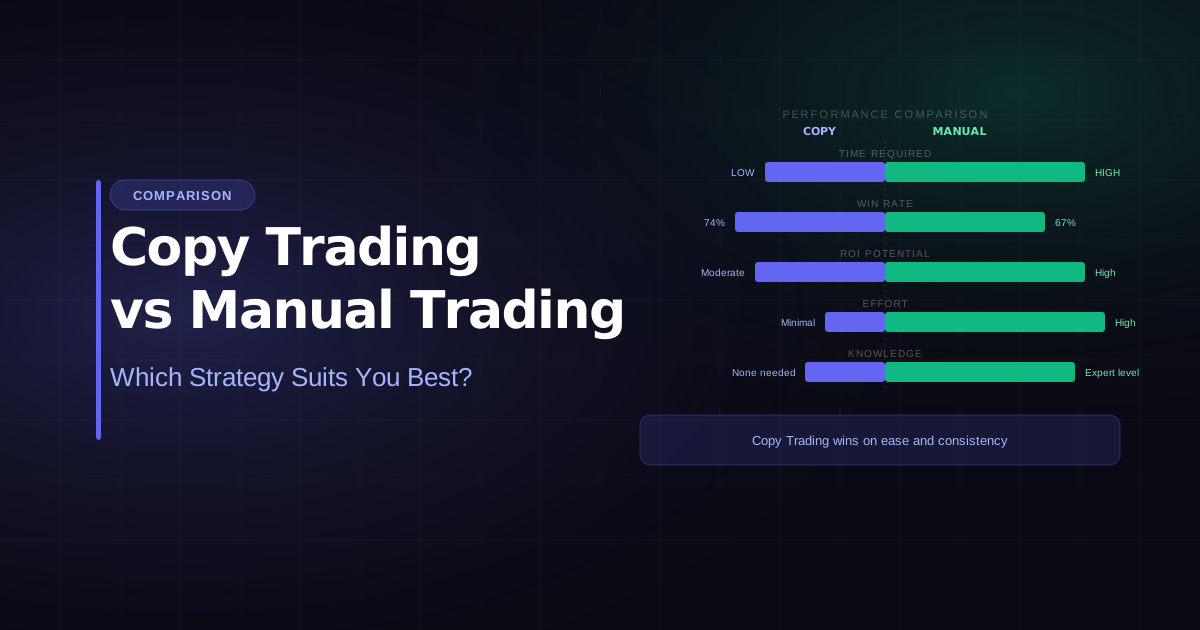
Time is the most concrete and honest dimension on which to compare the two approaches. Manual trading costs are front-loaded in daily attention and ongoing research. Copy trading costs are front-loaded in setup and minimised thereafter.
| Activity | Manual Trading | Copy Trading |
|---|---|---|
| Initial setup | Weeks to months of learning | 20–30 minutes |
| Daily market research | 1–3 hours | None required |
| Order placement & management | 30–60 min/day | Automated |
| News monitoring | Ongoing throughout day | None required |
| Portfolio review | Daily | 10–15 min/week |
| Emotional management | Constant active effort | Eliminated by automation |
| Total weekly time | 15–25+ hours | 15–20 minutes |
For anyone trading Polymarket alongside a full-time job, family, or other meaningful commitments, the manual trading time requirement is not a minor consideration — it is the central constraint that determines whether the strategy is viable at all.
Performance Comparison: Top Traders vs the Average Manual Trader
Here is where the data becomes uncomfortable for manual trading advocates. Polymarket’s on-chain records are fully public, which means the distribution of trader performance is not a matter of debate — it is observable. And what that distribution shows is that most manual traders do not generate consistent positive returns.
The top decile of Polymarket traders — the cohort whose positions copy trading platforms track — generate monthly ROIs in the 5–15% range across diverse market categories. Their Sharpe ratios are positive and sustained across hundreds of resolved markets. These are not flukes or lucky streaks; the sample sizes involved are large enough to distinguish skill from variance.
The median manual trader, by contrast, oscillates around breakeven after accounting for the implicit time cost, and frequently shows negative returns in their first 12–18 months. This is not unique to Polymarket. The pattern mirrors what is observed in sports betting, financial markets, and other prediction environments: a small elite earns consistent returns, a large majority does not, and the majority systematically overestimates its own edge.
Copy trading does not give you top-decile performance — it gives you proportional exposure to it. If the traders you copy generate 8% monthly ROI, your copy portfolio generates returns in that neighbourhood, minus any platform fees. That is a different value proposition than “become a top trader,” but it is a realistic and accessible one. For a deeper look at how top trader returns actually compound, our Polymarket passive income guide walks through the numbers at different capital levels.
The Skill Ceiling Problem
One of the most honest arguments against manual trading for most people is what might be called the skill ceiling problem. Prediction markets are not inefficient indefinitely — as more sophisticated traders participate, mispricings get arbitraged away faster. The Polymarket of 2026 is more competitive than the Polymarket of 2022. Edge is harder to find, requires deeper domain expertise, and disappears more quickly when found.
Building the research infrastructure, domain knowledge base, and probabilistic calibration required to reliably identify Polymarket mispricings takes years, not months. Most traders who attempt this path eventually plateau at a skill level below what is required to generate consistent positive returns — and the on-chain data reflects this. They have not failed through laziness; they have encountered a genuine skill ceiling that separates the top decile from everyone else.
This does not mean manual trading improvement is impossible. It means that for the majority of people, the path to consistent Polymarket returns runs through copy trading, not through the years-long process of becoming a top-decile manual trader. The skill ceiling problem is not a flaw in the people — it is a structural feature of competitive prediction markets. For more on the psychological dimensions of this, see our piece on Polymarket trading psychology.
When Manual Trading Beats Copy Trading
Manual trading does have genuine advantages in specific, well-defined circumstances. It is important to be honest about these rather than presenting copy trading as universally superior.
Niche domain expertise is the clearest case. If you are a professional political analyst, a working scientist in a relevant field, or someone with deep, current expertise in a market category, your information and interpretive advantages can generate edges that no copy trading algorithm captures. Your edge exists in real-time, domain-specific knowledge that is not yet reflected in on-chain trader behaviour.
Emerging markets — newly opened prediction markets with thin liquidity and wide spreads — can offer manual trading edges before the top-tier traders have established positions. Copy trading necessarily follows; it cannot lead into illiquid markets without amplifying slippage.
Timing-sensitive arbitrage between Polymarket and related markets (other prediction platforms, financial derivatives, sports books) is a manual trading opportunity that automated copy systems are not designed to capture.
If you recognise yourself in any of these descriptions, manual trading — or at minimum a hybrid approach — deserves serious consideration. The people who should be manual trading on Polymarket are those who have a genuine, demonstrable edge. Everyone else is competing against people who do. Our article on Polymarket full-time trading covers what that edge actually looks like in practice.
When Copy Trading Wins
Copy trading wins on three dimensions that matter for the majority of Polymarket participants: consistency, diversification, and accessibility.
Consistency: Top traders on PolyCopyTrade have verified track records across hundreds of markets and multiple market categories. Their consistency is observable and auditable, not claimed. Manual trading returns for non-expert traders are inherently less consistent because they are based on a narrower sample of decisions and more susceptible to emotional variance.
Diversification: A copy trading portfolio can simultaneously mirror multiple traders across different market categories — political, crypto, macroeconomic, sports. Building equivalent diversified manual trading expertise across all these categories is not realistic for most people. Copy trading achieves it by default.
Accessibility and scalability: Copy trading has no skill barrier to entry and scales linearly with capital. Manual trading has a steep skill curve and does not scale — more capital does not help if the fundamental edge is not there, and more capital can actually hurt by increasing the emotional stakes of each decision.
The Hybrid Approach: Best of Both
The false choice framing — copy trading or manual trading, pick one — ignores a strategy that many sophisticated Polymarket participants actually use: a hybrid allocation that deploys the majority of capital via copy trading for consistent automated returns, while reserving a smaller discretionary allocation for manual positions where genuine domain expertise exists.
A typical hybrid structure might allocate 70–80% of trading capital to copy trading, generating consistent automated returns without daily research overhead, and 20–30% to manual positions in specific market categories where the trader has demonstrable expertise or information advantages. This structure captures the consistency and passivity of copy trading while preserving the upside of genuine domain-specific edges.
The hybrid approach also has an important psychological benefit: it gives manual trading enthusiasts a structured outlet for their research instincts without putting the entire portfolio at the mercy of emotional decision-making. The copy trading allocation provides a performance baseline; the manual allocation is where skill-building happens at contained risk. For more on the strategic dimensions of this, see our piece on top Polymarket trading strategies and our Polymarket bankroll building guide for growing your account sustainably across both approaches.
How PolyCopyTrade Works in Practice
Understanding the mechanics helps evaluate whether copy trading is the right fit for your situation. PolyCopyTrade connects to your Polymarket wallet and monitors the live on-chain positions of verified top traders in real time. When a tracked trader opens a position, the platform calculates the proportional equivalent for your portfolio size and executes an equivalent trade automatically to your wallet.
Trader selection on the platform is based on verified metrics — not self-reported performance claims, but actual on-chain resolution history. The key metrics to evaluate when choosing traders to copy are: sustained ROI across a large sample of resolved markets (not just a short winning streak), maximum drawdown (how badly the portfolio declined at its worst point), Sharpe ratio (risk-adjusted return, not just raw ROI), and market category focus (matching their expertise to market types you want exposure to).
Risk controls are configurable at the portfolio level: you set a maximum per-trade position size, a total daily exposure cap, and can pause copying at any time without closing existing positions. The platform does not hold custody of your funds — all execution happens through your connected wallet, maintaining full on-chain transparency.
For a detailed walkthrough of the setup process and configuration options, see our guide on what Polymarket copy trading is.
Comprehensive Comparison: Copy Trading vs Manual Trading
| Dimension | Manual Trading | Copy Trading | Advantage |
|---|---|---|---|
| Time per week | 15–25+ hours | 15–20 minutes | Copy trading |
| Skill barrier | High (years to develop) | None | Copy trading |
| Average ROI (median trader) | –1% to +3% monthly | 3–8% monthly (top traders) | Copy trading |
| Emotional risk | High (FOMO, tilt, overtrading) | Eliminated by automation | Copy trading |
| Domain expertise leverage | Yes — edge is yours | No — edge is borrowed | Manual (for experts) |
| Diversification | Limited by expertise breadth | Across multiple market types | Copy trading |
| Scalability with capital | Edge may not scale | Linear with capital | Copy trading |
| Transparency & auditability | Your own records | On-chain verified | Copy trading |
| Performance ceiling | Unlimited for elite traders | Capped by top trader returns | Manual (for top tier) |
| Beginner viability | High loss rate in first year | Immediate access to top performance | Copy trading |
Who Should Choose Which Strategy
After examining the data across time commitment, performance distribution, skill ceiling, and structural advantages, the decision framework is actually quite simple.
Choose copy trading if: you do not have deep, demonstrable expertise in a specific Polymarket category; you cannot commit 15–25 hours per week to research and position management; you want consistent, automated exposure to top-tier Polymarket performance; you are new to prediction markets and want to learn by observing what top traders do; or you want to build a passive income stream without the emotional overhead of active trading. Our passive income guide covers how copy trading fits into a broader income strategy.
Choose manual trading if: you have verifiable domain expertise in political forecasting, crypto markets, macroeconomics, or another Polymarket category; you have time to monitor markets, news, and positions daily; you have a track record (even a modest one) of generating positive returns across a meaningful sample of resolved markets; or you are willing to invest 12–18 months of learning before expecting consistent profits.
Consider the hybrid if: you have expertise in one or two categories but not the breadth to trade all market types; you want a consistent automated baseline while preserving the ability to act on genuine edges when they appear; or you are in the process of developing manual trading skills and want to maintain positive returns during the learning curve.
The honest conclusion: for most people participating in Polymarket in 2026, copy trading delivers better risk-adjusted returns for far less time investment than manual trading. That is not a knock on manual trading — it is a realistic assessment of the skill distribution in a competitive prediction market, and a recognition that most people are better served by accessing elite performance than by trying to replicate it.
Frequently Asked Questions
Can copy trading outperform manual trading on Polymarket?
For the majority of traders, yes — and the on-chain data supports this. Copy trading gives you proportional access to the returns of verified top-tier performers who generate 5–15% monthly ROI consistently. The median manual trader generates far less, particularly in their first 12–18 months. The exception is traders with genuine domain expertise who can identify and act on mispricings that top traders have not yet priced in. For that minority, manual trading can outperform. For everyone else, mirroring the top performers is the more realistic path to consistent returns.
Is copy trading on Polymarket suitable for beginners?
Copy trading is especially well-suited to beginners precisely because it eliminates the steep learning curve of manual trading. Rather than spending 12–18 months building the research infrastructure and calibration skills required for positive manual returns, beginners can access top-tier performance immediately through PolyCopyTrade. The setup process is straightforward, the risk controls are configurable, and the on-chain transparency means you can observe exactly what positions are being taken and why — which is itself a powerful learning tool.
How much capital do I need to start copy trading on Polymarket?
There is no formal minimum, but practically speaking, $500–$1,000 is the threshold at which returns become meaningfully motivating. At $500 with 5% monthly returns, you generate $25/month — real, but modest. At $5,000–$10,000, that same performance tier generates $250–$500/month, which is a meaningful supplement. The more capital you deploy, the more the time efficiency of copy trading versus manual trading makes financial sense. See our passive income guide for a full return projection across capital levels.
Can I switch between manual and copy trading?
Yes — and many experienced Polymarket participants do exactly this via a hybrid allocation strategy. PolyCopyTrade allows you to pause, adjust, or stop copying at any time without affecting existing open positions. A common approach is to run a copy trading allocation for consistent automated returns while maintaining a smaller discretionary manual allocation for specific market categories where you have genuine expertise. This hybrid structure captures the efficiency of automation while preserving the ability to act on real edges when they appear.