Passive vs Active: Where Does Polymarket Sit?
Most people picture Polymarket as an active pursuit: scanning markets, reading news, placing bets, monitoring outcomes. That framing is accurate for one style of trading — but it is not the only style available. The full income spectrum on Polymarket runs from fully active (hours of daily research and order management) down to genuinely semi-passive strategies that require a one-time setup and modest ongoing oversight.
None of these methods are "earn money in your sleep with zero effort" — that framing belongs to the sales pitch, not reality. But several of them require far less active management than most traders assume, and the trade-off between time invested and return generated is very different depending on which method you use. This guide maps all five main passive income approaches on Polymarket, compares their realistic returns and time demands, and identifies the method best suited to each type of trader.
Method 1: Copy Trading via PolyCopyTrade (Lowest Effort)
Copy trading is the closest thing Polymarket has to a genuinely passive income strategy. Rather than researching markets yourself, you automatically mirror the on-chain positions of verified top traders whose performance has been validated across hundreds of resolved markets.
PolyCopyTrade ranks Polymarket traders by live, verifiable metrics: ROI, win rate, Sharpe ratio, and maximum drawdown. You select which traders to copy, set per-trade position limits, and configure risk parameters. After that initial setup — which typically takes 20–30 minutes — the platform executes all trades automatically to your connected wallet. You do not need to watch the markets, read the news, or manually place orders.
The ongoing time commitment is genuinely minimal: a weekly portfolio review of perhaps 10–15 minutes to check overall performance and confirm your copied traders are still performing at the level you selected them for. That is it. For a fuller breakdown of how the mechanics work, see our Polymarket copy trading guide.
Setup time: 20–30 minutes
Ongoing monitoring: 10–15 minutes per week
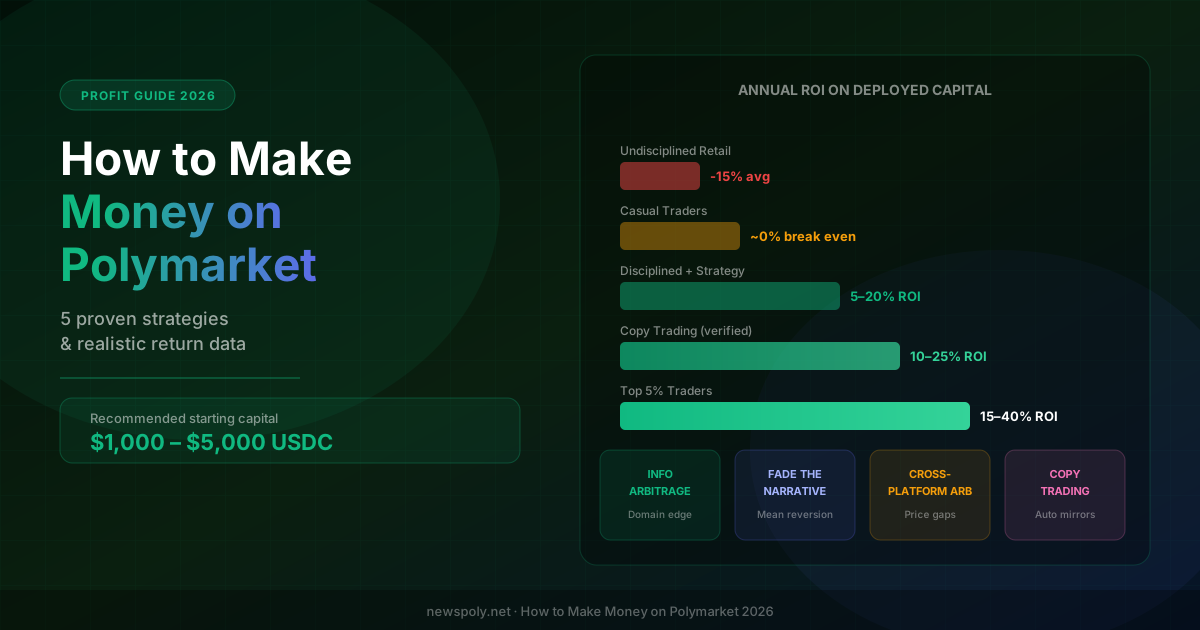
Realistic returns: Tied to the performance of the traders you copy — typically 3–8% monthly ROI for consistently top-ranked traders
Capital requirement: No formal minimum; practically $500+ to make meaningful returns
Method 2: Market Making with Limit Orders (Medium Effort)
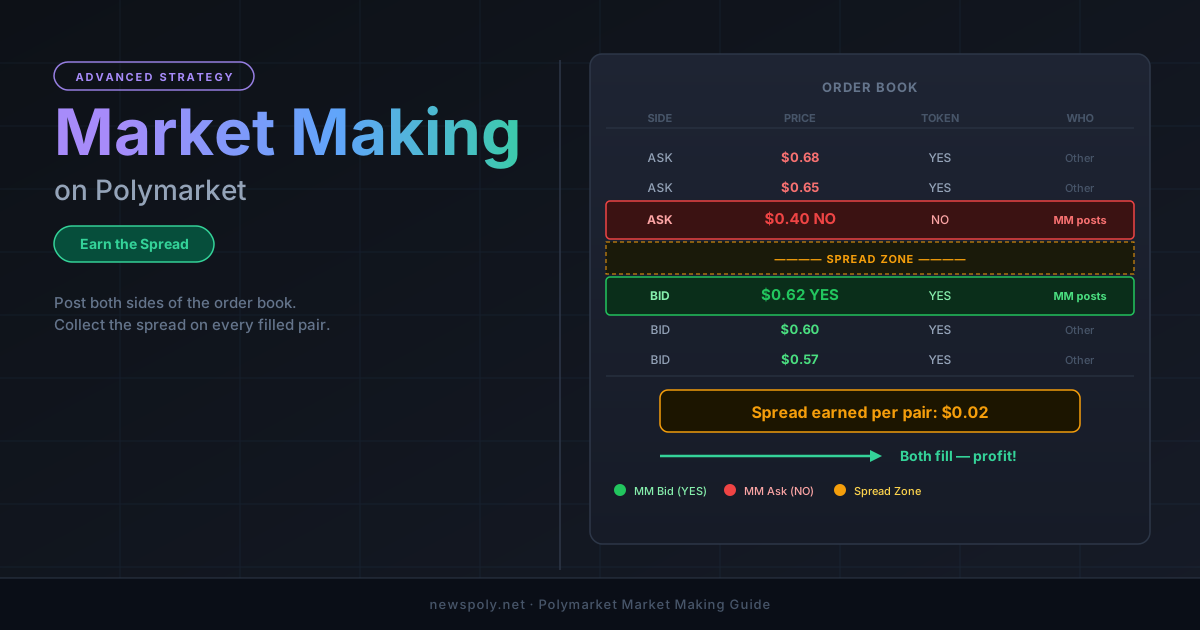
Market making means posting both a buy order and a sell order on the same market — offering to buy YES shares at $0.45 and sell them at $0.55, for example — and earning the spread when both sides fill. In liquid markets with tight spreads, this is a numbers game: small margin per trade, but accumulated across many fills, it adds up.
Polymarket's CLOB (Central Limit Order Book) supports this strategy natively via limit orders. You do not need to be watching the screen when your orders fill — they execute automatically when the price moves to your specified level. The passive element is in the execution; the active work is in selecting which markets to make and at what spreads.
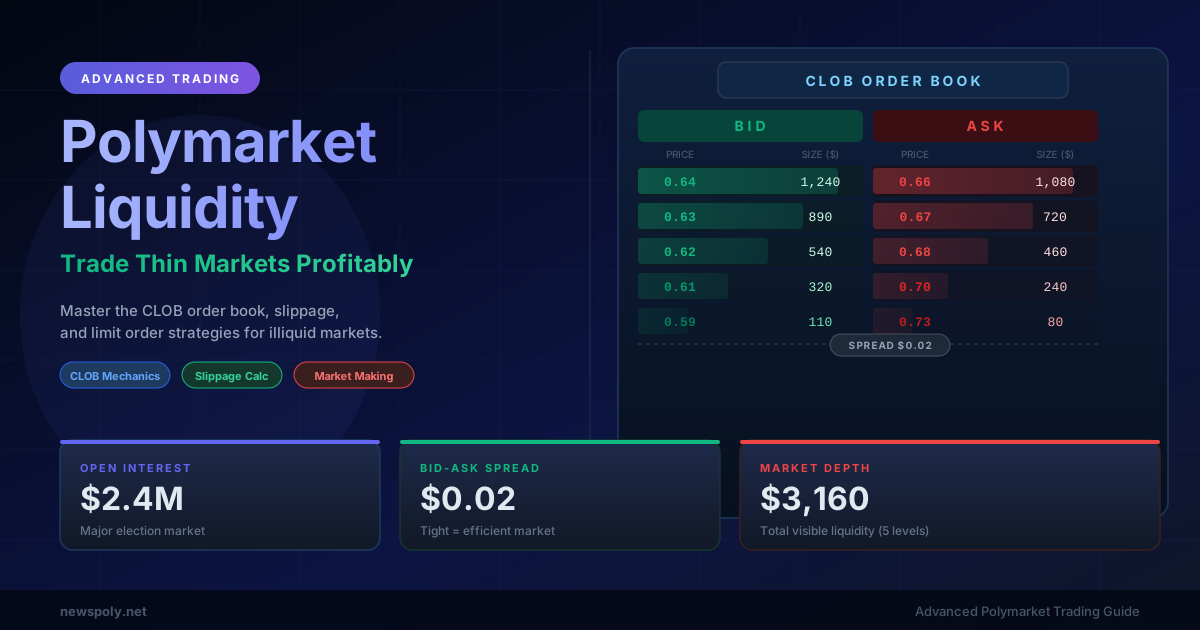
Market making is not fully passive. You need to periodically refresh stale limit orders, rotate capital to new markets as existing ones resolve, and monitor whether your quoted prices are still reflective of true probabilities after news events. In thin markets with wide spreads, there is also adverse selection risk: you may end up buying YES shares just before the probability collapses. How well this strategy works also depends on available market depth — our Polymarket liquidity guide explains how to assess this before committing capital. Our Polymarket market making guide covers the full mechanics.
Setup time: 1–2 hours to learn the model and identify target markets
Ongoing monitoring: 30–60 minutes per day
Realistic returns: 2–6% monthly ROI in actively traded markets
Capital requirement: $2,000+ to post meaningful limit orders on both sides
Method 3: Near-Certainty Positions (Low Effort, Low Return)
Near-certainty trading is the simplest passive strategy: find markets where the outcome is almost certain but not yet resolved, buy the winning side at $0.92–$0.97, and wait for resolution at $1.00. The return per trade is small — 3–8 cents per share — but the probability of loss is low and the time to resolution is often short.
This strategy works best in the final days before a market resolves. A political market where the outcome is already established by official announcement but not yet formally resolved on Polymarket, for example, may still be trading at $0.94–$0.96. Buying at $0.95 and resolving at $1.00 is a 5.3% return in days or hours.
The passive element: once you have bought, there is nothing to do but wait. No monitoring, no order management, no analysis of subsequent events. The main risk is resolution surprises — markets that appear certain can be disputed or delayed, leaving capital tied up longer than expected — and the opportunity cost of capital locked in at very small margins.
Setup time: 15–30 minutes per position to identify suitable markets
Ongoing monitoring: Minimal — check resolution status every few days
Realistic returns: 0.5–2% per week on deployed capital in favourable conditions
Capital requirement: $500+ to generate meaningful dollar returns at these margins
Method 4: Trading Bots (High Setup, Passive Once Running)
Automated trading bots let you define rules in code and have them execute trades on your behalf around the clock. Polymarket exposes the CLOB API and full on-chain data, making it accessible to programmatic traders. A bot might monitor a specific set of markets, execute limit orders when certain price thresholds are hit, or automatically close positions when probability moves against your entry.
The passive aspect is clear: once the bot is running, it operates without manual input. The non-passive aspect is just as clear: building, testing, and maintaining a profitable trading algorithm is technically demanding, time-intensive, and genuinely difficult to do profitably. Most bots built by retail traders either underperform manual trading or break when market conditions change.
Our Polymarket trading bot guide covers the full technical setup, including the API endpoints, authentication, and Python code structure. If you are a developer comfortable with Python and API integrations, this is the highest-ceiling passive income approach. If you are not, the setup complexity makes it a poor choice compared to copy trading.
Setup time: 10–40 hours depending on technical background
Ongoing monitoring: 30–60 minutes per week to review logs and adjust parameters
Realistic returns: Highly variable — 0% to 10%+ monthly depending on strategy quality
Capital requirement: $1,000+ to run meaningful position sizes
Method 5: Liquidity Provision on Polygon DeFi
Polymarket operates on Polygon, and USDC — the currency used for all Polymarket positions — can also be deployed in Polygon DeFi liquidity pools. Providing USDC liquidity to protocols like Aave or Curve on Polygon earns yield from borrowing fees and trading fees, entirely separately from any Polymarket trading activity.
This is the most genuinely passive strategy in this list, but it is also the least connected to Polymarket specifically. The returns are lower than active Polymarket trading (typically 3–8% annual, not monthly), and the risks are different: smart contract risk, protocol risk, and Polygon network risk rather than prediction market resolution risk. It is best thought of as a way to put idle USDC to work between active Polymarket positions, not as a primary income strategy. For a full breakdown of every option available — including Aave, Compound, Circle Yield, and Coinbase — see our dedicated Polymarket USDC yield guide.
Setup time: 1–2 hours to set up Polygon DeFi wallet positions
Ongoing monitoring: 15–30 minutes per month
Realistic returns: 3–8% annually (not monthly)
Capital requirement: $500+ for meaningful yields
Method Comparison: Returns vs Time Investment
| Method | Setup Time | Weekly Monitoring | Monthly ROI Range | Difficulty |
|---|---|---|---|---|
| Copy Trading (PolyCopyTrade) | 20–30 min | 10–15 min | 3–8% | Very Low |
| Market Making | 1–2 hrs | 3–7 hrs | 2–6% | Medium |
| Near-Certainty Positions | 15–30 min | 30–60 min | 0.5–2%/wk* | Low |
| Trading Bot | 10–40 hrs | 30–60 min | Variable | High |
| DeFi Liquidity (USDC) | 1–2 hrs | 5–10 min | 0.25–0.65% | Low |
*Near-certainty weekly ROI on deployed capital; annualised this approaches 25–100%+ but opportunity availability is limited and capital must constantly be redeployed.
Risks of Passive Polymarket Trading
Calling any Polymarket strategy "passive" does not eliminate its risks — it just changes the nature of your exposure. These are the main risks specific to low-monitoring Polymarket approaches:
- Unmonitored position risk: Markets can move sharply on unexpected news while you are not watching. A near-certainty position bought at $0.95 can drop to $0.60 if a surprise resolution event occurs. Copy trading partially mitigates this because the traders you are copying are actively monitoring — but they may not exit positions as quickly as a fully manual trader would.
- Resolution surprises: Polymarket relies on UMA protocol for resolution. In rare cases, markets resolve unexpectedly, are disputed, or are delayed significantly beyond their listed end date. Capital tied up in a delayed market cannot be redeployed. Read our copy trading guide for how this affects automated positions.
- Smart contract risk: All Polymarket positions and USDC are on-chain. Smart contract exploits, though rare, are a structural risk for all crypto-based platforms. Do not deploy capital you cannot afford to lose in the event of an extreme scenario.
- Liquidity risk in thin markets: Limit orders and near-certainty strategies work best in liquid markets. In illiquid markets, your orders may not fill at expected prices, or exiting a position early may require selling at a significant discount.
- Over-reliance on a single method: Diversifying across two or three methods (e.g., copy trading for the bulk of your exposure, near-certainty trades for opportunistic returns) reduces single-method risk.
Tax Implications of Passive Prediction Market Income
Income from Polymarket — whether actively or passively earned — is generally taxable. The passive framing does not create a tax advantage. In the United States, prediction market profits are treated as ordinary income in most cases, subject to federal and state income tax at your marginal rate. In the UK, frequent trading may be treated as income rather than capital gains.
For copy trading specifically, each mirrored position that resolves profitably is a taxable event — even if you did not manually place the trade. If you are running a bot or using copy trading that generates dozens of positions per month, the record-keeping burden can be substantial. Using a crypto tax tool that integrates with Polygon on-chain data is advisable. Our Polymarket tax guide covers the full framework for US and international traders.
DeFi liquidity provision income is treated differently in some jurisdictions: interest-like income from liquidity pools may be taxed as ordinary income when received, not only at the point of exit. Check your local rules before deploying significant capital to Polygon DeFi protocols.
Realistic Expectations for Passive Income
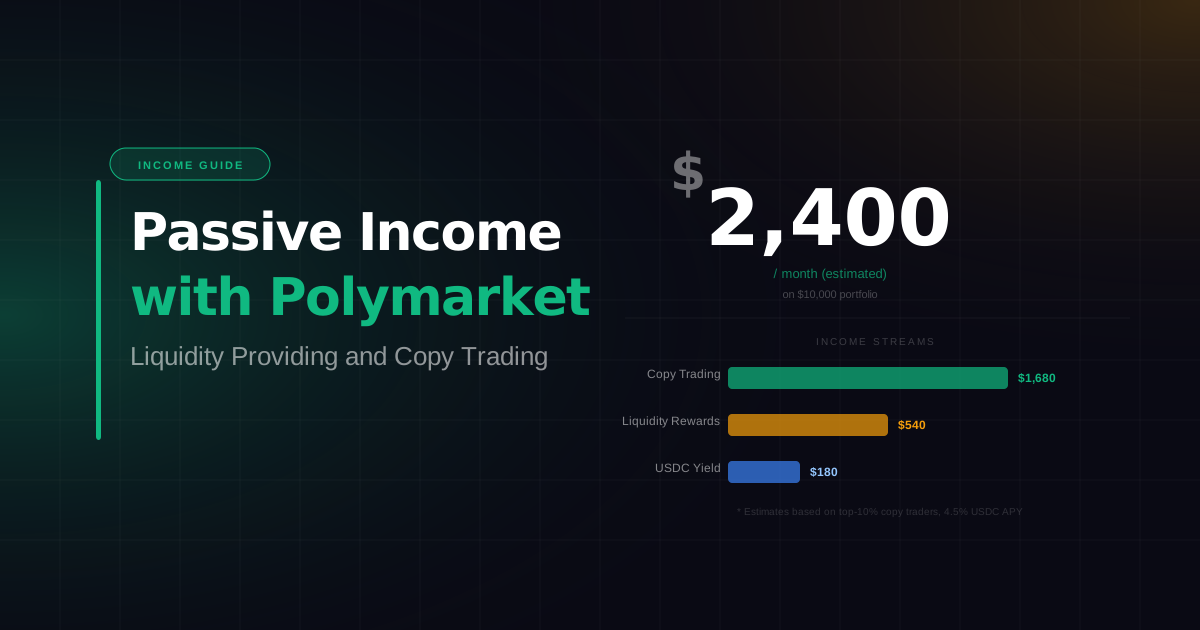
Passive Polymarket income is real, but calibrating expectations accurately matters. Consider what different capital deployments actually produce at realistic return rates using the copy trading method:
- $1,000 deployed: At 5% monthly ROI, that is $50/month gross — a coffee per day. Useful for learning the system, not for replacing income.
- $5,000 deployed: At 5% monthly, $250/month gross. A meaningful side income supplement after tax.
- $20,000 deployed: At 5% monthly, $1,000/month gross. Approaching a material secondary income stream. Post-tax at 30%, roughly $700/month.
- $50,000 deployed: At 5% monthly, $2,500/month gross — $1,750/month net at 30% tax. A substantial passive income stream for most people.
The compounding dynamic matters here too. Reinvesting returns rather than withdrawing them accelerates growth significantly over 12–24 months. A $10,000 starting balance compounding at 5% monthly (reinvested) grows to roughly $17,900 after 12 months and $32,000 after 24 months without adding any new capital.
For a comparison of passive vs active income potential on Polymarket, see our full-time Polymarket trading guide, which covers what it actually takes to generate a liveable income from prediction markets. If you are focused on growing your capital over the long term, our Polymarket bankroll building guide pairs well with the passive income methods described here.
Frequently Asked Questions
What is the most passive way to earn on Polymarket?
Copy trading via PolyCopyTrade is the most passive method currently available for Polymarket. After a one-time setup of 20–30 minutes, the platform automatically mirrors verified top traders to your wallet with no ongoing manual input required. You do not need to research markets, place orders, or monitor positions day-to-day. A weekly review of overall portfolio performance is the only consistent time commitment.
Can I fully automate everything on Polymarket?
Close, but not entirely. Copy trading automates trade execution completely — you still need to periodically review whether your copied traders are performing as expected and adjust your configuration if their metrics deteriorate. Trading bots automate execution based on your defined rules, but require maintenance when market conditions change. No method entirely eliminates the need for occasional oversight; the distinction is between checking in weekly versus monitoring daily or hourly.
What returns can I expect passively on Polymarket?
For copy trading, realistic monthly returns are 3–8% depending on which traders you copy and their recent performance. Near-certainty positions deliver 0.5–2% per week on deployed capital in favourable conditions, but capital must be actively redeployed as markets resolve. Market making delivers 2–6% monthly in liquid markets with consistent spread availability. DeFi liquidity provision on Polygon delivers 3–8% annually — closer to a traditional savings instrument than to trading returns. All of these figures are pre-tax estimates based on realistic (not best-case) scenarios.
Is copy trading on Polymarket legal?
Copy trading itself is not restricted by Polymarket's terms of service. The legality of using Polymarket in your jurisdiction depends on your country's rules regarding prediction markets and crypto-based trading — see our Polymarket countries guide for a jurisdiction-by-jurisdiction breakdown. PolyCopyTrade operates as a tool that automates your own on-chain activity based on your instructions.
How much capital do I need to start earning passively on Polymarket?
There is no formal minimum, but practically speaking, $500–$1,000 is the threshold where returns start to become meaningfully motivating. Below that, even a 5% monthly return produces less than $25–$50 per month — real, but modest. For a part-time income supplement, $5,000–$20,000 deployed via copy trading generates returns in the $250–$1,000/month range at realistic performance levels. The more capital you deploy, the more the passive nature of the setup actually makes financial sense relative to the time saved.