No — Polymarket itself pays zero interest on idle USDC. Your funds sit dormant in your embedded wallet between trades, earning nothing. That is not a temporary limitation waiting to be patched; it is a deliberate design choice by a platform focused on market infrastructure rather than yield products. But “Polymarket doesn’t pay yield” is not the same as “you can’t earn yield while trading Polymarket.” This guide covers every practical option available in 2026: DeFi lending protocols, Circle’s native product, centralized exchange alternatives, and — most practically — how to use automated trading to keep capital deployed instead of idle in the first place.
Does Polymarket Pay Interest on USDC?
The short answer is no, and it is worth being direct about why. Polymarket is a prediction market protocol built on Polygon. Its smart contracts handle position creation, order matching, and resolution — they do not route idle balances into yield-generating instruments. When you deposit USDC to Polymarket and leave it undeployed, it sits in your embedded wallet without compounding.
This is true for both the custodial wallet option (the embedded wallet new users get via Magic or similar providers) and for connected external wallets like MetaMask. Neither earns yield inside the Polymarket interface. There is no “savings mode,” no staking toggle, no automatic yield allocation. If you want your USDC to earn while it’s not in an open position, you have to move it yourself — or keep it constantly deployed in positions.
For a broader overview of how USDC flows through Polymarket including deposits and withdrawals, see our Polymarket USDC guide.
Why Idle Capital Is a Hidden Cost
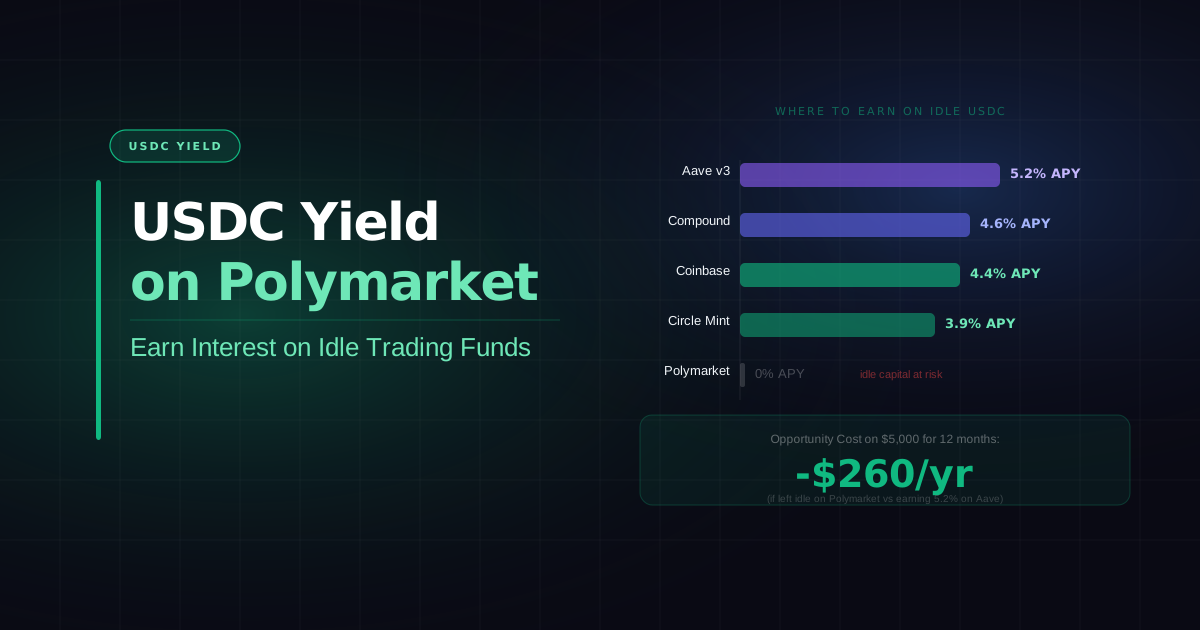
Most traders think of idle USDC as neutral — money parked safely, waiting for the right market. That framing ignores the real cost: opportunity cost. In an environment where DeFi lending protocols routinely offer 4–8% APY on stablecoins and even conservative centralized options yield 4–5%, leaving capital idle for weeks at a time has a measurable dollar cost.
Consider a trader with $5,000 on Polymarket who keeps 60% uninvested on average. That $3,000 in idle USDC, left dormant for a year, forgoes roughly $120–$240 in risk-free stablecoin yield at current rates. If you are still deciding how much to fund your account with, see our guide on the Polymarket minimum deposit for practical starting-amount guidance. For more active traders with larger balances, the number scales accordingly. The idle cost does not show up anywhere on your Polymarket dashboard, which is precisely why it goes unnoticed.
There is also an inflationary dimension. USDC’s peg is maintained against the US dollar, which itself loses purchasing power over time. Earning yield does not eliminate inflation risk, but it partially offsets it. A 4–5% APY on stablecoin holdings closely tracks US inflation rates in the current environment, meaning yield-generating options preserve real value while idle capital slowly erodes it.
The practical implication: every week your USDC sits unused on Polymarket is a week you are subsidising the protocol rather than compounding your capital. See our Polymarket passive income guide for a broader look at how to put capital to work across multiple methods.
USDC Yield Options While Not Trading
If you want to earn yield on USDC that is not currently deployed in Polymarket positions, here are the four main routes available in 2026.
Aave (DeFi Lending)
Aave is the largest decentralised lending protocol by total value locked. You supply USDC to Aave’s liquidity pool and earn interest from borrowers who post collateral to access it. Because Aave operates on Polygon, the round-trip — withdraw from Polymarket, deposit to Aave, later withdraw from Aave, redeposit to Polymarket — involves minimal gas fees (typically under $0.02 in MATIC per transaction). APY on Aave USDC supply fluctuates with borrowing demand but has ranged between 3% and 9% over the past 18 months. The protocol is non-custodial: your supplied USDC is held in audited smart contracts, not by a company.
Compound (DeFi Lending)
Compound Finance operates on a similar model to Aave. You supply USDC and receive cUSDC tokens representing your deposit plus accrued interest. APY on Compound USDC has been slightly lower on average than Aave in recent periods, typically 2–7%, but the protocol has an excellent long-term security track record. Compound is available on multiple chains; the Ethereum mainnet deployment has deeper liquidity but higher gas costs for entry and exit. The Compound v3 (Comet) architecture on Polygon offers lower-cost access comparable to Aave.
Circle Yield
Circle, the issuer of USDC, operates a direct yield product for institutional and high-net-worth users. Circle Yield offers fixed or variable returns on USDC balances held with Circle directly. The product targets larger allocations ($100,000+) and involves KYC verification and a formal account relationship. For individual traders with smaller balances this is not a practical option, but it is worth knowing it exists for anyone scaling to significant capital. Circle’s yield rates are generally competitive with DeFi lending while offering a more regulated, centralised structure.
Coinbase (Centralised, Simplest Access)
For traders who want the simplest possible yield without interacting with DeFi protocols, Coinbase offers USDC rewards to eligible users (currently 4.1% APY in supported regions as of Q1 2026). The flow is: withdraw USDC from Polymarket to your external wallet, send USDC to your Coinbase account, and it accrues rewards automatically. The downside is re-entry latency: moving USDC back from Coinbase to Polymarket takes 5–30 minutes depending on network congestion, which means you can miss fast-moving markets during the transfer window. If speed of redeployment matters to your strategy, DeFi protocols on Polygon are meaningfully faster. For a withdrawal walkthrough, see our guide to withdrawing from Polymarket.
Yield Comparison Table
| Platform | Approx. APY (Q1 2026) | Risk Level | Access Speed (back to Polymarket) | Min. Balance |
|---|---|---|---|---|
| Aave (Polygon) | 3–9% | Medium (smart contract risk) | 2–5 minutes | No minimum |
| Compound v3 (Polygon) | 2–7% | Medium (smart contract risk) | 2–5 minutes | No minimum |
| Coinbase USDC Rewards | ~4.1% | Low (regulated, FDIC-adjacent) | 10–30 minutes | No minimum |
| Circle Yield | 4–6% (negotiated) | Low–medium (counterparty) | 1–3 business days | $100,000+ |
| Polymarket (no action) | 0% | None | Instant | N/A |
Managing Capital Between Polymarket and Yield Protocols
The core tension is liquidity versus return. Yield protocols reward capital that stays deployed; Polymarket rewards capital that moves fast into mispriced markets. Managing between the two requires a clear mental model of your trading frequency.
If you trade actively — opening and closing multiple positions per week — the round-trip costs and delays of moving USDC to an external yield protocol probably outweigh the marginal APY you’d earn on funds that are only idle for a few days at a time. In this regime, the better solution is to stay fully invested in Polymarket positions rather than optimising idle yield.
If you trade intermittently — deploying capital in batches around specific events and then waiting — the calculus flips. Capital sitting idle for two to four weeks on Polymarket genuinely benefits from an external yield protocol. A practical workflow: after closing a batch of positions, withdraw surplus USDC to Aave on Polygon, let it earn while you identify your next set of markets, then withdraw from Aave back to Polymarket before you plan to trade again. The entire round-trip takes under 10 minutes and earns you days or weeks of passive yield.
For those using copy trading via PolyCopyTrade, the yield management question simplifies considerably: the system keeps capital deployed in positions continuously, removing the idle gap that makes external yield protocols necessary. See also our Polymarket market making guide for another capital-deployment strategy that eliminates idle periods.
The Gas Cost vs Yield Tradeoff
A common concern is whether gas costs eat into yield gains on small balances. On Polygon, this concern is largely moot — but it is worth quantifying. A full round-trip involving four transactions (withdraw from Polymarket, deposit to Aave, withdraw from Aave, deposit back to Polymarket) costs roughly $0.04–$0.08 in MATIC total at current fee levels. That is the all-in gas cost regardless of how much USDC you are moving.
At a 5% APY on a $500 balance, you earn approximately $6.85 per month. Even if you move capital in and out twice per month (eight total transactions, $0.16 in gas), the gas overhead is under 2.5% of your monthly yield. On larger balances the ratio improves further: a $5,000 balance earning 5% generates $68.50/month, making the same gas overhead negligible.
The scenario where gas matters is if you are moving very small amounts (<$100) very frequently. In that case the proportional overhead climbs. But for any balance above $200 on Polygon, gas costs are not a meaningful barrier to pursuing yield between Polymarket positions. For a full breakdown of Polymarket-related transaction costs, see our Polymarket gas fees guide.
Near-Certainty Polymarket Positions as Pseudo-Yield
There is a creative alternative to external yield protocols that some experienced Polymarket traders use: deploying capital into near-certain “YES” positions on already-resolved or near-resolved markets to earn a small but reliable return.
The mechanics work as follows. When a market is effectively resolved — the real-world outcome is clear but the on-chain resolution has not yet processed — the market price for the winning outcome will often be 0.96–0.99 rather than 1.00. Buying YES at 0.97 and holding until resolution at 1.00 earns you approximately 3.1% on that capital. If resolution happens within one to two weeks, that is an annualised return of 80–160% on a near-risk-free position.
The catches: these opportunities are not always available, the resolution timing is not always predictable, and there is always some residual dispute risk through the UMA oracle system. But for traders who monitor markets actively, near-certain positions serve as a pseudo-yield vehicle that dramatically outperforms any stablecoin lending rate. This is one of the strategies covered in our passive income guide.
The key distinction from true yield is liquidity: your capital is locked in an open position until resolution, not available for instant redeployment. Factor that into your capital management model if you plan to use this approach.
How PolyCopyTrade Keeps Capital Working via Automated Trading
The most effective answer to the idle USDC problem is not finding a better yield protocol — it is eliminating the idle periods entirely. PolyCopyTrade addresses this directly by automating your Polymarket trading based on the verified on-chain activity of top-performing traders.
Here is how it changes the capital utilisation picture. Without automation, a typical trader might have capital deployed 30–50% of the time — the rest is idle waiting for the right market or simply due to inattention. With PolyCopyTrade running, the system continuously monitors tracked traders and executes positions to your wallet as opportunities arise. Capital deployment increases to 60–80% or higher depending on how many traders you copy and their activity frequency.
The return implications compound over time. Capital earning 0% for half the year and a 15% trading ROI for the other half produces a blended annual return of 7.5%. Capital deployed 75% of the time at the same trading ROI produces a blended return of 11.25% — a 50% improvement from the same underlying strategy, simply by reducing idle periods. For a systematic approach to growing your trading capital alongside these strategies, see our Polymarket bankroll building guide.
For traders serious about capital efficiency, automated copy trading resolves the idle USDC problem more completely than any external yield protocol. The yield protocols are the right answer when capital genuinely cannot be deployed in Polymarket positions — but before optimising idle yield, it is worth asking whether the idle periods themselves can be reduced.
Frequently Asked Questions
Does Polymarket have a savings feature?
No. As of 2026, Polymarket has no native savings, staking, or yield feature. Idle USDC in your Polymarket wallet earns zero. There is no indication from the Polymarket team that a native yield product is planned.
Is it safe to leave USDC on Polymarket?
Polymarket uses audited smart contracts and non-custodial wallet infrastructure, so funds are not held by Polymarket the company in the way a bank holds deposits. The risk profile is smart contract risk plus the operational risk of your wallet setup. Leaving USDC on Polymarket is broadly considered safe for trading-sized amounts, though no on-chain protocol is entirely risk-free. For context on overall platform security, see our USDC guide.
Can I stake USDC on Polymarket to earn rewards?
No. Polymarket does not have a staking mechanism. Staking USDC for yield requires using an external protocol such as Aave, Compound, or a centralised exchange like Coinbase. The table above summarises your main options and their current APY ranges.
What is the best yield option for small Polymarket balances?
For balances under $5,000, Aave on Polygon is generally the best combination of yield, speed, and access. It requires no minimum, earns competitive APY, and the round-trip gas cost is negligible. Coinbase is a simpler alternative if you prefer not to interact with DeFi interfaces, though the redeployment lag is longer.
Will moving USDC to Aave affect my Polymarket trading?
Only if you move capital you need quickly. Withdrawing from Aave on Polygon to your wallet takes one transaction and roughly 2–5 minutes. If you monitor Polymarket actively and spot a time-sensitive opportunity, that lag could cause you to miss it. The solution is to keep a portion of capital on Polymarket at all times and only route surplus idle capital to external yield — never your full balance.