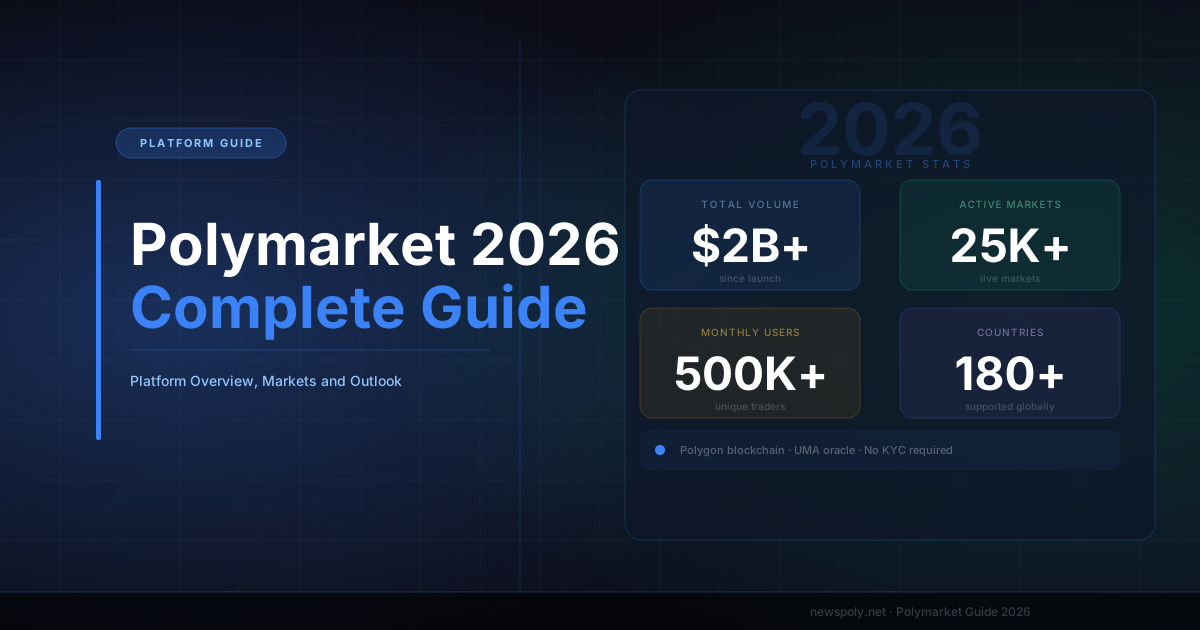
Polymarket in 2026 is bigger, more liquid, and more competitive than ever - here is everything you need to know right now. Whether you are a first-time bettor trying to understand prediction markets or a seasoned trader looking for fresh edge, this hub guide covers the full picture: platform growth, new features, the hottest markets, fees, strategies, and what comes next. Bookmark this page - we update it as Polymarket evolves throughout the year.
Polymarket's Growth Story: Where It Stands in 2026
Polymarket launched in 2020 as a niche crypto side project. By 2024 it had become the undisputed leader in prediction markets, processing over $1 billion in trading volume during the US presidential election cycle alone. In 2026 that momentum has only accelerated.
Key milestones heading into 2026:
- Total cumulative volume: Over $2 billion resolved across all markets since inception
- Monthly active traders: Hundreds of thousands of unique wallets interacting with the platform each month
- Open markets at any one time: Typically 800-1,200 live markets spanning politics, economics, crypto, sports, and science
- Liquidity depth: Major political and economic markets now regularly carry six-figure order books, making large-position entries practical for serious traders
- Regulatory clarity: Following the CFTC's evolving stance on decentralized prediction markets, Polymarket continues operating under its current structure while watching US regulatory developments closely
The platform's dominance is no accident. By settling all contracts in USDC and using decentralized infrastructure, Polymarket offers something centralized competitors cannot easily replicate: transparent, immutable, on-chain resolution. Learn exactly how Polymarket works if you are new to the model.
For an in-depth evaluation of the platform's strengths and weaknesses, see our full Polymarket review.
Key Platform Changes in 2025-2026
Polymarket has not stood still. The product has improved substantially over the past 12 months in several important areas.
Interface and Usability
The trading UI received a significant overhaul in late 2025. Position management is cleaner, the order book view is more intuitive, and the mobile experience - while still primarily a browser-based product - is substantially smoother. Portfolio analytics now show unrealized PnL, position sizing as a percentage of bankroll, and historical win rate per category.
New Market Categories
Polymarket has expanded beyond its politics-heavy roots. In 2025-2026 you will find active markets in:
- Federal Reserve interest rate decisions and economic indicators
- AI capability milestones (will GPT-5 pass a specific benchmark, will AI win a major scientific prize)
- Crypto regulatory decisions (ETF approvals, exchange enforcement actions)
- Geopolitical events (conflict resolution, election outcomes across 30+ countries)
- Sports (major championship winners, individual award markets)
- Science and technology (FDA approvals, space mission outcomes)
UMA Oracle Updates
Polymarket uses UMA's optimistic oracle for market resolution. In 2025, UMA upgraded its dispute resolution process to reduce resolution time on clear-cut markets and introduced a more structured escalation path for contested resolutions. This has meaningfully reduced "bad resolution" risk - one of the platform's historical pain points.
Regulatory Developments
The regulatory picture for prediction markets in the US remains fluid. Kalshi's legal victory against the CFTC in late 2024 opened the door for regulated event contracts. Polymarket, operating as a decentralized protocol, watches these developments carefully. For now, US users continue to face geographic restrictions, though enforcement has not escalated.
The Biggest Markets to Watch in 2026
2026 is a landmark year for Polymarket traders. Several high-stakes, high-liquidity event clusters are converging at once.
US Midterm Elections
The 2026 US midterm elections are shaping up to be the largest prediction market event since the 2024 presidential race. Congressional seat markets, gubernatorial races across key swing states, and House/Senate majority markets are already accumulating liquidity months ahead of election day. These markets historically offer the best price discovery and the tightest spreads on the platform.
AI Capability Milestones
Markets on artificial intelligence milestones have exploded in 2025-2026. Will a specific AI model achieve a defined benchmark score? Will AI win a Nobel Prize? Will autonomous AI agents execute a complex multi-step task without human intervention by year-end? These markets attract both traders with genuine domain knowledge and speculators - creating persistent mispricings for the informed.
Federal Reserve Rate Cycles
Macro traders have discovered that Fed rate decision markets on Polymarket often price differently from Fed Funds futures, creating arbitrage-adjacent opportunities. Markets on "Will the Fed cut rates by 25bps at the June 2026 meeting?" routinely carry millions in open interest in the weeks before each FOMC decision.
Crypto ETF and Regulatory Decisions
Following the Bitcoin and Ethereum ETF approvals, attention has shifted to altcoin ETF filings, crypto exchange licensing decisions, and stablecoin regulation. These markets often resolve on hard deadlines (SEC decision windows), making timing analysis straightforward.
Geopolitical Flashpoints
Active conflict zones, peace negotiation timelines, and election outcomes across Europe, Asia, and Latin America all have liquid markets in 2026. Traders with regional knowledge or access to non-English news sources hold a structural edge in these categories. See our Polymarket election markets guide for tactics on political trading.
How to Get Started on Polymarket in 2026
Getting started is faster than ever. Here is the condensed version:
- Create a wallet: Polymarket works with any EVM-compatible wallet. MetaMask, Coinbase Wallet, and Magic Link (email-based) are the most common entry points.
- Fund with USDC: All positions are denominated in USDC on the Polygon network. You can bridge from other chains or purchase USDC directly through on-ramp partners inside the app. Our Polymarket USDC guide covers every funding path in detail.
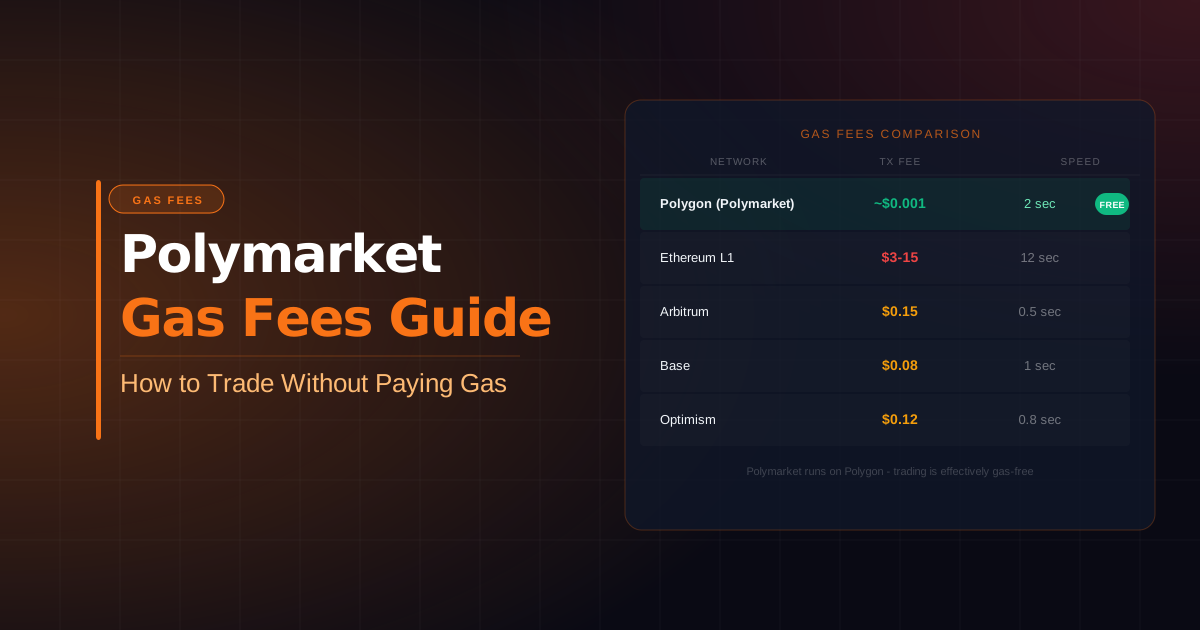
- Place your first trade: Browse markets, click YES or NO, enter your stake, and confirm the transaction. Gas fees on Polygon are negligible (fractions of a cent).
- Manage your positions: Your portfolio page shows all open positions, unrealized PnL, and resolved market history.
- Withdraw anytime: Winnings (and unused funds) can be withdrawn to your wallet at any time - no lock-up periods.
For a more detailed walkthrough, see our Polymarket beginner guide. For a deep dive into platform safety and custody risk, read is Polymarket safe?
Polymarket 2026 Quick Facts
| Feature | Detail |
|---|---|
| Founded | 2020, New York |
| Total Cumulative Volume | $2B+ (all-time through early 2026) |
| Registered Users | 1M+ registered wallets |
| Supported Countries | Global (US residents restricted) |
| Minimum Deposit | No official minimum (practical: $10+) |
| Trading Fee | 2% on winnings (no fee on losses) |
| Supported Assets | USDC (Polygon network) |
| Resolution Mechanism | UMA Optimistic Oracle (on-chain) |
| Mobile App | Mobile-optimized web app (no native app) |
| Copy Trading | Via PolyCopyTrade (third-party) |
Polymarket Fees and Rewards in 2026
Polymarket's fee structure is elegantly simple - and significantly better than most alternatives. Here is a full breakdown.
The Core Fee: 2% on Winnings
Polymarket charges a 2% fee on profits only. If you bet $100 on YES at 60 cents and it resolves YES, your $166.67 payout is reduced by 2% of the $66.67 profit - a fee of about $1.33. Losing trades incur zero fees. This structure is radically more trader-friendly than the 5-10% takes charged by traditional sportsbooks.
For a complete breakdown of all cost considerations including gas, spread, and market maker pricing, read our Polymarket fees guide.
Liquidity Provider Rewards
Polymarket operates an automated market maker (AMM) system on many markets. Providing liquidity earns a share of trading fees proportional to your LP contribution. For high-volume markets, this can be a meaningful yield source - though it carries directional risk if the market moves against your liquidity position.
USDC Yield Potential
Idle USDC sitting in your Polymarket portfolio does not earn yield by default. However, since Polymarket is non-custodial, you can keep funds in a yield-bearing USDC protocol (like Aave on Polygon) and only bridge what you need for active positions. Sophisticated traders treat this as standard practice.
Referral and Loyalty Programs
Polymarket periodically runs referral and trading incentive programs. These are announced via the official Discord and Twitter channels. Check those channels for current promotions - they can meaningfully offset fees for active traders.
Trading Strategies That Work in 2026
The Polymarket opportunity set in 2026 is rich - but so is the competition. Casual bettors are increasingly sharing the order book with quantitative traders and well-resourced research teams. Here are the approaches that continue to generate edge.
Information Arbitrage
Polymarket prices move on publicly available information, but not all information is equally accessible. Traders who monitor non-English news sources, niche policy newsletters, or real-time data feeds (court dockets, economic releases, regulatory filings) consistently find markets that lag the true probability by several percentage points.
Late-Resolution Trading
Markets that are "almost certainly" resolved but not yet officially closed often misprice. A market at 98 cents with 48 hours to go until official resolution represents a 2% return with minimal risk - compounding this across many markets annually produces strong risk-adjusted returns.
Calibration Analysis
Maintain a spreadsheet of your past trades. Traders who track their calibration (how often their 70% confident positions actually win) identify systematic biases - overconfidence in specific categories, underweighting of tail risks - and correct them. This alone separates long-term profitable traders from recreational bettors.
Copy Trading
If you do not have the time to research every market, copying skilled traders is a legitimate, proven approach. See our guide on Polymarket copy trading and automation setup for a technical walkthrough of how to implement this.
Polymarket vs Competitors in 2026
Polymarket is not the only game in town. Here is how it compares to the main alternatives:
| Criterion | Polymarket | Kalshi | PredictIt | Manifold |
|---|---|---|---|---|
| Liquidity | Excellent | Good | Moderate | Low |
| Fee Structure | 2% on wins | Spread-based | 10% + 5% | Play money |
| US Access | Restricted | Legal (CFTC) | Restricted | Yes |
| Market Variety | Excellent | Good | Limited (politics) | Excellent |
| Decentralized | Yes | No | No | Partially |
Polymarket wins on liquidity and fee efficiency for non-US traders. Kalshi is the clear choice for US residents seeking regulated access. PredictIt's high fees make it uncompetitive for active traders. Manifold remains useful for practice and niche market creation but uses play money by default.
The Polymarket Airdrop Question
One of the most searched topics about Polymarket in 2026 remains the POLY token question. Will Polymarket launch a governance token? Will early users receive an airdrop?
As of March 2026, Polymarket has not announced a native token. However, the speculation is not baseless. The platform's decentralized architecture, its demonstrated ability to attract millions in trading volume, and the precedent set by other DeFi protocols all point to a token launch being a genuine possibility over the next 12-24 months.
The calculus for "airdrop farming" (maximizing trading activity in hopes of qualifying for a future distribution) is straightforward: you are trading on real markets with real money, and any airdrop would be a bonus rather than the primary return. High-volume, diverse trading activity across multiple market categories is the typical qualification profile for DeFi airdrops.
For full analysis of the speculation, eligibility theories, and what to actually do about it, read our dedicated Polymarket airdrop guide.
Frequently Asked Questions
Is Polymarket legal to use in 2026?
Polymarket operates as a decentralized protocol, and its legality depends on your jurisdiction. US residents face geographic restrictions and are advised not to use the platform. For most of the rest of the world, there are no specific prohibitions, though the regulatory landscape continues to evolve. Always check your local laws before depositing.
How much money do I need to start trading on Polymarket in 2026?
There is no official minimum deposit. In practice, most traders start with $50-$200 to have enough to spread across multiple positions without transaction costs becoming a significant drag. Serious traders typically operate with $1,000+ to take meaningful positions in liquid markets.
What are the biggest changes on Polymarket in 2026 compared to previous years?
The most significant changes are: substantially improved UI and portfolio analytics, a much broader range of non-political market categories (especially AI and macro), deeper liquidity in top markets, and UMA oracle improvements that have reduced resolution disputes. The fundamental model - USDC, Polygon, decentralized resolution - remains unchanged.
Can I make consistent profit trading on Polymarket in 2026?
Yes, but it requires edge. Casual bettors face a negative expected value due to the 2% fee and competition from sophisticated traders. Consistent profitability comes from information advantages, disciplined bankroll management, and systematic calibration tracking. Copy trading proven traders via tools like PolyCopyTrade is a legitimate approach for those without the time to research markets independently.
Does Polymarket have a POLY token or plan to launch one?
As of March 2026, Polymarket has no native token. Speculation about a future POLY governance token persists given the platform's DeFi architecture, but there has been no official announcement. See our airdrop guide for the full breakdown of what is known and what remains speculation.