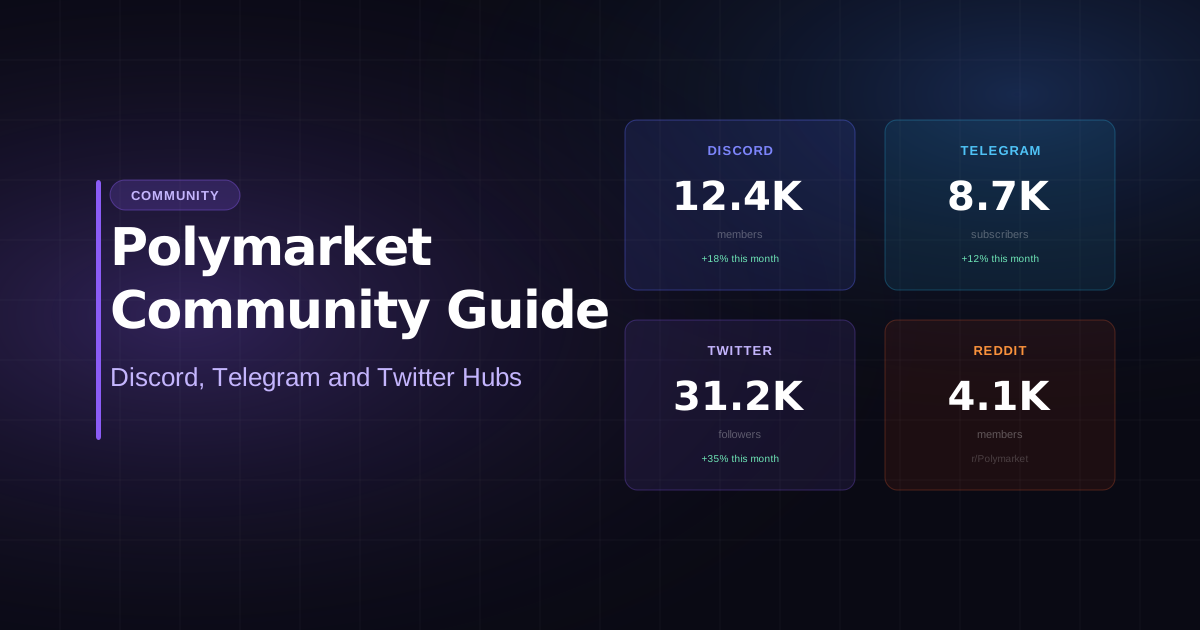
Prediction markets are fundamentally social. The price on any Polymarket contract reflects the collective judgment of thousands of traders — and behind every sharp move is a community of analysts, degens, and information hounds sharing signals in real time. If you’re only watching the markets themselves, you’re missing half the picture. This guide maps every corner of the Polymarket community so you know exactly where the conversation is happening and how to plug in.
The Polymarket Discord: The Official Hub
The official Polymarket Discord server is the closest thing the platform has to a home base for its community. With tens of thousands of members, it’s active around the clock and covers everything from platform announcements to in-depth market debates.
Key channels to bookmark when you join:
- #announcements — Official platform updates, new market launches, and policy changes. Always worth monitoring so you catch major news before it affects prices.
- #general — High-volume general chat. Noisy, but useful for gauging real-time sentiment on breaking events.
- #market-discussion — The most analytically useful channel. Traders share theses, post conflicting sources, and debate probabilities. This is where genuine edge surfaces.
- #whale-watch — Community members flag unusually large positions. Pairs well with the formal techniques covered in our Polymarket whale tracking guide.
- #off-topic — Lighter conversation. Good for building relationships with traders you want to follow more closely.
Discord etiquette matters. Engage substantively rather than just asking for tips. Traders who share their reasoning publicly tend to attract thoughtful pushback, which sharpens everyone’s thinking — including yours. If you’re brand new to the platform, our Polymarket beginner guide covers the fundamentals you’ll want before diving into community debate.
Twitter/X: Real-Time Signal Flow
Twitter (now X) is arguably the fastest signal source in the Polymarket ecosystem. Breaking news hits the platform before it registers anywhere else, and a tight following list of the right accounts can give you a meaningful information edge.
Types of accounts worth following
- @Polymarket (official) — New market announcements, resolution updates, and platform news. Follow it, but don’t expect raw trading alpha here.
- High-volume Polymarket traders — Many of the platform’s most profitable traders are publicly identifiable and post their reasoning openly. Search for accounts that regularly share Polymarket portfolio screenshots alongside written analysis.
- Prediction market analysts — Manifold community members, Metaculus forecasters, and quantitative analysts who operate across multiple platforms. Their calibration work often surfaces on Twitter before anywhere else.
- Vertical domain experts — If you trade political markets, follow election analysts. If you trade sports, follow sharp bettors. Domain expertise translates directly into prediction market edge, and many of these accounts share it freely.
- Primary news sources — Official government accounts, central bank feeds, major wire services. Speed matters; following primary sources cuts out the intermediary delay.
Build a dedicated Twitter list of your highest-signal follows and check that list before anything else when a market is moving. The cognitive discipline of separating signal from noise is itself an edge — something explored in depth in our piece on cognitive biases in prediction market trading.
Twitter search as a research tool
Beyond your following list, Twitter’s search function is underused by most traders. Searching “Polymarket [topic]” or “prediction market [event]” during a live development surfaces takes and data points that never make it into your feed. Set up saved searches for the market categories you trade most frequently.
Reddit: Slower Tempo, Deeper Threads
Reddit operates on a different cadence than Discord or Twitter — longer posts, more structured arguments, and a culture that rewards cited analysis over hot takes. For traders who want depth over speed, several subreddits are consistently worth reading.
| Subreddit | Primary Focus | Best Used For |
|---|---|---|
| r/Polymarket | Platform-specific discussion | Market analysis, platform questions, trader introductions |
| r/PredictionMarkets | Broader prediction market ecosystem | Cross-platform strategy and academic research links |
| r/Forecasting | Probabilistic thinking and calibration | Improving base-rate reasoning and forecasting models |
| r/RealWorldAssets | On-chain finance and crypto infrastructure | Understanding Polymarket’s USDC and Polygon underpinning |
| r/sportsbook | Sharp sports betting community | Line movement analysis applicable to sports prediction markets |
The quality floor on Reddit is higher than Discord simply because posts are semi-permanent and searchable. Before entering an unfamiliar market category, spending 20 minutes searching that topic across these subreddits is almost always worthwhile. Someone has almost certainly wrestled with the same forecasting question before you.
Telegram Groups: The Fast-Moving Inner Circle
Telegram groups occupy the space between Discord’s structured community and a private group chat. The most valuable Polymarket-adjacent Telegram channels tend to be smaller and more curated than Discord, which means the signal-to-noise ratio can be significantly higher — if you find the right ones.
What to look for when evaluating a Telegram group:
- Active moderation — Groups that allow unchecked spam quickly become useless. Look for communities where off-topic posts are removed and recurring contributors are identifiable by reputation.
- Transparent track records — The most credible Telegram channels show their calls over time, including losses. Anyone only posting winners is cherry-picking.
- Domain specificity — A Telegram group focused entirely on US political markets will produce sharper analysis than a general-purpose crypto group that occasionally discusses Polymarket.
- Primary source sharing — Groups that habitually link original data — polling crosstabs, court documents, legislative calendars — rather than just opinions are disproportionately worth your time.
Exercise caution in any Telegram community where members are promoting specific positions aggressively. Coordinated price pressure on low-liquidity Polymarket contracts does occur. Treat sudden enthusiasm for an obscure market with appropriate skepticism until you can verify the underlying rationale independently.
How Community Insights Sharpen Your Trading Decisions
Having access to community chatter is only valuable if you use it intelligently. Raw social signal is noisy, biased, and frequently wrong. The traders who benefit most from communities aren’t the ones who follow the crowd — they’re the ones who extract structured information from unstructured conversation.
Valuable signals you can pull from communities
Primary source leads. Communities surface links to raw data before that data gets synthesized into mainstream takes. A court filing, an obscure statistical release, a leaked document — these often appear in Discord or Twitter before any analyst has processed them. Being able to read primary sources quickly is a core skill covered in our top Polymarket trading strategies overview.
Consensus calibration. When a community strongly agrees on a probability, that consensus is itself informative — but not always in the direction you’d expect. Extreme community consensus can signal that a market is efficiently priced, but it can equally signal narrative-driven groupthink. Learning to distinguish the two is one of the higher-order skills in prediction market trading.
Whale activity alerts. Community members watching on-chain data often flag large position changes before they show up in any aggregator. Being in the right channel can give you minutes of advance notice — which is material in a fast-moving market.
Resolution risk flags. Communities are often quicker than official channels to surface potential resolution disputes, ambiguous contract language, or conflicting sources that could affect how a market settles. This is especially valuable in political and legal markets where resolution criteria can be genuinely contested.
Community pitfalls to avoid
- Recency bias amplification — Communities tend to overweight the most recent dramatic event. If a candidate just had a bad debate, the crowd will price in more bad debates than the base rate justifies. Our cognitive biases guide goes deep on this pattern.
- In-group confirmation loops — If everyone in your Discord agrees that a certain outcome is likely, you may be in an echo chamber rather than a well-calibrated forecasting community. Actively seek out the best opposing argument before you trade.
- Shill detection failure — Bad actors participate in prediction market communities to move prices. Develop a personal framework for evaluating new voices: track record, skin in the game, quality of reasoning. Enthusiasm without evidence is a red flag.
Using PolyCopyTrade to Act on Community Alpha
There’s a significant gap between identifying good traders in the community and systematically profiting from their insight. Even if you’ve built a strong network across Discord, Twitter, Reddit, and Telegram, manually tracking and replicating positions is time-consuming, emotionally taxing, and prone to execution errors. You see a position discussed at 11 PM, you mean to act on it, and by the time markets open your edge has evaporated.
This is exactly the problem PolyCopyTrade solves. The platform lets you:
- Identify top performers by historical return, calibration score, and market category. The community surfaces names — PolyCopyTrade surfaces the verified data behind those names.
- Automate position mirroring so you never miss an entry because you were offline when the community was reacting to a breaking development.
- Scale proportionally to your bankroll, so position sizing happens automatically rather than requiring manual calculation across dozens of markets.
- Diversify across multiple traders rather than concentrating on any single voice, which reduces your exposure to any one person’s bad week.
Traders building toward consistent, research-driven returns should also read our piece on full-time Polymarket trading, which covers how serious traders structure their entire process across research, execution, and review cycles.
The Polymarket community is one of the most information-rich environments in online finance. The traders winning consistently are the ones who engage with it systematically: pulling signal from every platform, filtering ruthlessly, and then executing with discipline. PolyCopyTrade adds the execution layer that most community participants are missing — turning your research and network-building into an automated, repeatable edge.