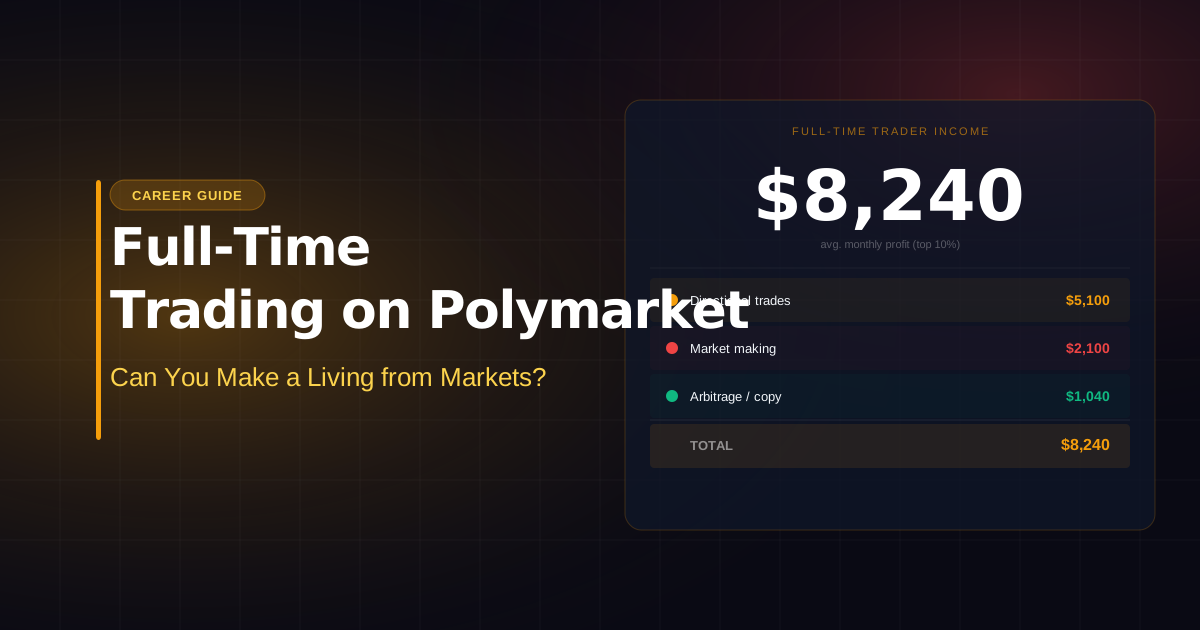
The Honest Answer: Yes — But the Bar Is Higher Than You Think
Some Polymarket traders do earn a full-time income from prediction markets. That part is true. The verified on-chain data shows a small cohort of traders generating consistent, substantial returns month after month. What that data also shows — and what most "quit your job and trade full time" content conveniently omits — is how thin that group is, how much capital it requires, and how brutally the math compounds against you once you factor in variance, tax, and living costs.
This guide does not sugarcoat it. If you are genuinely considering trading Polymarket full time, you need three things working in your favour simultaneously: a proven edge, sufficient bankroll, and the financial runway to survive losing streaks without making desperate decisions. Most people who attempt it are missing at least one of the three.
What "Full Time" Actually Requires
Trading full time means your Polymarket profits must reliably cover your living costs, month after month, net of tax, with enough buffer to absorb the inevitable losing months. That breaks down into three non-negotiable components:
- Consistent edge: A positive expected value on your trades, demonstrated over a large enough sample (hundreds of resolved markets) to separate skill from luck. See our Polymarket expected value guide for how to calculate and verify your edge.
- Sufficient bankroll: Enough deployed capital that your edge, at realistic monthly ROI, produces the income you need after tax. At 5% monthly ROI on $50,000, you gross $2,500 — before tax, before fees, before bad months.
- Income target maths: Your target monthly income divided by your net post-tax ROI rate equals the minimum bankroll required. If you need $3,000/month net and your realistic post-tax ROI is 3.5%, you need $85,714 deployed. Most people do not have that.
Income Maths: What Each Bankroll Actually Produces
The table below shows gross monthly income and approximate post-tax income (assuming 30% effective tax rate) at three ROI levels across four bankroll sizes. ROI is applied to total bankroll, not just deployed capital.
| Bankroll | 2% Monthly ROI | 5% Monthly ROI | 10% Monthly ROI |
|---|---|---|---|
| $10,000 | $200 gross / $140 net | $500 gross / $350 net | $1,000 gross / $700 net |
| $25,000 | $500 gross / $350 net | $1,250 gross / $875 net | $2,500 gross / $1,750 net |
| $50,000 | $1,000 gross / $700 net | $2,500 gross / $1,750 net | $5,000 gross / $3,500 net |
| $100,000 | $2,000 gross / $1,400 net | $5,000 gross / $3,500 net | $10,000 gross / $7,000 net |
Read across any row and the pattern is clear: at bankrolls below $50,000, even elite-level monthly ROI does not produce a liveable income in most Western cities. At $10,000, hitting 10% monthly — a performance level achieved by a tiny fraction of all Polymarket traders — nets you $700. That is not a living; that is a side hustle.
What Realistic ROI Actually Looks Like
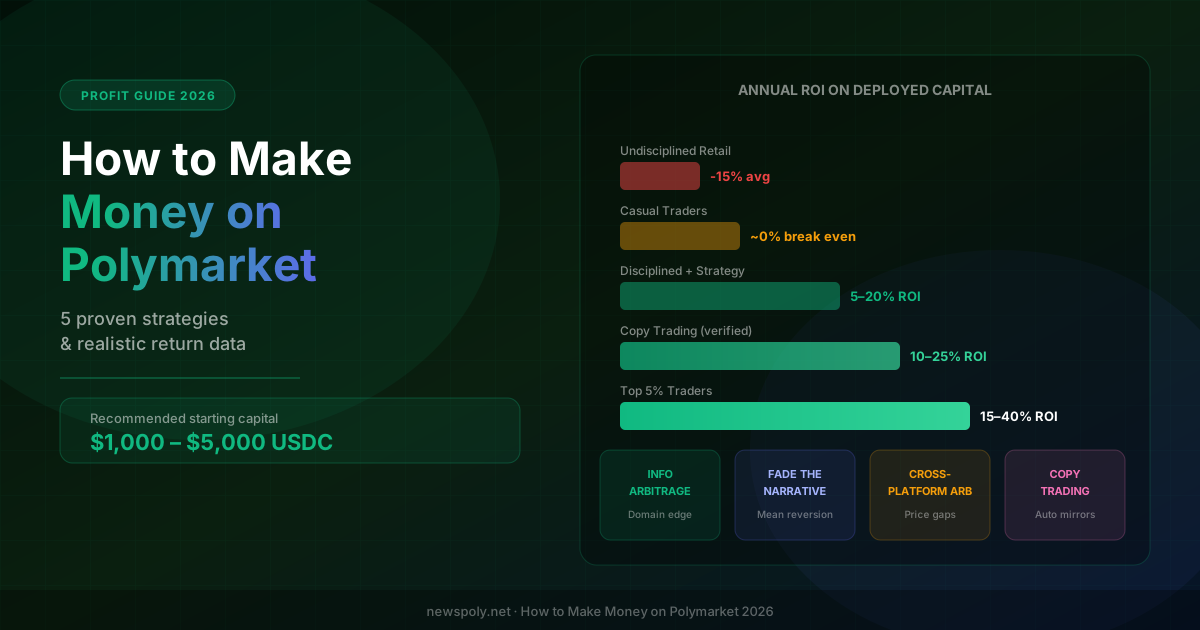
The numbers traders quote on social media are almost always survivorship-biased, cherry-picked from best months, or calculated on a tiny deployed capital base. Here is what the on-chain data suggests across trader cohorts:
- Casual traders (most people): 0–2% monthly ROI, often negative after accounting for opportunity cost. Breaking even after fees is a genuine achievement for this group.
- Disciplined traders with a real edge: 3–8% monthly ROI over meaningful sample sizes. This requires consistent research, good bankroll sizing via Kelly Criterion, and strict risk management.
- Top-tier traders (top 5%): 10–20%+ monthly ROI. These are people with genuine domain expertise, large networks, proprietary research processes, or automated systems. This performance level is rare and tends to compress as their own trading moves markets.
If you are reading this article to decide whether to go full time, the honest question to ask yourself is: which cohort am I actually in? Not which cohort you aspire to be in — which cohort does your last 12 months of verified performance place you in?
Capital Requirements by Income Target
Working backwards from a target income is more useful than working forwards from a bankroll. Here is the minimum bankroll required for common income targets at two realistic ROI levels — the 5% figure for skilled traders and the 8% figure for high performers — both post-tax at 30%:
- $2,000/month net: $57,143 at 5% net ROI (post-tax) — or $35,714 at 8% net ROI
- $3,000/month net: $85,714 at 5% net ROI — or $53,571 at 8% net ROI
- $4,000/month net: $114,286 at 5% net ROI — or $71,429 at 8% net ROI
- $5,000/month net: $142,857 at 5% net ROI — or $89,286 at 8% net ROI
Most people who want to trade Polymarket full time do not have $85,000–$143,000 in liquid capital to deploy. That is not a reason not to try — it is a reason to build towards it carefully rather than quit a salary prematurely.
The Variance Problem: Even Good Traders Have Losing Months
The income projections above assume average monthly performance. Real trading does not work that way. A trader with a true 5% monthly edge will have months at −8%, months at +18%, and everything in between. The critical question is whether you have the runway to survive a cold streak without blowing up or panic-trading.
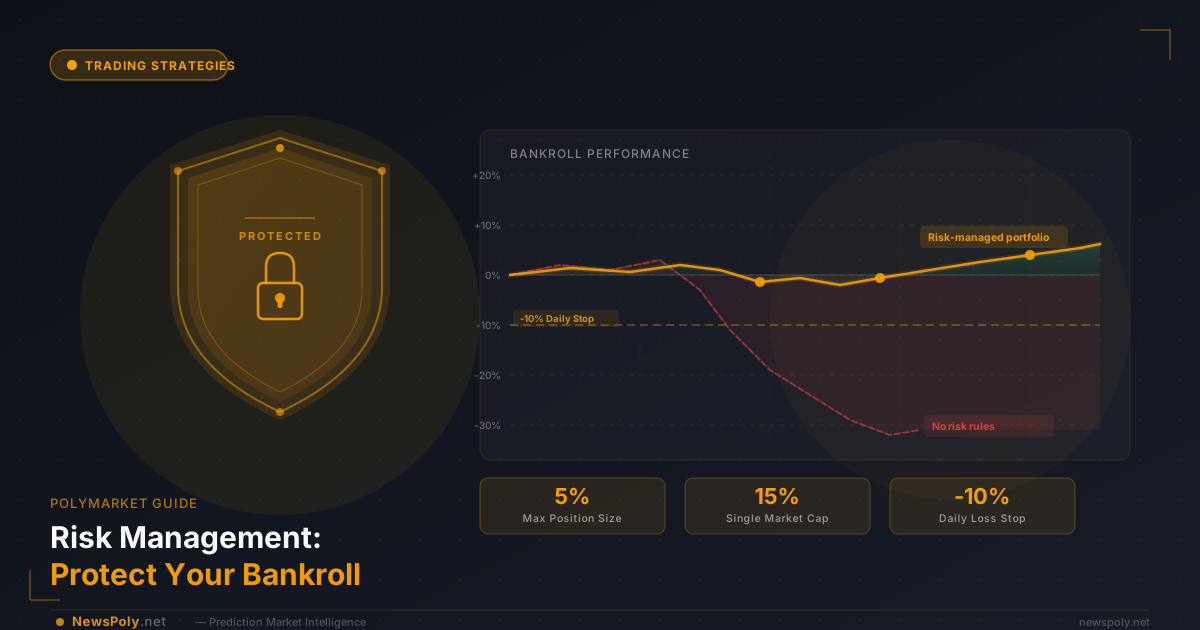
Standard risk management practice for full-time traders requires a cash reserve of at least 6 months of living costs held outside your trading bankroll. This is not part of your trading capital — it is pure emergency runway. If your monthly costs are $3,000, you need $18,000 sitting in a savings account before you even consider going full time, separate from your trading bankroll. Our Polymarket risk management guide covers drawdown limits and reserve requirements in detail.
Additionally, use appropriate position sizing. Bet too large per market relative to bankroll and a single bad run can wipe you out before the law of large numbers rescues you. The Kelly Criterion provides a mathematical framework for sizing positions in a way that maximises long-run growth while limiting ruin risk.
Tax Drag: The Number Most People Forget
Prediction market profits are taxable in most jurisdictions. In the United States, short-term trading gains are taxed as ordinary income — up to 37% at federal level, plus state taxes. UK traders face capital gains tax or income tax depending on trading frequency. Effective tax rates of 20–45% on profits are typical for active traders in the US and UK.
This has a compounding effect on your effective ROI. A 5% monthly gross ROI becomes 3.5% post-tax at a 30% rate, or 2.75% post-tax at a 45% rate. That changes the minimum bankroll required for a given income target by 50–80%. Read our Polymarket tax guide for a full breakdown of how to structure and calculate your tax obligations as a prediction market trader.
Quarterly estimated tax payments are also a cash flow consideration. If you are pulling $3,500/month net from trading, you will owe tax quarterly — which means you cannot spend all $3,500 each month without building a tax liability that catches up with you.
Time Requirements: Is It Actually "Passive"?
Full-time trading on Polymarket is not passive. Casual observers see trades being placed and assume the hard work is the clicking. The actual time cost is in research. A skilled political markets trader might spend 3–5 hours per day reading news, polling data, primary sources, and analyst reports before placing a single position. A crypto markets specialist is monitoring on-chain flows, exchange order books, and macro data continuously.
Order management adds further overhead: monitoring open positions, setting and adjusting limit orders, watching for resolution disputes, managing wallet balances. A realistic estimate for a serious full-time Polymarket trader is 6–8 hours of active work per day — comparable to a professional job, without the employment protections, benefits, or guaranteed income.
If you want Polymarket exposure with genuine semi-passive characteristics, the copy trading model is structurally better suited. Automating position mirroring from verified top traders via PolyCopyTrade eliminates most of the research and monitoring burden. You still need to configure the system and monitor overall performance, but the time requirement drops from hours per day to minutes. Read our Polymarket copy trading guide for a full comparison of the two approaches.
When to Consider Going Full Time: Track Record Criteria
If you are serious about making the transition, here are the minimum criteria that professional traders typically use before going full time. These are not guarantees of success — they are evidence that you have a real edge worth betting a career on:
- 12+ months of verified performance: At least one full year of on-chain trading history with positive net returns. This is long enough to include multiple market regimes and test your edge under different conditions.
- Sharpe ratio above 1.0: Risk-adjusted returns that justify the volatility. A Sharpe below 1.0 means your returns do not adequately compensate for the swings you are taking.
- Maximum drawdown under 30%: Your worst peak-to-trough loss should be manageable enough that you could recover from it without destroying your bankroll or your psychology. Use our Polymarket portfolio management guide to track your drawdown metrics systematically.
- Sufficient bankroll already in place: Based on the income target maths above, you should have the capital deployed to hit your income target before quitting — not after, hoping it will grow to the required level.
- 6-month cash reserve separate from bankroll: As discussed above, this is non-negotiable.
Meeting all five criteria does not mean you should definitely go full time — it means you have the minimum evidence that makes the decision rational rather than speculative.
The Semi-Passive Alternative: Copy Trading on PolyCopyTrade
For most people, the most rational path to meaningful Polymarket income is not going full time — it is semi-passively compounding returns via copy trading while maintaining a primary income source. This approach lets you:
- Keep your salary (and its compounding benefits: pension, healthcare, career progression)
- Allocate a portion of savings to Polymarket via automated copy trading
- Build your bankroll faster than if you were relying on trading income to cover living costs
- Develop genuine trading skills by studying what the top traders you are copying actually do
PolyCopyTrade ranks Polymarket traders by verified on-chain performance metrics — ROI, Sharpe ratio, drawdown, win rate — and automatically mirrors their positions to your connected wallet. You can diversify across multiple traders simultaneously, set per-trade position limits, and configure risk parameters to match your bankroll size. It is the most capital-efficient way to access skilled Polymarket trading without the full-time time commitment.
Risk Factors to Understand Before You Quit
Beyond the personal finance maths, full-time Polymarket trading carries structural risks that a salary does not:
- Platform risk: Polymarket is a crypto-based platform subject to smart contract risk, regulatory action, and operational risk. A platform outage or forced withdrawal event during a critical holding period could be catastrophic for a full-time trader with no other income.
- Regulatory changes: Prediction markets face an evolving regulatory environment in the US and EU. A significant regulatory intervention could restrict your ability to trade or withdraw funds.
- Market efficiency increasing over time: Polymarket is getting more liquid and more efficient as it grows. The edges that exist today — particularly in thin, niche markets — may compress or disappear as more capital and more sophisticated players enter. A trader going full time in 2026 faces a different competitive landscape than one who started in 2022.
- Concentration risk: Unlike a diversified investment portfolio, your full-time trading income depends entirely on one platform, one asset class (prediction markets), and your own skill. Any of those three failing simultaneously produces a catastrophic outcome.
Frequently Asked Questions
How much do top Polymarket traders make?
Top Polymarket traders — the top 1–5% by verified on-chain performance — typically generate 10–20%+ monthly ROI on deployed capital. On a $100,000 bankroll, that translates to $10,000–$20,000 gross per month before tax. A handful of elite traders with very large bankrolls are likely earning six figures annually from Polymarket alone. However, this performance level requires genuine domain expertise, large research time investment, or proprietary analytical advantages. It is not replicable for most traders.
Can you automate Polymarket trading?
Yes. Polymarket exposes on-chain data and the CLOB (Central Limit Order Book) API, which allows programmatic trading. Some sophisticated traders run algorithmic systems that monitor markets and execute trades automatically. However, building and maintaining a profitable trading algorithm is extremely difficult — most retail traders who attempt it underperform manual trading. The more accessible automation option is copy trading: using a service like PolyCopyTrade to automatically mirror verified top traders. This captures the benefits of automation without requiring you to build or maintain a proprietary algorithm.
What is the minimum bankroll to start full-time Polymarket trading?
Based on realistic ROI expectations, you need a minimum of $85,000–$143,000 deployed in trading capital to generate a modest living income ($3,000–$5,000/month net of tax) at achievable performance levels. This is on top of a 6-month cash reserve held separately. For most traders, starting with a smaller bankroll and scaling through reinvested profits while maintaining other income is the more rational path.
Is Polymarket trading a viable career long term?
It is viable for a small number of elite traders, but the structural risks are significant: platform concentration, regulatory uncertainty, and increasing market efficiency over time. The traders most likely to sustain it long term are those with diversified prediction market exposure (trading on multiple platforms), genuine domain expertise that compounds over time, and robust risk management. Treating Polymarket as one income stream among several — rather than your sole income source — is structurally more resilient.
How do I know if I have a real edge on Polymarket?
A real edge shows up in your expected value calculation over a large sample of resolved markets. Use our EV guide to work out whether your historical returns reflect skill or luck. As a rough rule of thumb: 100+ resolved markets with consistent positive returns across multiple market categories — not just one domain you happened to call correctly — is the minimum evidence base. Anything less is too small a sample to distinguish skill from variance.