Every trade you place on Polymarket ends the same way: a resolution. Someone — or more precisely, something — has to decide whether the outcome was “Yes” or “No” and distribute the winnings accordingly. Understanding how that process works is not optional knowledge for serious traders. Resolution surprises are one of the leading causes of unexpected losses on the platform, and most of them are entirely avoidable if you know what to look for before you enter a position.
What Resolution Means on Polymarket
On Polymarket, every market is a binary question with a defined expiry date. Before that date, shares trade between 0 and $1 USDC, with the price reflecting the crowd’s implied probability of “Yes.” At expiry, the market resolves: “Yes” shares pay out $1 each and “No” shares pay out $0, or vice versa. There is no partial resolution — every market produces one outcome, and the USDC flows to the winning side.
This binary structure is what makes Polymarket fundamentally different from a stock exchange. You are not betting on a price movement; you are betting on a specific, verifiable real-world outcome. The resolution machinery exists to bridge the gap between what happens in the real world and what the smart contract pays out. If you’re new to how the platform works overall, the Polymarket beginner guide covers the full trading lifecycle from deposit to payout.
Resolution is also the point where all the USDC that was locked in the market gets redistributed. Understanding this mechanic matters for your bankroll — positions are illiquid from the perspective of their locked collateral until resolution completes. Our Polymarket USDC guide explains how the stablecoin mechanics interact with your trading account at every stage.
The UMA Oracle Settlement Process
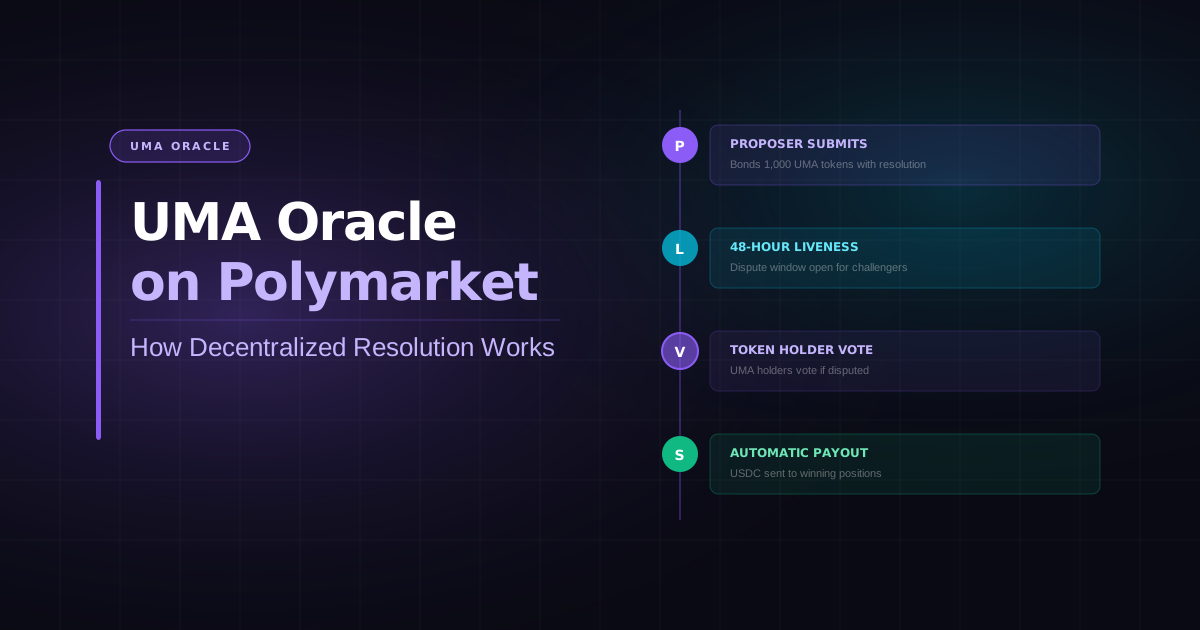
Polymarket does not have a centralised team manually deciding outcomes. Resolution is handled by the UMA Optimistic Oracle, a decentralised dispute resolution protocol built on Ethereum. This is the engine behind every market settlement on the platform.
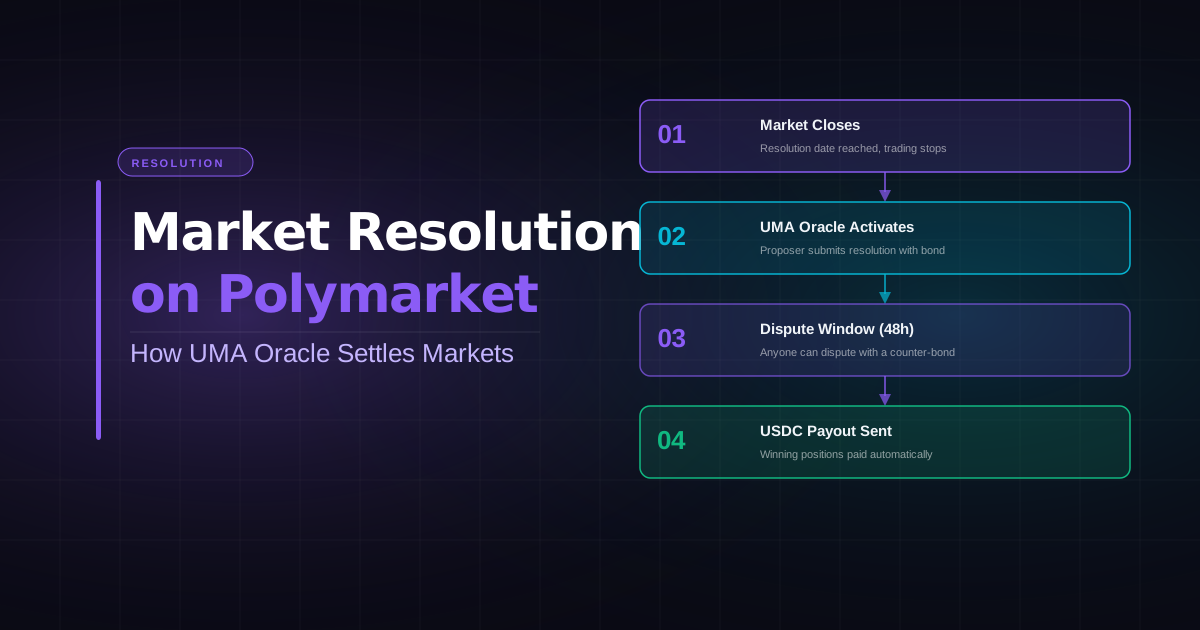
The UMA oracle operates on an “optimistic” model: it assumes proposed answers are correct unless someone challenges them. This keeps costs low and resolution fast in the vast majority of cases, where outcomes are unambiguous. Here is how the process unfolds step by step:
- Market expires: Once the resolution date passes, anyone can submit a proposed outcome to the UMA oracle.
- Challenge window opens: A two-hour window begins during which UMA token holders can dispute the proposed resolution by posting a bond.
- No dispute → settlement: If no dispute is raised in two hours, the proposed outcome is accepted as final and the smart contract distributes USDC to winning shareholders.
- Dispute raised → escalation: If a dispute is filed, the question goes to the UMA DVM (Data Verification Mechanism), where token holders vote on the correct outcome. This process takes longer — typically several days.
For a deep dive into the oracle’s technical architecture and how UMA tokenomics incentivise honest reporting, see our dedicated Polymarket UMA oracle guide.
Resolution Criteria and Market Rules
Each Polymarket market has a resolution source and a set of rules written at creation. These rules define precisely what evidence the oracle will use to determine the outcome. The rules are not always as simple as they look from the market title.
Common resolution rule structures include:
- Single authoritative source: The market resolves based on a specific publication (e.g., the Associated Press, an official government body, a specific data provider). If that source doesn’t publish within the resolution window, the market may resolve “No” by default.
- Threshold-based rules: Some markets use quantitative thresholds (“Will inflation exceed 3%?”). The precise data source and revision policy matters — initial reports vs. revised figures can produce different outcomes.
- Earliest credible source: Some markets use the earliest widely-cited credible report, which introduces subjectivity and is more likely to produce disputes.
- N/A resolution: Markets can resolve as “N/A” (cancelled) if the underlying event becomes impossible or the question can no longer be answered meaningfully. In this case, all positions are refunded at their last traded price, not at $1.
The resolution rules are always visible in the market details panel on Polymarket. Reading them before entering a position is not optional — it is the minimum due diligence every trader should do. For a broader framework on evaluating market quality, see our guide on how accurate Polymarket is.
What Happens at Expiry: USDC Payout Mechanics
Once a market resolves without dispute, the settlement sequence is straightforward. The smart contract reads the confirmed outcome from the UMA oracle and executes the payout automatically:
| Your Position | Resolved Outcome | Payout per Share | Net Return on $100 Stake |
|---|---|---|---|
| YES shares (bought at $0.70) | YES | $1.00 USDC | +$42.86 (42.9%) |
| YES shares (bought at $0.70) | NO | $0.00 USDC | —$100 (total loss) |
| NO shares (bought at $0.30) | NO | $1.00 USDC | +$233.33 (233.3%) |
| NO shares (bought at $0.30) | YES | $0.00 USDC | —$100 (total loss) |
| Any position | N/A (cancelled) | Entry price refunded | $0 gain/loss |
Payouts land directly in your Polymarket wallet as USDC on the Polygon network, typically within minutes of resolution confirming. A 2% fee is deducted from winning payouts — the only fee Polymarket charges. There are no fees on losing positions. Once USDC is in your wallet, you can redeploy it into new markets or withdraw to an external wallet. If you haven’t yet completed identity verification, see our Polymarket KYC verification guide before attempting a withdrawal. The full withdrawal process is covered in our USDC guide.
Disputed Resolutions and the Escalation Process
Disputes are uncommon on Polymarket — the overwhelming majority of markets resolve during the two-hour challenge window without any challenge being raised. But they do happen, and when they do, the timeline and process change significantly.
To raise a dispute, a challenger must post a bond in UMA tokens. This bond requirement exists to prevent frivolous disputes — if your dispute is rejected as incorrect by the UMA DVM, you lose your bond. This economic skin in the game keeps the dispute system honest.
Once escalated to the UMA DVM, the resolution process works as follows:
- Commit phase: UMA token holders submit encrypted votes on the correct outcome.
- Reveal phase: Votes are decrypted and tallied.
- Decision: The majority vote determines the final resolution. The losing side’s bonds are redistributed to the winning voters as an incentive for accurate reporting.
- Final settlement: The outcome is written back to the Polymarket smart contract and USDC is distributed.
The full UMA dispute cycle typically takes between two and seven days. During this period, positions remain locked and cannot be sold on the secondary market. This illiquidity risk is worth factoring into your position sizing on markets where the resolution criteria are ambiguous. Our Polymarket risk management guide covers how to account for extended resolution risk when sizing positions.
Early Resolution Cases
Not all markets wait until their scheduled expiry date to resolve. Polymarket supports early resolution when the outcome becomes unambiguous before the expiry date. This is most common in political and sports markets — for example, a market asking “Will Candidate X win the 2026 election?” can resolve as soon as the official result is declared, even if the market’s formal expiry is set weeks later.
Early resolution is generally positive for traders — it frees up your USDC sooner and removes the uncertainty of holding a position whose outcome is already known. However, there are edge cases to be aware of:
- Premature resolution risk: Occasionally a market resolves “early” based on a widely-reported outcome that is later reversed or corrected. The UMA dispute window exists partly to catch these cases.
- Definition mismatch: A market might ask “Will X happen by December 31?” and the event happens on December 20. If the resolution rules require waiting until the end date to confirm no reversal occurred, early resolution may not be triggered even though the outcome seems obvious.
- Liquidity impact: Secondary market liquidity can drop sharply once early resolution is proposed, making it harder to exit a position at a fair price during the challenge window.
How to Avoid Resolution Surprises: Reading Rules Carefully
The single most effective thing you can do to avoid resolution surprises is to read the full resolution rules before entering any position. This sounds obvious, but most traders on Polymarket never do it. They trade the headline and ignore the footnotes. The footnotes are where resolution surprises live.
A systematic pre-trade checklist for resolution due diligence:
- Identify the resolution source. Is it a single authoritative source or the oracle’s discretion? Discretionary resolution is higher dispute risk.
- Check the default outcome. What happens if the event doesn’t occur before expiry? Many markets default to “No” — which is fine if you hold “No” shares, but potentially costly if you hold “Yes” in a slow-moving situation.
- Look for ambiguous language. Words like “credible,” “widely reported,” or “significant” in the rules introduce subjectivity. More subjective rules mean higher dispute probability.
- Check the expiry date against the real-world timeline. Does the expiry give enough time for the event to actually conclude and be officially reported?
- Review past resolutions. Polymarket’s history of resolved markets is public. For a recurring market type (e.g., monthly economic data), checking how similar past markets resolved gives you a reliable signal about how the rules get applied in practice.
This process takes two to five minutes per market. Over a trading career, it prevents a disproportionate share of the unexpected losses that derail otherwise well-calibrated strategies. Resolution surprises are just one of several traps that trip up new traders — our guide to common Polymarket beginner mistakes covers the full list. For more on building systematic research habits, see our guide on how Polymarket’s accuracy compares to other forecasting methods.
Resolution Timeline Expectations
Understanding the typical resolution timeline helps you plan your capital deployment. Here is what to expect under different scenarios:
| Scenario | Typical Resolution Time | Notes |
|---|---|---|
| Uncontested resolution | 2–3 hours after expiry | Most markets fall into this category |
| Early resolution (uncontested) | 2–3 hours after proposal | USDC released earlier than expiry date |
| Disputed resolution | 2–7 days | Positions locked during UMA DVM vote |
| N/A resolution | 2–3 hours after proposal | Entry price refunded, no winners or losers |
| Complex dispute with appeals | Up to 2 weeks | Rare; occurs on highly contested outcomes |
The practical implication: if you need your capital liquid by a specific date, don’t enter a position in a market that expires close to that date on rules that could plausibly generate a dispute. Build in buffer time, especially for markets with subjective or multi-source resolution criteria.
Frequently Asked Questions
How long does Polymarket resolution take?
In the vast majority of cases, markets resolve within two to three hours of expiry or early-resolution proposal. If a dispute is raised during the two-hour challenge window, resolution moves to the UMA DVM and typically takes two to seven days. Complex disputes can extend beyond a week in rare cases. During any disputed period, positions are locked and cannot be traded on the secondary market.
What happens if Polymarket resolves a market incorrectly?
The two-hour UMA challenge window is specifically designed to catch incorrect resolutions. If you believe a proposed outcome is wrong, you (or any UMA token holder) can file a dispute by posting a bond. The question then goes to a full UMA token-holder vote, which serves as the final check. Historically, UMA’s dispute mechanism has been effective at correcting erroneous proposals, though it does require someone to actively raise the challenge within the window. Our UMA oracle guide covers the full dispute-and-vote process in detail.
Can a Polymarket market resolve as N/A?
Yes. Markets resolve as N/A (cancelled) when the underlying event becomes impossible, is officially cancelled, or cannot be meaningfully determined within the resolution window. When this happens, all positions are refunded at their entry price — not at $1. You neither win nor lose on an N/A resolution, but your capital is tied up until the refund processes, and you miss the opportunity cost of deploying that USDC elsewhere during the period. N/A resolutions are more common in event-driven markets where the event itself (a scheduled summit, a specific vote, an anticipated announcement) fails to materialise.
Does the 2% fee apply to all resolved winnings?
Yes — Polymarket’s 2% fee is applied to winning payouts at resolution. If your shares pay out $1 each, you receive $0.98 per share. The fee does not apply to losing positions (which pay out $0) or to N/A refunds. There are no per-trade commissions, no deposit fees, and no withdrawal fees. This makes Polymarket’s total cost of trading substantially lower than traditional prediction markets or sports betting platforms, where embedded vig typically runs 5–10%. For a full breakdown of all platform costs, see our Polymarket USDC and fees guide.